HARMONISING TRADITION: CHORALISATION OF CENTRAL THAI 'KIAO KHAO' FOLK SONGS
DOI:
https://doi.org/10.65824/mmj.v9.282111Keywords:
Creative Music, Phleng Kiao Khao, ChoralisationAbstract
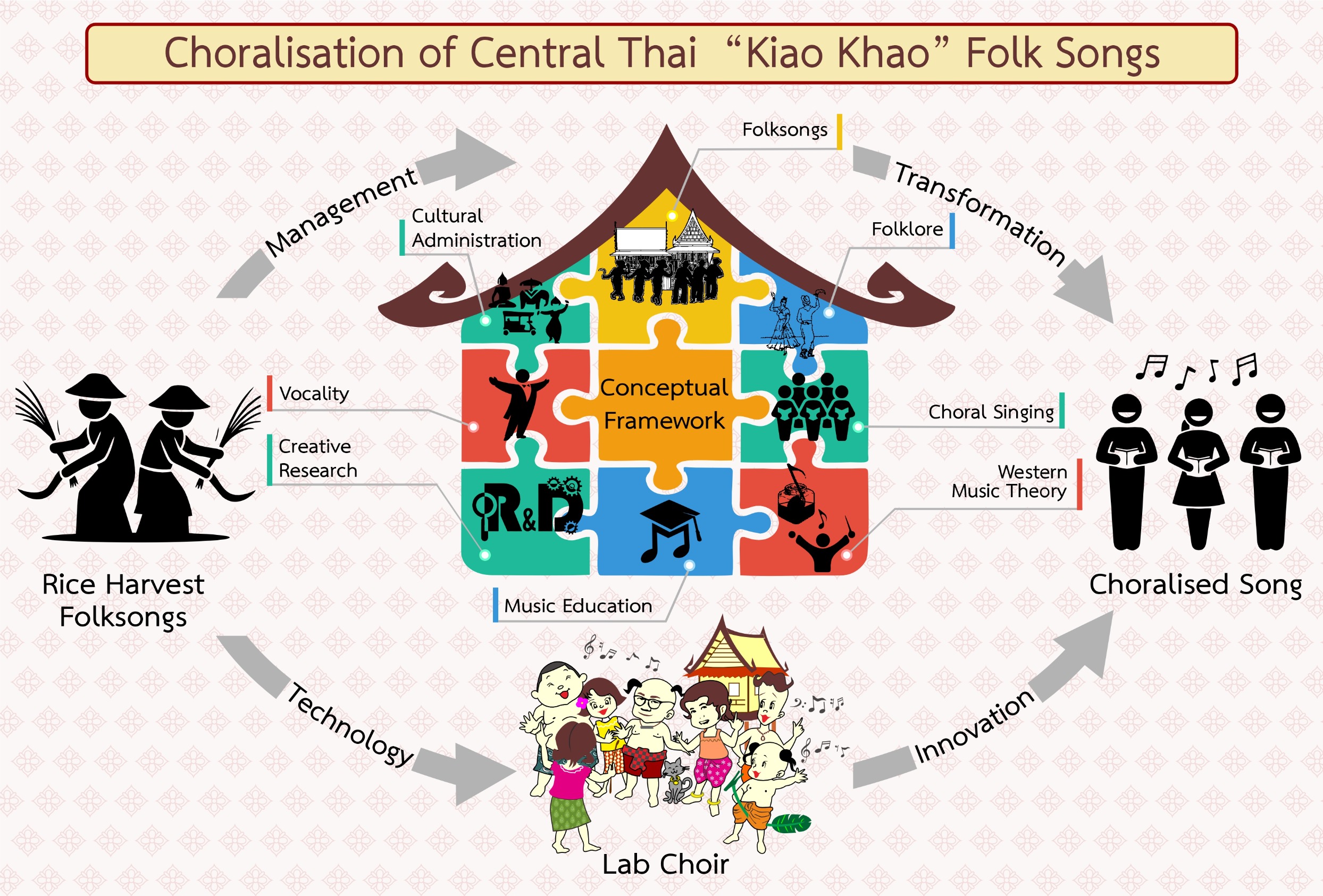
Background and Objectives: This research focuses on the preservation and creative transformation of phleng kiao khao (Rice Harvesting Song), a traditional Central Thai folk song deeply embedded in the region’s agricultural way of life. The study reimagines this folk genre in the context of choral music, specifically exploring how its cultural, musical, and poetic elements can be adapted into a structured a cappella choral setting. The main objectives are twofold: (1) to investigate the musical characteristics and traditional vocal styles associated with kiao khao songs, which include call-and-response structures, tonal fluidity, and improvisational phrasing; and (2) to develop a choral reinterpretation that maintains these songs’ original spirit while applying principles of Western music theory. In doing so, the research aims to bridge the gap between oral folk traditions and modern choral performance, allowing for a new mode of cultural expression that resonates with contemporary audiences.
Methods: The study employed a mixed-methods approach, incorporating qualitative ethnomusicological research with creative practice. Fieldwork of kiao khao song was carried out across four provinces—Suphan Buri, Ang Thong, Bangkok, and Nakhon Pathom—where master folk singers (pho phleng and mae phleng) were engaged through interviews and collaborative singing sessions. These interactions provided valuable insights into regional dialects and performance gestures. They also revealed poetic structures and improvisational techniques used in the original folk context. The researchers recorded and transcribed all collected songs into Western notation, using digital audio tools and manual notation methods. Based on these transcriptions, a series of choral arrangements were developed using four-part harmony as a base, though the final compositions involved five vocal parts—including two ostinato lines—to retain the repetitive and rhythmic qualities of the folk idiom. A laboratory choir was then formed to rehearse and refine the arrangements, providing feedback that shaped the final performance structure.
Results: The findings confirm that kiao khao songs, originally used to ease the burden of harvesting rice through humor and flirtation, possess distinct features such as semi-sung and semi-spoken delivery, flexible rhythm, and tonal variance. These features posed challenges when adapting the songs into a choral format, particularly in standardising pitch and metre while preserving the natural speech rhythms of Thai language. However, through iterative experimentation, the choralisation process succeeded in maintaining the cultural identity of the original work. Key strategies included anchoring the pitch around baritone lines, using ostinato patterns to simulate traditional repetition, and incorporating drone tones and traditional percussion instruments (ching, krap, ramana) to emulate the folk atmosphere. The homophonic and antiphonal textures in the choral arrangement allowed the piece to retain its dialogic nature, while enhancing musical complexity through harmony. Audience responses from the concert tour indicated high levels of engagement and cultural resonance. The inclusion of master singers in public performances validated the authenticity of the adaptation and reinforced intergenerational connections. This study also demonstrates how traditional oral literature, when translated effectively into written musical form, can serve educational, performative, and cultural-preservation purposes within a modern framework.
Conclusions: This research presents a viable model for transforming oral folk songs into formal choral compositions, achieving both preservation and innovation. The choralisation of kiao khao not only revitalises a fading cultural practice but also opens new possibilities for integrating folk music into contemporary musical education and performance. This method supports Thailand’s broader cultural policy goals, offering a sustainable framework for safeguarding intangible cultural heritage through interdisciplinary collaboration and creative engagement. The project stands as a testament to the enduring value of Thai folk music and its potential to evolve within changing cultural landscapes.
References
Kantasiri, Kovit, and Jiranan Tosin. “Techniques for Playing the Fiddle and Violin for Creativity Song by Kovit Kantasiri.” Journal of MCU Ubon Review 9, no. 1 (January-April 2024): 1689-1706. (in Thai)
Kingkaew, Sippavich. Musical Cultures of the Four Regions of Thailand. Nakhon Pathom: Silpakorn University, 2016. (in Thai)
Laovanich, Monsikarn. “Processes of Developing Thai Choirs to International Standards: A Grounded Theory.” Srinakharinwirot Research and Development (Journal of Humanities and Social Sciences) 13, no. 26 (July-December 2021): 90-104. https://so04.tci-thaijo.org/index.php/swurd/article/view/258849. (in Thai)
Laovanich, Vitchatalum, and Monsikarn Laovanich. “Transferability Process of Musical Knowledge by Ramon Lijauco Jr. in the Development of Thailand Choral Representatives for the World Choir Game 2014: Suanplu Chorus and Chulada Choir of Chulalongkorn University Demonstration Secondary School - Case Studies.” Journal of Education Studies, Chulalongkorn University 45, no. 2 (April-June 2017): 90-108. (in Thai)
Nawigamune, Anake. Encyclopedia of Central Thai Folk Songs. Bangkok: Pikanes Printing House, 1985. (in Thai)
Nawigamune, Anake. Songs Beyond the Century. Bangkok: Matichon, 2007. (in Thai)
Patrachai, Sukanya. “Central Thai Folk Songs.” In Thailand Cultural Encyclopedia: Central Region, Vol. 10, 4610-4624. Bangkok: Thailand Cultural Encyclopedia Foundation, Siam Commercial Bank, 1999. (in Thai)
Suphanyot, Buaphan, Aphilak Kasempholkoon, Kittisak Kerdarunsuksri, Sombat Somsriploy, Olan Rattanapakdee, and Monthira Tamuang. “Central Thai Folk Songs.” Research Report, Department of Cultural Promotion, Ministry of Culture, 2014. (in Thai)
Suphanyot, Buaphan. “An Analysis of the E-Saew in Suphanburi.” Master’s thesis, Srinakharinwirot University, 1992. (in Thai)
Yamprai, Jittapim. “Music in Roman Catholic Mass of Thailand.” Master’s thesis, Mahidol University, 2005. (in Thai)
Downloads
Published
How to Cite
Issue
Section
License
Copyright (c) 2026 College of Music

This work is licensed under a Creative Commons Attribution-NonCommercial-NoDerivatives 4.0 International License.
The copyright of the article belongs to the author. Published articles represent the views of the authors. The editorial team neither necessarily agree with nor take any responsibility for the article.