
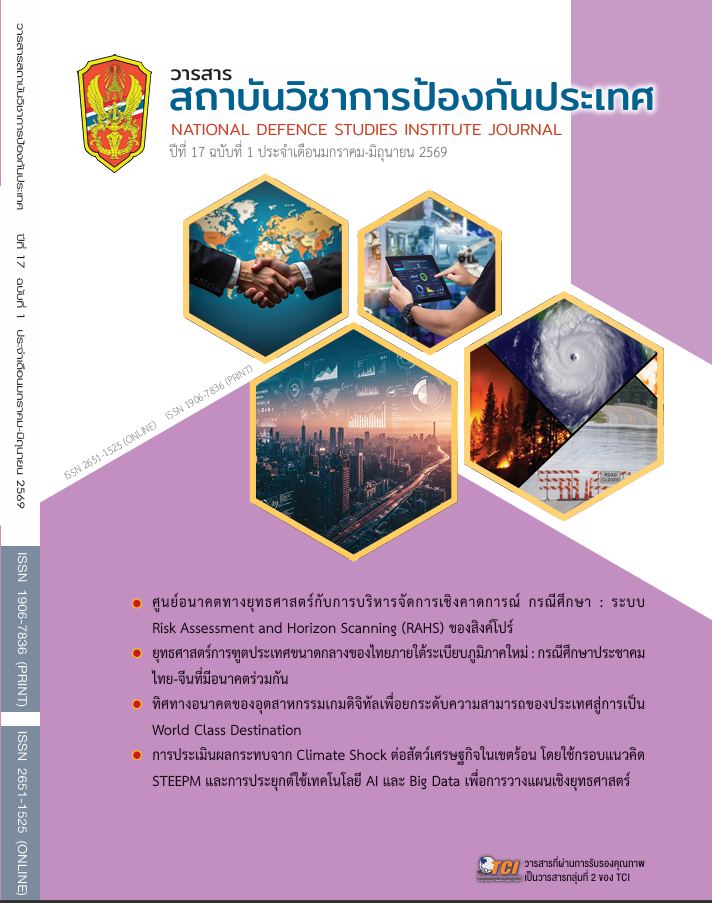
Thailand’s Middle Power Diplomatic Strategy in the New Regional Order: A Case Study of the Thailand-China Community with a Shared Future
Article Sidebar
Main Article Content
Abstract
This academic article aims to analyze Thailand’s diplomatic strategy as an influential middle power within the context of the changing regional order in the 21st century, using the case study of Thailand-China relations under the Community with a Shared Future framework. The study employs a qualitative analytical approach through literature review on middle power diplomacy theory, policy document analysis of joint statements between Thailand and China, and examination of Thailand’s diplomatic behavior across various dimensions including development strategy alignment, economic and security cooperation, and multilateral engagement. The analysis reveals that Thailand has pursued a multidimensional diplomatic strategy reflecting key characteristics of middle powers: (1) a hedging strategy demonstrated through active economic engagement with China while maintaining diversified security partnerships; (2) a bridge-builder role between China and Southeast Asia through ASEAN mechanisms; and (3) niche diplomacy in areas where Thailand possesses comparative strengths, including food security and sustainable agriculture, medical tourism, the promotion of Universal Health Coverage, and the exercise of soft power through cultural exchange and tourism at the regional level. However, Thailand faces significant challenges in maintaining strategic autonomy amid intensifying great power competition, particularly pressure to choose sides between China and the United States, concerns about excessive economic dependence on China, and constraints in resources and political credibility. This article recommends that Thailand enhance transparency in large-scale cooperative projects, diversify economic and security risks, develop diplomatic and strategic analytical capabilities, strengthen ASEAN unity, and advance niche diplomacy aligned with national strengths.
Article Details

This work is licensed under a Creative Commons Attribution-NonCommercial-NoDerivatives 4.0 International License.
The articles, images, tables, graphs, written content, and opinions published in this journal are solely those of the authors and do not necessarily reflect the views or positions of the National Defence Studies Institute or its academic affiliates.
References
Beeson, M. (2011). Can Australia save the world? The limits and possibilities of middle power diplomacy. Australian Journal of International Affairs, 65(5), 563-577. https://doi.org/10.1080/10357718.2011.613148
Carr, A. (2014). Is Australia a middle power? A systemic impact approach. Australian Journal of International Affairs, 68(1), 70-84. https://doi.org/10.1080/10357718.2013.840264
Cooper, A. F., Higgott, R. A., & Nossal, K. R. (1993). Relocating middle powers: Australia and Canada in a changing world order. UBC Press.
Gilley, B., & O’Neil, A. (Eds.). (2014). Middle powers and the rise of China. Georgetown University Press.
Haacke, J. (2019). The concept of hedging and its application to Southeast Asia: A critique and a proposal for a modified conceptual and methodological framework. International Relations of the Asia-Pacific, 19(3), 375-417. https://doi.org/10.1093/irap/lcy010
Hewison, K. (2018). Thailand: An old relationship renewed. The Pacific Review, 31(1), 116-130. https://doi.org/10.1080/09512748.2017.1357652
Hiep, L. H. (2013). Vietnam’s hedging strategy against China since normalization. Contemporary Southeast Asia, 35(3), 333-368. https://doi.org/10.1355/cs35-3b
Jordaan, E. (2003). The concept of a middle power in international relations: Distinguishing between emerging and traditional middle powers. Politikon, 30(2), 165-181. https://doi.org/10.1080/0258934032000147282
Kuik, C. C. (2008). The essence of hedging: Malaysia and Singapore’s response to a rising China. Contemporary Southeast Asia, 30(2), 159-185. https://doi.org/10.1355/CS30-2A
Kuik, C. C. (2016). How do weaker states hedge? Unpacking ASEAN states’ alignment behavior towards China. Journal of Contemporary China, 25(100), 500-514. https://doi.org/10.1080/10670564.2015.1132714
Ministry of Foreign Affairs of the Kingdom of Thailand. (2025, February 8). Joint Statement between the Government of the Kingdom of Thailand and the Government of the People’s Republic of China on Advancing the Comprehensive Strategic Cooperative Partnership and Building a Thailand-China Community with a Shared Future for Enhanced Stability, Prosperity, and Sustainability through a Forward-looking and People-Centred Vision. https://www.mfa.go.th/en/content/joint-statement-th-ch-2025-en?cate=5d5bcb4e15e39c306000683c
Patience, A. (2014). Imagining middle powers. Australian Journal of International Affairs, 68(2), 210-224.
https://doi.org/10.1080/10357718.2013.840557
Ping, J. H. (2005). Middle power statecraft: Indonesia, Malaysia and the Asia-Pacific. Ashgate.
Raditio, K. H. (2024, September 9). Deciphering Xi Jinping’s Community of Shared Future for Mankind. E-International Relations. https://www.eir.info/2024/09/09/deciphering-xi-jinpings-community-of-sharedfuture-for-mankind/
Wongsurawat, W. (2020). Disturbing the inequality of PRC influence on the position of ethnic Chinese in Thailand in the New Era. In Chinese People's Diplomacy and Developmental Relations with East Asia (pp. 146-161). Routledge.
Yao, Y. (2022). Opportunities, challenges and countermeasures for Chinese enterprises investing in Thailand in post-epidemic era. In Proceedings of the 2022 2nd International Conference on Enterprise Management and Economic Development (ICEMED 2022), 1169-1174. https://doi.org/10.2991/aebmr.k.220603.189
