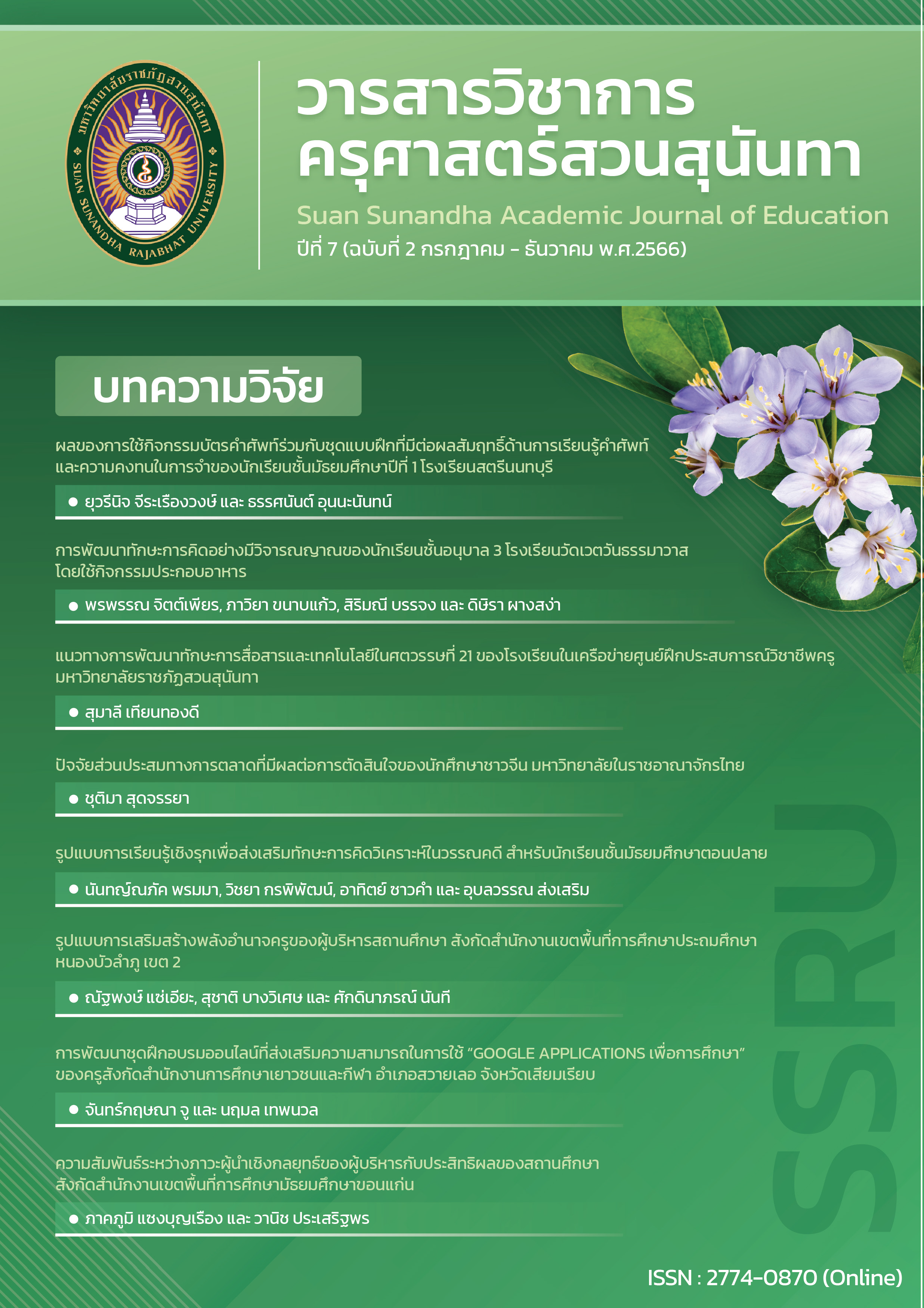
The Active Learning Instructional Model Enhancing Critical Thinking Skills in Literature for High School Students
Keywords:
critical thinking skills, active learning, literatureAbstract
The objectives of the research were 1) to develop the active learning instructional model enhancing critical thinking skills in literature for high school students and 2) to study the effectiveness of the active learning instructional model enhancing critical thinking skills in literature for high school students. The research was in the form of research and development using embedded design. The sample consisted of 39 students in grades 5/1, Kowitt Thamrong Chiang Mai School, Mueang Chiang Mai District, Chiang Mai Province, Semester 1, Academic Year 2022. The tools used in this study were the active learning instructional model enhancing critical thinking skills in literature for high school students, learning management plans, analytical thinking skills measurement tests in the literature, and opinion questionnaires. Data were analyzed by means, standard deviations. dependent t-test and content analysis. The research found that: 1) The active learning instructional model enhancing critical thinking skills in literature for high school students named “MECPA Model”. The "MECPA Model" is composed of four components, including: 1) Goals, 2) Objectives, 3) Learning management activities and 4) Assessments and evaluation. The learning management activities consisted of M: Motivation, E: Explore, C: Collaborate, P: Present, and A: Apply. This model had quality that can be applied to the sample. 2) The effectiveness of the model found that: 2.1) After using the model, the students had higher critical thinking skills than before with statistical significance at .05. 2.2). The opinions of students on the model were at the most agreeable level.
References
ทิศนา แขมมณี. (2560). ศาสตร์การสอน: องค์ความรู้เพื่อการจัดกระบวนการเรียนรู้ที่มีประสิทธิภาพ. (พิมพ์ครั้งที่8). กรุงเทพฯ: สำนักพิมพ์แห่งจุฬาลงกรณ์มหาวิทยาลัย.
มาเรียม นิลพันธุ์. (2558). วิธีวิจัยทางการศึกษา. (พิมพ์ครั้งที่ 9). นครปฐม: ภาควิชาหลักสูตรและวิธีสอน คณะศึกษาศาสตร์ มหาวิทยาลัยศิลปากร.
รื่นฤทัย สัจจพันธุ์. (2549). สุนทรียภาพแห่งชีวิต. กรุงเทพฯ: สำนักพิมพ์ ณ เพชร.
สง่า วงศ์ไชย. (2560). การพัฒนารูปแบบการเรียนการสอนโดยบูรณาการแนวการสอนที่เน้นภาษา วรรณกรรม และประสบการณ์เพื่อส่งเสริมความสามารถในการอ่านเพื่อความเข้าใจและเขียนสรุปความของ นักศึกษา ระดับปริญญาบัณฑิต. (วิทยานิพนธ์ปริญญาญาดุษฎีบัณฑิต) นครปฐม. มหาวิทยาลัยศิลปากร.
แสงดาว นพพิทักษ์. (2557). การเปรียบเทียบผลสัมฤทธิ์ทางการเรียนระหว่างการใช้กับไม่ใช้โปรแกรมควบคุมเครื่องคอมพิวเตอร์รายวิชาระบบฐานข้อมูล. มหาวิทยาลัยราชภัฏบุรีรัมย์.
สำนักงานคณะกรรมการการศึกษาขั้นพื้นฐาน. (2562). นโยบายสํานักงานคณะกรรมการการศึกษาขั้นพื้นฐาน ปีงบประมาณ พ.ศ.2562. กรุงเทพมหานคร: สำนักงานคณะกรรมการการศึกษาขั้นพื้นฐาน กระทรวงศึกษาธิการ.
Armstrong, P. (2010). Bloom’s Taxonomy. Vanderbilt University Center for Teaching. Retrieved January 30, 2022 from https://cft.vanderbilt.edu/guides- sub-pages/blooms-taxonomy.
Felder, R. M. and Brent, R. (2009). Active Learning: An Introduction. สืบค้น 2 กันยายน 2565, จาก http://www4.ncsu.edu/unity/lockers/users/f/felder/bublic/Papers/
McKinney, Kathleen. (2010). Active Learning. สืบค้น 2 กันยายน 2565, จาก http://www.cat.ilstu.edu/additional/active.php
Downloads
Published
How to Cite
Issue
Section
License
Copyright (c) 2023 Faculty of Education, Suan Sunandha Rajabhat University

This work is licensed under a Creative Commons Attribution-NonCommercial-NoDerivatives 4.0 International License.