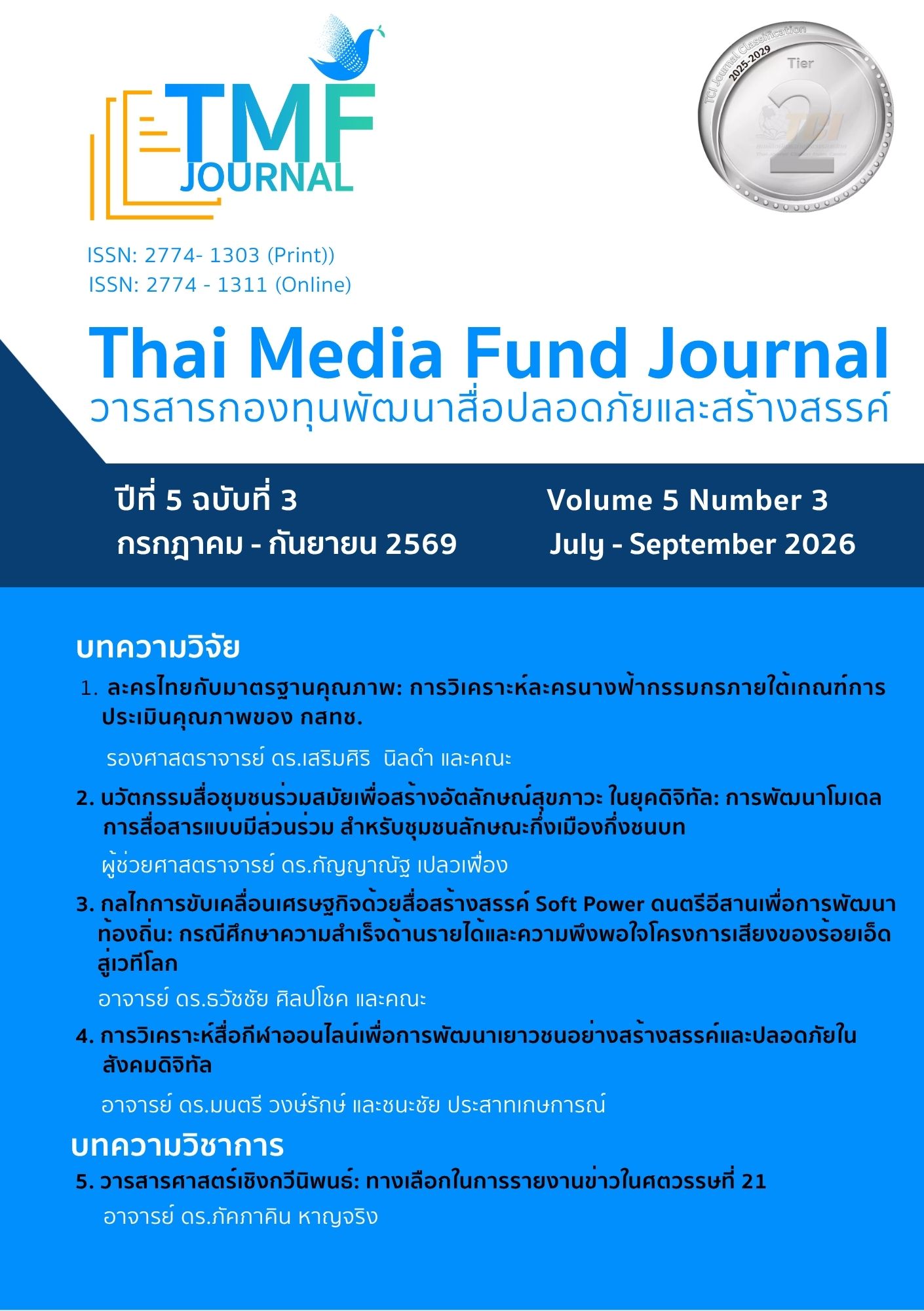
การวิเคราะห์สื่อกีฬาออนไลน์เพื่อการพัฒนาเยาวชนอย่างสร้างสรรค์และปลอดภัยในสังคมดิจิทัล
Article Sidebar
Main Article Content
บทคัดย่อ
งานวิจัยนี้มีวัตถุประสงค์เพื่อ (1) วิเคราะห์ลักษณะและรูปแบบเนื้อหาของสื่อกีฬาออนไลน์ที่ได้รับความนิยมในกลุ่มเยาวชน (2) จำแนกระดับความปลอดภัยและความสร้างสรรค์ของเนื้อหาตามกรอบสื่อปลอดภัยและการพัฒนาเยาวชน และ (3) ประเมินบทบาทและศักยภาพของสื่อกีฬาออนไลน์ต่อการพัฒนาเยาวชนในสังคมดิจิทัล ด้วยการวิเคราะห์เนื้อหา ร่วมกับการวิจัยเอกสาร จากสื่อกีฬาออนไลน์ที่เผยแพร่ระหว่างเดือนตุลาคม 2568 – มีนาคม 2569
โดยการคัดเลือกตัวอย่างแบบเจาะจงจำนวน 200 ชิ้น ผลการวิจัยพบว่าสื่อกีฬาออนไลน์มีอิทธิพลต่อเยาวชน โดยทำหน้าที่เป็นพื้นที่ทางสังคม แหล่งเรียนรู้
ไม่เป็นทางการ และแหล่งแรงบันดาลใจ เปิดโอกาสให้เยาวชนเข้าถึงข้อมูล ติดตามนักกีฬา และมีส่วนร่วมกับชุมชน ส่งผลให้เกิดการเรียนรู้ผ่านแบบอย่างและนำไปสู่การมีส่วนร่วมในกิจกรรมกีฬา อย่างไรก็ตาม หากเนื้อหาขาดความปลอดภัย อาจนำไปสู่การเลียนแบบพฤติกรรมที่ไม่เหมาะสมได้ สื่อกีฬาออนไลน์ยังมีศักยภาพในการส่งเสริมการออกกำลังกาย การพัฒนาทักษะ และค่านิยมเชิงบวก แต่ผลลัพธ์ขึ้นอยู่กับความเหมาะสมของเนื้อหา การรู้เท่าทันสื่อ และการกำกับดูแลจากผู้ใหญ่ ดังนั้น การผลิตสื่อควรเน้นการเล่าเรื่องเชิงสร้างสรรค์ คำนึงถึงความปลอดภัยและวัยผู้ชม และหลีกเลี่ยงค่านิยมสุดโต่ง เพื่อให้สื่อกีฬาออนไลน์เป็นเครื่องมือพัฒนาเยาวชนอย่างยั่งยืน
Article Details

อนุญาตภายใต้เงื่อนไข Creative Commons Attribution-NonCommercial-NoDerivatives 4.0 International License.
เอกสารอ้างอิง
Akarasriworn Nagaoka, C., & Santawee, K. (2022). Media Literacy and Awareness of Impacts from E-Sport in Thai Youth. The journal of social communication innovation, 10(1), 21-29.
Anderson, C. A., Berkowitz, L., Donnerstein, E., Huesmann, L. R., Johnson, J. D., Linz, D., Malamuth, N. M., & Wartella, E. (2003). The influence of media violence on youth. Psychological Science in the Public Interest, 4(3), 81-110. https://doi.org/10.1111/j.1529-1006.2003.pspi_1433.x
Aschwanden, R., & Messner, C. (2024). How influencers motivate inactive adolescents to be more physically active: A mixed methods study. Frontiers in Public Health, 12, 1429850. https://doi.org/10.3389/fpubh.2024.1429850
Bailey, R. (2006). Physical education and sport in schools: A review of benefits and outcomes. Journal of School Health, 76(8), 397-401. https://doi.org/10.1111/j.1746-1561.2006.00132.x
Bandura, A. (1977). Social learning theory. Prentice Hall.
Bandura, A. (2001). Social cognitive theory of mass communication. Media Psychology, 3(3), 265-299. https://doi.org/10.1207/S1532785XMEP0303_03
Coalter, F. (2010). The politics of sport-for-development: Limited focus programmes and broad gauge problems? International Review for the Sociology of Sport, 45(3), 295-314. https://doi.org/10.1177/1012690210366791
Denduang, E. (2023). Social media activities influencing exercise motivation among working-age people in Bangkok (Master’s thesis, Dhurakij Pundit University).
Fiedler, R., Heidari, J., Birnkraut, T., & Kellmann, M. (2023). Digital media and mental health in adolescent athletes. Psychology of Sport and Exercise, 67, 102421.
https://doi.org/10.1016/j.psychsport.2023.102421
Frühauf, A., Loinger, M., & Kopp, M. (2025). Adventure sports athletes on social media: Potential effects on adolescents’ sports participation and risk-taking behavior. German Journal of Exercise and Sport Research, 55, 4-13.
https://doi.org/10.1007/s12662-024-01010-z
Katz, E., Blumler, J. G., & Gurevitch, M. (1974). Utilization of mass communication by the individual. In J. G. Blumler & E. Katz (Eds.), The uses of mass communications: Current perspectives on gratifications research (pp. 19-32). Sage.
Khamcharoen, P., & Phonnikornkit, W. (2018). Children and digital literacy. Journal of Social Communication Innovation, 6(2), 22-31.
Li, F. (2025). Investigating the role of Chinese sports media in shaping young adults’ exercise habits through the lens of the health belief model. Frontiers in Sports and Active Living, 7, 1600486. https://doi.org/10.3389/fspor.2025.1600486
Livingstone, S., & Helsper, E. (2007). Gradations in digital inclusion: Children, young people and the digital divide. New Media & Society, 9(4), 671-696. https://doi.org/10.1177/1461444807080335
Livingstone, S., & Third, A. (2017). Children and young people's rights in the digital age. New Media & Society, 19(5), 657-670. https://doi.org/10.1177/1461444816686318
Muangthon, A., Vipawatthana, S., & Pluempitichaikul, T. (2024). Developing online media literacy through presenting news information via Facebook. Journal of Local Management and Development Pibulsongkram Rajabhat University, 4(2), 54-61.
National Health Commission Office. (2019). Protecting the nation’s future from online threats: Easily accessible technology.
National Institute of Development Administration (NIDA). (2024). Conceptualizing digital citizenship for digital natives in Thailand.
OECD. (2021). 21st-century readers: Developing literacy skills in a digital world. OECD Publishing. https://doi.org/10.1787/a83d84cb-en
Panuthai, C. (2024). The effect of online physical activity on health, emotional quotient and quality of life of youth. Academic Journal of Thailand National Sports University, 16(3), 35-46.
Pisaniello, A., Figus, A., Digennaro, S., & Spulber, D. (2025). The impact of digital technologies on youth sports dropout: Challenges and opportunities for educational environments. Giornale Italiano di Educazione alla Salute, Sport e Didattica Inclusiva, 9(1). https://doi.org/10.32043/gsd.v9i1.1393
Potter, W. J. (2014). Media effects. Sage.
Rowe, D. (2013). Sport, culture and the media: The unruly trinity (2nd ed.). Open University Press.
Steinsbekk, S., Bjørklund, O., Valkenburg, P., Nesi, J., & Wichstrøm, L. (2024). The new social landscape: Relationships among social media use, social skills, and offline friendships from age 10-18 years. Computers in Human Behavior, 156, 108235. https://doi.org/10.1016/j.chb.2024.108235
Thai Health Promotion Foundation. (2021). Strategy for promoting and protecting children and youth in online media use, 2017-2021. M-Powered.
Twenge, J. M., & Campbell, W. K. (2018). Associations between screen time and lower psychological well-being among children and adolescents. Preventive Medicine Reports, 12, 271-283. https://doi.org/10.1016/j.pmedr.2018.10.003
UNESCO. (2019). Media and information literacy curriculum for educators and learners. UNESCO Publishing.
UNICEF. (2019). The state of the world’s children 2019: Children in a digital world. UNICEF.
Wongrak, M., Prasartketkarn, C., & Tipsorn, W. (2023). A communication model on virtual setting for enhancing the public relations potential of sports organization. Lawasri Journal, 7(1), 77-90.
Wuttipipattanapong, P., Tanrattanakul, A., & Juicharoen, N. (2024). Communication to encourage sports among adolescents. TMF Journal, 3(2), 103-136.
