COMMUNICATION PERSONALITY OF SIGN LANGUAGE INTERPRETERS ON TELEVISION PROGRAMS AND ITS IMPACTS ON PERCEPTION OF PEOPLE WITH HEARING DISABILITIES
Article Sidebar
Main Article Content
Abstract
The objectives of the research are (1) to study the communication personality of sign language interpreters on television programs and its impacts on the perception of people with haring disabilities and (2) to study factors affecting the communication personality of sign language interpreters on such television programs. This is a quantitative research involving the following: (1) study of videotapes of news program with sign language interpretation service, aired between 1 March 2021 and 30 April 2021, of three TV stations, i.e. Thailand TV Channel 3, Channel 7 HD, and MONO 29 Channel, 7 videotapes each, (2) in-depth interview with 8 sign language interpreters, and (3) focus group discussion with 12 people with hearing disabilities.
The finding reveals the following:
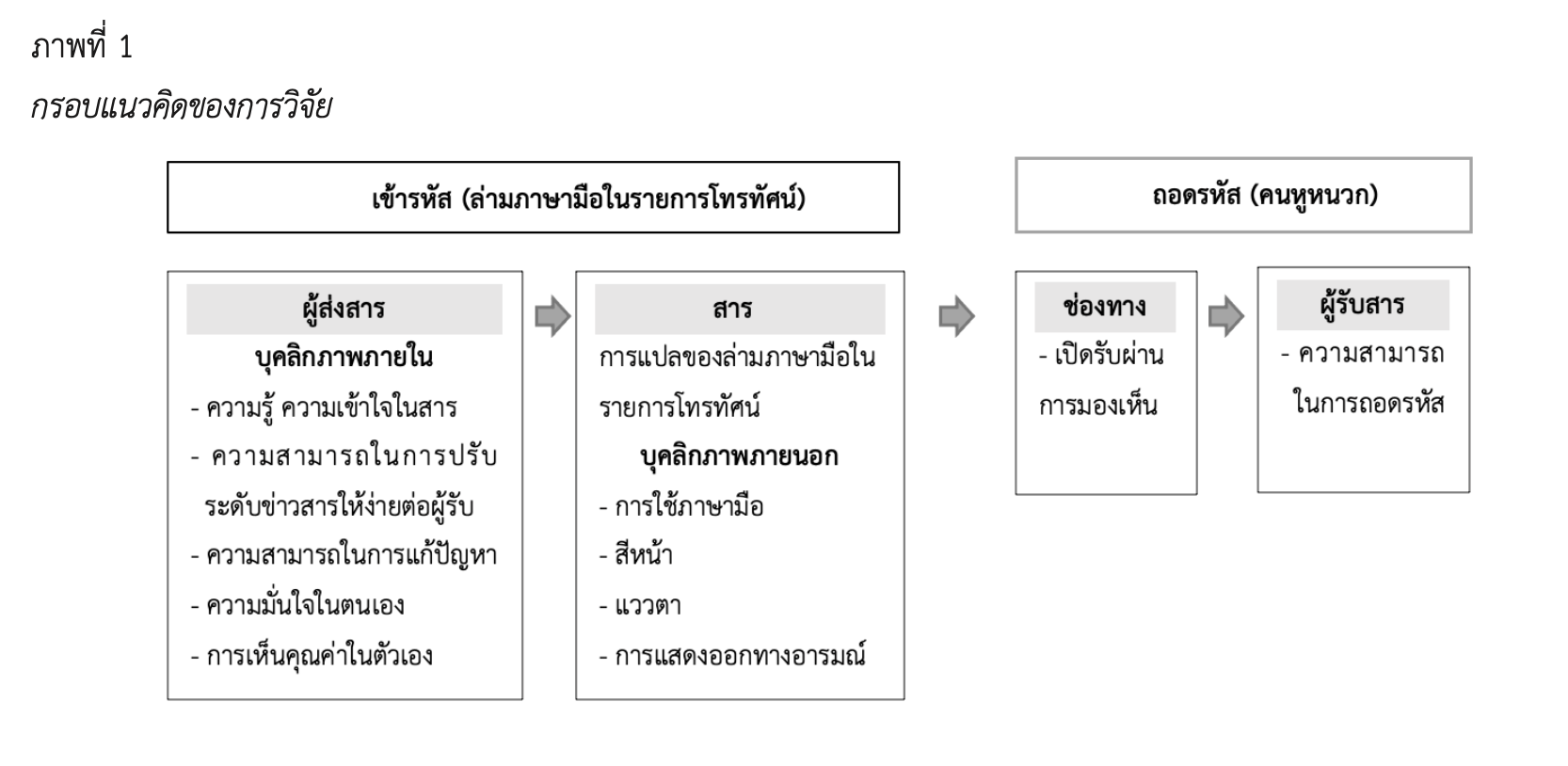
- The communication personality of sign language interpreters with impacts on the perception of people with hearing disabilities can be grouped into (1.1) internal personality, consisting of the interpreter’s confidence and concentration and (1.2) external personality consisting of the interpreter’s facial and eye expression, conveyance of emotion, lip movements while interpreting, face makeup, and hair style.
- Factors that affect the communication personality of sign language interpreters consist of (2.1) internal factors, including the interpreter’s knowledge of sign language words, knowledge of the news contents interpreted, Thai language skills, and positive external appearances and (2.2) external factors, comprising the program format, news contents, and newscasters, as well as the interpreter’s personality, experience in television programs, earphone and vocal quality, TV station policy, and organization that the interpreter is affiliated with.
Downloads
Article Details
References
กระทรวงพัฒนาสังคมและความมั่นคงของมนุษย์. (2564). รายงานข้อมูลสถานการณ์ด้านคนพิการในประเทศไทย. ข้อมูล
ณ วันที่ 30 กันยายน 2564. https://www.dep.go.th/images/uploads/files/situation_Sep64.pdf
กระทรวงพัฒนาสังคมและความมั่นคงของมนุษย์ เรื่อง ประเภทและหลักเกณฑ์ความพิการ (2552, 29 พฤษภาคม).
ราชกิจจานุเบกษา. เล่ม 126 ตอนพิเศษ 77 ง. หน้า 2 .
law.m-society.go.th/law2016/uploads/lawfile/20090601_09_36_46_1088.pdf
เขมนิจ จามิกรณ์, เอกสิทธิ์ สนามทอง, อิทธิพัทธ์ สุวทันพรกูล, และดวงเดือน จันทร์เจริญ. (2563). แนวทางการพัฒนาสมรรถนะผู้ดำเนินรายการโทรทัศน์ระดับมืออาชีพในประเทศไทย. วารสารสวนสุนันทาวิชาการและวิจัย. ปีที่ 12 (ฉบับที่ 2), 105-115.
คณะกรรมการกิจการกระจายเสียง กิจการโทรทัศน์ และกิจการโทรคมนาคมแห่งชาติ เรื่อง การส่งเสริมและคุ้มครองสิทธิของคนพิการให้เข้าถึงหรือรับรู้และใช้ประโยชน์จากรายการของกิจการโทรทัศน์. (2559, 5 กุมภาพันธ์).
ราชกิจจานุเบกษา. เล่มที่ 133 ตอนพิเศษ 35 ง. https://broadcast.nbtc.go.th/data/document/law/doc/th/590200000001.pdf
ปิยนันท์ สวัสดิ์ศฤงฆาร (2565). 7-38-55 Rule of Communication [Mehrabian].
https://drpiyanan.com/2022/05/26/7-38-55-rule-of-communication-mehrabian/
ผดุง อารยะวิญญู. (2542). การเรียนรวมระหว่างเด็กปกติกับเด็กที่มีความต้องการพิเศษ. รำไทยเพรส.
มณีรัตน์ ศิริปัญจนะ. (2557). ประสิทธิผลด้านการรับรู้และความเข้าใจข้อมูลข่าวสารของคนหูหนวก จากรายการโทรทัศน์ผ่านล่ามภาษามือ. [วิทยานิพนธ์ปริญญาโท, มหาวิทยาลัยธรรมศาสตร์].
ethesisarchive.library.tu.ac.th/thesis/2014/TU_2014_5607030060_1585_1083.pdf
ศิวนารถ หงษ์ประยูร. (2558). การพัฒนารายการข่าวทางสื่ออินเตอร์เน็ตทีวี (IPTV) สำหรับคนหูหนวก. สุทธิปริทัศน์.ปีที่ 29 (ฉบับที่ 90), 291-312.
ศูนย์นวัตกรรมการเรียนรู้ตลอดชีวิต มหาวิทยาลัยศรีนครินทรวิโรฒ. (2553). หลักสูตรพัฒนาบุคลิกภาพ. ห้างหุ้นส่วนจำกัด สินทวีกิจ พริ้นติ้ง.
รุ้ง ศรีอัษฎาพร. (2558). บุคลิกภาพและความสามารถในการสื่อสาร จากวัยเด็กสู่วัยทำงาน. สำนักพิมพ์แห่งจุฬาลงกรณ์มหาวิทยาลัย.
สุทธิวรรณ อินทะกนก. (2559). เอกสารประกอบการสอน รายวิชาภาษาไทยเพื่อการสื่อสาร. สำนักวิชาศึกษาทั่วไป มหาวิทยาลัยราชภัฎอุดรธานี. portal5.udru.ac.th/ebook/pdf/upload/1778Ws1U59233b073985.pdf
อารดา ครุจิต. (2560). โทรทัศน์เพื่อการเข้าถึงของคนพิการ. สำนักพิมพ์มหาวิทยาลัยธรรมศาสตร์.
David K.Berlo. (1960). The Process of Communication. New York:Holt, Rinehart and Winston.
