INNOVATION OF HUMAN RESOURCE MANAGEMENT IN PUBLIC AUTONOMOUS UNIVERSITY FOR THE NEXT DECADES
Article Sidebar
Main Article Content
Abstract
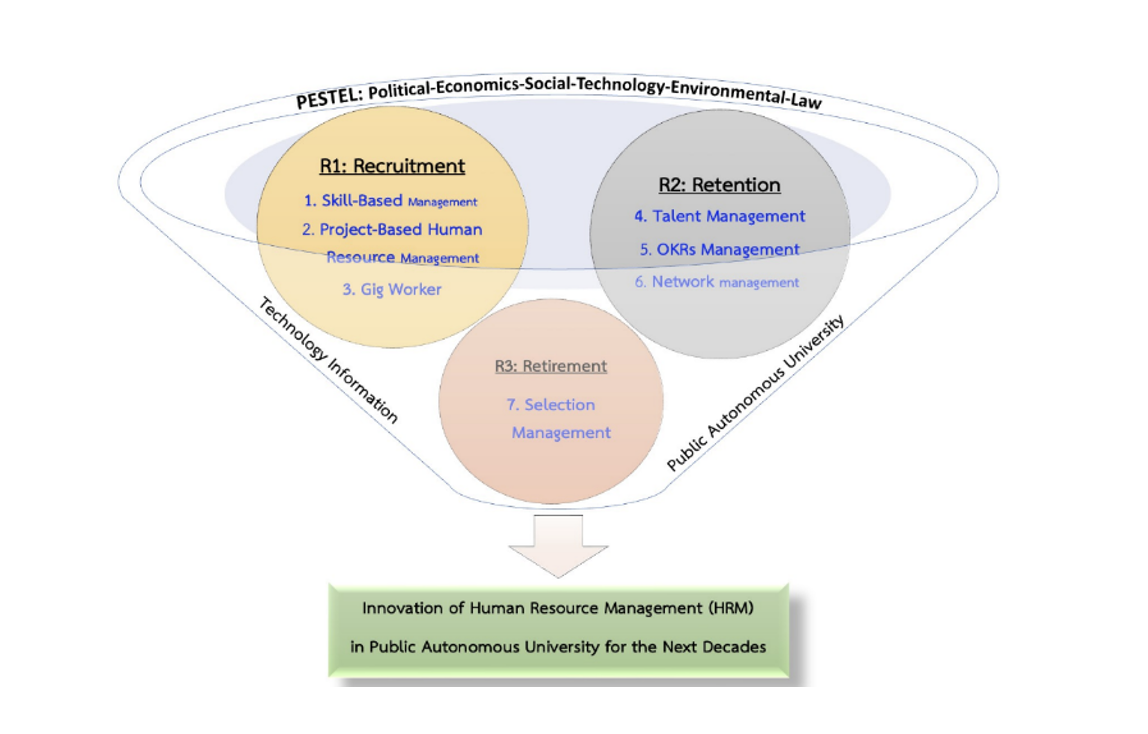
Introduction: Rapid societal changes require state-governed higher education institutions to adapt their human resource management accordingly. This research aims to identify the innovation of human resource management in public autonomous universities for the next decades. Research Methodology: The study employs the Ethnographic Delphi Future Research (EDFR) method, a form of future research that examines probable future trends relevant to the topic under study. In the first EDFR round, the researcher reviewed related documents and conducted in-depth interviews with 17 experts. In the second EDFR round, a questionnaire based on the first round's findings was administered to the same group of experts, using a five-point Likert scale to achieve consensus. Experts were selected through purposive sampling, and data were analyzed using median, mode, and interquartile range statistics. Research Findings: The second-round findings indicate a consensus among experts regarding potential future innovations in human resource management for public autonomous universities. These include talent management, skill-based HR management, objectives and key results management, selection management, network management, project-based HR management, and gig worker arrangements that depend on mutual satisfaction between employers and workers. Conclusion: Practical application of these innovations will depend on the decision-making of institutional leaders and the specific context of each institution.
Downloads
Article Details
References
Srisaan.,V. (2016). State-Regulated Universities: Innovation in University Management in Thailand. Academic Papers
Klinwichit., S. (2016). Human Resource Management for the Role of Autonomous University: A Case Study of Burapha University. Burapha Journal of Medicine, 2(2), 22-40.
Khamsopa., Th, Sathapornwachana., S, and Wichitphatcharaporn., W. (2017). The Development of Human Resoure Management Strategy for Autonomous University. Journal of MCU Social Science Review, 6(2-05), 249–266.
Wessayasirin., S. and Vanitsuppavong., P. (2019). Organizational Administration Strategy throughCommunication Base for Administrators of Rajabhat University in Southern Regional Area. Journal of Education, Prince of Songkla University, Pattani Campus, 30(3), 160-170.
Adobor, H. (2004). Selecting management talent for joint ventures: A suggested framework. Human Resource Management Review, 14(2), 161-178.
al Dalahmeh, M. (2020). Talent Management: A Systematic Review. Oradea Journal of Business and Economics, 5, 115–123. https://doi.org/10.47535/1991ojbe102
Andres Troian, T., GORI, R., Lacerda, D., Gauss, L., & WEBER, J. (2022). OKRs as a results-focused management model: A systematic literature review. https://doi.org/10.14488/IJCIEOM2022_FULL_0020_37589
Bredin, K. (2006). Human Resource Management in Project-Based Organizations: Challenges and Changes.
Channuwong, S. (2008). Human resource management of the private and public universities in Bangkok Metropolitan Areas. Journal of Association of Private Higher Education Institutions of Thailand, 14(2), 176-191.
Jongrak, W. and Yavirach, N. (2016). Human Resource Management Process to INDONESIA Coal Industrial Efficiency Administration. Journal of Humanities and Social Science Valaya Alongkorn, 11(1), 113-121.
Poolpatarachewin, C. (2003). Ethnographic Delphi Future Research (EDFR). Journal of Education Studies, 32(1), 20-39.
Phempilalai, N. (2020). Personnel Management in the Next Decade: Case Study of Autonomous University. Mahachula Academic Journal, 7(2), 132-148.
Feng, A. and Valero, A. (2019). CEP Discussion Paper No 1594 Revised October 2019 (Replaced January 2019 version) Skill Based Management: Evidence from Manufacturing Firms. Center for economic performance, London
Grzesiuk, K. (2017). Network-driven approach to human resources management. 5. https://doi.org/10.29015/ceejme.648
Jotabá, M. N., Fernandes, C. I., Gunkel, M., & Kraus, S. (2022). Innovation and human resource management: A systematic literature review. European Journal of Innovation Management, 25(6), 1–18. https://doi.org/10.1108/EJIM-07-2021-0330
Laurence, C. and Will, M. (2012). Build, Borrow, Or Buy: Solving the Growth Dilemma. Harvard Business Press, Business & Economics - 244 pages.
Richman, N. (2015). Human Resource Management and Human Resource Development: Evolution and Contributions. Creighton Journal of Interdisciplinary Leadership, 1(2), 120. https://doi.org/10.17062/cjil.v1i2.19
Roy, G., & Shrivastava, A. (2020). Future of Gig Economy: Opportunities and Challenges. 9, 14–25.
Jotabá, M. N., Fernandes, C. I., Gunkel, M., & Kraus, S. (2022). Innovation and human resource management: A systematic literature review. European Journal of Innovation Management, 25(6), 1–18. https://doi.org/10.1108/EJIM-07-2021-0330
Kalimullin, A. M., Yungblud, V. T., & Khodyreva, E. A. (2016). Characteristic Features of Innovation Project Management Aimed at University Human Resource Development. International Journal of Environmental and Science Education, 11(9), 2237–2253.
Taylor, F. W. (2004). The Principles of Scientific Management. https://www.gutenberg.org/ebooks/6435
Zang, S., & Ye, M. (2015). Human Resource Management in the Era of Big Data. Journal of Human Resource and Sustainability Studies, 3(1), Article 1. https://doi.org/10.4236/jhrss.2015.31006
Vasileva, E. 2018. Application of the Pest Analysis for Strategic Planning of Regional Development. 49th International Scientific Conference Quantitative and Qualitative Analysis in Economics, Economic Faculty in Nis, 223-229.
Waller, R., Lemoine, P., Mense, E., Garretson, C., & Richardson, M. (2019). Global Higher Education in a VUCA World: Concerns and Projections. Journal of Education and Development, 3, 73. https://doi.org/10.20849/jed.v3i2.613
Yuksel, I. 2012. “Developing a Multi-Criteria Decision-Making Model for PESTEL Analysis.” International Journal of Business and Management, 7(24), 52-66.
