HAPPINESS BASED ON RELIGION AMONG PRE-RETIREMENT STAGE CAREERS OF BUDDHISTS IN THAILAND: INSIGHTS FROM A NATIONAL SURVEY
Keywords:
Happiness, Religion, Pre-retirement Stage Careers, Buddhists, ThailandAbstract
Background and Objectives: Thailand was a predominantly Buddhist country where religious beliefs and practices were deeply embedded in the social and cultural fabric of the population. Religion plays a significant role in shaping individual values, coping mechanisms, and overall well-being. For individuals in the pre-retirement stage, particularly those aged 50-60, this period was marked by significant life transitions, including career wind-down and preparation for retirement. It was during this stage that the interplay between religiosity and happiness became particularly relevant, as spiritual practices and religious activities might have served as sources of emotional support and life satisfaction. The objective of this research was to examine the relationship between happiness and religion among pre-retirement stage careers of Buddhists (Aged 50-60)
in Thailand, with a focus on understanding how religiosity and religious activities contributed to their overall happiness.
Methodology: This study analyzed secondary data from the 2018 Survey on Conditions of Society, Culture, and Mental Health, which was conducted by Thailand's National Statistical Office. The nationwide data collection used population size for proportional stratification, with households being surveyed through face-to-face interviews using a structured questionnaire. A subset of 6,060 individuals aged 50-60 years, who represented pre-retirement stage careers of Buddhists,
was manually extracted for hypothesis testing that focused on this demographic.
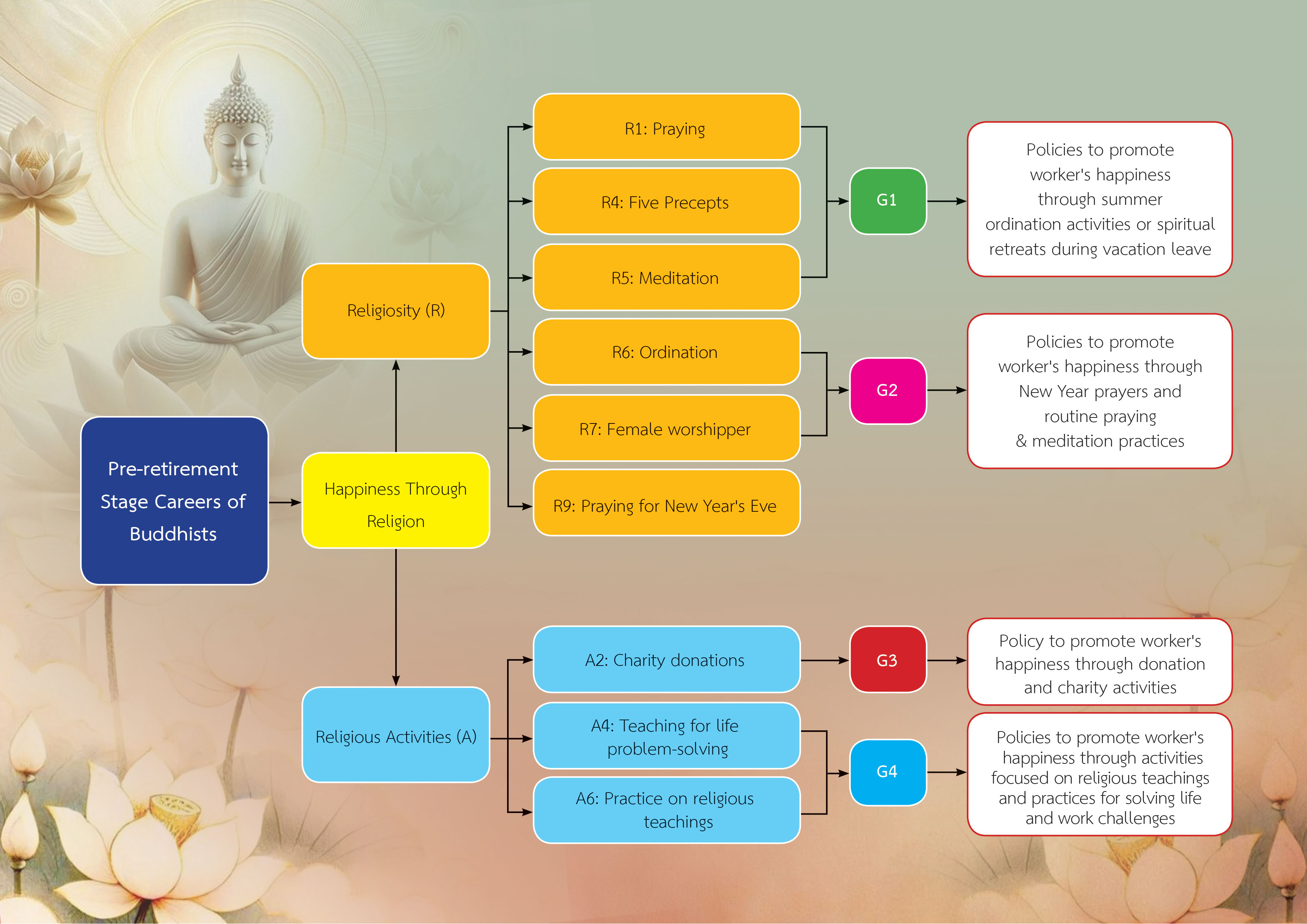
Main Results: The findings confirmed that both religiosity and specific religious activities played a critical role in promoting psychological well-being among pre-retirement stage careers of Buddhists. Activities such as praying, observing the Five Precepts, meditation, participating in ordination ceremonies, becoming a nun, and engaging in New Year prayers significantly enhanced happiness in this demographic. Additionally, religious activities like charity donations, using religious teachings to solve life problems, and practicing according to religious principles also showed strong positive associations with happiness. These activities provided meaningful ways to integrate spirituality into daily life, enhancing emotional resilience and a sense of direction during the transitional phase of retirement.
Involvement to Buddhadhamma: This finding aligned with the framework of the Applied Buddhism Group, which involved the application of Buddhism alongside modern or recent knowledge and the use of research on religious principles from a new perspective, such as their impact on societal well-being. The finding suggested that integrating Buddhist knowledge could be applied to enhance the mental well-being of the Thai population. It fell under the category of Buddhism and the development of wisdom and morality, such as the application of Buddhist teachings in societal aspects or the use of Buddhist principles to promote mental happiness among Buddhists. Regarding the issue of alignment with Buddhism and the development of wisdom and morality as the foundation of happiness, this study validated the discovery and demonstrated how these teachings could be effectively applied to enhance happiness in the lives of Buddhists.
Conclusions: This study highlighted the significant role of both religiosity and specific religious activities in promoting psychological happiness among pre-retirement stage careers of Buddhists. Key practices, such as religiosity, were found to be strongly associated with increased happiness. Moreover, religious activities also had a positive impact on happiness. The study underscored the importance of religiosity and religious activities in fostering psychological well-being and happiness among pre-retirement Buddhists, making a compelling case for incorporating these practices into mental health and public health strategies.
References
Abdel-Khalek, A. M. & Lester, D. (2018). Subjective Well-Being and Religiosity: Significant Associations among College Students from Egypt and the United Kingdom. International Journal of Culture and Mental Health, 11(3), 332-337. https://doi.org/10.1080/17542863.2017.1381132.
Abdel-Khalek, A. M. (2007). Religiosity, Happiness, Health, and Psychopathology in a Probability Sample of Muslim Adolescents. Mental Health, Religion & Culture, 10(6), 571-583. https://doi.org/10.1080/13674670601034547.
Anders, A. I. M. (2022). Diagnosis of Subjects Damaged in Buddhist Groups by Means of the Symptom Checklist (SCL-90). European Psychiatry, 65(S1), S742. https://doi.org/10.1192/j.eurpsy.2022.1917.
Bilodeau, J., Mikutra-Cencora, M. & Quesnel-Vallée, A. (2023). Work-Family Interface and Children's Mental Health: A Systematic Review. Child and Adolescent Psychiatry and Mental Health, 17, 45. https://doi.org/10.1186/s13034-023-00596-w.
Can Oz, Y., Duran, S. & Dogan, K. (2022). The Meaning and Role of Spirituality for Older Adults: A Qualitative Study. Journal of Religion and Health, 61(2), 1490-1504. https://doi.org/10.1007/s10943-021-01258-x.
Channuwong, S., Ruksat, S. & Ploychum, S. (2018). An Integration of Buddhist Teachings in Stress Management. Journal of Community Development Research (Humanities and Social Sciences), 11(4), 148-158. https://doi.org/10.14456/jcdr-hs.2018.29.
Childs, E. (2010). Religious Attendance and Happiness: Examining Gaps in the Current Literature A Research Note. Journal for the Scientific Study of Religion, 49(3), 550-560. https://doi.org/10.1111/j.1468-5906.2010.01528.x.
Colgan, D. D., Klee, D., Memmott, T., Proulx, J. & Oken, B. (2019). Perceived Stress Mediates the Relationship Between Mindfulness and Negative Affect Variability: A Randomized Controlled Trial Among Middle-aged to Older Adults. Stress and Health: Journal of the International Society for the Investigation of Stress, 35(1), 89-97. https://doi.org/10.1002/smi.2845.
Cranney, S. (2013). Do People Who Believe in God Report More Meaning in Their Lives? The Existential Effects of Belief. Journal for the Scientific Study of Religion, 52(3), 638-646. https://doi.org/10.1111/jssr.12046.
Estrada, C. A. M., Lomboy, M. F. T. C., Gregorio, E. R., Amalia, E., Leynes, C. R., Quizon, R. R. & Kobayashi, J. (2019). Religious Education Can Contribute to Adolescent Mental Health in School Settings. International Journal of Mental Health Systems, 13(1), 28. https://doi.org/10.1186/s13033-019-0286-7.
Fave, A. D., Brdar, I., Vella-Brodrick, D. & Wissing, M. P. (2013). Religion, Spirituality, and Well-Being Across Nations: The Eudaemonic and Hedonic Happiness Investigation. In Knoop, H. & Delle Fave, A. (Eds), Well-Being and Cultures. Cross-Cultural Advancements in Positive Psychology, Vol 3. (pp. 117-134). Dordrecht, Netherlands: Springer. https://doi.org/10.1007/978-94-007-4611-4_8.
Fincham, F. D. (2022). Towards a Psychology of Divine Forgiveness. Psychology of Religion and Spirituality, 14(4), 451-461. https://doi.org/10.1037/rel0000323.
Francis, L. J. (1998). Happiness is a Thing Called Stable Extraversion: A Further Examination of the Relationship Between the Oxford Happiness Inventory and Eysencks Dimensional Model of Personality and Gender. Personality and Individual Differences, 26(1), 5-11. https://doi.org/10.1016/S0191-8869(98)00185-8.
Greenfield, E. A., Vaillant, G. E. & Marks, N. F. (2009). Do Formal Religious Participation and Spiritual Perceptions Have Independent Linkages with Diverse Dimensions of Psychological Well-Being? Journal of Health and Social Behavior, 50(2), 196-212. https://doi.org/10.1177/002214650905000206.
Grim, J. (2011). The Roles of Religions in Activating an Ecological Consciousness. Int Soc Sci J, 62, 255-269. https://doi.org/10.1111/issj.12008.
Hanklang, S., Ratanasiripong, P., Naksranoi, S., Sathira-Anant, S. & Patanasri, K. (2018). Quality of Life and Mental Health Among Thai Older Workers in Community Enterprises. Journal of Health Research, 32(3), 237-250. https://doi.org/10.1108/JHR-05-2018-025.
Holt, M. K. & Dellmann-Jenkins, M. (1992). Research and Implications for Practice: Religion, Well-Being/Morale, and Coping Behavior in Later Life. Journal of Applied Gerontology, 11(1), 101-110. https://doi.org/10.1177/073346489201100108.
Jansuwan, P. & Zander, K. K. (2021). What To Do with the Farmland? Coping with Ageing in Rural Thailand. Journal of Rural Studies, 81, 37-46. https://doi.org/10.1016/j.jrurstud.2020.12.003.
Jitapunkul, S., Bunnag, S. & Ebrahim, S. (1993). Health Care for Elderly People in Developing Countries: A Case Study of Thailand. Age and Ageing, 22(5), 377-381. https://doi.org/10.1093/ageing/22.5.377.
Jones, M. E. (2008). Thailand and Globalization: The State Reform Utilities of Buddhism, Culture, and Education and the Social Movement of Socially and Spiritually Engaged Alternative Education. In Hopson, R. K., Camp Yeakey, C. & Musa Boakari, F. (Eds.) Power, Voice and the Public Good: Schooling and Education in Global Societies (Advances in Education in Diverse Communities, Vol. 6) (pp. 419-453). Leeds, England: Emerald Group Publishing Limited. https://doi.org/10.1016/S1479-358X(08)06016-6.
Khaitan, T. & Norton, J. C. (2019). The Right to Freedom of Religion and the Right Against Religious Discrimination: Theoretical Distinctions. International Journal of Constitutional Law, 17(4), 1125-1145. https://doi.org/10.1093/icon/moz087.
Koenig, H. G., King, D. E. & Carson, V. B. (2012). Handbook of Religion and Health. Oxford, United Kingdom: Oxford University Press.
Leelavanichkul, S., Chamratrithirong, A., Jampaklay, A. & Gray, R. (2018). Religiosity, the Practices of Religions, and the Perception of Older People Among Muslims and Buddhists in Thailand. The International Journal of Aging and Human Development, 86(2), 131-151. https://doi.org/10.1177/0091415017699937.
Lewis, C. A. & Cruise, S. M. (2006). Religion and Happiness: Consensus, Contradictions, Comments and Concerns. Mental Health, Religion & Culture, 9(3), 213-225. https://doi.org/10.1080/13694670600615276.
Lewis, C. A., Maltby, J. & Burkinshaw, S. (2000). Religion and Happiness: Still no Association. Journal of Beliefs & Values, 21(2), 233-236. https://doi.org/10.1080/713675504.
Lim, C. (2015). Religion and Subjective Well-Being Across Religious Traditions: Evidence from 1.3 Million Americans. Journal for the Scientific Study of Religion, 54(4), 684-701. https://doi.org/10.1111/jssr.12232.
Maddock, A. (2023). The Clinically Modified Buddhist Psychological Model for Social Work Practice and Self-Care. Clinical Social Work Journal, 51, 54-64. https://doi.org/10.1007/s10615-022-00849-9.
Maheshwari, S. & Singh, P. (2009). Psychological Well-Being and Pilgrimage: Religiosity, Happiness and Life Satisfaction of Ardh-Kumbh Mela Pilgrims (Kalpvasis) at Prayag, India. Asian Journal of Social Psychology, 12, 285-292. https://doi.org/10.1111/j.1467-839X.2009.01291.x.
O'Sullivan, L. & Lindsay, N. (2023). The Relationship between Spiritual Intelligence, Resilience, and Well-Being in an Aotearoa New Zealand Sample. Journal of Spirituality in Mental Health, 25(4), 277-297. https://doi.org/10.1080/19349637.2022.2086840.
Ratanakul, P. (2012). Reflections on Aging in Buddhist Thailand. Journal of Religion, Spirituality & Aging, 25(1), 12-19. https://doi.org/10.1080/15528030.2012.738582.
Robinson, K. M. (2010). Policy Issues in Mental Health among the Elderly. Nursing Clinics of North America, 45(4), 627-634. https://doi.org/10.1016/j.cnur.2010.06.005.
Senasu, K. & Singhapakdi, A. (2017). Determinants of Happiness in Thailand: The Moderating Role of Religiousness. Journal of Human Behavior in the Social Environment, 27(4), 270-290. https://doi.org/10.1080/10911359.2017.1279580.
Sharifi, K., Anoosheh, M., Foroughan, M. & Kazemnejad, A. (2014). Barriers to Middle-Aged Women's Mental Health: A Qualitative Study. Iranian Red Crescent Medical Journal, 16(6), e18882.
Singh, K., Junnarkar, M., Singh, D., Suchday, S., Mitra, S. & Dayal, P. (2020). Associations Between Religious/Spiritual Practices and Well-Being in Indian Elderly Rural Women. Journal of Religion and Health, 59(6), 2753-2774. https://doi.org/10.1007/s10943-019-00877-9.
Sumngern, C., Azeredo, Z., Subgranon, R., Sungvorawongphana, N. & Matos, E. (2010). Happiness among the Elderly in Communities: A Study in Senior Clubs of Chonburi Province, Thailand. Japan Journal of Nursing Science, 7(1), 47-54. https://doi.org/10.1111/j.1742-7924.2010.00139.x.
Takase, A., Matoba, Y., Taga, T., Tanaka, M. & Hoshiko, M. (2022). Middle-Aged and Older People with Urgent, Unaware, and Unmet Mental Health Care Needs: Practitioners' Viewpoints from Outside the Formal Mental Health Care System. BMC Health Services Research, 22(1), 1400. https://doi.org/10.1186/s12913-022-08838-x.
Thanissaro, N. (2014). Internal Diversity in Buddhism: Comparing the Values of Buddhist Teens Raised by Heritage and Convert Parents. Journal of Contemporary Religion, 29(2), 315-330. https://doi.org/10.1080/13537903.2014.903668.
Witter, R. A., Stock, W. A., Okun, M. A. & Haring, M. J. (1985). Religion and Subjective Well-Being in Adulthood: A Quantitative Synthesis. Review of Religious Research, 26(4), 332-342. https://doi.org/10.2307/3511048.
Xu, T., Xu, X., Sunil, T. & Sirisunyaluck, B. (2020). Buddhism and Depressive Symptoms among Married Women in Urban Thailand. International Journal of Environmental Research and Public Health, 17(3), 761. https://doi.org/10.3390/ijerph17030761.
Yiengprugsawan, V., Somboonsook, B. & Sleigh, A. C. (2012). Happiness, Mental Health, and Socio-Demographic Associations among a National Cohort of Thai Adults. Journal of Happiness Studies, 13, 1019-1029. https://doi.org/10.1007/s10902-011-9304-4.
Zotti, R., Speziale, N. & Barra, C. (2016). On the Causal Effect of Religiosity on Life Satisfaction Using a Propensity Score Matching Technique. International Journal of Social Economics, 43(10), 1031-1048. https://doi.org/10.1108/IJSE-12-2014-0262.
Downloads
Published
How to Cite
Issue
Section
License
Copyright (c) 2025 Journal of Buddhist Anthropology

This work is licensed under a Creative Commons Attribution-NonCommercial-NoDerivatives 4.0 International License.