THE ROLE OF BUDDHIST PRACTICES IN PROMOTING HAPPINESS AMONG YOUNG WORKERS POPULATION IN THAILAND
Keywords:
Happiness, Buddhist Practices, Young Workers, ThailandAbstract
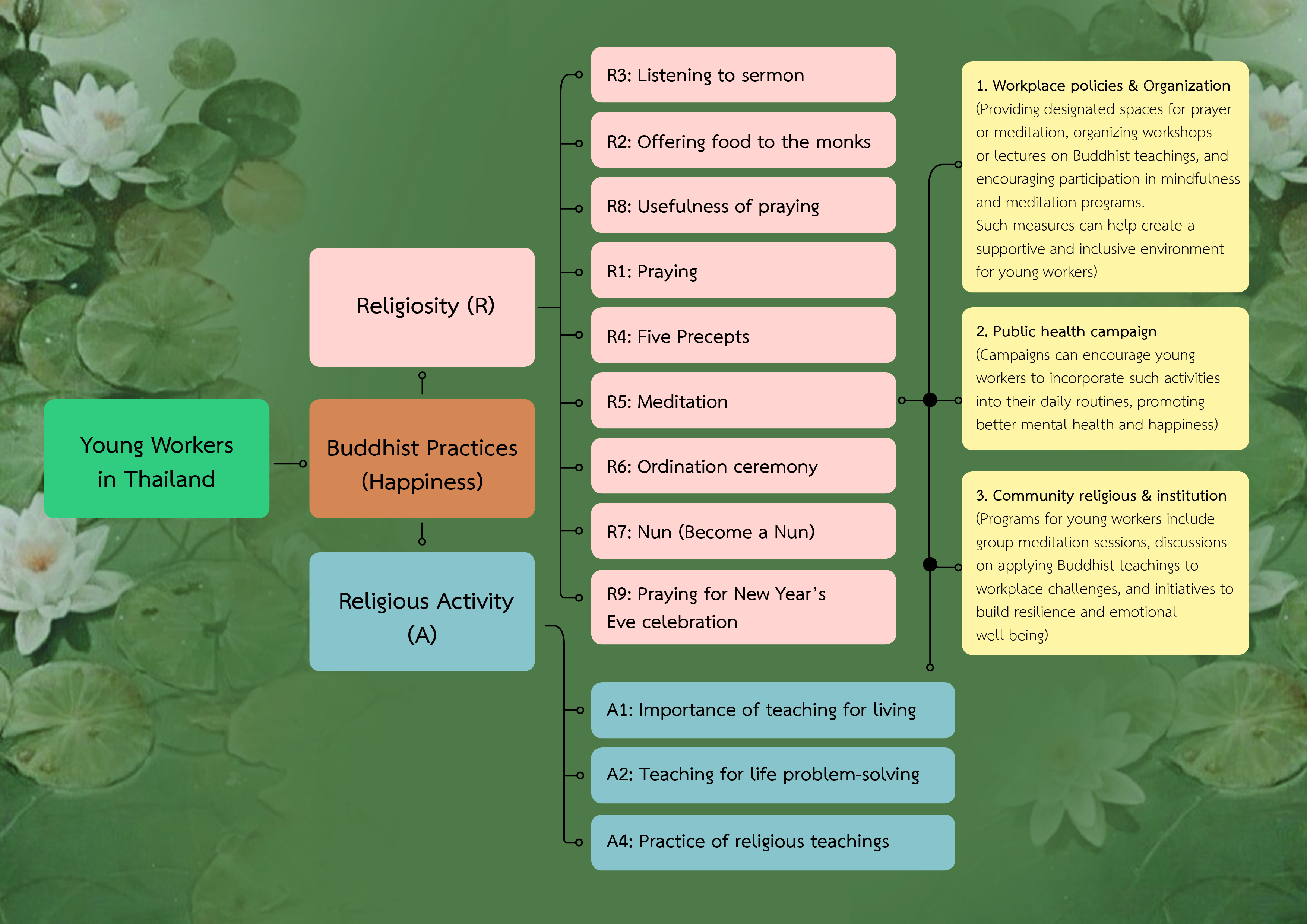
Background and Objectives: Thailand, where Buddhism was the predominant religion, deeply incorporated its spiritual practices and traditions into the country's social and cultural systems. Buddhist teachings played a significant role in shaping individual values, promoting emotional well-being, and supporting coping strategies throughout different phases of life. For young workers aged 30-40, this stage marked a crucial period of personal and professional development, often accompanied by challenges such as career progression, work-life balance, and self-identity formation. During this stage, religiosity and participation in Buddhist practices provided emotional support, fostered resilience, and enhanced life satisfaction. This study investigated the role of Buddhist practices in promoting happiness among young workers (Aged 30-40) in Thailand, with an emphasis on understanding how religiosity and religious activities contributed to their overall happiness.
Methodology: The study utilized secondary data from the 2018 Survey on Conditions of Society, Culture, and Mental Health, conducted by Thailand's National Statistical Office, a government agency. This nationwide dataset was based on proportional stratification by population size, with households surveyed through face-to-face interviews using a structured questionnaire. A subset of 3,526 individuals aged 30-40 years, representing young workers, was analyzed to examine the relationship between Buddhist practices and happiness.
Main Results: The findings highlighted two critical perspectives: 1) Religiosity significantly enhanced psychological well-being through practices such as praying, meditating, listening to sermons, observing the Five Precepts, and participating in cultural and religious events. These practices fostered mindfulness, emotional stability, and mental resilience, equipping young workers better to navigate the complexities of professional and personal life; and 2) Engaging in religious activities, such as applying Buddhist teachings to daily life, addressing workplace challenges with moral principles, and practicing according to religious precepts, promoted emotional resilience, a sense of purpose, and a strong sense of community belonging. These factors were vital for cultivating positivity and collaborative relationships in the workplace.
References
Abdel Khalek, A. M. & Lester, D. (2018). Subjective well-being and religiosity: significant associations among college students from Egypt and the United Kingdom. International Journal of Culture and Mental Health, 11(3), 332-337. https://doi.org/10.1080/17542863.2017.1381132.
Abdel-Khalek, A. M. (2007). Religiosity, happiness, health, and psychopathology in a probabilitysample of Muslim adolescents. Mental Health, Religion & Culture, 10(6), 571-583. https://doi.org/10.1080/13674670601034547.
Anders, A. I. M. (2022). Diagnosis of subjects damaged in Buddhist groups by means of the Symptom Checklist (SCL-90). European Psychiatry, 65(S1), S742. https://doi.org/10.1192/j.eurpsy.2022.1917.
Cranney, S. (2013). Do People Who Believe in God Report More Meaning in Their Lives? The Existential Effects of Belief. Journal for the Scientific Study of Religion, 52(3), 638-646. https://doi.org/https://doi.org/10.1111/jssr.12046.
Cunningham, C. J. L. (2014). Religion and spirituality as factors that influence occupational stress and well-being. In P. L. Perrewé, C. C. Rosen & J. R. B. Halbesleben (Eds.), The role of demographics in occupational stress and well being. (pp. 135-172). Emerald Group Publishing. https://doi.org/10.1108/S1479-355520140000012004.
Estrada, C. A. M., Lomboy, M. F. T. C., Gregorio, E. R., Amalia, E., Leynes, C. R., Quizon, R. R. & Kobayashi, J. (2019). Religious education can contribute to adolescent mental health in school settings. International Journal of Mental Health Systems, 13(1), 28. https://doi.org/10.1186/s13033-019-0286-7 .
Fave, A. D., Brdar, I., Vella-Brodrick, D. & Wissing, M. P. (2013). Religion, Spirituality, and Well-Being Across Nations: The Eudaemonic and Hedonic Happiness Investigation. In Knoop, H., Delle Fave, A. (eds), Well-Being and Cultures. Cross-Cultural Advancements in Positive Psychology. (pp. 117-134). Dordrecht, Netherlands: Springer. https://doi.org/10.1007/978-94-007-4611-4_8.
Hanklang, S., Ratanasiripong, P., Naksranoi, S., Sathira-Anant, S. & Patanasri, K. (2018). Quality of life and mental health among Thai older workers in community enterprises. Journal of Health Research, 32(3), 237-250. https://doi.org/10.1108/JHR-05-2018-025.
Holt, M. K. & Dellmann-Jenkins, M. (1992). Research and Implications for Practice: Religion,Well-Being/Morale, and Coping Behavior in Later Life. Journal of Applied Gerontology, 1(1), 101-110. https://doi.org/10.1177/073346489201100108.
Jitapunkul, S., Bunnag, S. & Ebrahim, S. (1993). Health care for elderly people in developing countries: A case study of Thailand. Age and Ageing, 22(5), 377-381. https://doi.org/10.1093/ageing/22.5.377.
Koenig, H. G., King, D. E. & Carson, V. B. (2012). Handbook of Religion and Health. Oxford University Press: Oxford.
Leelavanichkul, S., Chamratrithirong, A., Jampaklay, A. & Gray, R. (2018). Religiosity, the practices of religions, and the perception of older people among Muslims and Buddhists in Thailand. The International Journal of Aging and Human Development, 86(2), 131-151. https://doi.org/10.1177/0091415017699937.
Lewis, C. A. & Cruise, S. M. (2006). Religion and happiness: Consensus, contradictions, comments and concerns. Mental Health, Religion & Culture, 9(3), 213-225. https://doi.org/10.1080/13694670600615276.
Lewis, C. A., Maltby, J. & Burkinshaw, S. (2000). Religion and Happiness: Still no association. Journal of Beliefs & Values, 21(2), 233-236. https://doi.org/10.1080/713675504 .
Lim, C. (2015). Religion and Subjective Well-Being Across Religious Traditions: Evidence from 1.3 Million Americans. JOURNAL FOR THE SCIENTIFIC STUDY OF RELIGION, 54, 684-701. https://doi.org/10.1111/jssr.12232.
Maheshwari, S. & Singh, P. (2009). Psychological well-being and pilgrimage: Religiosity, happiness and life satisfaction of Ardh-Kumbh Mela pilgrims (Kalpvasis) at Prayag, India. Asian Journal of Social Psychology, 12, 285-292. https://doi.org/10.1111/j.1467-839X.2009.01291.x.
Ngamaba, K. H. & Soni, D. (2018). Are Happiness and Life Satisfaction Different Across Religious Groups? Exploring Determinants of Happiness and Life Satisfaction. Journal of Religion and Health, 57, 2118-2139. https://doi.org/10.1007/s10943-017-0481-2.
O'Sullivan, L. & Lindsay, N. (2023). The relationship between spiritual intelligence, resilience, and well-being in an Aotearoa New Zealand sample. Journal of Spirituality in Mental Health, 25(4), 277-297. https://doi.org/10.1080/19349637.2022.2086840 .
Phillips, R. E., Cheng, C. M., Pargament, K. I., Oemig, C., Colvin, S. D., Abarr, A. N., Dunn, M. C. & Reed, A. S. (2009). Spiritual Coping in American Buddhists: An Exploratory Study. The International Journal for the Psychology of Religion, 19(4), 231-243. https://doi.org/10.1080/10508610903143263.
Ratanakul, P. (2012). Reflections on Aging in Buddhist Thailand. Journal of Religion, Spirituality & Aging, 25(1), 12-19. https://doi.org/10.1080/15528030.2012.738582.
Robinson, K. M. (2010). Policy issues in mental health among the elderly. Nursing Clinics of North America, 45(4), 627-634. https://doi.org/10.1016/j.cnur.2010.06.005.
Singh, K., Junnarkar, M., Singh, D., Suchday, S., Mitra, S. & Dayal, P. (2020). Associations Between Religious/Spiritual Practices and Well-Being in Indian Elderly Rural Women. Journal of Religion and Health, 59(6), 2753-2774. https://doi.org/10.1007/s10943-019-00877-9.
Sumngern, C., Azeredo, Z., Subgranon, R., Sungvorawongphana, N. & Matos, E. (2010). Happiness among the elderly in communities: A study in senior clubs of Chonburi Province, Thailand. Japan Journal of Nursing Science, 7(1), 47-54. https://doi.org/10.1111/j.1742-7924.2010.00139.x.
Thanissaro, N. (2014). Internal Diversity in Buddhism: Comparing the Values of Buddhist Teens Raised by Heritage and Convert Parents. Journal of Contemporary Religion, 29(2), 315-330. https://doi.org/10.1080/13537903.2014.903668.
Xu, T., Xu, X., Sunil, T. & Sirisunyaluck, B. (2020). Buddhism and Depressive Symptoms among Married Women in Urban Thailand. International Journal of Environmental Research and Public Health, 17(3), 761. https://doi.org/10.3390/ijerph17030761.
Zotti, R., Speziale, N. & Barra, C. (2016). On the causal effect of religiosity on life satisfaction using a propensity score matching technique. International Journal of Social Economics, 43(10), 1031-1048. https://doi.org/10.1108/IJSE-12-2014-0262.
Downloads
Published
How to Cite
Issue
Section
License
Copyright (c) 2025 Journal of Buddhist Anthropology

This work is licensed under a Creative Commons Attribution-NonCommercial-NoDerivatives 4.0 International License.