DEVELOPING AN INNOVATIVE BUDDHIST COMMUNICATION PROCESS TO PROMOTE THE QUALITY OF LIFE OF DIABETIC PATIENTS USING THE 7 BOJJHAṄGA
Keywords:
Innovative Buddhist Communication, Quality of Life, Diabetic Patients, 7 Bojjhaṅga (The Seven Factors of Enlightenment) , Buddhist Health PromotionAbstract
Background and Objective: Diabetes is a chronic non-communicable disease found in all nations and has increased yearly. This disease could be inherited through genetics or by adopting a lifestyle that increases the risk of the disease. Diabetes was an incurable and extremely dangerous condition that gradually destroyed the patient's health, causing serious complications that could even lead to death. In Buddhist teachings, health and quality of life were emphasized, as the Buddha had said, "Being free from disease is the greatest blessing (Ārogyaparamā lābhā)," which meant being free from both physical and mental illness. Therefore, promoting quality of life with the 7 Bojjhaṅga, along with medical and public health knowledge, was considered essential for diabetic patients in a way that could be effectively applied to their daily lives. This research aimed to study the current situation and develop and present the process of Buddhist innovation in communication to promote the quality of life of diabetic patients.
Methodology: A mixed-method research approach was used, consisting of qualitative research that collected data from documents and field data through in-depth interviews and quantitative research in the form of quasi-experimental research. Data on general, illness, quality of life, and Buddhist innovation to promote quality of life were gathered through interviews with questionnaires. Activities were organized to promote quality of life for a study group of 35 participants across six sessions, each 1 month apart. The data were analyzed and presented using frequencies, percentages, means, and statistical tests, including the independent t-test and the Paired Samples t-test.
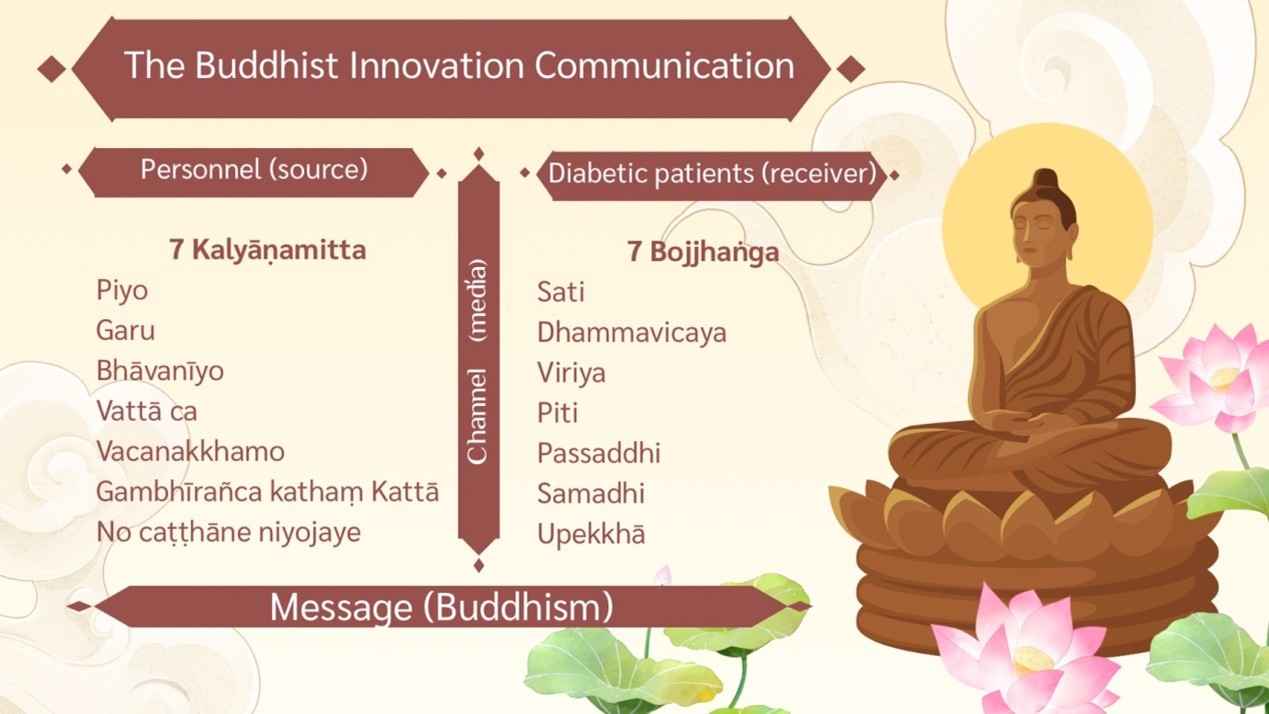
Main Results: 1) Public health service institutions had not integrated Buddhist principles into public health work. Before organizing the skill promotion activities, it was found that the quality of life of the study group and the control group did not differ; 2) Skill promotion activities were organized to integrate medical work, public health, and Buddhist principles. The message was conveyed by monks and personnel, using the content of the message "the 7 Bojjhaṅga" with the study group, and various activities were organized through related media channels, and 3) When measuring quality of life scores, it was found that the study group had higher scores for "physical," "mental," "social relationships," and "overall quality of life," resulting in an average score significantly higher than that of the control group.
Involvement to Buddhadhamma: Applied Buddhism integrated the use of Buddhist principles to benefit society, particularly through the practice of the 7 Bojjhaṅga (The Seven Factors of Enlightenment), which included: Sati, Dhammavicaya, Viriya, Pīti, Passaddhi, Samādhi, and Upekkhā. Additionally, it emphasized the application of the seven qualities of a good friend or the 7 Kalyāṇamitta (Piyo, Garu, Bhāvanīyo, Vattā ca, Vacanakkhamo, Gambhīrañca kathaṃ kattā and No caṭṭhāne niyojaye) in providing compassionate and understanding care to patients-treating in conjunction with medical and public health knowledge to promote quality of life for diabetic patients through various communication methods.
Conclusions: Promoting the quality of life for diabetic patients required a holistic approach that addressed both physical and mental well-being, enabling patients to incorporate effective practices into their daily lives in a meaningful and sustainable way. Diabetes was an incurable and life-threatening disease. Given the seriousness of this condition, there was a clear and urgent need for innovative strategies that support long-term health and well-being. This research, therefore focused on developing an innovative Buddhist communication process, grounded in the principles of the 7 Bojjhaṅga, to promote and enhance the quality of life for diabetic patients. By integrating spiritual and psychological dimensions with health care, this approach offered a more comprehensive and compassionate support model for those with diabetes.
References
Anukul, S. (1985). Diabetes Patient Handbook (5th ed.). Bangkok: Liang Chiang Press.
Bureau of Elderly Health. (2021). Guidelines for Promoting Healthy Aging and Longevity (For Healthcare Personnel) (2nd ed.). Bangkok: Printing Operations Office, Veterans Welfare Organization.
Intharampan, W. (1985). Nutrition and Diabetes. Bangkok: Phayathai Printing Center.
Mahachulalongkornrajavidyalaya University. (1996). Thai Tripitaka. Bangkok: MCU Press.
Mahayotsanan, N. (2020). An Approach in Buddhist Health Care for Diabetes at Thawangpha Hospital, Thawangpha District, Nan Province. Journal of Thammawat, 1(1), 49-57.
Phra Thammoli. (2008). Analytical Study of The Way of Life, Health Behavior and Holistic Health Care of Monks As Stated In The Tripitaka [Unpublished Doctoral dissertation]. Mahachu lalongkornrajavidyalaya University. Bangkok, Thailand.
Phrakhru Inthasarnwichak. (2007). Treatment of Disease with Herbal Medicine and Dharma Medicine as Appeared in Buddhist Scriptures. [Unpublished Master's Thesis]. Mahachula longkornrajavidyalaya University. Bangkok, Thailand.
Phrakhru Phibulkijjarak Tongmak Chanthia & Phramaha Surasak Puccantaseno. (2019). Care Center for Cancer Patients in the Integrated Buddhist Perspective. MCU Buddhist Studies, 3(1), 32-48.
Somdej Phra Buddhaghosachan (P.A. Payutto). (2023). The Noble Friendship of Luang Pu Chah (8th ed.). Bangkok: Place of publication not identified.
Somdej Phra Buddhaghosachan (P.A. Payutto). (2024). Bojjhaṅga: Buddhist Methods for Promoting Health (223th ed.). Bangkok: Place of publication not identified.
Taylor, S. H. (1987). Drug therapy and quality of life in angina pectoris. American Heart Journal, 114(1 Part 2), 234-240.
The WHOQOL group. (1995). The World Health Organization Quality of Life assessment (WHOQOL): position paper from the World Health Organization. Social Science & Medicine, 41(10), 1403-1409. https://doi.org/10.1016/0277-9536(95)00112-K.
Trongsoon, N. & Noppiboon, S. (2023). The Model Development of Holistic Care of The Sangha by The Participation of Community Network in Sikhoraphum District, Surin Province. Primary Health Care Journal (Northeastern Edirion), 38(1), 126-140.
Witthayanarat, A., Deerojanawong, C., Panthumjinda, K., Kongkanan, A. & Intharampan, W. (1981). Endocrine and Metabolic Diseases for General Practice II. Bangkok: Chulalongkorn University Press.
World Health Organization Quality of Life Assessment Group. (1996). People and Health. World Health Forum, 17(1), 354-356.
Downloads
Published
How to Cite
Issue
Section
License
Copyright (c) 2025 Journal of Buddhist Anthropology

This work is licensed under a Creative Commons Attribution-NonCommercial-NoDerivatives 4.0 International License.