INTEGRATING MINDFULNESS AND YOGA: A BUDDHIST-INSPIRED PROGRAM TO ENHANCE COGNITIVE FLEXIBILITY AND EMOTION REGULATION IN OLDER THAI ADULTS
Keywords:
Yoga, Mindfulness, Cognitive Flexibility, Emotion Regulation, Older Thai AdultsAbstract
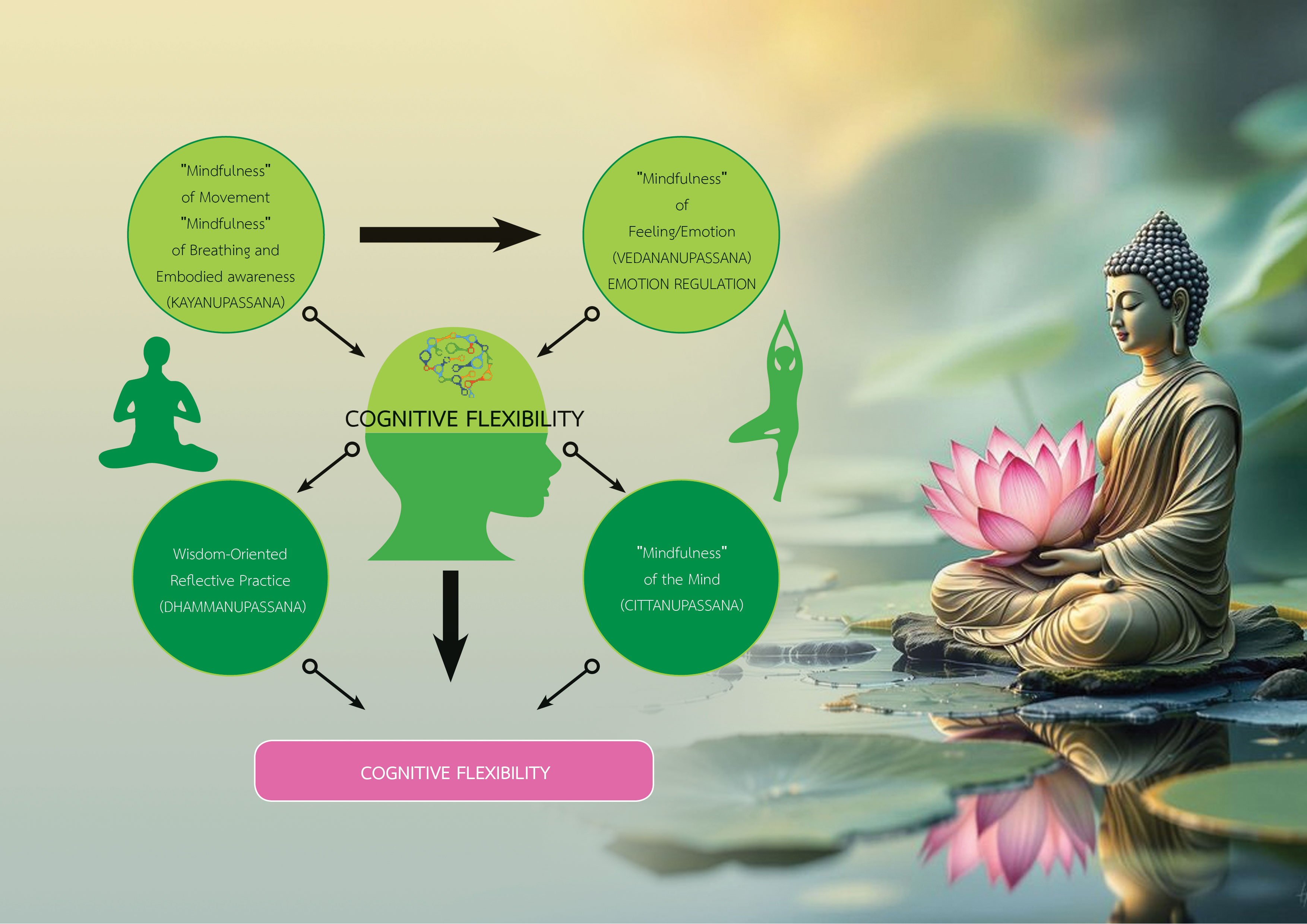
Background and Objectives: Thailand was facing a rapidly aging population, with older adults increasingly vulnerable to cognitive decline and emotional dysregulation. In response, this study examined a culturally tailored yoga-based mindfulness program designed specifically for older Thai adults. Grounded in the principles of the neuroplasticity model of Buddhist mindfulness and observational learning, the study aimed to assess the preliminary effectiveness of the program in enhancing cognitive flexibility and emotion regulation in older Thai adults and to explore their learning processes through a Buddhist-informed framework that integrated the neuroplasticity model of mindfulness and observational learning.
Methodology: A quasi-experimental design was employed. Twenty-three Thai adults were recruited. Thirteen were assigned to the intervention group to complete 16 sessions (60 minutes each). The sessions integrated gentle yoga, mindful breathing, mindfulness meditation, and reflective group discussions. Quantitative outcomes were measured using Thai versions of Cognitive Flexibility Inventory and Emotion Regulation Questionnaire, before and after the intervention. Multivariate Analysis of Variance (MANOVA) was used to assess changes in cognitive flexibility and emotion regulation. Complementary qualitative data were gathered through After-Action Review (AAR) at the end of each session on learning experiences. The mixed-methods approach strengthened the study by methodological triangulation, enhancing the validity and comprehensiveness of the findings. The qualitative study facilitated cultural engagement, elevating lived experiences and contextualizing changes within a Buddhist-informed learning process.
Main Results: Quantitative analysis revealed significant improvements in cognitive flexibility and emotion regulation, particularly in cognitive reappraisal. Qualitative analysis from the AAR revealed six learning processes: 1) Observation and modeling; 2) Focused attention; 3) Retention and habit formation; 4) Skill reproduction; 5) Intrinsic motivation, and 6) Neuroplasticity through repetition as cognition and behavior changed consistently with increased mindfulness and adaptability. These results corresponded with the study's objective by showing how psychological improvements were supported by a Buddhist-informed approach. Learning processes also reflected some key elements of the noble eightfold path. Increased awareness and calmness allowed participants to reflect wisely and be more mindful in regulating emotions.
Involvement to Buddhadhamma: This study reflected applied Buddhism, integrating Buddhist principles with modern health approaches under the theme of "Buddhism and the development of wisdom and morality." The program embodied the foundations of mindfulness (Satipatthāna) and the noble eightfold path (Ariyamagga),right effort (Sammā-Vāyāma), right concentration (Sammā-Samādhi) and right mindfulness (Sammā-Sati). Reflections from AAR revealed enhanced loving-kindness (Mettā) and wholesome thinking (Kusalā Vitakkāvitakkā). The program served as a spiritual and psychological resource, bridging traditional Buddhadhamma with modern approaches.
Conclusions: The study showed that the program significantly improved cognitive flexibility and emotion regulation among older Thai adults. Beyond measurable outcomes, the program fostered experiential learning and inner transformation through embodied mindful practices. These findings highlighted the promise of integrating traditional contemplative practices with modern wellness strategies as a non-pharmacological model for supporting healthy aging. The study achieved its objectives to assess the program's effectiveness in enhancing both cognitive and emotional domains and to explore how older adults engaged in learning processes rooted in mindfulness and repetition. The incorporation of culturally relevant practices based on Buddhist principles, right mindfulness (Sammā-Sati), and wise attention (Yoniso Manasikāra) provided a significant, community-oriented method for older Thai adults. These results indicated broader implications for health promotion in Thailand, advocating for the integration of mind-body practices in aging-related wellness intervention.
References
Analayo, B. (2019). Mindfulness-based interventions and the four satipatthanas. Mindfulness, 10(4), 611-615. https://doi.org/10.1007/s12671-019-1097-2.
Bandura, A. (1977). Social learning theory. Englewood Cliffs, NJ: Prentice-Hall.
Bodhi, B. (2011). What does mindfulness really mean? A canonical perspective. Contemporary Buddhism, 12(1), 19-39. https://doi.org/10.1080/14639947.2011.564813.
Borges, U., Knops, L., Laborde, S., Klatt, S. & Raab, M. (2020). Transcutaneous vagus nerve stimulation may enhance only specific aspects of the core executive functions: A randomized crossover trial. Frontiers in Neuroscience, 14, 523. https://doi.org/10.3389/fnins.2020.00523.
Buitenweg, J. I. V., Van de Ven, R. M., Ridderinkhof, K. R. & Murre, J. M. J. (2019). Does cognitive flexibility training enhance subjective mental functioning in healthy older adults? Neuropsychology, Development, and Cognition: Section B, Aging, Neuropsychology and Cognition, 26(5), 688-710. https://doi.org/10.1080/13825585.2018.1519106.
Choi, E., Han, K. M., Chang, J., Lee, Y. J., Choi, K. W., Han, C. & Ham, B. J. (2021). Social participation and depressive symptoms in community-dwelling older adults: Emotional social support as a mediator. Journal of Psychiatric Research, 137, 589-596. https://doi.org/10.1016/j.jpsychires.2020.10.043.
Cotman, C. W. & Berchtold, N. C. (2002). Exercise: A behavioral intervention to enhance brain health and plasticity. Trends in Neurosciences, 25(6), 295-301. https://doi.org/10.1016/s0166-2236(02)02143-4.
Cousins, L. S. (2006). Satipatthana: The direct path to realization, Analayo. Buddhist Studies Review, 23(1), 131-134.
Dennis, J. P. & Vander Wal, J. S. (2010). The Cognitive Flexibility Inventory: Instrument development and estimates of reliability and validity. Cognitive Therapy and Research, 34, 241-253. https://doi.org/10.1007/s10608-009-9276-4.
Diamond, A. (2013). Executive functions. Annual Review of Psychology, 64, 135-168. https://doi.org/10.1146/annurev-psych-113011-143750.
Field, T. (2016). Yoga research review. Complementary Therapies in Clinical Practice, 24, 145-161. https://doi.org/10.1016/j.ctcp.2016.06.005.
FitzGerald, M. J. T., Folan-Curran, J., Richardson, P. E. & Tibbitts, R. (2002). Clinical neuroanatomy and related neuroscience. Edinburgh, UK: W. B. Saunders.
Garland, E. L., Hanley, A., Farb, N. A. & Froeliger, B. E. (2015). State mindfulness during meditation predicts enhanced cognitive reappraisal. Mindfulness, 6(2), 234-242. https://doi.org/10.1007/s12671-013-0250-6.
Goldin, P. & Gross, J. (2010). Effect of mindfulness meditation training on the neural bases of emotion regulation in social anxiety disorder. In [Unpublished manuscript]. Davis: University of California.
Gothe, N. P., Khan, I., Hayes, J., Erlenbach, E. & Damoiseaux, J. S. (2019). Yoga effects on brain health: A systematic review of the current literature. Brain Plasticity, 5(1), 105-122. https://doi.org/10.3233/BPL-190084.
Gross, J. J. & John, O. P. (2003). Individual differences in two emotion regulation processes: Implications for affect, relationships, and well-being. Journal of Personality and Social Psychology, 85, 348-362. https://doi.org/10.1037/0022-3514.85.2.348.
Growney, C. M. & English, T. (2023). Fluid and crystallized cognitive resources differentially linked to emotion regulation success in adulthood. Emotion, 23(2), 589-594. https://doi.org/10.1037/emo0001087.
Huang, M., Liu, K., Liang, C., Wang, Y. & Guo, Z. (2023). The relationship between living alone or not and depressive symptoms in older adults: A parallel mediation effect of sleep quality and anxiety. BMC Geriatrics, 23(1), 506. https://doi.org/10.1186/s12877-023-04161-0.
Joormann, J. & Gotlib, I. H. (2010). Emotion regulation in depression: Relation to cognitive inhibition. Cognition and Emotion, 24(2), 281-298. https://doi.org/10.1080/02699930903407948.
Kabat-Zinn, J. (1990). ull catastrophe living: Using the wisdom of your body and mind to face stress, pain, and illness. New York: Dell Publishing.
Keute, M. & Gharabaghi, A. (2021). Brain plasticity and vagus nerve stimulation. Autonomic Neuroscience, 236, 102876. https://doi.org/10.1016/j.autneu.2021.102876.
Laukkonen, R. E., Leggett, J., Gallagher, R., Biddel, H., Mrazek, A., Slagter, H. & Mrazek, M. (2020). The science of mindfulness-based interventions and learning: A review for educators. MindRxiv Papers, 2020 (Feb. 3), 1-29. https://doi.org/10.31231/osf.io/6g9uq.
Lin, F. V., Heffner, K., Gevirtz, R., Zhang, Z., Tadin, D. & Porsteinsson, A. (2021). Targeting autonomic flexibility to enhance cognitive training outcomes in older adults with mild cognitive impairment: Study protocol for a randomized controlled trial. Trials, 22, 560. https://doi.org/10.1186/s13063-021-05530-z.
Loevaas, M. E. S., Sund, A. M., Patras, J., Martinsen, K., Hjemdal, O., Neumer, S. P., Holen, S. & Reinfjell, T. (2018). Emotion regulation and its relation to symptoms of anxiety and depression in children aged 8-12 years: Does parental gender play a differentiating role? BMC Psychology, 6(1), 42. https://doi.org/10.1186/s40359-018-0255-y.
Malhotra, V., Sampath, A., Javed, D., Bharshankar, R., Mishra, S., Singh, V. & Gautham, N. (2023). Effect of mobile-based online meditation module and yoga intervention on depression, anxiety, and stress in the elderly during the COVID-19 pandemic. Yoga Mimamsa, 55(1). https://doi.org/10.4103/ym.ym_151_22.
Moore, A. & Malinowski, P. (2009). Meditation, mindfulness and cognitive flexibility. Consciousness and Cognition, 18, 176-186. https://doi.org/10.1016/j.concog.2008.12.008.
Müller, B., Gerasimova, A. & Ritter, S. M. (2016). Concentrative meditation influences creativity by increasing cognitive flexibility. Psychology of Aesthetics, Creativity, and the Arts, 10. https://doi.org/10.1037/a0040335.
Pandya, S. P. (2020). Yoga education program for improving memory in older adults: A multicity 5-year follow-up study. Journal of Applied Gerontology, 39(6), 576-587. https://doi.org/10.1177/0733464818794153.
Pirson, M., Langer, E., Bodner, T. & Zilcha-Mano, S. (2012). The development and validation of the Langer Mindfulness Scale: Enabling a socio-cognitive perspective of mindfulness in organizational contexts. SSRN Electronic Journal, https://doi.org/10.2139/ssrn.2158921.
Preece, D. A., Becerra, R., Robinson, K. & Gross, J. J. (2020). The Emotion Regulation Questionnaire: Psychometric properties in general community samples. Journal of Personality Assessment, 102(3), 348-356. https://doi.org/10.1080/00223891.2018.1564319.
Schwaba, T., Luhmann, M., Denissen, J. J. A., Chung, J. M. & Bleidorn, W. (2018). Openness to experience and culture-openness transactions across the lifespan. Journal of Personality and Social Psychology, 115(1), 118-136. https://doi.org/10.1037/pspp0000150.
Silk, J. S., Steinberg, L. & Morris, A. S. (2003). Adolescents' emotion regulation in daily life: Links to depressive symptoms and problem behavior. Child Development, 74(6), 1869-1880. https://doi.org/10.1046/j.1467-8624.2003.00643.x.
Skaper, S. D., Facci, L., Zusso, M., & Giusti, P. (2017). Synaptic plasticity, dementia and Alzheimer disease. CNS & Neurological Disorders-Drug Targets, 16(3), 220-233. https://doi.org/10.2174/1871527316666170113120853.
Sungprakorn, O. & Tangwongchai, S. (2019). Depression and associated factors in retired employees at the Department of Internal Medicine, Outpatient Clinic, Metropolitan Electricity Authority Hospital. Chulalongkorn Medical Journal, 1(4), 393-402. https://doi.org/10.14456/chulamedbull.2019.33.
Van Aalst, J., Ceccarini, J., Demyttenaere, K., Sunaert, S. & Van Laere, K. (2020). What has neuroimaging taught us on the neurobiology of yoga? A review. Frontiers in Integrative Neuroscience, 14, 34. https://doi.org/10.3389/fnint.2020.00034.
Winner, B. & Winkler, J. (2015). Adult neurogenesis in neurodegenerative diseases. Cold Spring Harbor Perspectives in Biology, 7(4), a021287. https://doi.org/10.1101/cshperspect.a021287.
Zagaria, A., Vacca, M., Cerolini, S., Terrasi, M., Bacaro, V., Ballesio, A. & Lombardo, C. (2023). Differential associations of cognitive emotion regulation strategies with depression, anxiety, and insomnia in adolescence and early adulthood. International Journal of Environmental Research and Public Health, 20(10). https://doi.org/10.3390/ijerph20105857.
Zeidan, F., Johnson, S. K., Diamond, B. J., David, Z. & Goolkasian, P. (2010). Mindfulness meditation improves cognition: Evidence of brief mental training. Consciousness and Cognition, 19(2), 597-605. https://doi.org/10.1016/j.concog.2010.03.014.
Downloads
Published
How to Cite
Issue
Section
License
Copyright (c) 2025 Journal of Buddhist Anthropology

This work is licensed under a Creative Commons Attribution-NonCommercial-NoDerivatives 4.0 International License.