THAI BUDDHIST UNIVERSITY MEET THE CRITERIA OF HEALTHY UNIVERSITIES UNDER THE AUN-HPN FRAMEWORK
Keywords:
Healthy University, Monastic Education, Health Promotion Policy, AUN-HPN, BuddhabatvernplaAbstract
Background and Objectives: Thailand has recognized the importance of promoting health through institutional engagement, particularly by leveraging the collaborative capacity of higher education institutions under the ASEAN University Network-Health Promotion Network (AUN-HPN). This research article identified its primary objective as developing mechanisms and a management system for a Buddhist-oriented health-promoting organization within MCU. However, integrating AUN-HPN practices with religious contexts involved several key conditions that served both as limitations and protective factors-for example, the care of monks' physical health and avoiding smoking and drinking alcohol, which aligned with the principles of the Dhamma-Vinaya.
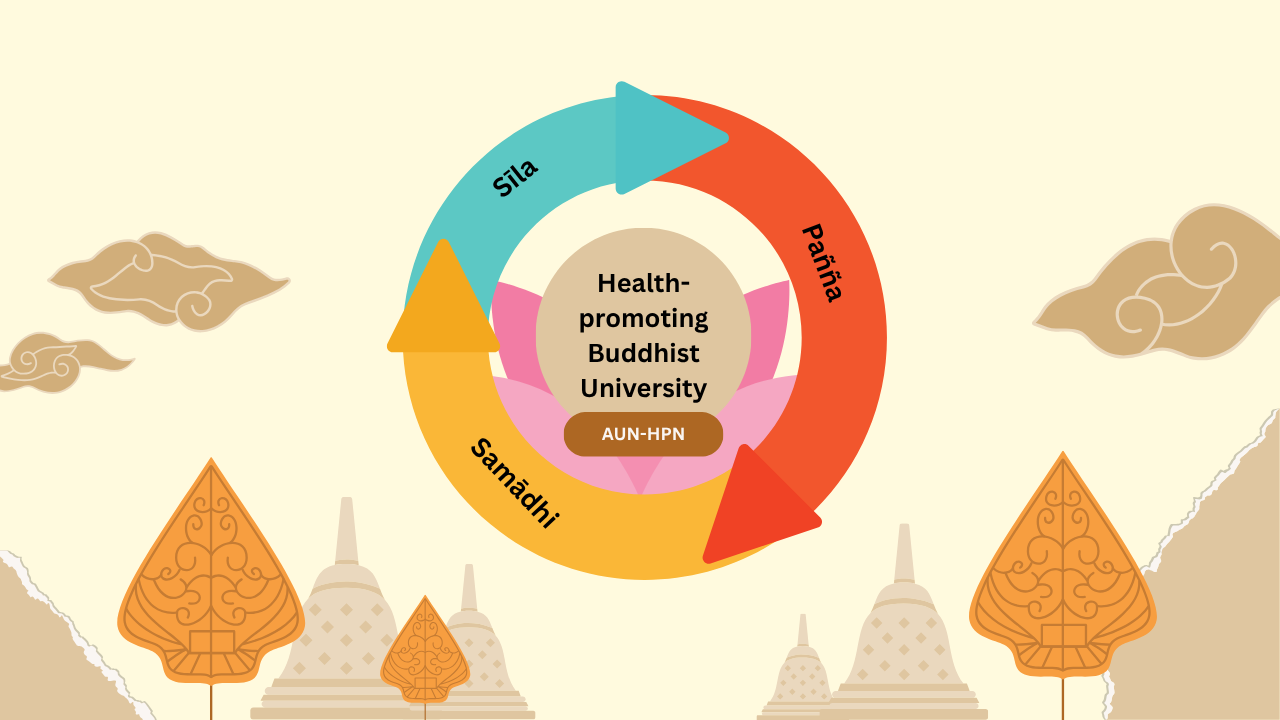
Methodology: The study employed an implementation research design. It integrated the holistic framework of the "Three Spheres of Well-being" sīla (Moral Discipline), samādhi (Meditation), and paññā (Wisdom). These represented moral and ethical conduct in daily life, mental strength, adaptability, and knowledge application to foster health through Buddhist principles. This framework was used to guide practical health initiatives. A total of 36 stakeholders participated as members of the university's Health Promotion Committee to co-develop strategies. All 36 stakeholders were university policy-level actors who participated in focus group discussions, after-action reviews, and lessons learned based on their practical involvement in health promotion activities.
Main Results: Driving the university toward becoming a Healthy University under the AUN-HPN framework through the Threefold Way required strong mental health, firm moral integrity, and a continuous readiness to adapt and learn. These dimensions were interconnected with physical health, mental health, social health, and spiritual/intellectual well-being. The findings revealed three key components: 1) The development of sīla-based well-being (Ethical Conduct), which focused on creating enabling environments through systemic structures and policy-driven networks within the AUN-HPN framework; 2) The advancement of samādhi-based well-being (Mental Concentration), which emphasized mental health, social connection, and work-life balance-aligned with the spiritual capital inherent in Buddhist practices, and 3) The promotion of paññā-based well-being (Wisdom), highlighted the internal development and external dissemination of health knowledge through the lens of socially engaged Buddhism.
Involvement to Buddhadhamma: This research involved Buddhadhamma through the application of Applied Buddhism to promote the development of Healthy Buddhist Universities. The research findings reflected the Three Domains of Holistic Well-being, which were linked to Buddhist principles and contributed to the management and transformation toward a health-promoting Buddhist university. This holistic approach encompassed sīla (Moral Discipline), samādhi (Meditation), and paññā (Wisdom), served as an important model for other health-oriented organizations to adopt in their development efforts. Therefore, integrating Buddhism with the AUN-HPN framework was feasible and capable of transcending the contextual limitations of the religious contexts. It can be concretely applied at both policy and practice levels. Moreover, the Threefold Way helps to support the achievement of key indicators within the AUN-HPN framework-such as promoting strong mental health and establishing a smoke-free and alcohol-free university.
Conclusions: The study concluded that integrating Buddhist principles into health promotion strengthened institutional strategies and fostered holistic well-being in university settings. Although implementing health-promoting university initiatives under the AUN-HPN framework was guided by structured operational models and evaluation indicators, in practice, successful health promotion at the university level required a profound understanding of social and cultural context. The AUN-HPN framework served as a valuable compass, enabling institutions to adapt and apply its components according to their unique settings. Nevertheless, Buddhist universities in Thailand were diverse and regionally dispersed. Future research should have involved lesson drawing and comparative analysis to highlight the contextual differences in implementation. Such an approach would have contributed to the sustainability of development efforts and facilitated more tangible progress toward achieving the health and education-related Sustainable Development Goals (SDGs).
References
ASEAN University Network-Health Promotion Network. (2023). Healthy University Framework 2023. Nakon Pathom, Thailand: ASEAN University Network-Health Promotion Network.
ASEAN University Network-Health Promotion Network. (2024). Healthy University Rating System (HURS): Version 2024. Nakon Pathom, Thailand: ASEAN University Network-Health Promotion Network.
Dooris, M. & Doherty S. (2010). Healthy Universities: Current Activity and Future Directions-Findings And Reflections from A National-Level Qualitative Research Study. Global Health Promotion, 17(3), 6-16. https://doi.org/10.1177/1757975910375165.
Hjern, B. (1982). Implementation Research: The Link Gone Missing. Journal of Public Policy, 2(3), 301-308.
Intarakamhang, U. & Macaskill, A. (2018). Multi-group Causal Model of Health Literacy and Behaviors on Family Wellbeing among Thai Adults at Risk of Non-Communicable Diseases (NCDs). Journal of Research in Health Sciences, 18(4), e00429.
Jeamjitvibool, T., Tankumpuan, T., Lukkahatai, N. & Davidson, P. M. (2022). Noncommunicable Diseases and Social Determinants of Health in Buddhist Monks: An Integrative Review. Research in Nursing & Health, 45(2), 249-260. https://doi.org/10.1002/nur.22215.
Nilsen, P., Ståhl, C., Roback, K. & Cairney, P. (2013). Never the Twain Shall Meet? - A Comparison of Implementation Science and Policy Implementation Research. Implementation Science, 8, 63 (2013). https://doi.org/10.1186/1748-5908-8-63.
Panyachit, S. (2025). Barefoot Health: The Healthy Lifestyle Path of Monks in Thailand. Journal of Population and Social Studies, 34(2026), 236-252. http://doi.org/10.25133/JPSSv342026.013.
Sbaiti, M., Cohen, E., Odofin, X., Viola, J. K. & Lam, J. K. S. (2025). The 'Us and Them Divide': A Qualitative Study of Student Experiences of Global Health Education Through the Lens of 'Inclusivity'. Social Science & Medicine, 367, 117759. https://doi.org/10.1016/j.socscimed.2025.117759.
Schedneck, B. (2019). Buddhist Education and Temple Schools in Thailand. Education About Asia, 24(1), 37-42.
Smith, J.D., Li, D.H. & Rafferty, M.R. (2020). The Implementation Research Logic Model: A Method for Planning, Executing, Reporting, and Synthesizing Implementation Projects. Implementation Science, 15, 84 (2020). https://doi.org/10.1186/s13012-020-01041-8.
Suárez-Reyes M. & Van den Broucke, S. (2016). Implementing the Health Promoting University Approach in Culturally Different Contexts: A Systematic Review. Global Health Promotion, 23, 46-56. https://doi.org/10.1177/1757975915623933.
Suwanprateep, T., Kantatian, W. & Traipornpattana, K. (2023). Three Triads, Three Teachings: Developing the District-Level Dhamma Training Units (A.P.T.) [in Thai]. Bangkok: Thailand Nititham Publishing.
Thianthai, C. & Tamdee, P. (2024). Understanding Digital Well-being and Insights From Technological Impacts on University Students' Everyday Lives in Bangkok. Journal of Health Research, 38(2), 137-145. https://doi.org/10.56808/2586-940X.1069.
Tsouros, A. D. (1998). From The Healthy City to the Healthy University: Project Development and Networking. In D. Tsouros, A. Dowding, J. Thompson, & R. Dooris (Eds.), Health Promoting Universities: Concept, Experience and Framework for Action (pp. 9-22). Copenhagen: WHO Regional Office for Europe.
Wattanapisit, A., Abdul Rahman, H., Car, J., Haji Abdul-Mumin, K., de la Cruz, M. H. T. O., Chia, M., Rosenberg, M., Ho, M.-R., Chaiyasong, S., Mahmudiono, T., Rodjarkpai, Y. & Dinov, I. D. (2022). The Clusters of Health-Risk Behaviours and Mental Wellbeing and their Sociodemographic Correlates: A Study of 15,366 ASEAN University students. BMC Public Health, 22, 1840. https://doi.org/10.1186/s12889-022-14233-2.
Yeravdekar, R., Chandak, A., Anchala, R. & Singh, A. (2024). AUN-HPN Healthy University Compliance: Does Medical College at Heis Facilitate Health Promotion? International . Journal of Health Promotion and Education, 1–15. https://doi.org/10.1080/14635240.2024.2438038.
Yiengprugsawan, V., Seubsman, Sa., Sleigh, A. C. & The Thai Cohort Study Team. (2012). Well-being, and Social Indicators Among Monks, Prisoners, and Other Adult Members of an Open University Cohort in Thailand. Journal of Religion and Health, 51, 925-933. https://doi.org/10.1007/s10943-010-9410-3.
Downloads
Published
How to Cite
Issue
Section
License
Copyright (c) 2025 Journal of Buddhist Anthropology

This work is licensed under a Creative Commons Attribution-NonCommercial-NoDerivatives 4.0 International License.