A STUDY OF TA KHAMUK (TA SAMUK) HANDWOVEN TEXTILES USED IN BUDDHIST PRACTICES OF PEOPLE IN RAYONG PROVINCE
Keywords:
Ta Samuk (Ta Khamuk), Handwoven Textiles, Buddhist Practices, People in Rayong Province, Khmer-Thai GroupAbstract
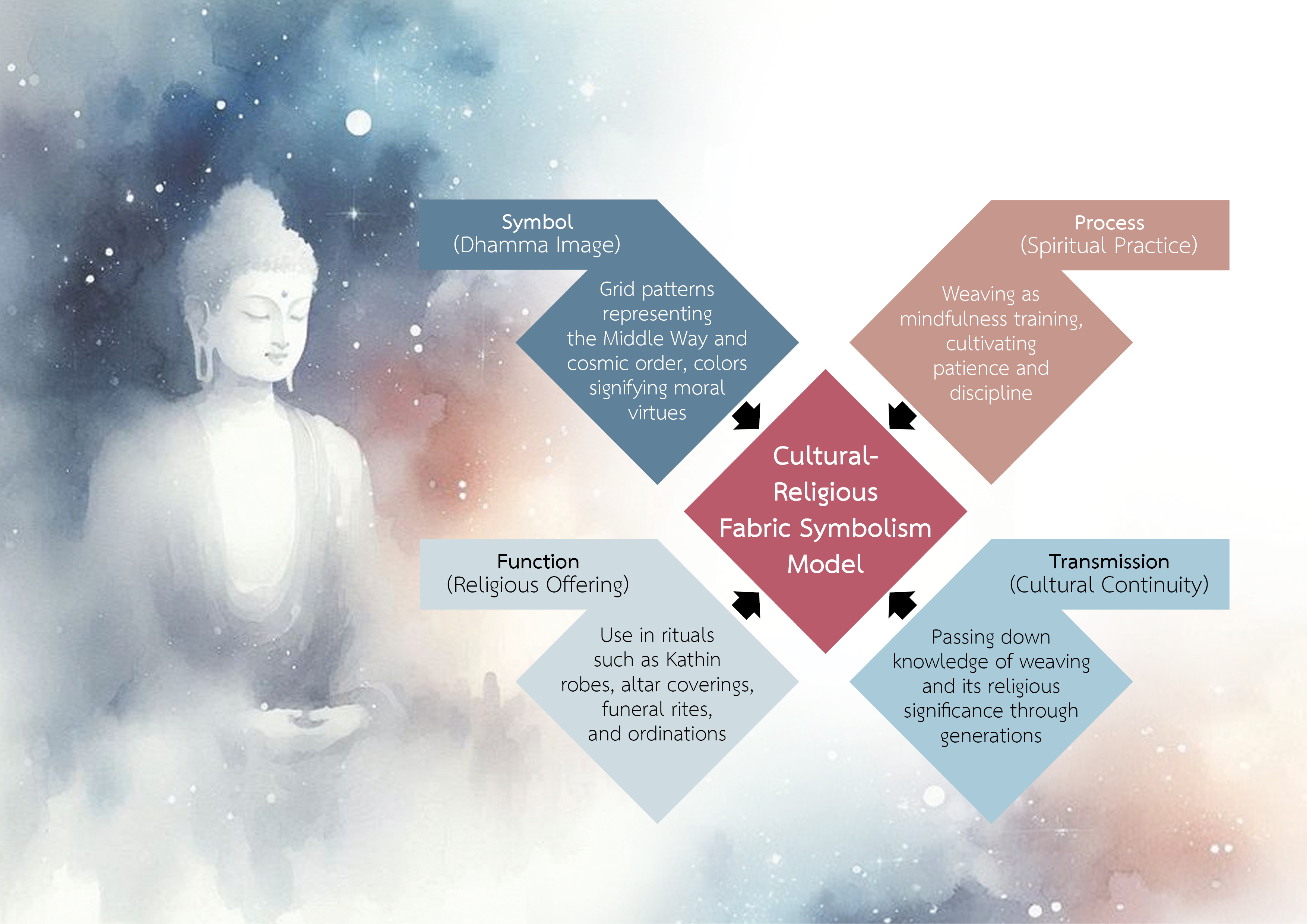
Background and Objectives: Historically, fabric has been one of the four essential necessities, serving not only domestic purposes but also as a cultural medium reflecting belief systems and local wisdom. In Rayong Province, Khmer-Thai communities had preserved traditional weaving through the Ta Samuk cloth, a distinctive textile featuring grid-like patterns that symbolized perseverance, order, and the Middle Way in Buddhism. More than just clothing, it had been used in rituals as an offering and symbol of merit-making, expressing devotion, ancestral respect, and cultural identity. The weaving process itself had been seen as a meditative act that nurtured mindfulness and moral discipline, sustaining both spiritual and cultural heritage across generations. The objectives of this study were to study the motto of woven fabrics in Buddhist scriptures and to study the pattern of pearl weaving cloth (Ta Samuk) used in Buddhism by the people of Rayong Province.
Methodology: A qualitative approach was adopted, combining documentary analysis with ethnographic fieldwork. Data collection included in-depth interviews with fifteen key informants: Five local master weavers, five Buddhist monks and novices, and five ritual leaders (Maccanaiyok). These interviews were conducted in Ban Phe Subdistrict, Mueang Rayong District, a community where Ta Samuk weaving is still actively practiced. Additional data were drawn from traditional textile pattern analysis, primary Buddhist texts (e.g., the Tripitaka), and relevant secondary literature, including scholarly articles and ethnographic records.
Main Results: The findings revealed that textiles mentioned in Buddhist scriptures and traditionally used in Khmer-Thai communities fell into five main functional categories: Garments for the Buddha, symbolic items representing the Dharma, robes for the Sangha, sacred offerings, and ritual-related fabrics. In Rayong, Ta Samuk weaving followed this classification. A unique textile known as the "Pearl-Eyed Fabric" featured geometric grid patterns symbolizing order, harmony, and the Middle Way. Weaving itself was interpreted as a meditative act that fostered mindfulness and spiritual focus. Specific fabric colors carried symbolic meaning: White represented purity, gold denoted wisdom and enlightenment, red symbolized compassion, and black reminded of impermanence. This color codes closely align with moral values emphasized in Buddhist teachings.
Involvement to Buddhadhamma: The study highlighted that textile offerings extended beyond material generosity. They embodied core Buddhist principles such as Dāna (Giving), gratitude to ancestors, and Puññānumodana (Transfer of Merit). The weaving process served as a spiritual discipline promoting moral cultivation and communal cohesion. These practices were deeply integrated into the Khmer-Thai cultural-religious framework and have been adapted to modern contexts by combining traditional Buddhist knowledge with contemporary academic perspectives, supporting both ethical development and intellectual growth.
Conclusions: To protect and revitalize this endangered cultural practice, the study proposed four key strategies: 1) Documenting and exhibiting traditional woven fabrics in museums and cultural centers; 2) Integrating Ta Samuk weaving into school curricula, especially in Khmer-Thai communities; 3) Creating multimedia materials to raise public awareness of the spiritual and cultural significance of the textiles; and 4) Promoting Buddhist teachings that emphasize the symbolic and ethical dimensions of weaving and ritual offerings. These initiatives were deemed essential for ensuring the continuity of traditional textile arts, reinforcing Buddhist identity, and preserving the intangible cultural heritage that connects generations through faith, craftsmanship, and shared values.
References
Gillow, J. & Sentence, B. (1999). The fabric of civilization: How textiles made the world. London, United Kingdom: Thames & Hudson.
Hintow, B. (2014). Participatory Action Research for the Conservationon Local Wisdoms of Lao Khrang’s Woven Cloth. Parichart Journal, 27(3), 132-145.
Hongyon, S. & Saiduang, P. (2017). Maintaining the Art of Silk Weaving and Promoting Cultural Awareness and Inheritance: Case Study of a Community in Ubon Ratchathani. Humanities and Social Sciences Journal, Ubon Ratchathani Rajabhat University, 8(2), 222-234.
Klomklumnum, I., Jakae, O. & Thipviset, V. (2024). The conservation of the local wisdom of Mudmee cotton products Thung Pho Weaving Group Khampang phet. Phikun Journal Faculty of Humanities and Social Sciences Kamphaeng Phet Rajabhat University, 22(1), 71-85
Kusupolon, P. (2015). Thai Lue Woman's Weaving Group of Ban Tadsobvan, Chiang Kham District, Phayao Province. [Research report, Chiang Mai University]: CMU Institutional Repository. https://doi.nrct.go.th/ListDoi/listDetail?Resolve_DOI=10.14457/CMU.res.2005.47
Leksuit, S. (2018). Local Wisdom of Hand-Woven Textitle Conservation in Accordance with Dharma Principles of Bann Nongnguak Tetile Center, Mae Raeng, Pasang District Lamphun. Journal of Humanities and Social Sciences Thonburi University, 12(29), 135-146
Mahachulalongkornrajavidyalaya University. (1996). The Tipitaka: Pali Canon of Theravāda Buddhism (Thai edition). Bangkok, Thailand: Mahachulalongkornrajavidyalaya University Press.
Prangwattanakul, S. (2008). Cultural heritage of Tai Lue textiles. Chiang Mai, Thailand: Chiang Mai University.
Thongchoen, P. (2003). Participatory action research on the standard of environmentally local textile. [Research report, The National Science and Technology Development Agency (NSTDA)]. Thammasat University Library. https://digital.library.tu.ac.th/tu_dc/frontend/Info/item/dc:83138
Thongchun, P. (2015). Weaving belief: Textiles and symbolism in Thai Buddhist culture. [Unpublished doctoral dissertation]. Silpakorn University. Bangkok, Thailand.
Downloads
Published
How to Cite
Issue
Section
License
Copyright (c) 2025 Journal of Buddhist Anthropology

This work is licensed under a Creative Commons Attribution-NonCommercial-NoDerivatives 4.0 International License.