CHANTING AND MEDITATION: THE JOURNEY OF THAI YOUTH TAEKWONDO ATHLETES AND THEIR PERCEIVED EFFECTS
Keywords:
Taekwondo, Youth, Chanting, Meditation, Athletic DevelopmentAbstract
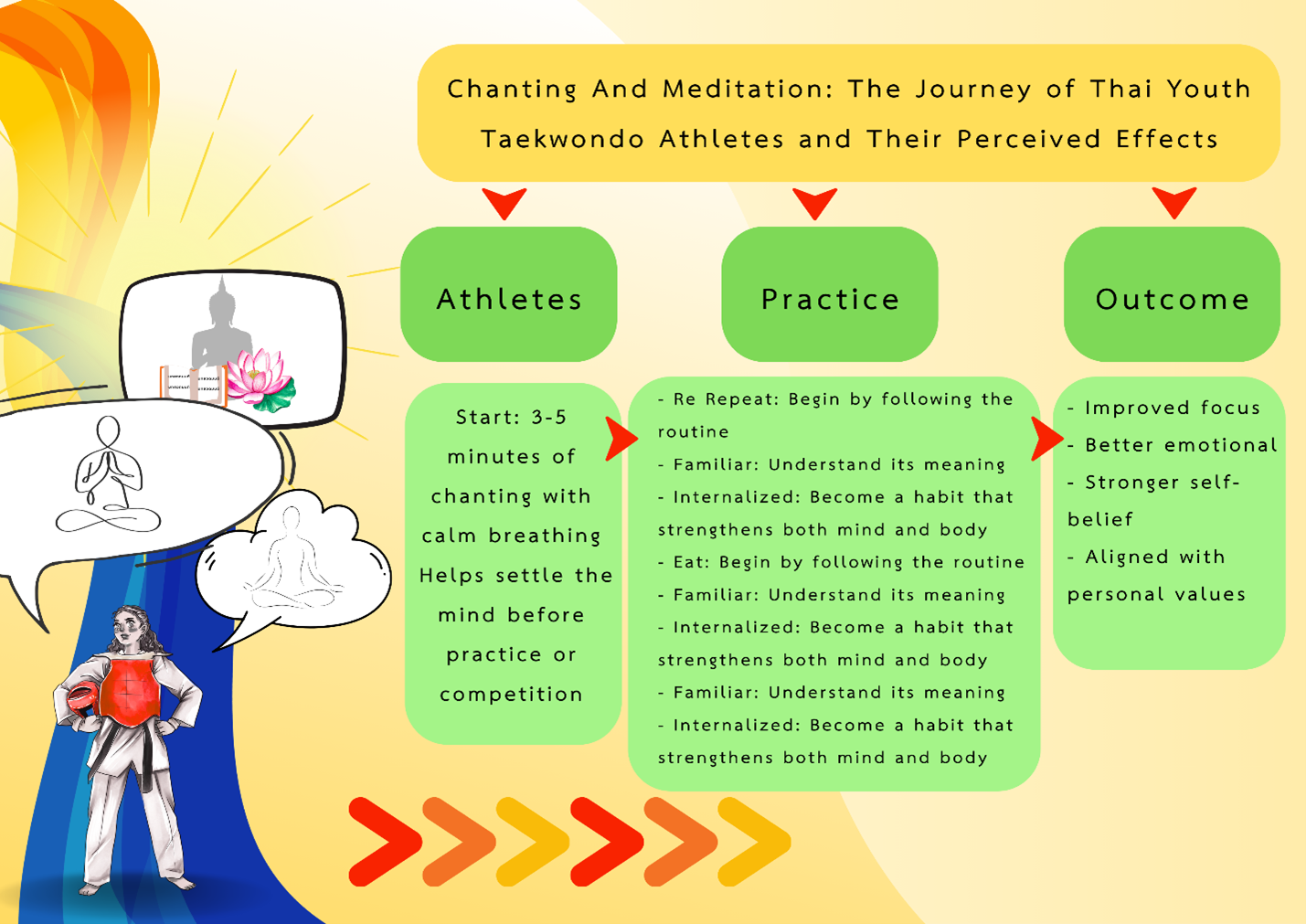
Background and Objectives: Youth Taekwondo athletes face both physical and emotional pressures from training, school, and competition. Traditional coaching often emphasizes technique over mental well-being, leaving many individuals without the necessary tools to manage stress or sustain motivation. Meditation and chanting have shown benefits for focus, emotional balance, and resilience, yet few studies explore how young athletes actually use these practices or how Buddhist chanting, combined with meditation, becomes part of their training routines. This study aimed to investigate how youth Taekwondo athletes, who faced not only physical demands but also academic and emotional pressures, experienced chanting and meditation practices rooted in Buddhism as part of their training. It focused on how they perceived these practices as supporting attention, emotional regulation, resilience, and athletic motivation, areas often overlooked in traditional coaching.
Methodology: A qualitative narrative inquiry framework was employed to explore personal experiences and meaning-making processes. Seven youth Taekwondo athletes aged 10 to 20 were recruited through purposive sampling. All participants practiced at a Taekwondo club in Bangkok and had engaged in chanting and meditation for at least one year as part of their training routine. Data were collected through observations, semi-structured interviews, and participant-generated timelines, then transcribed and analyzed using thematic analysis. The process aimed to capture the personal journeys of the athletes, from initial engagement through internalization, highlighting the evolving relationships they developed with these practices over time.
Main Results: Participants initially engaged in chanting and meditation due to external encouragement from coaches or parents. At first, they felt indifferent or uncertain about the purpose. Over time, consistent practice led to noticeable psychological and moral shifts. Many reported increased calmness, focus, and emotional control-chanting before competitions helped ease nervousness, while meditation improved concentration. Gradually, athletes began to view chanting not as mere ritual but as a personal strategy to "Clear the Mind" and "Reset the Day." As they internalized the practice, they associated it with greater self-discipline, patience, and self-awareness. Beyond mental benefits, many linked these practices to Buddhist principles of compassion, forgiveness, and letting go, which became embodied ways of managing pressure, recovering from setbacks, and maintaining balance. For some, this transformation reflected moral and spiritual growth, as they learned to approach challenges with calmness, humility, and a stronger sense of ethical responsibility.
Involvement to Buddhadhamma: This study explored how the application of Buddhadhamma practices, namely chanting and meditation, could enhance the performance of youth taekwondo athletes. Although derived from Buddhist teachings such as Anapanasati (Mindfulness of Breathing), athletes did not describe their experience as religious. Instead, they focused on the psychological and emotional benefits. Chanting verses about compassion, forgiveness, and letting go helped them manage stress, frustration, and competition pressure. These principles were experienced as promoting calmness, emotional resilience, and mental clarity. Some participants described chanting as a way to "Lighten the Mind" or "Release Negative Energy," allowing them to refocus before and after matches. The spiritual aspect appeared subtly, reflected in greater self-awareness, intentional action, and sensitivity to inner states. Overall, chanting and meditation became tools not only for mental preparation but also for cultivating composure, empathy, and focus-qualities that enhanced both athletic performance and personal growth.
Conclusions: Buddhist chanting and meditation were experienced by youth Taekwondo athletes as practical tools for achieving emotional balance, sustaining focus, and building resilience in the face of competitive and academic pressures. Beyond immediate benefits, these practices supported steady motivation, patience, and self-discipline, contributing to both athletic and personal growth. The findings suggest that when integrated consistently and meaningfully, chanting and meditation can promote holistic development in young athletes, providing accessible strategies for balance and resilience without requiring overtly religious framing.
References
Acharya, K., Maity, K., Acharya, R. M., Pradhan, B. & Patra, S. (2025). Autonomic and respiratory Modulations Induced by Different Styles of Mantra Chanting. Annals of Neurosciences, 1-8. https://doi.org/10.1177/09727531251345310.
Baltzell, A. L. & Summers, J. (2018). The Future of Mindfulness and Performance across Disciplines. In Baltzell, A. (Ed.), Mindfulness and performance (pp. 515-541). Cambridge, United Kingdom: Cambridge University Press.
Braun, V. & Clarke, V. (2006). Using thematic analysis in psychology. Qualitative Research in Psychology, 3(2), 77-101. https://doi.org/10.1191/1478088706qp063oa.
Creswell, J. D. (2017). Mindfulness Interventions. Annual Review of Psychology, 68, 491-516. https://doi.org/10.1146/annurev-psych-042716-051139.
Dahl, C. J., Wilson-Mendenhall, C. D. & Davidson, R. J. (2020). The plasticity of well-being: A training-based framework for the cultivation of human flourishing. Proceedings of the National Academy of Sciences, 117(51), 32197-32206. https://doi.org/10.1073/pnas.2014859117.
Duda, A. T., Clarke, A. R., Barry, R. J. & De Blasio, F. M. (2024). Mindfulness meditation is associated with global EEG spectral changes in theta, alpha, and beta amplitudes. International Journal of Psychophysiology, 206, 112465. https://doi.org/10.1016/j.ijpsycho.2024.112465.
Felver, J. C., Celis-de Hoyos, C. E., Tezanos, K. & Singh, N. N. (2016). A Systematic Review of Mindfulness-Based Interventions for Youth in School Settings. Mindfulness, 7, 34-45. https://doi.org/10.1007/s12671-015-0389-4.
Gardner, F. L. & Moore, Z. E. (2020). Mindfulness in Sport Contexts. In Tenenbaum, G. & Eklund, R. C. (Eds.), Handbook of sport psychology (pp. 738-750). New Jersey, United States of America: Wiley. https://doi.org/10.1002/9781119568124.ch35.
Goyal, M., Singh, S., Sibinga, E. M. S., Gould, N. F., Rowland-Seymour, A., Sharma, R., Berger, Z., Sleicher, D., Maron, D. D., Shihab, H. M., Ranasinghe, P. D., Linn, S., Saha, S., Bass, E. B. & Haythornthwaite, J. A. (2014). Meditation Programs for Psychological Stress and Well-being A Systematic Review and Meta-analysis. JAMA Internal Medicine, 174(3), 357-368. https://doi.org/10.1001/jamainternmed.2013.13018.
Kongurai, U., Hamera, C., Pongchompoo, S. & Thongdee, S. (2023). THE EFFECT ON SKT MEDITATION TRAINING ON ARCHERY SKILL FOR EXCELLENCE. Academic Journal of Thailand National Sports University, 15(3), 89-104.
Kozhevnikov, M., Strasser, A. V. I., McDougal, E., Dhond, R. & Samuel, G. (2022). Beyond mindfulness: Arousal-driven modulation of attentional control during arousal-based practices. Current Research in Neurobiology, 3, 100053. https://doi.org/10.1016/j.crneur.2022.100053.
Lomas, T., Ivtzan, I. & Fu, C. H. Y. (2015). A systematic review of the neurophysiology of mindfulness on EEG oscillations. Neuroscience & Biobehavioral Reviews, 57, 401-410. https://doi.org/10.1016/j.neubiorev.2015.09.018.
Noetel, M., Ciarrochi, J., Van Zanden, B. & Lonsdale, C. (2019). Mindfulness and acceptance approaches to sporting performance enhancement: a systematic review. International Review of Sport and Exercise Psychology, 12(1), 139-175. https://doi.org/10.1080/1750984X.2017.1387803.
Deci, E. L. & Ryan, R. M., (1985). Intrinsic Motivation and Self-Determination in Human Behavior. New York, United States of America: Springer EBooks https://doi.org/10.1007/978-1-4899-2271-7.
Schonert-Reichl, K. A. & Lawlor, M. S. (2010). The Effects of a Mindfulness-Based Education Program on Pre- and Early Adolescents' Well-Being and Social and Emotional Competence. Mindfulness, 1, 137-151. https://doi.org/10.1007/s12671-010-0011-8.
Si, X. W., Yang, Z. K. & Feng, X. (2024). A meta-analysis of the intervention effect of mindfulness training on athletes' performance. Frontiers in Psychology, 15. https://doi.org/10.3389/fpsyg.2024.1375608.
Sibinga, E. M. S., Webb, L., Ghazarian, S. R. & Ellen, J. M. (2016). School-Based Mindfulness Instruction: An Randomized Controlled Trial. Pediatrics, 137(1), e20152532. https://doi.org/10.1542/peds.2015-2532.
Stephen, F. A., Ermalyn, L. P., Yasmin, M. B., Louise, L. J. D. & Juvenmile, T. B. (2022). A Voyage into the Visualization of Athletic Performances: A Review. American Journal of Multidisciplinary Research and Innovation, 1(3), 105-109. https://doi.org/10.54536/ajmri.v1i3.479.
Downloads
Published
How to Cite
Issue
Section
License
Copyright (c) 2025 Journal of Buddhist Anthropology

This work is licensed under a Creative Commons Attribution-NonCommercial-NoDerivatives 4.0 International License.