EXPLORING ALTERNATIVE DISPUTE RESOLUTION (ADR) IN BUDDHISM: THE SYMBIOTIC RELATIONSHIP BETWEEN MEDITATION AND MEDIATION AS AN INSIGHT FOR CONTEMPORARY MEDIATORS
Keywords:
Alternative Dispute Resolution (ADR), Buddhism, Conflict Resolution, Mediation, MeditationAbstract
Background: The Alternative Dispute Resolution (ADR) process has become popular as a means of resolving disputes beyond the formal judicial system. Modes of dispute resolution grounded in dialogue have a long history in many legal systems and cultures. Among all these traditions, Buddhism provides a holistic model for comprehending and resolving conflict. Drawing from the tenets of compassion (Karuṇā), mindfulness (Sati), non-harming (Ahiṃsā), and non-attachment (Anupādāna), the Buddhist approach transcends procedural justice and responds to the emotional, moral, and psychological aspects of conflict empathetically. In an era marked by escalating geopolitical conflicts, including tensions in the South China Sea, border clashes in South Asia, inter-ethnic conflict zones like the Myanmar area, border issues between India and Pakistan, and transboundary issues linked to water sharing between India and China. The infusion of Buddhist principles into ADR is timely and critical to offer a transformational alternative to adversarial and interest-based models. To address this gap, the study aims to examine the synthesis of Buddhist doctrine and the contemporary ADR framework, focusing on the transformative aspects of meditation in the mediation process. Adopting a qualitative and doctrinal approach, the study analyses Buddhist philosophical texts alongside contemporary ADR literature to explore how meditative practices contribute to emotional regulation, focused attention, empathy, and constructive dialogue. Based on the teachings of right awareness, right speech, and cultivating inner peace, it further examines how mindfulness-informed mediation practices may enhance conflict de-escalation and promote durable, mutually acceptable outcomes in family, workplace, and community disputes.
Involvement to Buddhadhamma: The study reflects a contemplative encounter with the Buddhadhamma, which critically examines whether Buddhist philosophical fundamentals serve as a universal and ethically coherent basis for reconciliation and conflict transformation. At the heart of this study is the Buddhist view of conflict in relation to suffering (Dukkha), its cause in craving (Taṇhā), and its cessation through morality (Sīla), meditation (Samādhi), and wisdom (Paññā). These teachings suggest that struggle originates from a deeper source than external circumstances; It stems from the heart or the mind. The study suggests that the Noble Path serves to address these sources of conflict, in the context of right intention (Sammā-saṅkappa), right speech (Sammāvācā), right action (Sammākammanta), and right mindfulness (Sammā-sati). These principles provide moral guidelines for personal conduct and a framework for resolving conflicts at social, and institutional levels. These components help individuals develop ethical behaviour and self-awareness, which are valuable tools for mediators who aspire to foster constructive communication and emotional transparency during disputes. The study highlights that the Buddhist approach of conflict transformation is more than a method for resolving interpersonal or societal conflicts. It recognises that peace, emotional well-being, and relationships are interconnected.
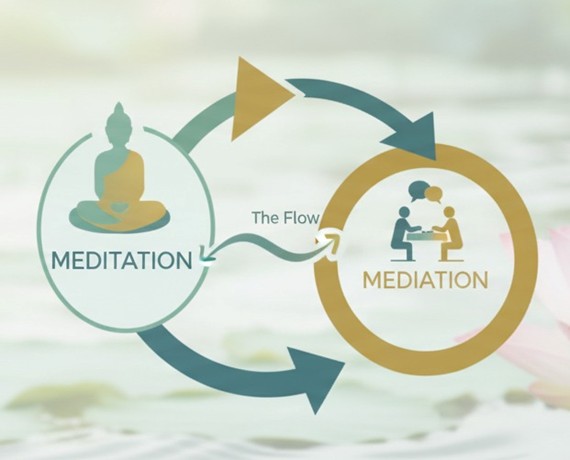
Conclusions: The study concluded that Buddhism offers a positive foundation for ADR by replacing adversarial competition with compassionate understanding and shared healing. Incorporating mindfulness and meditation into mediation creates an atmosphere in which parties can de-escalate from finger-pointing and hostility to peace-making and mutual resolution. Through the infusion of Buddhist principles, mediators can help disputants to become more settled and enable both parties to find inner peace amidst conflicts, as well as promote socially harmonious relationships within the community. This research supports mediators' use of Buddhist-inspired techniques to cultivate empathetic understanding, ethical discernment, and emotional resilience, which are necessary to achieve more sustainable and substantial conflict resolution.
References
Arai, T. (2017). Toward a Buddhist Theory of Conflict Transformation: From Simple Actor-Oriented Conflict to Complex Structural Conflict. Peace and Conflict Studies, 24(2), Article 5. https://doi.org/10.46743/1082-7307/2017.1450.
Bagshaw, D. & Stud, D. S. (2017). The future of dispute resolution in the Asia-Pacific region: What has culture got to do with it?. Paper presented at the 8th Asia-Pacific Mediation Forum Conference (pp. 1-26). Da Nang, Vietnam: Asia-Pacific Mediation Forum.
Blix, S. B. & Wettergren, Å. (2024). Chapter 8: Integrating rationality and emotion in legal institutions. In Research handbook on the sociology of emotion (pp. 173-197). Cheltenham, United Kingdom: Edward Elgar Publishing. https://doi.org/10.4337/9781803925653.00015.
Bowling, D. & Hoffman, D. (2000). Bringing Peace into the Room: The Personal Qualities of the Mediator and Their Impact on the Mediation. Negotiation Journal, 16(1), 5-28. https://doi.org/10.1111/j.1571-9979.2000.tb00199.x.
Chen, N., Chao, M. C.-h., Xie, H. & Tjosvold, D. (2018). Transforming cross-cultural conflict into collaboration: The integration of western and eastern values. Cross Cultural & Strategic Management, 25(1), 70-95. https://doi.org/10.1108/CCSM-10-2016-0187.
Chua, E. (2019). The Singapore Convention on Mediation—A brighter Future for Asian Dispute Resolution. Asian Journal of International Law, 9(2), 195-205. https://doi.org/10.1017/S2044251318000309.
Close, T. S. (2020). Pursuing Peace: Examining Alternative Dispute Resolution Practices Throughout The World's Religious Traditions. [Doctoral dissertation, Drew University]. Drew University Library Drew University. https://digitalcollections.drew.edu/UniversityArchives/ThesesAndDissertations/CSGS/DLitt/2020/Close/.
Cobb, S. & Rifkin, J. (1991). Practice and Paradox: Deconstructing Neutrality in Mediation. Law & Social Inquiry, 16(1), 35-62. https://doi.org/10.1111/j.1747-4469.1991.tb00283.x.
Dalai Lama. (2016). Foreword. The Buddha's Teachings on Social and Communal Harmony: An Anthology of Discourses from the Pali Canon. Massachusetts, United States of America: Wisdom Publications.
Das, P. (2014). Issues in the Management of the India-Pakistan International Border. Strategic Analysis, 38(3), 307-324. https://doi.org/10.1080/09700161.2014.895235.
Della Noce, D. J. (1999). Seeing Theory in Practice: An Analysis of Empathy in Mediation. Negotiation Journal, 15(3), 271-301. https://doi.org/10.1111/j.1571-9979.1999.tb00196.x.
Dhirasekera, J. (2007). Buddhist Monastic Discipline. Dehiwala, Sri Lanka: Buddhist Cultural Centre.
Diab, R. (2016). Shades of Sulh: The Rhetorics of Arab-Islamic Reconciliation. Pennsylvania, United States of America: University of Pittsburgh Press.
Folger, J. & Bush, R. A. B. (2014). Transformative Mediation. International Journal of Conflict Engagement and Resolution, 2(1), 20-34.
Friedlander, P. (2012). Conflict and peace in Buddhism. In Lee Marsden (Ed.), The Ashgate research companion to religion and conflict resolution (pp. 79-95). London, United Kingdom: Routledge. https://doi.org/10.4324/9781315613505.
Fulton, C. L. (2018). Self-Compassion as a Mediator of Mindfulness and Compassion for Others. Counseling and Values, 63(1), 45-56. https://doi.org/10.1002/cvj.12072.
Gale, J. E. (2017). Meditation skills for the mediation process. Mediation Theory and Practice, 2(1), 54-68. https://doi.org/10.1558/mtp.32195.
Girish, I. (2019). Mind in Harmony: A Buddhist Perspective. In Buddhist Approach to Harmonious Families, Healthcare, and Sustainable Societies (pp. 513-530). Ha Nam, Vietnam: Hong Duc Publishing House.
Goh, F. & Tangkiriphimarn, A. (2023). Looking Around: Should Thailand Promote Mediation Effectiveness and How?. Thai Legal Studies, 3(2), 169-194. https://doi.org/10.54157/tls.270008.
Goodman, C. (2014). Consequences of Compassion: An Interpretation and Defense of Buddhist Ethics. New York, United States of America: Oxford University Press.
Grabovac, A. D., Lau, M. A. & Willett, B. R. (2011). Mechanisms of Mindfulness: A Buddhist Psychological Model. Mindfulness, 2, 154-166. https://doi.org/10.1007/s12671-011-0054-5.
Hanh, T. N. (2020). Interbeing : The 14 Mindfulness Trainings of Engaged Buddhism (4th ed.). California, United States of America: Parallax Press.
Hattam, R. (2007). Socially-Engaged Buddhism as a Provocation for Critical Pedagogy in Unsettling Times. In Claudia Eppert & Hongyu Wang (Eds.), Cross-Cultural Studies in Curriculum Eastern Thought, Educational Insights (pp. 128-155). New York, United States of America: Routledge. https://doi.org/10.4324/9780203826249.
He, Y. (2021). Current and future transboundary water cooperation over the YarlungZangbo/ Brahmaputra River basin: from an interdisciplinary perspective. Water Policy, 23(5), 1107-1128. https://doi.org/10.2166/wp.2021.008.
Iacobucci, D., Saldanha, N. & Deng, X. (2008). A Meditation on Mediation: Evidence That Structural Equations Models Perform Better Than Regressions. Journal of Consumer Psychology, 17(2), 139-153. https://doi.org/10.1016/S1057-7408(07)70020-7.
Igunbor, S. E. (2025). Faith and Unity: A Global Religious Tapestry. Wah Academia Journal of Global Religions, 1(1), 36-44. https://doi.org/10.63954/j3fh3b21.
Insakorn, S. (2021). Tactics for Solving Conflict Problems according to Buddhist concept: A study of the Applied principles of Tassapapiyasika in Athikaranasmatha 7. Buddhism in Mekong Region Journal, 4(2), 55-67.
Johnson, I. (2002). The application of Buddhist principles to lifelong learning. International Journal of Lifelong Education, 21(2), 99-114. https://doi.org/10.1080/02601370110111673.
Kabat-Zinn, J. & Davidson, R. J. (Eds.). (2012). The mind's own physician: A scientific dialogue with the Dalai Lama on the healing power of meditation. California, United States of America: New Harbinger Publications.
Karunamuni, N. & Weerasekera, R. (2019). Theoretical Foundations to Guide Mindfulness Meditation: A Path to Wisdom. Current Psychology, 38, 627-646. https://doi.org/10.1007/s12144-017-9631-7.
Kawanami, H. (2015). Buddhist monasticism and contemporary trends: from the viewpoint of Buddhist women and Buddhist nuns. Historia Religionum: An International Journal, 7, 75-86.
Kelly, B. D. (2023). Beyond mindfulness: Buddhist psychology and the Abhidharma. Journal of Spirituality in Mental Health, 25(1), 71-82. https://doi.org/10.1080/19349637.2022.2081952.
Kidron, C. A. (2021). "Rebirthing" the violent past: the Violent Past: Friction Between Post-Conflict Axioms of Remembrance and Cambodian Buddhist Forgetting. Anthropological Forum, 31(3), 291-311. https://doi.org/10.1080/00664677.2021.1971512.
King, S. B. (2023). Mindfulness, Compassion and Skillful Means in Engaged Buddhism. Mindfulness, 14, 2516-2531. https://doi.org/10.1007/s12671-022-01847-1.
Knieper, J. & Haddad, J. (2023). The history, evolution, and future of the UNCITRAL mediation framework. In The Elgar Companion to UNCITRAL (pp. 216-241). Cheltenham, United Kingdom: Edward Elgar Publishing. https://doi.org/10.4337/9781803924540.00020.
Kraft, K. (Ed.). (1992). Inner peace, World peace: essays on Buddhism and nonviolence. New York, United States of America: State University of New York Press.
Kung, C. (2010). Buddhism: The Awakening of Compassion and Wisdom. Toowoomba, QLD, Australia: Pure Land Learning College Association.
Kuttner, R. (2009). A Buddhist-Oriented Relational View of Transformation in Mediation. In Ronald, S. Green & Mun, C. (Eds.), Buddhist roles in peacemaking: How Buddhism can contribute to sustainable peace (pp. 271-291). Honolulu, Hawaii: Blue Pine Books.
Makhumtup, N., Promchin, C., Tonggon, S. & Phrapalad Thana Aggadhammo Pimparat. (2024). Buddhism and Political Conflicts: Understanding the Role of Religion in Peacebuilding and Reconciliation. Journal of Dhamma for Life, 30(3), 404-412. https://doi.org/10.14456/jdl.2024.55.
Matko, K. & Sedlmeier, P. (2019). What Is Meditation? Proposing an Empirically Derived Classification System. Frontiers in Psychology, 10, Article 2276. https://doi.org/10.3389/fpsyg.2019.02276.
Mazza, D. (2021). How Did the Buddha Deal with Conflicts During his Life? A Theravāda Perspective. Journal of Buddhist Ethics, 28, 159-176. https://doi.org/10.13140/RG.2.2.12107.52008.
McConnell, J. A. (1995). Mindful mediation: A handbook for Buddhist peacemakers. Dehiwala, Sri Lanka: Buddhist Research Institute.
McElrea, F. W. M. (2001). A Christian approach to conflict resolution. [Unpublished paper]. Paper presented at the Australasian Christian Legal Convention, Melbourne, Australia.
Melchin, K. R. & Picard, C. A. (2008). Transforming Conflict Through Insight. Toronto, Canada: University of Toronto Press.
Miller, W. B. (2015). Like an Elephant Pricked by a Thorn: Buddhist Meditation Instructions as a Door to Deep Listening. Buddhist-Christian Studies, 35, 15-20. https://doi.org/10.1353/bcs.2015.0016.
Nash, J. D., Newberg, A. & Awasthi, B. (2013). Toward a unifying taxonomy and definition for meditation. Frontiers in Psychology, 4, 806. https://doi.org/10.3389/fpsyg.2013.00806.
Phan, P. C. (2016). Peacekeeping, Peacemaking, Peacebuilding: An Interreligious Spirituality for Just Peace. In Irvin-Erickson, D. & Phan, P. C. (Eds.), Violence, religion, peacemaking (pp. 21-60). Interreligious Studies in Theory and Practice. New York, United States of America: Palgrave Macmillan. https://doi.org/10.1057/978-1-137-56851-9_2.
Phramaha Hansa Dhammahaso. (2016). Peace Studies: the Buddhist Path to World Peace. Journal of MCU Peace Studies, 4(sp1), 1-9.
Phramaha Itsret Kittisslo, Phramaha Somphong Khunakaro & Phramaha Nantakorn Piyabhani. (2024). Buddhism-Based Resolution to the Problems Leading to Conflict in Thai Society. The Journal of International Buddhist Studies College (JIBSC), 10(3), 111-126.
Riskin, L. L. (2004). Mindfulness: Foundational Training for Dispute Resolution. Journal of Legal Education, 54(1), 79-90.
Riskin, L. L. (2009). Awareness and Ethics in Dispute Resolution and Law: Why Mindfulness Tends to Foster Ethical Behavior. South Texas Law Review, 50(3), 493-503.
Riskin, L. L. (2013). Managing Inner and Outer Conflict: Selves, Subpersonalities, and Internal Family Systems. Harvard Negotiation Law Review, 18(1), 28-56.
Roca, P., Vazquez, C., Diez, G., Brito-Pons, G. & McNally, R. J. (2021). Not all types of meditation are the same: Mediators of change in mindfulness and compassion meditation interventions. Journal of Affective Disorders, 283, 354-362. https://doi.org/10.1016/j.jad.2021.01.070.
Sampson, C. (1997). Religion and peacebuilding. In Zartman I. W. & Rasmussen, J. L. (Ed.), Peacemaking in international conflict: Methods and techniques (Rev. ed., pp. 273-318). Washington, DC, United States of America: United States Institute of Peace Press.
Shaw, S. (2021). The Art of Listening A Guide to the Early Teachings of Buddhism. Boulder, Colorado, United States of America: Shambhala Publications.
Singh, A. K. (2017). World peace and conflict resolution: A solution from Buddhist point of view. The Journal of the International Association of Buddhist Universities, 10(1), 89-116.
Smith, K. A. (2009). Discipline, compassion and monastic ideals of community, c. 950-1250. Journal of Medieval History, 35(4), 326-339. https://doi.org/10.1016/j.jmedhist.2009.08.002.
Somaratne, G. A. (2012). Modernity in the Ancient Methods of Resolving Monastic Conflicts: A Study of the Sāmagāma-sutta. Sri Lanka International Journal of Buddhist Studies, 2, 38-51.
Stipanowich, T. J. (2004). ADR and the "Vanishing Trial": The growth and impact of "Alternative Dispute Resolution". Journal of Empirical Legal Studies, 1(3), 843-912. https://doi.org/10.1111/j.1740-1461.2004.00025.x.
Sunandabodhi, R. B. (2024). Buddhist mindfulness practices in conflict resolution. International Journal of Governance and Public Policy Analysis (IJGPPA), 6(1), 141-157. https://doi.org/10.31357/ijgppa.v6i1.7656.
Tachibana, S. (2021). The ethics of Buddhism. London, United Kingdom: Routledge. https://doi.org/10.4324/9781315026008.
Tanabe, J. (2011). Buddhist Philosophy and the Epistemological Foundations of Conflict Resolution. [Doctoral dissertation, University of Bradford]. University of Bradford eTheses. http://hdl.handle.net/10454/4910.
Tanabe, J. (2022). A Holistic Peace: Buddhism and Liberal Peace. In Cogan, M. S. & Sakai, H. (Eds.), Alternative Perspectives on Peacebuilding: Theories and case studies (pp. 131-161). Cham, Switzerland: Springer International Publishing. http://dx.doi.org/10.1007/978-3-031-05756-4_6.
Tavachalee, R., Pulanram, P., Phramaha Natthabhan Hanpong & Kenaphoom, S. (2021). The Conflict Management based on Buddhism Principle. Annals of the Romanian Society for Cell Biology, 25(6), 4747-4754.
Thero, M. M. (2022). The evolution of the concept of the Buddha within the Pāli Canon and commentaries. [Doctoral dissertation, University of the West]. University of the West Institutional Repository. https://ir.uwest.edu/s/index/item/1673.
Tophoff, M. M. (2020). A Mediator's Way to Conflict Resolution: A Buddhist Perspective. American Journal of Mediation, 13, 55-70.
Venerable Dr. Phramaha Hansa Dhammahaso. (2010). Human Nature and Conflict: A Buddhist Perspective. In Buddhist Approach to Political Conflict and Peace Development (p. 225). Hanoi, Vietnam: International Buddhist Conference.
Venerable Sumanpriya Bhikkhu (Suman Barua). (2017). An analytical study of symbiotic relationship between the monk behaviors and the faith of lay community. [Unpublished Doctoral dissertation]. Mahachulalongkornrajavidyalaya University. Phra Nakhon Si Ayutthaya, Thailand.
Verma, R. (2024). India-China rivalry, border dispute, border standoffs, and crises. India Review, 23(5), 397-408. https://doi.org/10.1080/14736489.2024.2423996.
Viengsavanh, V. P. (2024). The Essential Principles of Buddhism for Human Beings. Buddhism in Mekong Region Journal, 7(2), 94-109.
Vijitha, V. M. (2019). A Study of Buddhist Teachings With Respect to Conflict Resolution. In Mindful leadership for sustainable peace (pp. 359-377). Hanoi, Vietnam: Hong Duc Publishing House.
Werner, K. (2005). Buddhism and Peace: Peace in the World or Peace of Mind?. International Journal of Buddhist Thought and Culture, 5, 7-33.
Wongsawangsiri, W. (2023). Mediation in Thailand. Revista Brasileira de Alternative Dispute Resolution, 5(9), 167-178.
Zelcer, H. (2007). Two Models of Alternative Dispute Resolution. Ḥakirah: The Flatbush Journal of Jewish Law and Thought, 4, 69-113.
Downloads
Published
How to Cite
Issue
Section
License
Copyright (c) 2026 Journal of Buddhist Anthropology

This work is licensed under a Creative Commons Attribution-NonCommercial-NoDerivatives 4.0 International License.