THE ROLE OF THE NATIONAL OFFICE OF BUDDHISM IN PROMOTING MONASTIC ADAPTATION AMID GLOBAL SOCIAL TRANSFORMATIONS
Keywords:
National Office of Buddhism, Monastic Adaptation, Global Social TransformationsAbstract
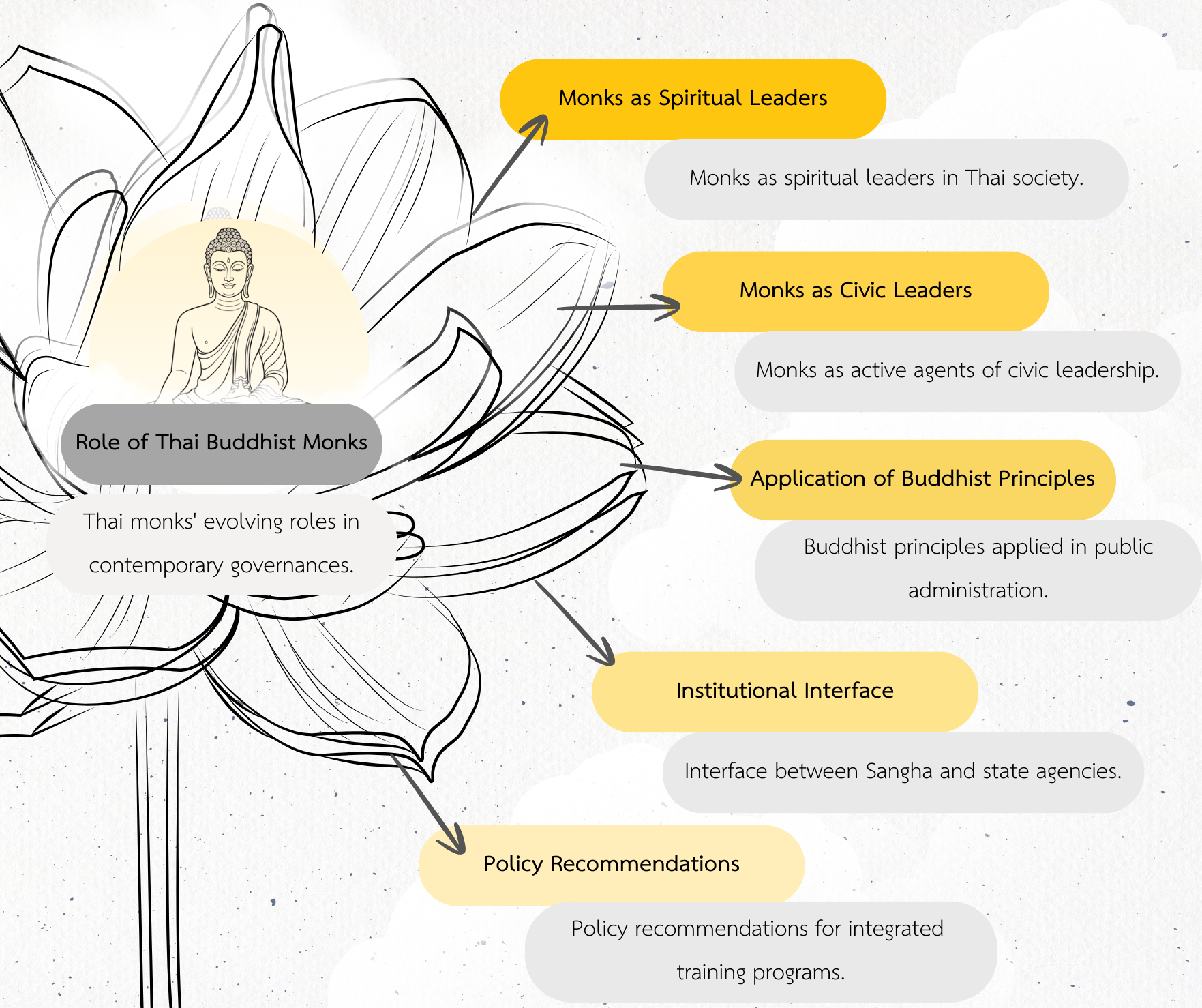
Background and Objectives: In the context of accelerating globalization, digital disruption, and socio-political transformation, Thailand faces an increasing demand for governance models that are both ethically grounded and culturally responsive. As a predominantly Buddhist country, Thailand possesses a longstanding tradition of intertwining spiritual leadership with communal and civic functions. Thai Buddhist monks (Phra Song), once regarded primarily as spiritual guides, were now repositioning themselves as active agents in public affairs. This study aimed to investigate the evolving roles of Thai Buddhist monks in public administration, examined how Buddhist moral principles were integrated into policy and service delivery, and identified institutional opportunities and challenges in fostering monk-state collaboration toward ethical and community-centered governance.
Methodology: A qualitative research design was employed, utilizing in-depth semi-structured interviews and document analysis over a one-year period (2023-2024). Thirty key informants were purposively selected from three stakeholder groups: Senior monks involved in community development, government officials overseeing religious and social affairs, and lay scholars or local leaders familiar with both Buddhism and policy processes. Interviews were conducted in-person
and virtually, recorded with consent, and analyzed using thematic coding. Documentary sources included state policies, Buddhist canonical texts, and relevant academic literature. Triangulation was used to validate findings across different data types and perspectives.
Main Results: The study revealed a significant shift in the role of Thai monks from primarily ceremonial and spiritual duties to active involvement in diverse public functions such as health promotion, environmental sustainability, youth development, and social welfare. This change was particularly evident in rural areas with limited state capacity, and monks served as informal administrators and moral leaders. Although formal state systems remain largely secular, there was a growing appreciation of the potential for Buddhist principles to enhance governance outcomes. Core values such as Karuṇā (Compassion), Saṅgahavatthu (Social Harmony), and the Majjhima Paṭipadā (Middle Path) were being applied both formally and informally in public service initiatives, especially where state and temple collaboration exists. However, significant barriers remain, including fragmented communication channels, a lack of formal institutional linkages between the Sangha and state agencies, and a general underutilization of monks' civic potential.
Involvement to Buddhadhamma: The research showed that the integration of Buddhadhamma into public administration goes beyond symbolic references. Buddhist ethical frameworks offer concrete guidance for promoting participatory governance, conflict resolution, and equitable service provision. The study highlights how monks' involvement was not simply a religious duty but a form of moral public service, rooted in the Dhamma's emphasis on compassion, mindfulness, interdependence, and ethical leadership. These teachings serve as soft infrastructure to cultivate trust, legitimacy, and moral accountability in local governance. Moreover, monks trained in both spiritual and administrative competencies were found to be more effective collaborators with governmental and civil society actors, suggesting a new generation of hybrid civic leaders.
Conclusions: This study contributed original empirical and conceptual insights to the emerging field of religion-informed governance. It showed that Buddhist monks can function as co-governors
in ethical, community-responsive, and culturally legitimate ways. Policy recommendations include establishing formal coordination mechanisms between the Sangha and state, developing integrated training programs that bridge Buddhist ethics and administrative skills, and institutionalizing participatory governance models that recognize monks as partners in public service. In a time of rapid societal change, such integrative approaches offer Thailand a culturally grounded pathway toward sustainable and ethical public administration.
References
Berger, P. L. (1967). The sacred canopy: Elements of a sociological theory of religion. Garden City, New York, United States of America: Doubleday.
Braun, V. & Clarke, V. (2006). Using thematic analysis in psychology. Qualitative Research in Psychology, 3(2), 77-101. https://doi.org/10.1191/1478088706qp063oa.
Buaban, J. (2021). Gerontocracy of the Buddhist monastic administration in Thailand. Simulacra, 4(1), 43-56. https://doi.org/10.21107/sml.v4i1.9880.
Charmaz, K. (2014). Constructing grounded theory. (2nd ed.). London, United Kingdom: SAGE Publications.
Creswell, J. W. & Poth, C. N. (2018). Qualitative inquiry and research design: Choosing among five approaches. (4th ed.). Thousand Oaks, California, United States of America: SAGE Publications.
Jones, M. E. (2008). Thailand and globalization: The state reform utilities of Buddhism, culture and education and the social movement of socially and spiritually engaged alternative education. In Hopson, R. K., Yeakey, C. C. & Boakari, F. M. (Eds.), Power, Voice and the Public Good: Schooling and Education in Global Societies. Leeds, United Kingdom: Emerald Publishing Limited. https://doi.org/10.1016/S1479-358X(08)06016-6.
Keyes, C. F. (1989). Buddhist Politics and Their Revolutionary Origins in Thailand. International Political Science Review, 10(2), 121-142. https://doi.org/10.1177/019251218901000203.
Larsson, T. (2018). Buddhist bureaucracy and religious freedom in Thailand. Journal of Law and Religion, 33(2), 197-211. https://doi.org/10.1017/jlr.2018.27.
Morse, J. M. & Richards, L. (2002). Readme first for a user's guide to qualitative methods. London, United Kingdom: Sage.
Norris, P. & Inglehart, R. (2004). Sacred and secular: Religion and politics worldwide. Cambridge, United Kingdom: Cambridge University Press.
Phrakru Arunsutalangkarn. (2023). Role of Thai Buddhist Monks and Education in Thai Society. Journal of Buddhist Anthropology, 8(2), 96-103.
Phrakru Siridhammapirat, Ittithanasuphavitch, V., Chongla-iad, P., Hanthet, S. & Issaradet, T. (2024). The Efficiency of The Saṅgha Administration by Ecclesiastical Administrative Officers in Saṅgha Administrative Regions 17-18 (The Dhammayutika Sect). Journal of Buddhist Anthropology, 9(1), 1-11.
Phramaha Pongthep Papakro (Loprsoet). (2021). Learning Resources in Buddhist Context for Temples in Bangkok. ASEAN Journal of Religious and Cultural Research, 4(3), 1-7.
Phrarat Sittivetee, Phrapalad Anuchat Narintho & Kenaphoom, S. (2023). Public Administration in Buddhist Views. Elementary Education Online, 20(5), 5087-5094.
Satasut, P. (2019). Monastic activism and state-Sangha relations in post-coup Thailand. [Doctoral dissertation, University of Wisconsin-Madison]. University of Wisconsin-Madison Libraries Search. https://digital.library.wisc.edu/1711.dl/3TCQC5IN4LO4D8B.
Somdet Phra Buddhaghosacariya (P. A. Payutto). (2009). Viewing world peace through the background of globalization civilization. (2nd ed.). Bangkok, Thailand: Buddhadham Foundation.
Subrahmanyan, A. (2019). Worldly compromise in Thai Buddhist modernism. Journal of Southeast Asian Studies, 50(2), 179-201. https://doi.org/10.1017/S0022463419000250.
Thaisuntad, T. (2023). Role of the National Office of Buddhism (NOB) in managing the abandoned monasteries of Chiang Mai. Journal of Architectural/Planning Research and Studies, 20(2), 1-17.
Downloads
Published
How to Cite
Issue
Section
License
Copyright (c) 2025 Journal of Buddhist Anthropology

This work is licensed under a Creative Commons Attribution-NonCommercial-NoDerivatives 4.0 International License.