FROM INNER ORDER TO URBAN ORDER: A BUDDHIST ANTHROPOLOGICAL PERSPECTIVE ON ETHICAL CITIES
Keywords:
Inner Order, Urban Order, Buddhist, Anthropology, Ethical CitiesAbstract
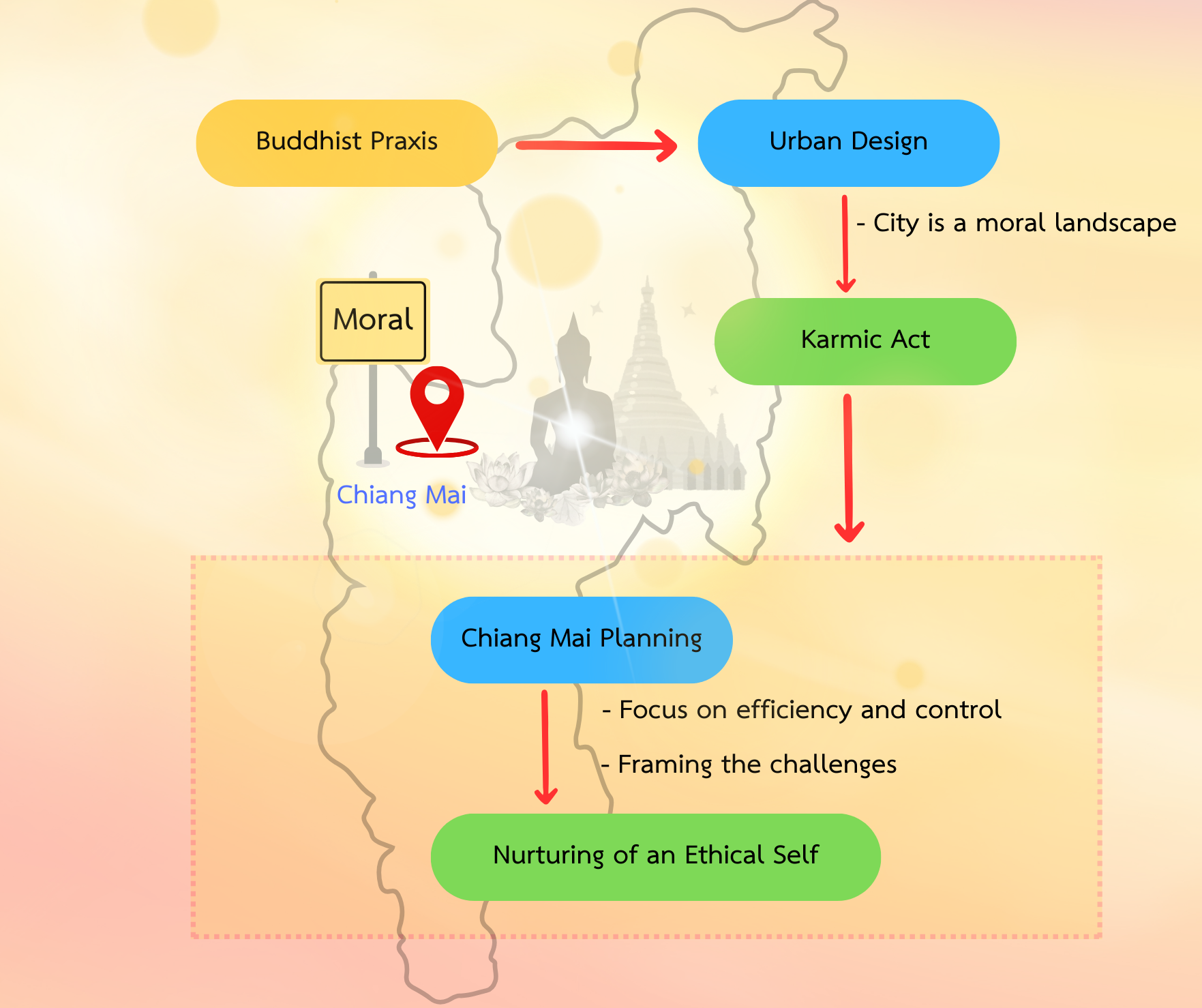
Background and Objectives: Urban development across the Global South, particularly in Thailand, was increasingly shaped by economic optimization and administrative efficiency. However, these paradigms often overlook the ethical, cultural, and spiritual dimensions of space. This paper aimed to propose a Buddhist ethical framework for urban design, drawing on the training principles of Sīla, Samādhi, and Paññā as an alternative model of civic development. The central objective was to reframe city-making as a moral process that emphasized the cultivation of inner ethical consciousness as foundational to spatial justice and civic sustainability.
Methodology: The study adopted a qualitative, interpretive-reflective case study approach.
It drew on Buddhist hermeneutics and spatial ethics to analyze urban conditions in Chiang Mai through the lens of the Threefold Training. Data sources included textual analysis of the Handbook for Mankind, planning documents, and observational evidence from urban sites in Chiang Mai. To ensure trustworthiness, triangulation was applied by cross-checking textual interpretation,
field observation, and literature. Urban phenomena such as traffic congestion, PM2.5 pollution, gentrification, and sacred space encroachment were interpreted as ethical dilemmas rather than technical issues. The methodology emphasized thick description and reflexive interpretation rather than empirical generalization.
Main Results: Findings revealed that Chiang Mai's urban transformation embodied multiple ethical tensions. The city's increasing congestion and air pollution violated the principle of Sīla by contributing to collective harm. Gentrification in Nimmanhaemin reflected craving, undermining social equity and mindfulness. In the old city area, sacred zones faced profanation due to tourism, diluting reverence and relational ethics. In response, spatial interventions, such as quiet lanes, breathable transit nodes with air-quality displays, heritage-sensitive zoning, and inter-being markets, were proposed to operationalize the Threefold Training. These interventions aimed to reduce harm (Sīla), stabilize attention and rhythm (Samādhi), and cultivate insight into interdependence and impermanence (Paññā). Such proposals demonstrated how Buddhist ethics could guide practical design choices in zoning, mobility, and community spaces.
Involvement to Buddhadhamma: This study contributed to the field of Applied Buddhism, with a focus on Buddhism and sustainable development and Buddhist innovations. Our research was deeply grounded in the principles of Traditional Buddhism, specifically the Threefold Training (Tisikkhā) as taught by Buddhadāsa Bhikkhu in Handbook for Mankind. By drawing from the Buddhadhamma, the article provided a comprehensive moral ecology for evaluating urban spaces and reframing spatial decisions as ethical acts. We argued that urban design, often treated as a technical field, could be a form of Buddhist innovation. The research further connected with Buddhist anthropology by asserting that urban space was never value-neutral but a karmic field that either supported or obstructed inner liberation (Buddhism and the Development of Wisdom and Morality). This perspective demonstrated how applying Buddhist teachings could lead to the development of wisdom and morality for individuals and society. The Handbook for Mankind became a foundational text for a new method development that used urban design to cultivate ethical awareness and foster social and moral awakening.
Conclusions: This study contributed to ethical urbanism by proposing a Buddhist-informed design framework that bridged personal transformation and spatial justice. It argued that sustainable urban order had to be rooted in "Inner Order" a cultivated ethical awareness among planners, residents, and institutions. The findings highlighted potential contributions to urban policy, community engagement, and cross-cultural discussions of urban ethics. While the results were context-specific to Chiang Mai, the framework held broader implications for how spiritual traditions could inform urban ethics.
Future research should explore comparative religious perspectives and integrate plural ontologies into the ethical urban design discourse. Ultimately, the city became not only a material infrastructure but a moral landscape, where every design act carried karmic weight and ethical potential.
References
Ashton, A. S. (2018). Spiritual retreat tourism development in the Asia Pacific region: investigating the impact of tourist satisfaction and intention to revisit: a Chiang Mai, Thailand case study. Asia Pacific Journal of Tourism Research, 23(11), 1098-1114. https://doi.org/10.1080/10941665.2018.1526198.
Askew, M. (2002). Bangkok: Place, practice and representation. London, United Kingdom: Routledge.
Bangkok Post. (2025, April 30). Mass Rapid Transit Act tweaks eyed to pave way for flat fare. Bangkok Post, p. 2.
Barrie, T. (2010). The sacred In-between: The mediating roles of architecture. New York, United States of America: Routledge.
Buddhadāsa Bhikkhu. (1996). Handbook for Mankind. Tullera, Australia: Buddha Dharma Education Association Inc.
Carmona, M., Heath, T., Oc, T. & Tiesdell, S. (2010). Public Places, Urban Spaces: The Dimensions of Urban Design. (2nd ed.). Burlington, United States of America: Architectural Press.
Clifford, J. & Marcus, G. E. (1986). Writing culture: The poetics and politics of ethnography. (25th anniversary ed.). Berkeley, United States of America: University of California Press.
Cohen, E. H. (2008). The changing faces of tourism. Society, 45(4), 330-333.
Cook, J. (2010). Meditation in modern Buddhism: Renunciation and the practice of Buddhist anthropology. Cambridge, United Kingdom: Cambridge University Press.
Davidson, R. J. & McEwen, B. S. (2012). Social influences on neuroplasticity: Stress and interventions to promote well-being . Nature Neuroscience, 15(5), 689-695. https://doi.org/10.1038/nn.3093.
Eliade, M. (1959). The sacred and the profane: The nature of religion. New York, United States of America: Harcourt Inc.
Flyvbjerg, B. (2001). Making social science matter: Why social inquiry fails and how it can succeed again. (Sampson, S. Trans). Cambridge, United Kingdom: Cambridge University Press.
Geertz, C. (1973). The interpretation of cultures: Selected essays. (3rd ed.). New York, United States of America: Basic Books.
Harvey, P. (2000). An introduction to Buddhist ethics: Foundations, values and issues. Cambridge, United Kingdom: Cambridge University Press.
Joas, H. (2001). The genesis of values. Chicago, United States of America: University of Chicago Press.
Keyes, C. F. & Tanabe, S. (2016). Cultural crisis and Social memory: Modernity and identity in Thailand and Laos. London, United Kingdom: Routledge.
Low, S. M. & Lawrence-Zúñiga, D. (2012). The anthropology of space and place: Locating culture (12th printing). Malden, United States of America: Blackwell Publishing.
McDaniel, J. T. (2011). The lovelorn ghost and the magical monk. New York, United States of America: Columbia University Press.
Norberg-Schulz, C. (1979). Genius loci: Towards a phenomenology of architecture. London, United Kingdom: Rizzoli.
Pothisiri, W., Prasitsiriphon, O. & Aekplakorn, W. (2020). Extent of aging across education and income subgroups in Thailand: Application of a characteristic-based age approach. PLOS One, 15(12), e0243081. https://doi.org/10.1371/journal.pone.0243081.
Relph, E. C. (1976). Place and placelessness. London, United Kingdom: Pion Limited.
Sandercock, L. (2003). Cosmopolis II: Mongrel cities of the 21st century. New York, United States of America: Continuum.
Shatkin, G. (2017). Cities for profit: The real estate turn in Asia's urban politics. Ithaca, United States of America: Cornell University Press. https://doi.org/10.7591/cornell/9781501709906.001.0001.
Silva Leite, J., Fernandes, S. & Dias Coelho, C. (2024). The Sacred Building and the City: Decoding the Formal Interface between Public Space and Community. Religions, 15(2), 246. https://doi.org/10.3390/rel15020246.
Soja, E. W. (2010). Seeking spatial justice. Minneapolis, United States of America: University of Minnesota Press.
Spiro, M. E. (1970). Buddhism and society: A great tradition and its Burmese vicissitudes. Berkeley, United States of America: University of California Press.
Spiro, M. E. (1993). Oedipus in the Trobriands. Chicago, United States of America: University of Chicago Press.
Swearer, D. K. (2010). The Buddhist world of Southeast Asia. (2nd ed.). Albany, United States of America: SUNY Press.
Tambiah, S. J. (1976). World conqueror and world renouncer: A study of Buddhism and polity in Thailand against a historical background. Cambridge, United Kingdom: Cambridge University Press.
Throgmorton, J. A. (1996). Planning as persuasive storytelling: The rhetorical construction of Chicago's electric future. Chicago, United States of America: University of Chicago Press.
TomTom. (2025, January 8). TomTom Traffic Index 2025: Unveiling data-driven insights from over 450 billion miles driven in 2024. TomTom Newsroom, pp. 1-4.
Tuan, Y.-F. (1977). Space and place: The perspective of experience. Minneapolis, United States of America: University of Minnesota Press.
Van Esterik, P. (2000). Materializing Thailand. London, United Kingdom: Routledge. https://doi.org/10.4324/9781003086048.
World Health Organization. (2009). Night noise guidelines for Europe. Copenhagen, Denmark: Publications WHO Regional Office for Europe.
Downloads
Published
How to Cite
Issue
Section
License
Copyright (c) 2025 Journal of Buddhist Anthropology

This work is licensed under a Creative Commons Attribution-NonCommercial-NoDerivatives 4.0 International License.