MORAL GROWTH IN A DIGITAL AGE: APPLYING THE THREEFOLD TRAINING TO ENHANCE THE LIFESTYLES AND TECHNOLOGY USE OF GENERATION C STUDENTS IN THE THAILAND 4.0 ERA
Keywords:
Generation C, Threefold Training, Educational Innovation, Technology Ethics, Digital MindfulnessAbstract
Background and Objectives: Within the Thailand 4.0 context, where digital transformation has reshaped education and society, the lifestyles of Generation C, defined by connectivity, creativity, and collaboration, are shaped by pervasive technology use. While these changes offer opportunities for innovation and learning, they raise concerns regarding ethical awareness, digital well-being, and value-based living. Educational institutions must therefore address both digital access and students' personal, social, and ethical development. Generation C favors personalized learning, online collaboration, and constant connectivity, yet also faces risks such as digital addiction, distraction, and psychological stress. Although Generation C's digital lifestyles have been widely studied, prior research has largely treated digital behavior, digital literacy, and moral education as separate domains. This fragmentation has limited empirical understanding of how moral development can be systematically cultivated in technology-mediated learning environments, revealing a clear gap in integrative models grounded in indigenous ethical frameworks.
Drawing on Buddhadhamma, the Threefold Training, sīla (Moral Discipline), samādhi (Concentration), and paññā (Wisdom), offers a holistic theoretical foundation for addressing
this gap. Accordingly, this study aimed to examine how integrating the Buddhist Threefold Training into the digital lifestyles of Generation C students in higher education contributes to moral growth, ethical awareness, and self-regulation, and to propose an educational model aligning digital literacy with moral cultivation in Thailand.
Methodology: A mixed-methods design was employed. Quantitative data were collected through a structured questionnaire administered to 480 undergraduate students from six universities across Thailand, using stratified random sampling. Data were analyzed using Structural Equation Modeling (SEM) and regression analysis to examine relationships among digital lifestyles, moral development, and the Threefold Training components. The instrument assessed digital literacy, lifestyle balance, and ethical awareness mapped to sīla, samādhi,
and paññā. Qualitative data were obtained through in-depth interviews with 15 experts, including educators, digital literacy specialists, and Buddhist scholars, and were analyzed thematically to complement the quantitative findings.
Main Results: The findings indicated that students' digital lifestyles significantly influenced moral development and digital well-being, presenting both strengths and risks. Reflective digital practices aligned with paññā emerged as the strongest predictor of digital moral growth.
Ethical online collaboration associated with sīla supported empathy and responsible interaction, while samādhi enhanced attention regulation and reduced problematic technology use. Conversely, excessive social media engagement negatively affected ethical awareness and
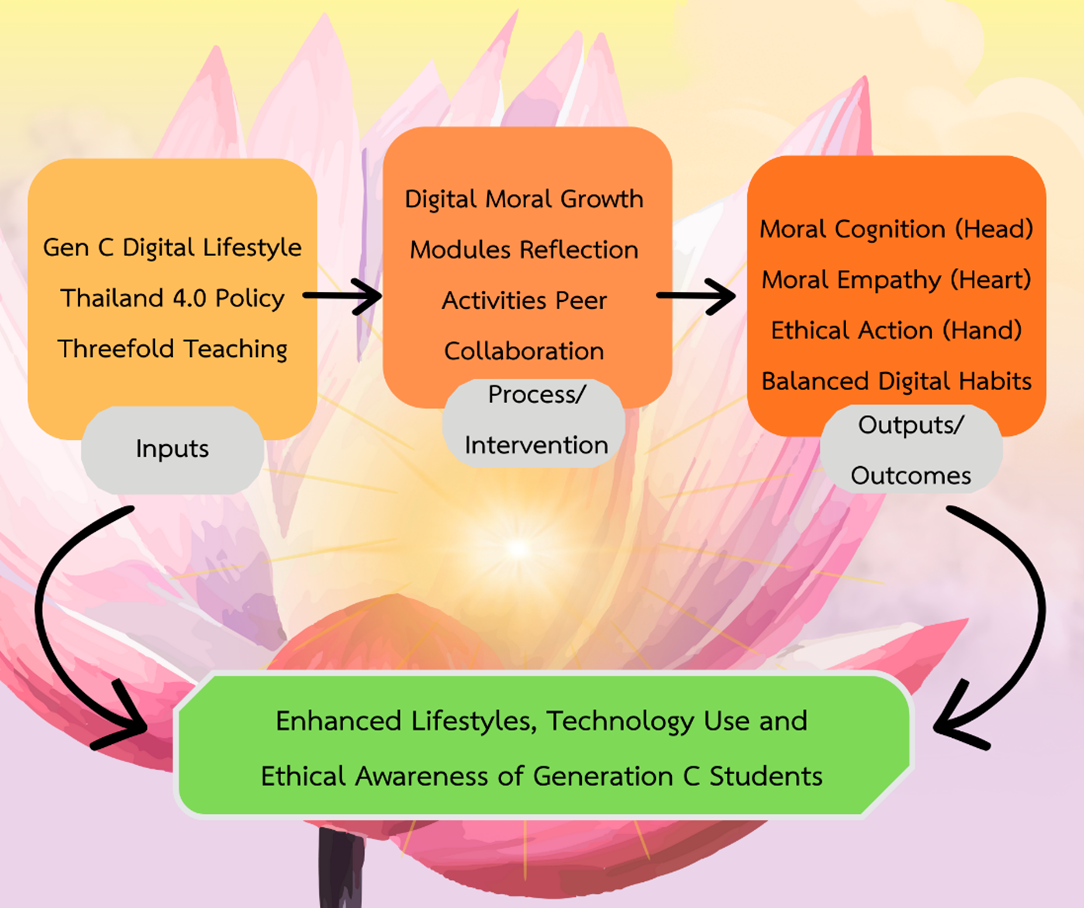
self-regulation. Qualitative findings highlighted Buddhist-informed practices-such as mindful pauses, pre-commitment rules, and purpose-driven routines- support healthier technology use. These integrated findings informed the development of the S-M-P Innovation Model,
which embeds morality, concentration, and wisdom into digital learning environments to promote ethical and mindful digital living aligned with Thailand 4.0.
Involvement to Buddhadhamma: Grounded in Applied Buddhism and the development of wisdom and morality, this study employed the Threefold Training as an integrated theoretical and practical framework for digital ethics and lifestyle development. Its contributions include: Translating Buddhist principles into contemporary digital ethics; Applying mental cultivation to enhance technology self-regulation; Harnessing wisdom for media discernment; Embedding Buddhist pedagogy within Thailand 4.0 capital development; and Bridging Dhamma and education through empirical evidence. The findings demonstrate that Buddhadhamma remains both timeless and relevant in guiding Generation C toward ethical, mindful, and purposeful digital living.
Conclusions: The research confirms that the Buddhist Threefold Training constitutes a culturally grounded and pedagogically effective educational innovation for enhancing ethical attitudes, self-regulation, and reflective competencies among Generation C students. It recommends integrating the S-M-P Innovation Model into curricula, digital literacy programs, and student support systems to foster ethical technology use and value-driven digital lifestyles. Beyond Thailand,
the model offers relevance for ASEAN and global education systems seeking to balance digital advancement with values-based human development.
References
Goleman, D. & Davidson, R. J. (2017). Altered Traits: Science Reveals How Meditation Changes Your Mind, Brain, and Body. New York, United States of America: Avery.
Gombrich, R. (2009). What the Buddha Thought. London, United Kingdom: Equinox Publishing.
Harwood, N. (2021). Coda: An expanding research agenda for the use of instructional materials. Modern Language Journal, 105(S1), 175-184.
Janthapassa, S., Chanthapassa, N. & Kenaphoom, S. (2024). THE ROLE OF DIGITAL LITERACY IN SHAPING EDUCATION IN THE NEXT-NORMAL. Asian Education and Learning Review, 2(1), 29-41. https://doi.org/10.14456/aelr.2024.3.
Kabat-Zinn, J. (2015). Mindfulness. Mindfulness, 6, 1481-1483. https://doi.org/10.1007/s12671-015-0456-x.
Krejcie, R. V. & Morgan, D. W. (1970). Determining Sample Size for Research Activities. Educational and Psychological Measurement, 30(3), 607-610. https://doi.org/10.1177/001316447003000308.
Leeflang, P. S. H., Verhoef, P. C., Dahlström, P. & Freundt, T. (2014). Challenges and solutions for marketing in a digital era. European Management Journal, 32(1), 1-12.
Leung, L. (2013). Generational differences in content generation in social media: The roles of the gratifications sought and of narcissism. Computers in Human Behavior, 29(3), 997-1006. https://doi.org/10.1016/j.chb.2012.12.028.
Livingstone, S., Haddon, L., Görzig, A. & Ólafsson, K. (2011). Risks and safety on the internet: the perspective of European children: full findings and policy implications from the EU Kids Online survey of 9-16-year-olds and their parents in 25 countries. EU Kids Online Network. London, United Kingdom: EU Kids Online.
Ministry of Digital Economy and Society. (2016). Thailand Digital Economy and Society Development Plan. Bangkok, Thailand: Ministry of Digital Economy and Society.
Ministry of Industry. (2017). Thailand 4.0 policy framework. Bangkok, Thailand: Royal Thai Government.
NESDC. (2020). Thailand 4.0 policy framework. Bangkok, Thailand: Office of the National Economic and Social Development Board.
OECD. (2019). How's Life in the Digital Age?: Opportunities and Risks of the Digital Transformation for People's Well-being. Paris, France: OECD Publishing. https://doi.org/10.1787/9789264311800-en.
Phra Dhammakosajarn (Prayoon Dhammajitto). (2010). Methods for Integrating Buddhism with Modern Science. Bangkok, Thailand: Kasem Saengnon.
Phrakhru Suwannasuttalankara, Suwannamal, P., Chanthanuan, R. & Maneeratwong, N. (2020). Buddhist principles for students to learn in the present time. Mahachula Tanee Review Journal, Mahachulalongkornrajavidyalaya University, 2(4), 50-62.
Rosen, L. D. (2013). iDisorder: Understanding our Obsession with Technology and Overcoming its Hold on Us. London, United Kingdom: Palgrave Macmillan Publishing.
Rosen, L. D., Lim, A. F., Carrier, L. M. & Cheever, N. A. (2011). An Empirical Examination of the Educational Impact of Text Message-Induced Task Switching in the Classroom: Educational Implications and Strategies to Enhance Learning. Psicología Educativa, 17(2), 163-177.https://doi.org/10.5093/ed2011v17n2a4.
Sinlarat, P. (2005). Changing the Culture of Education in Thai Universities. Higher Education Policy, 18, 265-269. https://doi.org/10.1057/palgrave.hep.8300088.
Tamil S. P. & Kalaiyarasan, G. (2022). Awareness of Digital Education Ethics among the Higher Education Students. International Journal of Emerging Knowledge Studies, 1(1), 10-13.
Tapscott, D. (2009). Grown up Digital: How the Net Generation Is Changing the World. New York, United States of America: McGraw-Hill.
Thanissaro Bhikkhu. (2012). Right Mindfulness: Memory & Ardency on the Buddhist Path. California, United States of America: Metta Forest Monastery.
Turkle, S. (2015). Reclaiming Conversation: The Power of Talk in a Digital Age. Chicago, United States of America: Penguin Press.
UNESCO. (2015). Rethinking education: Towards a global common good. Paris, France: UNESCO Publishing.
Ura, K., Alkire, S., Zangmo, T. & Wangdi, K. (2012). A Short Guide to Gross National Happiness Index. Thimphu, Bhutan: The Center for Bhutan Studies.
Wongwuttiwat, J., Buraphadeja, V. & Tantontrakul, T. (2020). A case study of blended e-learning in Thailand. Interactive Technology and Smart Education, 17(2), 197-214. https://doi.org/10.1108/ITSE-10-2019-0068.
Young, K. S. & de Abreu, C. N. (Eds.). (2011). Internet addiction: A handbook and guide to evaluation and treatment. New Jersey, United State of America: John Wiley & Sons, Inc.
Downloads
Published
How to Cite
Issue
Section
License
Copyright (c) 2025 Journal of Buddhist Anthropology

This work is licensed under a Creative Commons Attribution-NonCommercial-NoDerivatives 4.0 International License.