HOW ARE SOCIAL CLASS AND SPATIAL DISPARITIES RELATED TO THE SMOKING HABITS OF THAI MONKS?
Keywords:
Social Class, Spatial Disparities, Health Disparities, Smoking, Thai Buddhist Monks, BuddhismAbstract
Background and Objectives: Since the United Nations announced the Sustainable Development Goals in 2015, countries worldwide have prioritized achieving these targets, particularly in the aftermath of the COVID-19 pandemic, when ensuring good health has become a central, collective concern.
To achieve good health, it is imperative to consider the social determinants shaping health outcomes. Thailand places strong emphasis on well-being and holistic health. Smoking poses a major challenge in achieving this goal as it constitutes a risky health behavior that negatively affects overall health outcomes. This study examines smoking among Thai Buddhist monks,
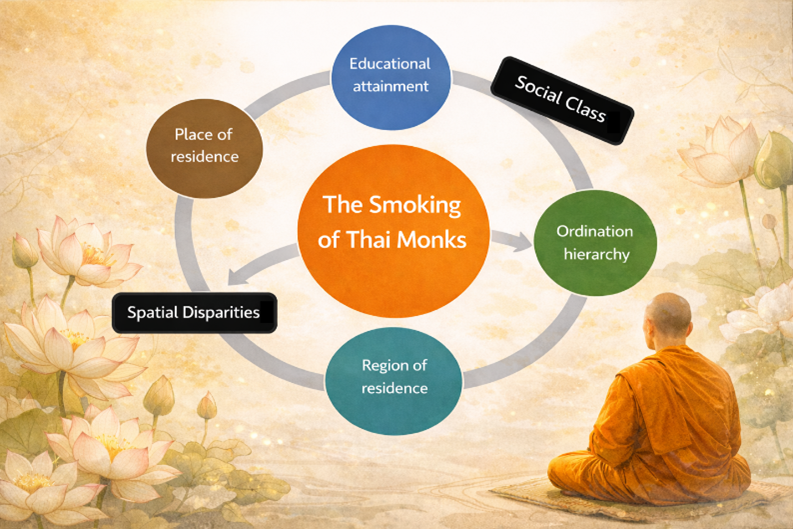
an issue that has remained underexplored in existing scholarship. Smoking among monks not only directly affects their health, but also intersects with the sensitivities of monastic disciplinary principles (Vinaya). To analyze this phenomenon, the objective of this study was to examine how social class and spatial disparities revealed the social complexity underlying the smoking behavior of Thai monks.
Methodology: The study aimed to understand the differences in smoking decisions among Thai monks, who represent a culturally specific population. It drew on the concepts of social class and spatial disparities to explain smoking patterns among monks. This quantitative research used secondary data from a questionnaire administered to 911 monks and novices. After managing the dataset, statistical analyses were conducted using ordered logistic regression.
Main Results: Important considerations regarding population health and sustainable development must account for the obstacles to achieving good health within the contexts of social environments, cultural patterns, and the lifestyles of particular population groups. The results demonstrate the relationship between social class, spatial disparities, and smoking among Thai monks. When considering the dimensions of educational attainment, ordination hierarchy, region of residence, and place of residence, a correlation with smoking behavior among Thai monks was observed.
Involvement to Buddhadhamma: This article is situated within Applied Buddhism, focusing on understanding the relationship between health risks and Buddhism. Health risks arising from smoking reflect relevant Buddhist principles, particularly the Five Precepts, in which tobacco
is regarded as an addictive substance and a form of vice. Smoking not only has adverse effects on physical health but is also associated with diminished mental, intellectual, and social well-being. Although the monastic disciplinary code (Vinaya) does not explicitly prohibit or permit smoking, the practice remains a matter of concern. Nevertheless, an important tool of Buddhist principles, the Four Noble Truths, provides a fundamental framework that can be practically applied to support smoking cessation. The process begins with recognizing that smoking leads to suffering (Dukkha, Unsatisfactoriness), followed by identifying the reasons or causes underlying the smoking habit (Samudaya, The Origin of Suffering). Once these causes are identified, monks who are determined to quit smoking can set personal goals to eliminate the source of suffering (Nirodha, The Cessation of Suffering). This understanding can then be translated into practical actions in their daily lives, such as gradually reducing cigarette consumption until complete cessation is achieved (Magga, The Path Leading to The Cessation of Suffering). Furthermore, monks who intend to quit smoking can apply the principle of yoniso manasikāra (Wise Reflection) by considering the harms of smoking, seeking information from credible sources about the health risks associated with tobacco use, and committing themselves to the reduction and eventual cessation of smoking.
Conclusions: Thai Buddhist monk's decision to smoke may stem from underlying social and cultural structures, which increase their health risks and hinder the achievement of the Sustainable
Development Goals.
References
Amrock, S. M., Zakhar, J., Zhou, S. & Weitzman, M. (2014). Perception of E-Cigarette Harm and Its Correlation with Use among U.S. Adolescents. Nicotine & Tobacco Research, 17(3), 330-336. https://doi:10.1093/ntr/ntu156.
Barbeau, E. M., Leavy-Sperounis, A. & Balbach, E. D. (2004). Smoking, social class, and gender: what can public health learn from the tobacco industry about disparities in smoking? Tobacco Control, 13, 115-120. https://doi:10.1136/tc.2003.006098.
Cockerham, W. (2017). Health lifestyle theory. The Wiley-Blackwell Encyclopedia of Social Theory (pp. 1–3). https://doi:10.1002/9781118430873.est0160.
Diemer, M. A., Mistry, R. S., Wadsworth, M. E., López, I. & Reimers, F. (2012). Best Practices in Conceptualizing and Measuring Social Class in Psychological Research. Analyses of Social Issues and Public Policy, 13(1), 77-113. https://doi.org/10.1111/asap.12001.
Elo, I. T. (2009). Social Class Differentials in Health and Mortality: Patterns and Explanations in Comparative Perspective. Annual Review of Sociology, 35, 553-572. https://doi.org/10.1146/annurev-soc-070308-115929.
Fullerton, A. S. (2009). A Conceptual Framework for Ordered Logistic Regression Models. Sociological Methods & Research, 38(2), 306-347. https://doi:10.1177/0049124109346162.
Hammond, D., Kin, F., Prohmmo, A., Kungskulniti, N., Lian, T. Y., Sharma, S. K., Sirirassamee, B., Borland, R. & Fong, G. T. (2008). Patterns of Smoking Among Adolescents in Malaysia and Thailand: Findings From the International Tobacco Control Southeast Asia Survey. Asia Pacific Journal of Public Health, 20(3), 193-203. https://doi:10.1177/1010539508317572.
Holt-Lunstad, J. (2022). Social Connection as a Public Health Issue: The Evidence and a Systemic Framework for Prioritizing the "Social" in Social Determinants of Health. Annual Review of Public Health, 43, 193-213. https://doi.org/10.1146/annurev-publhealth-052020-110732.
Jeamjitvibool, T., Tankumpuan, T., Lukkahatai, N. & Davidson, P. M. (2022). Noncommunicable diseases and social determinants of health in Buddhist monks: An integrative review. Research in Nursing & Health, 45(2). 249-260. https://doi.org/10.1002/nur.22215.
Jitnarin, N., Kosulwat, V., Rojroongwasinkul, N., Boonpraderm, A., Haddock, C. K. & Poston, W. S.C. (2010). Socioeconomic Status and Smoking Among Thai Adults: Results of the National Thai Food Consumption Survey. Asia Pacific Journal of Public Health, 23(5), 672-681 https://doi:10.1177/1010539509352200.
Kungskulniti, N., Charoenca, N., Kengganpanich, T., Kusolwisitkul, W., Pichainarong, N.,Kerdmongkol, P., Silapasuwan, P., Hamann, S. L. & Arpawong, T. E. (2011). Smoking Prevalence among Monks in Thailand. Evaluation & the Health Professions, 35(3), 305-322.https://doi:10.1177/0163278711426424.
Lian, T. Y. & Dorotheo, U. (2018). The Tobacco Control Atlas: ASEAN Region. Pathum Thani, Bangkok: Southeast Asia Tobacco Control Alliance.
McGovern, P. & Nazroo, J. Y. (2015). Patterns and causes of health inequalities in later life: a Bourdieusian approach. Sociology of Health & Illness, 37(1), 143-160. https://doi:10.1111/1467-9566.12187.
Mentis, A. A. (2017). Social determinants of tobacco use: Towards an equity lens approach. Tobacco Prevention & Cessation, 3(7), 1-8. https://doi:10.18332/tpc/68836.
National Health Commission Office (NHCO) Thailand. (2024). The National Sangha Health Charter B.E. 2566. Bangkok: National Health Commission Office (NHCO) Thailand.
Statistical Forecasting Division National Statistical Office. (2021). The 2021 Health Behavior of Population Survey. Bangkok: Statistical Forecasting Division National Statistical Office.
Nichter, M. (2015). Lighting Up: The Rise of Social Smoking on College Campuses. New York: New York University Press.
Nichter, M. & Nichter, M. (2016). Promoting Smoking in Indonesia. In Mandersom, L., Cartwright, E., & Hardon, A. (Eds.), The Routledge Handbook of Medical Anthropology (pp.107-112). New York: Routledge.
Oncini, F. & Guetto, R. (2018). Cultural capital and gender differences in health behaviours: a study on eating, smoking and drinking patterns. Health Sociology Review, 27(1), 15-30. https://doi.org/10.1080/14461242.2017.1321493.
Panyachit, S. (2025). Barefoot Health: The Healthy Lifestyle Path of Monks in Thailand. Journal of Population and Social Studies, 34(2026), 236-252. http://doi.org/10.25133/JPSSv342026.
Parkinson, C. M., Hammond, D., Fong, G. T., Borland, R., Omar, M., Sirirassamee, B., Awang, R.,Driezen, P. & Thompson, M. (2009). Smoking beliefs and behavior among youth in Malaysia and Thailand. Am J Health Behav, 33(4), 366-375. PMID: 19182982; PMCID: PMC4665091.
Stillwell, J., Norman, P., Thomas, C. & Surridge, P. (2010). Spatial and Social Disparities. In Spatial and Social Disparities. In: Stillwell, J., Norman, P., Thomas, C., Surridge, P. (eds) Spatial and Social Disparities. Understanding Population Trends and Processes, vol 2. Springer, Dordrecht. https://doi.org/10.1007/978-90-481-8750-8_1.
Thongsawang, S., Rehbein, B. & Chantavanich, S. (2020). Inequality, Sociocultures and Habitus in Thailand. Sojourn: Journal of Social Issues in Southeast Asia, 35(3), 493-524.
United Nations. (2024). The Sustainable Development Goals Report 2024. New York, United States: United Nations.
Vanphanom, S., Phengsavanh, A., Hansana, V., Menorath, S. & Tomson, T. (2009). Smoking prevalence, determinants, knowledge, attitudes and habits among Buddhist monks in Lao PDR. BMC Research Notes, 2, 100 (2009). https://doi.org/10.1186/1756-0500-2-100.
Williams, S. J. (1995). Theorising class, health and lifestyles: can Bourdieu help us? Sociology of Health & Illnes, 17(5), 577-604. https://doi.org/10.1111/1467-9566.ep10932093.
Downloads
Published
How to Cite
Issue
Section
License
Copyright (c) 2025 Journal of Buddhist Anthropology

This work is licensed under a Creative Commons Attribution-NonCommercial-NoDerivatives 4.0 International License.