INTERNAL BIOTECHNOLOGY OF THE SELF: A PSYCHONEUROIMMUNOLOGICAL MODEL LINKING CONTEMPLATIVE PRACTICES TO MOLECULAR AGING
Keywords:
Internal Biotechnology, Buddhist Therapeutics, Psychoneuroimmunology, Epigenetic Aging, Contemplative ScienceAbstract
Background: The relentless global pursuit of longevity has catalyzed profound advancements in biomedical sciences. However, a paradox remains: While the human lifespan has extended, the healthspan, the functional period of life spent in good health, has not kept pace. Contemporary gerontology largely operates within a materialist, reductionist paradigm, prioritizing "External Pharmacology" such as senolytics, gene editing, and stem cell therapies, to repair the cumulative cellular damage. However, this approach frequently treats aging organisms as purely mechanical entities, neglecting the significant impact of psychosocial stressors and existential distress on physiological decline. Current evidence in Psychoneuroimmunology (PNI) indicates that psychological states are not merely epiphenomena but potent drivers of biological aging processes through allostatic load and immunosenescence mechanisms. Specifically, chronic psychological stress, driven by maladaptive cognitive patterns, triggers the dysregulation of the Hypothalamic Pituitary Adrenal (HPA) axis and the Sympathetic Nervous System (SNS), leading to a systemic pro-inflammatory state known as "Inflammaging." Consequently, there is a critical need for integrative models that address the "Upstream" psychological causes of this "Downstream" cellular pathology to bridge the widening gap between biological longevity and existential well-being.
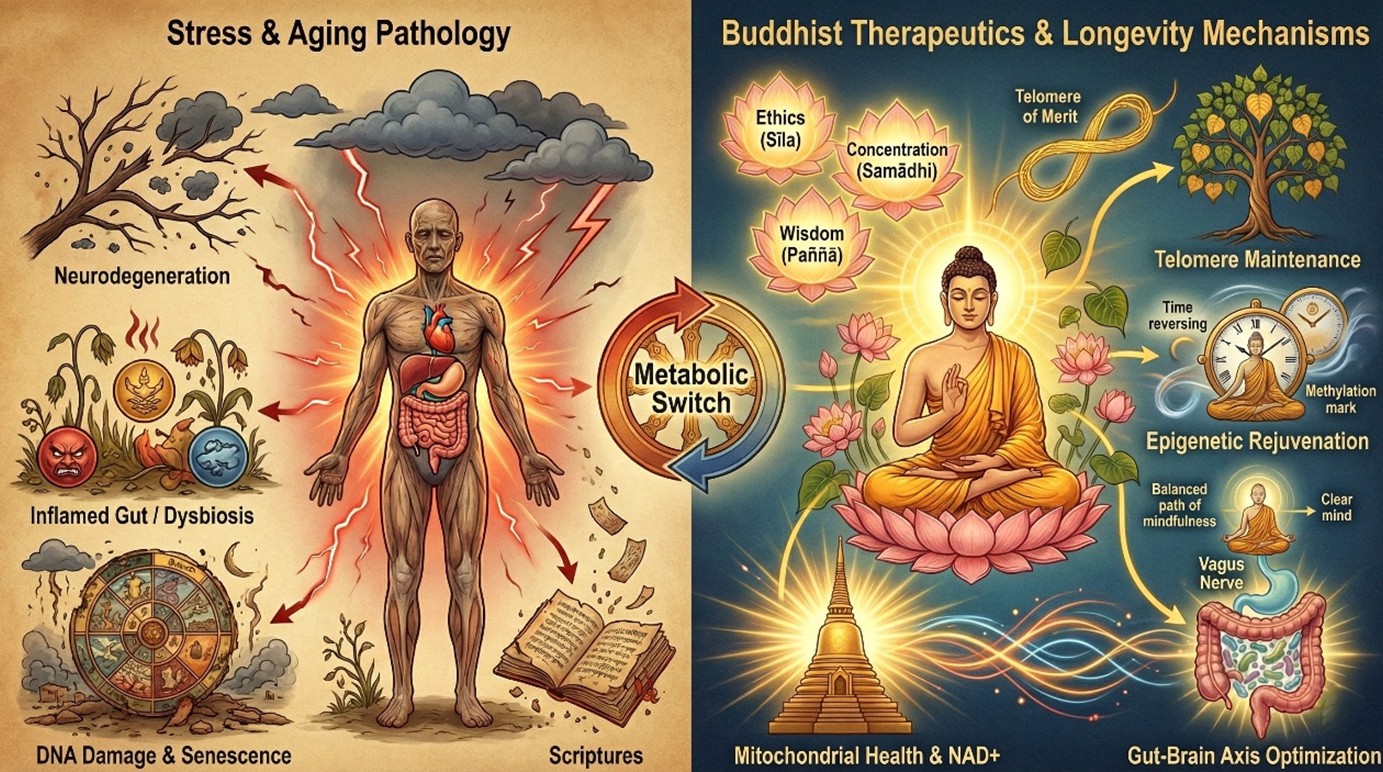
Involvement to Buddhadhamma: To address the critical gap between biological longevity and existential well-being, this article situates itself within the domain of Applied Buddhism, specifically focusing on Buddhist innovations in health science. We propose a novel framework termed "Internal Biotechnology," implemented through the methodology of "Buddhist Therapeutics." This approach reinterprets the classical "Threefold Training" (Tri-Sikkhā) not merely as religious praxis, but as a precise Buddhist innovation in bio-regulatory processes. The framework posits a causal transduction from mental cultivation to cellular resilience: 1) Morality (Sīla) functions as a behavioral regulation mechanism that reduces psychosocial stress exposure and prevents the onset of allostatic load by fostering social safety signals; 2) Concentration (Samādhi) acts as an autonomic regulation mechanism that enhances vagal tone and parasympathetic dominance, inducing a physiological relaxation response that counteracts the catabolic effects of chronic sympathetic arousal; and 3) Wisdom (Paññā) serves as a cognitive regulation mechanism that alters the perception of stress through interoception and equanimity, effectively uncoupling the psychological experience of adversity from the physiological stress response. By systematically extinguishing the "Three Poisons" (Akusala Mūla, Greed, Hatred, and Delusion), this Applied Buddhism model demonstrates how the practitioner activates a "Restorative Metabolic Switch." This process downregulates chronic HPA axis activation and systemic "Inflammaging," while potentially upregulating restorative mechanisms, such as DNA repair, NAD+ conservation, and telomerase activity. Thus, this section elucidates how the cessation of mental defilements (Kilesa) translates into genomic stability, proposing a systematic methodology for human development that aligns with contemporary scientific needs.
Conclusions: This synthesis challenges the prevailing biocentric view of aging, suggesting that consciousness is a fundamental determinant of molecular vitality. Through the application of "Buddhist Therapeutics," this "Internal Biotechnology" framework offers a non-invasive, sustainable, and empowering modality for healthspan extension, shifting the paradigm from treating aging as inevitable decay to viewing it as a malleable process influenced by mental discipline.
The integration of these disciplines suggests that longevity is not merely a matter of preserving the flesh through external intervention but is intrinsically linked to the cultivation of wisdom.
By reframing spiritual development as a potent, autogenous biotechnology, this model offers a holistic roadmap for the 21st century, where the pursuit of Nirvana and the preservation of biological youthfulness converge into a unified science of human thriving.
References
Blackburn, E. H., Epel, E. S. & Lin, J. (2015). Human telomere biology: A contributory and interactive factor in aging, disease risk, and protection. Science, 350(6265), 1193-1198. https://doi.org/10.1126/science.aab3389.
Bodhi, B. (2010). The Noble Eightfold Path The Way to the End of Suffering. Kandy, Sri Lanka: Buddhist Publication Society.
Breines, J. G., Thoma, M. V., Gianferante, D., Hanlin, L., Chen, X. & Rohleder, N. (2014). Self-compassion as a predictor of interleukin-6 response to acute psychosocial stress. Brain, Behavior, and Immunity, 37, 109-114. https://doi.org/10.1016/j.bbi.2013.11.006.
Chaix, R., Alvarez-López, M. J., Fagny, M., Lemee, L., Regnault, B., Davidson, R. J., Lutz, A. & Kaliman, P. (2017). Epigenetic clock analysis in long-term meditators. Psychoneuroendocrinology, 85, 210-214. https://doi.org/10.1016/j.psyneuen.2017.08.016.
Covarrubias, A. J., Perrone, R., Grozio, A. & Verdin, E. (2021). NAD+ metabolism and its role in cellular processes during aging. Nature Reviews Molecular Cell Biology, 22, 119-141. https://doi.org/10.1038/s41580-020-00313-x.
Crosswell, A. D., Mayer, S. E., Whitehurst, L. N., Picard, M., Zebarjadian, S. & Epel, E. S. (2024). Deep Rest: An Integrative Model of How Contemplative Practices Combat Stress and Enhance the Body’s Restorative Capacity. Psychological Review, 131(1), 247-270. https://doi.org/10.1037/rev0000453.
Cryan, J. F., O'Riordan, K. J., Cowan, C. S. M., Sandhu, K. V., Bastiaanssen, T. F. S., Boehme, M., Codagnone, M. G., Cussotto, S., Fulling, C., Golubeva, A. V., Guzzetta, K. E., Jaggar, M., Long-Smith, C. M., Lyte, J. M., Martin, J. A., Molinero-Perez, A., Moloney, G., Morelli, E., Morillas, E., O'Connor, R., Cruz-Pereira, J. S., Peterson, V. L., Rea, K., Ritz, N. L., Sherwin, E., Spichak, S., Teichman, E. M., van de Wouw, M., Ventura-Silva, A. P., Wallace-Fitzsimons, S. E., Hyland, N., Clarke, G. & Dinan, T. G. (2019). The microbiota-gut-brain axis. Physiological Reviews, 99(4), 1877-2013. https://doi.org/10.1152/physrev.00018.2018.
Dasanayaka, N. N., Sirisena, N. D. & Samaranayake, N. (2022). Impact of Meditation-Based Lifestyle Practices on Mindfulness, Wellbeing, and Plasma Telomerase Levels: A Case-Control Study. Frontiers in Psychology, 13, 846085. https://doi.org/10.3389/fpsyg.2022.846085.
Dunne, P. J. & Schubert, C. (2021). Editorial: New Mind-Body Interventions That Balance Human Psychoneuroimmunology. Frontiers in Psychology, 12, 706584. https://doi.org/10.3389/fpsyg.2021.706584.
Granoff, P. (2011). The Buddha as the Greatest Healer: The Complexities of a Comparison. Journal Asiatique, 299(1), 5-22. https://doi.org/10.2143/JA.299.1.2131058.
Hoge, E. A., Chen, M. M., Orr, E., Metcalf, C. A., Fischer, L. E., Pollack, M. H., DeVivo, I. & Simon, N. M. (2013). Loving-Kindness Meditation practice associated with longer telomeres in women. Brain, Behavior, and Immunity, 32, 159-163. https://doi.org/10.1016/j.bbi.2013.04.005.
Horvath, S. (2013). DNA methylation age of human tissues and cell types. Genome Biology, 14, 3156. https://doi.org/10.1186/gb-2013-14-10-r115.
Imai, S. -I. & Guarente, L. (2016). It takes two to tango: NAD+ and sirtuins in aging/longevity control. npj Aging and Mechanisms of Disease, 2, 16017. https://doi.org/10.1038/npjamd.2016.17.
Kaliman, P., Álvarez-López, M. J., Cosín-Tomás, M., Rosenkranz, M. A., Lutz, A. & Davidson, R. J. (2014). Rapid changes in histone deacetylases and inflammatory gene expression in expert meditators. Psychoneuroendocrinology, 40, 96-107. https://doi.org/10.1016/j.psyneuen.2013.11.004.
Le Nguyen, K. D., Lin, J., Algoe, S. B., Brantley, M. M., Kim, S. L., Brantley, J., Salzberg, S. & Fredrickson, B. L. (2019). Loving-kindness meditation slows biological aging in novices: Evidence from a 12-week randomized controlled trial. Psychoneuroendocrinology, 108, 20-27. https://doi.org/10.1016/j.psyneuen.2019.05.020.
Nicholson, H. (2022). Buddhism, Cognitive Science, and the Doctrine of Selflessness: A Revolution in Our Self-Conception. London, United Kingdom: Routledge. https://doi.org/10.4324/9781003303893.
Obeyesekere, G. (2002). Imagining Karma: Ethical Transformation in Amerindian, Buddhist, and Greek Rebirth. California, United States of America: University of California Press. https://doi.org/10.1525/california/9780520232204.001.0001.
Pace, T. W. W., Negi, L. T., Adame, D. D., Cole, S. P., Sivilli, T. I., Brown, T. D., Issa, M. J. & Raison, C. L. (2009). Effect of compassion meditation on neuroendocrine, innate immune, and behavioral responses to psychosocial stress. Psychoneuroendocrinology, 34(1), 87-98. https://doi.org/10.1016/j.psyneuen.2008.08.011.
Phrabrahmagunabhorn (P. A. Payutto). (2016). Buddhadhamma. Bangkok, Thailand: Buddhadhamma Foundation.
Phramaha Wichit Akkhachito, Khammuangsaen, B. & Phramaha Phocana Suvaco. (2022). The Ayussa-Dhamma for Promoting Healthy Life. SAU JOURNAL OF SOCIAL SCIENCES & HUMANITIES, Southeast Asia University, 5(2), 277-289.
Salguero, C. P. (2017). Buddhism and Medicine: An Anthology of Premodern Sources. New York, United States of America: Columbia University Press.
Santosa, I. G. N. P. E., Jawi, I. M., Bakta, I. M., Yasa, I. W. P. S., Wirawan, I. M. A., Lesmana, C. B. J., Kandarini, Y., Purnamawati, S. & Brahmantya, I. B. Y. (2024). The effect of meditation on telomerase and stem cells. International Journal of Research in Medical Sciences, 12(9), 3491-3499. https://doi.org/10.18203/2320-6012.ijrms20242638.
Sun, Y., Ju, P., Xue, T., Ali, U., Cui, D. & Chen, J. (2023). Alteration of faecal microbiota balance related to long-term deep meditation. General Psychiatry, 36(1). https://doi.org/10.1136/gpsych-2022-100893.
Thanissaro Bhikkhu. (1993). Adittapariyaya Sutta: The Fire Sermon. California, United States of America: Access to Insight.
Tolahunase, M., Sagar, R. & Dada, R. (2017). Impact of Yoga and Meditation on Cellular Aging in Apparently Healthy Individuals: A Prospective, Open-Label Single-Arm Exploratory Study. Oxidative Medicine and Cellular Longevity, 2017(1), 7928981. https://doi.org/10.1155/2017/7928981.
Zannas, A. S., Arloth, J., Carrillo-Roa, T., Iurato, S., Röh, S., Ressler, K. J., Nemeroff, C. B., Smith, A. K., Bradley, B., Heim, C., Menke, A., Lange, J. F., Brückl, T., Ising, M., Wray, N. R., Erhardt, A., Binder, E. B. & Mehta, D. (2015). Lifetime stress accelerates epigenetic aging in an urban, African American cohort: relevance of glucocorticoid signaling. Genome Biology, 16, 266. https://doi.org/10.1186/s13059-015-0828-5.
Downloads
Published
How to Cite
Issue
Section
License
Copyright (c) 2025 Journal of Buddhist Anthropology

This work is licensed under a Creative Commons Attribution-NonCommercial-NoDerivatives 4.0 International License.