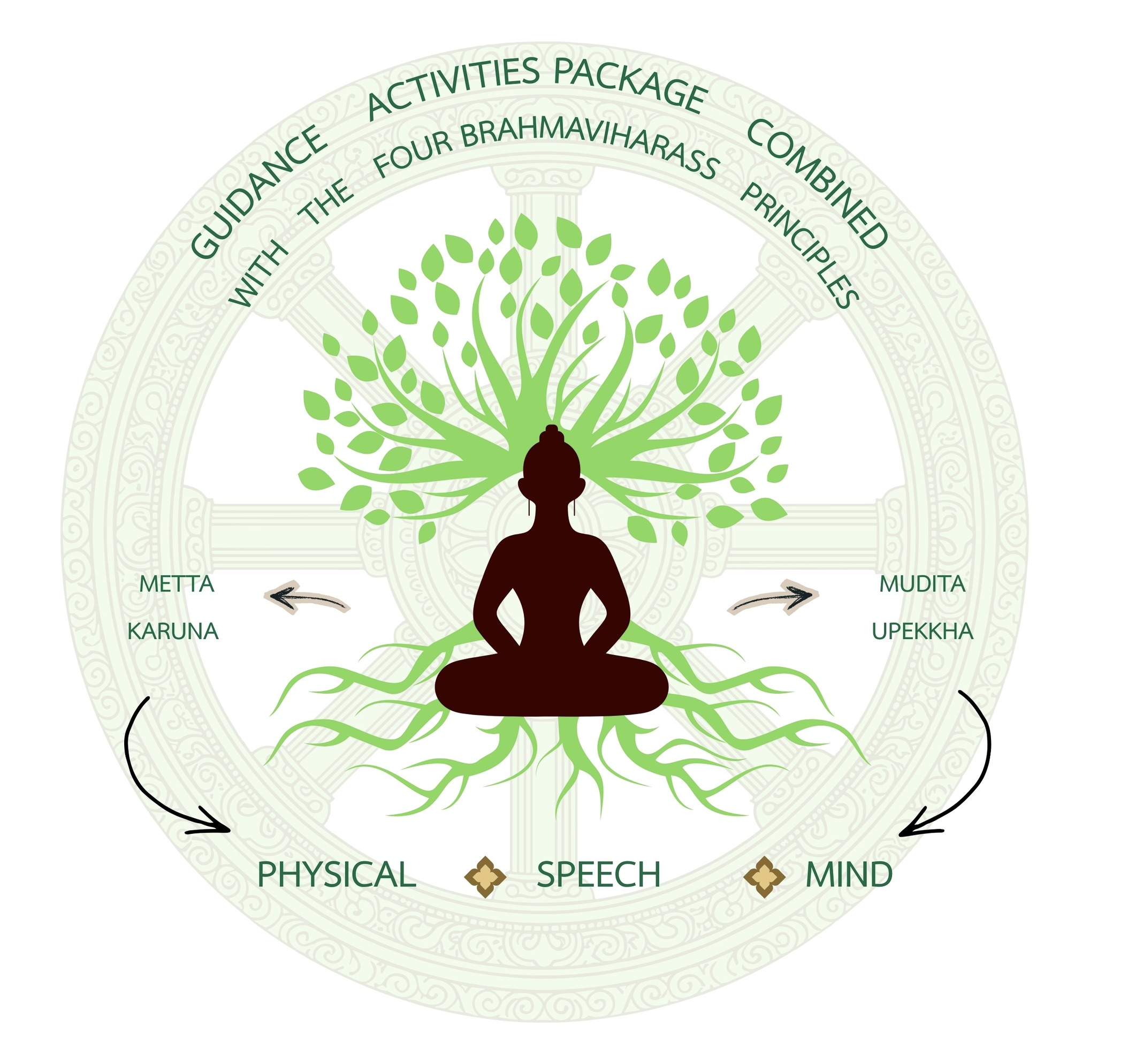
THE EFFECTS OF USING GUIDANCE ACTIVITIES PACKAGE COMBINED WITH THE FOUR BRAHMAVIHARAS PRINCIPLES TO ENHANCE GOOD RELATIONSHIPS WITH FRIENDS AMONG GRADE 6 ELEMENTARY STUDENTS AT SAINT MARY SCHOOL, AYUTTHAYA
Keywords:
Guidance Activity-Package, Four Brahmaviharas, Positive Peer RelationshipsAbstract
Background and Objectives: St. Mary's School in Bang Pa-in District, Phra Nakhon Si Ayutthaya Province, under the Office of the Private Education Commission, offers education from pre-kindergarten to lower secondary level. As a researcher, teacher of ethics at the school, and assistant guidance counselor, I observed that sixth-grade students lack fundamental knowledge of how to build good relationships with their peers. Interviewing teachers and students revealed that most students have difficulties in building relationships by using impolite language, not apologizing for mistakes, not co-helping, and arguing with friends. Furthermore, they still lack polite speech, appropriate behavior, a cheerful demeanor, empathy, and compassion. Therefore, building relationships is crucial, and cultivating these qualities in various ways. The researcher, in the capacity of a Buddhist ethics teacher and assistant guidance counselor at the school, is interested in studying the effectiveness of using guidance activities applying the Four Sublime States of Mind: Loving-kindness, Compassion, Sympathetic Joy, and Equanimity to enhance positive relationships with peers. The objectives of this study were to compare peer relationships of Grade 6 students in the experimental group before and after using the guidance activity set combined with the Four Sublime States, to compare peer relationships between the experimental and control groups after the experiment, and to examine students' satisfaction with the guidance activity set combined with the Four Sublime States.
Methodology: This research used a quasi-experimental design with an experimental and a control group. Measurements were taken in pre-post experiments. The guidance activities focused on applying the Four Sublime States to improve relationships with peers. The following steps were included: 1) Studying relevant concepts, theories, documents, and research to serve as a conceptual framework for creating the guidance activities; 2) Defining operational definitions to guide the activity planning; 3) Developing the guidance activities, incorporating the Four Sublime States of Mind to enhance positive relationships with peers; 4) Checking the quality of the guidance activity set: This was done by having 3 experts with knowledge and understanding of guidance activity set development evaluate its suitability; 5) Revising, revising, and developing the guidance activity set on good relationships with friends according to the experts' recommendations, and 6) Further improving the guidance activity sets on good relationships with friends to make it even more suitable. This will be used in experiments with sample groups and for further data collection.
Main Results: The results showed that: 1) The experimental group students who used the guidance activity set combined with the Four Sublime States had significantly better relationships with their friends after the experiment than before the experiment at the .01 statistical significance level; 2) After using the guidance activity set combined with the Four Sublime States, the good relationships with friends of the experimental group students had significantly different scores at the .01 statistical significance level, and 3) The experimental group students were highly satisfied the guidance activity set combined with the Four Sublime States and their good relationships with their friends.
Involvement to Buddhadhamma: Applied Buddhism emphasizes the development of wisdom and morality through Buddhist practice. The learning activities were designed to integrate the Four Brahmavihāras, mettā (Loving-kindness), karuṇā (Compassion), muditā (Sympathetic Joy), and upekkhā (Equanimity), which cultivate noble qualities in students by fostering kindness, empathy, appreciation of others' success, and impartiality.
Conclusions: The study found that the guidance activity package integrated with the Four Brahmaviharas successfully enhanced positive peer relationships among Grade 6 students. In addition, it introduced an innovative model for guidance counseling that can be applied to similar contexts for fostering social harmony and cooperative learning.
References
Banat, S., Al-Taj, H., Alshoubaki, N. & Younes, W. (2020). The effectiveness of a group counseling program in enhancing the ability to form friendship among academically talented students. Journal for the Education of Gifted Young Scientists, 8(2), 701–710. https://doi.org/10.17478/jegys.679131.
Blackwell, L. S., Trzesniewski, K. H. & Dweck, C. S. (2007). Implicit theories of intelligence predict achievement across an adolescent transition: a longitudinal study and an intervention. Child Development, 78 (1), 246-263.
Çalışkan H. & Kılınç G. (2012). The Relationship Between the Learning Styles of Students and Their Attitudes Towards Social Studies Course. Procedia-Social and Behavioral Sciences, 55(5), 47-56. https://doi.org/10.1016/j.sbspro.2012.09.476.
Capar, G. & Tarim, K. (2015). Efficacy of the Cooperative Learning Method on Mathematics Achievement and Attitude: Meta-Analysis Research. Educational Sciences: Theory and Practice, 15(2), 553-559.
Dewi, Y. T., Pratisti, W. D. & Prasetyaningrum, J. (2019). The Effect of Roleplay to Increase Empathy Toward Students with Disruptive Classroom Behavior. International Summit on Science Technology and Humanity 210-219.
Dong, Y. L., Hallberg, E. T. & Hassard, J. H. (1979). Effects of assertion training on aggressive behavior of adolescents. Journal of Counseling Psychology, 26(5), 459-461.https://doi.org/10.1037/0022-0167.26.5.459.
Jamila. & Rahmawati, H. (2022). The effect of emotion bingo board to improve the ability to recognize emotional expressions of children aged 4-6 years. Journal for the Child Development, Exceptionality and Education, 3(2), 87-94.
Landreth, G.L. (2012). Play therapy: The art of the relationship. New York, United States of America: Routledge.
Mardani, M. & Jahanbazian, T. (2015). A Study into the Effects of Competitive Team-Based Learning and 'Learning Together' on the Oral Performance of Intermediate EFL Learners. Iranian Journal of Research in English Language Teaching, 3(1), 60-73.
Phramaha Waritthon Chan Chuen, Arunwong. R. & Onyon N. (2022). The Development of an Instructional Model Based on Service Learning Approach to EnhanceJunior High School Students' Public Consciousness. Journal of MCU Peace Studies, 10(1), 392-406.
Shigetomi, S. (2007). Publicness and Taken-for-granted Knowledge: A Case Study of Communal Land Formation in Rural Thailand. Dissertation Abstracts International. 42(5), 1-17. https://doi.org/10.20561/00038054.
Yalom, I. D. & Leszcz, M. (2005). The theory and practice of group psychotherapy (5th ed.). New York,United States of America: Basic Books/Hachette Book Group.
Downloads
Published
How to Cite
Issue
Section
License
Copyright (c) 2026 Journal of Buddhist Anthropology

This work is licensed under a Creative Commons Attribution-NonCommercial-NoDerivatives 4.0 International License.