ASSOCIATIONS BETWEEN BUDDHIST PRACTICES AND MENTAL HEALTH PROMOTION IN THAI LATE ADOLESCENTS: A NATIONAL SURVEY DATA
Keywords:
Mental Health Promotion, Buddhist Practices, Late Adolescents, ThailandAbstract
Background and Objective: Despite existing evidence linking Buddhism and mental health, limited research has examined specific Buddhist practices together with demographic factors influencing mental health promotion among Thai late adolescents using empirical national data. This study aimed to examine demographic and Buddhist practice factors associated with mental health promotion among Thai late adolescents aged 17-20 years by using secondary data from
a national survey. The study sought to identify key demographic and Buddhist practice factors contributing to psychological well-being in this population.
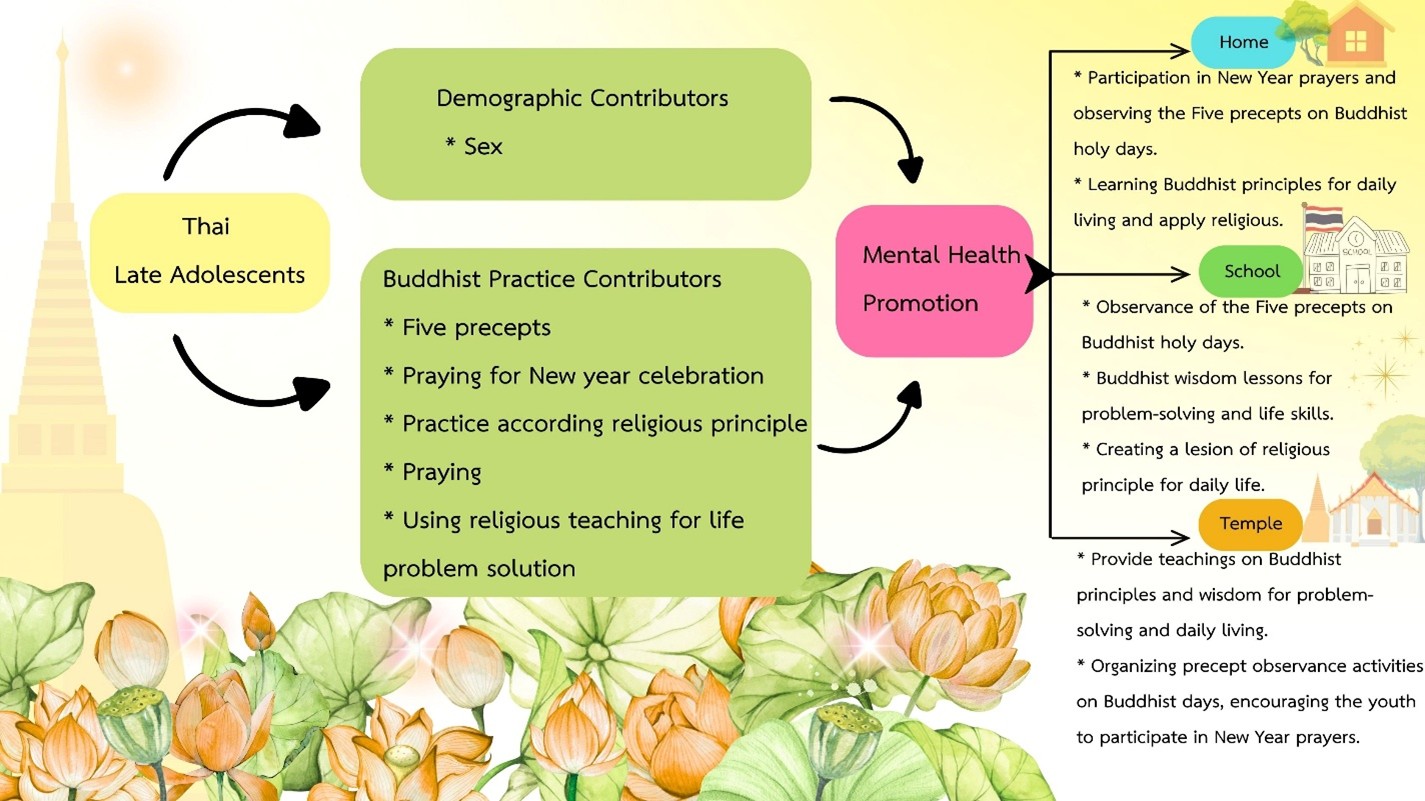
Methodology: The study adopted a cross-sectional research design and utilized secondary data from the 2018 National Survey on the Conditions of Society and Culture, conducted by the National Statistical Office (NSO) of Thailand. The total sample comprised 662 Thai late adolescents. Descriptive analysis was conducted to summarize demographic characteristics, while binary logistic regression analysis was performed to examine demographic and Buddhist practice factors associated with mental health promotion among late adolescents. The variables included demographic factors, such as sex, age, education, marital status, and occupation, as well as Buddhist practices, including praying, offering food to monks, observing the Five Precepts, listening to sermons, meditation, and New Year prayers.
Main Results: The findings indicated that mental health promotion among Thai late adolescents was closely associated with the practical application of core Buddhist principles. Practicing according to religious principles emerged as one of the strongest predictors, highlighting how consistently applied Dhamma, integrating Buddhist teachings into daily decision-making and personal conduct, contributed to inner stability, emotional balance, and overall well-being. Participation in New Year religious rituals demonstrated a significant positive association, illustrating the role of communal Buddhist practices in fostering a sense of social connection, moral support, and shared purpose, which directly enhanced mental well-being. Interestingly, observing the Five precepts showed a slight negative association, suggesting a complex dynamic where strict moral adherence interacted with developmental challenges in late adolescence. The practice of using Buddhist teachings to solve life problems also showed a positive impact, underscoring the value of practical application of Dhamma in coping strategies and promoting resilience. While regular praying had a minor negative association, potentially reflecting its use as a coping mechanism during times of psychological stress overall, the results emphasized that core Buddhist practices, particularly applied Dhamma and participation in communal rituals, played a central role in supporting mental health among Thai late adolescents.
Involvement to Buddhadhamma: This research provided empirical evidence that Buddhist practices functioned as holistic and practical mechanisms for promoting mental well-being among Thai adolescents. The findings reflected the core orientation of Applied Buddhism, which moved beyond doctrinal understanding toward the integration of Dhamma principles, mindfulness (Sati), compassion (Karunā), and ethical conduct (Sīla) into everyday contexts such as education, family life, and community-based programs. In particular, practices such as Ānāpānasati (Mindfulness of Breathing) helped cultivate attentional stability, emotional regulation, and self-awareness, while the Noble Eightfold Path (Ariya Aṭṭhaṅgika Magga) provided an ethical and cognitive framework for right understanding, right action, and balanced living. Together, these applied practices aligned with the Buddhist concept of Sukha (Well-being or Happiness) and contributed to moral development, psychological resilience, emotional balance, and sustainable mental health among the younger generation, fostering a deeper sense of purpose grounded in ethical conduct and spiritual growth.
Conclusions: The study underscored the vital role of Buddhist practices in fostering mental health promotion among Thai late adolescents. These practices not only enhanced individual well-being but also strengthened family and community harmony. Encouraging youth participation in Buddhist-based activities thus served as an effective pathway for building resilience, emotional balance, and holistic mental health in contemporary Thai society, while also nurturing moral values, self-discipline, and social responsibility that contributed to long-term personal growth and sustainable collective well-being.
References
Aggarwal, S., Wright, J., Morgan, A., Patton, G. & Reavley, N (2023). Religiosity and spirituality in the prevention and management of depression and anxiety in young people: a systematic review and meta-analysis. BMC Psychiatry, 23, 729. https://doi.org/10.1186/s12888-023-05091-2.
Abdel-Khalek, A. M. (2015). Happiness, health, and religiosity among Lebanese young adults. Cogent Psychology, 2(1), 1035927. https://doi.org/10.1080/23311908.2015.1035927.
Akib, M. M. M., Ishak, H., Zabidi, A. F. M. Sa'ari, C. Z., Muhsin,S. B. S. & Yahya, N. S. M. (2025). Systematic Literature Review of the Impact of Islamic Psychotherapy on Adolescent Spiritual Well-Being. Journal of Religion and Health, 64, 3365-3405. https://doi.org/10.1007/s10943-025-02304-8.
Behere, P. B., Das, A., Yadav, R. & Behere, A. P. (2013). Religion and mental health. Indian Journal of Psychiatry, 55(2), 187-194, https://doi:10.4103/0019-5545.105526.
Bodhiprasiddhinand, P. (2024). Buddhist Ethics for Improving Health and Well-Being during Pandemics Like COVID-19 with Special References to Modern Scientific Experiments. Religions, 15(4), 511. https://doi.org/10.3390/rel15040511.
Can Oz, Y., Duran, S. & Dogan, K. (2022). The Meaning and Role of Spirituality for Older Adults: A Qualitative Study. Journal of Religion and Health, 61, 1490-1504. https://doi.org/10.1007/s10943-021-01258-x.
Chaiphugdee, D. (2021). Innovative Curriculum Development for Vocational Skill Enhancement and Learning Solution for Underprivileged Youths Using Community Learning Resources. International Journal of Science and Innovative Technology (IJSIT), 4(2), 42-51.
Childs, E. (2010). Religious Attendance and Happiness: Examining Gaps in the Current Literature-A Research Note. Journal for the Scientific Study of Religion, 49(3), 550-560. https://doi.org/10.1111/j.1468-5906.2010.01528.x.
Collinge, W. (1997). The American Holistic Health Association Complete Guide to Alternative Medicine. United States of America, New York: Warner Books.
Estrada, C. A. M., Lomboy, M. F. T. C., Gregorio, E. R. Jr., Amalia, E., Leynes, C. R. Quizon, R. R. & Kobayashi, J. (2019). Religious education can contribute to adolescent mental health in school settings. International Journal of Mental Health Systems, 13, 28. https://doi.org/10.1186/s13033-019-0286-7.
Fincham, F. D. (2022).Towards a Psychology of Divine Forgiveness. Psychology of Religion and Spirituality, 14(4), 451-461. https://doi.org/10.1037/rel0000323.
Francis, L. J. (1998). Happiness is a thing called stable extraversion: a further examination of the relationship between the Oxford Happiness Inventory and Eysencks dimensional model of personality and gender. Personality and Individual Differences, 26(1), 5-11. https://doi.org/10.1016/S0191-8869(98)00185-8.
Galderisi, S., Heinz, A., Kastrup, M., Beezhold, J. & Sartorius, N. (2015). Toward a new definition of mental health. World Psychiatry, 14, 231-233. https://doi.org/10.1002/wps.20231.
Ghaemi, S. N. (2009). The rise and fall of the biopsychosocial model. The British Journal of Psychiatry, 195(1), 3-4. https://doi.org/10.1192/bjp.bp.109.063859.
Hackney, C. H. & Sanders, G. S. (2003). Religiosity and Mental Health: A Meta-Analysis of Recent Studies. Journal for the Scientific Study of Religion, 42(1), 43-55. https:doi.org/10.1111/1468-5906.t01-1-00160.
Johnson, C., Taylor, A., Dray, J. & Dunning, D. (2024). You Can Lead an Adolescent to Mindfulness, but You Can't Make Them Mindful. Mindfulness, 15, 1861-1869. https://doi.org/10.1007/s12671-024-02391-w.
Karimipour, M., Sawari, S. S. M. & Al Hafiz, M. M. (2015). Religion, Spirituality and Mental Health: A Review of Literature. Research Journal of Commerce & Behavioural Science, 5(1), 42-47.
Koenig, H. G., King, D. E. & Carson, V. B. (2012). Handbook of religion and health (2nd ed.). Oxford University Press: Oxford.
Kohlberg, L. (1984). The psychology of moral development: The nature and validity. United States of America: Harper & Row.
Lewis, C. A., Maltby, J. & Burkinshaw, S. (2000). Religion and Happiness: Still no association. Journal of Beliefs & Values, 21(2), 233-236. https://doi.org/10.1080/713675504.
Manchanda, T., Stein, A. & Fazel, M. (2023). Investigating the Role of Friendship Interventions on the Mental Health Outcomes of Adolescents: A Scoping Review of Range and a Systematic Review of Effectiveness. International Journal of Environmental Research and Public Health, 20(3), 2160. https://doi.org/10.3390/ijerph20032160.
Meer, S. & Mir, G. (2014). Muslims and depression: the role of religious beliefs in therapy. Journal of Integrative Psychology and Therapeutics, 2(1), 2. https://doi:10.7243/2054-4723-2-2.
Long, N. H., Thanasilp, S., Chimluang, J., Suwannapong, K., Tantitrakul, W., Taylor-Robinson, A. W., Pudtong, N. & Upasen, R. (2025). Predictive model of death acceptance among Thai Buddhist patients with chronic diseases. BMC Psychology, 13, 399. https://doi.org/10.1186/s40359-025-02711-2.
Onthaisong, S. (2020). Children and Youths Promotion for Buddhist Activity Participation of Monks at Muang District, Chaiyapum Province. Journal of Administration and Social Science Review, 3(1), 41-48.
O'Sullivan, L. & Lindsay, N. (2023). The Relationship between spiritual intelligence, resilience, and well-being in an Aotearoa New Zealand sample. Journal of Spirituality in Mental Health, 25(4), 277-297. https://doi.org/10.1080/19349637.2022.2086840.
Pengpid, S. & Peltzer, K. (2025). Religiosity and Mental and Behavioural Health Among Community-Dwelling Middle-Aged and Older Adults in Thailand: Results of a Longitudinal National Survey in 2015-2020. Journal of Religion and Health, 64, 2053-2068. https://doi.org/10.1007/s10943-025-02280-z.
Pholphirul, P. & Srijamdee, K. (2025). Buddhist practices and mental health outcomes in Thailand. Journal of Religion and Health. https://doi.org/10.1007/s10943-025-02354-y.
Khunkaew, S., Khunkaew, A., Srivisai, T., Kaewprom, C. & Pongpumma, L. (2022). Livedexperiences of nursing students on their clinical practicum among third-year bachelor's program at Borommarajonani Nursing College, Uttaradit. Journal of Nursing and Health Science Research, 14(2), 101-113.
Piaget, J. (1969). The psychology of the child. New York: Basic Books.
World Health Organization & Ministry of Public Health (Thailand). (2021). Global school-based student health survey: Thailand 2021 fact sheet. Geneva, Switzerland: World Health Organization.
Prati, G. (2024). Is religion beneficial for mental health? A 9-year longitudinal study. International Journal of Clinical and Health Psychology, 24(3), 100491. https://doi.org/10.1016/j.ijchp.2024.100491.
Robinson, K. M. (2010). Policy Issues in Mental Health Among the Elderly. Nursing Clinics of North America, 45(4), 627-634. https://doi.org/10.1016/j.cnur.2010.06.005.
Santre, S. (2022). Mental Health Promotion in Adolescents. Journal of Indian Association for Child and Adolescent Mental Health, 18(2), 122-127. https://doi.org/10.1177/09731342221120709.
Singh, K., Junnarkar, M., Singh, D., Suchday, S., Mitra, S. & Dayal, P. (2020). Associations Between Religious/Spiritual Practices and Well-Being in Indian Elderly Rural Women. Journal of Religion and Health, 59, 2753-2774. https://doi.org/10.1007/s10943-019-00877-9.
Steinberg, L. (2014). Adolescence (10th ed.). New York: McGraw-Hill Education.
Tosyali, F., Coban-Tosyali, E. & Harma, M. (2024). Predictors of Subjective Health Among Spouses and Its Relations With Happiness: A Multilevel Analysis in a Nationwide Survey in Turkey. Journal of Happiness Studies, 25(62). https://doi.org/10.1007/s10902-024-00769-0.
Vaillant, G. E. (2012). Positive mental health: is there a cross-cultural definition?. World Psychiatry, 11(2), 93-99, https://doi.org/10.1016/j.wpsyc.2012.05.006.
Vithana, C., Lokubalasooriya, A., Pragasan, G., Mahagamage, K. L., Nanayakkara, K., Herath, H. P., Karunarathna, P., Perera, N., De Silva, C., Jayawardene, D. & Wickramasinghe, N. D. (2023). Effectiveness of an educational intervention to promote psychosocial well-being of school-going adolescents in Sri Lanka. BMC Public Health, 23, 2185. https://doi.org/10.1186/s12889-023-17023-6.
Vitorino, L. M., Lucchetti, G., Leão, F. C., Vallada, H. & Peres, M. F. P. (2018). The association between spirituality and religiousness and mental health. scientific reports, 8, 17233. https://doi.org/10.1038/s41598-018-35380-w.
Winzer, L. & Gray, R. S. (2019). The Role of Buddhist Practices in Happiness and Health in Thailand: A Structural Equation Model. Journal of Happiness Studies, 20, 411-425. https://doi.org/10.1007/s10902-017-9953-z.
Winzer, L., Samutachak, B. & Gray, R. S. (2018). Religiosity, Spirituality, and Happiness in Thailand from the Perspective of Buddhism. Journal of Population and Social Studies, 26(4), 332-343.
Zotti, R., Speziale, N. & Barra, C. (2016). On the causal effect of religiosity on life satisfaction using a propensity score matching technique. International Journal of Social Economics, 43(10), 1031-1048. https://doi.org/10.1108/IJSE-12-2014-0262.
Downloads
Published
How to Cite
Issue
Section
License
Copyright (c) 2025 Journal of Buddhist Anthropology

This work is licensed under a Creative Commons Attribution-NonCommercial-NoDerivatives 4.0 International License.