A THEORY OF BUDDHISM INTEGRATION FOR SUSTAINABLE DEVELOPMENT OF WISDOM AND VIRTUE IN THE 21ST CENTURY
Keywords:
Buddhism Integration, Sustainable Development, 21st Century, Theory, Wisdom and VirtueAbstract
Background and Objectives: All things in the universe are mysteriously encrypted, subject to the rule of nature. Integrating knowledge is the only key to understanding them. In Buddhism, all objects contain microscopic elementary particles that cannot be seen with the naked eye. Theories of religious integration have been less visible despite the widespread integration of science and Buddhism. The Buddha sees all things with wise eyes. Likewise, a wise one should not solely look at the world and all things with just the physical eyes, but with wisdom. A person with a vision of wisdom can see nature as it really is. A holistic view is a key feature in deeply and wisely considering (Yoniso-manasikāra) the integration phenomena of different fields and disciplines. Integration reflects a study method that integrates Buddhism and modern science. This qualitative research work aimed to address that need. This paper aimed to achieve three objectives: To investigate the development of wisdom and virtue in the 21st century according to Buddhism and the United Nations Sustainable Development Goals (SDGs), to create a theory of Buddhism integration for the sustainable development of wisdom and virtue in the 21st century, and to validate a theory of Buddhism integration for the sustainable development of wisdom and virtue in the 21st century.
Methodology: A qualitative research design was employed. Data were collected from documentary and field studies with 25 experts and scholars, from 11 countries, who were monks and Buddhist scholars from the three Buddhist sects, selected using the purposive and snowball sampling method. In-depth interviews with 15 key informants were carried out to create the theory. The theory was validated through the Focus Group Discussions FGDs among 10 specialists. The interview forms were examined with the CVI by five experts. Data were analyzed using content, thematic, discourse, narrative, and grounded theory analysis.
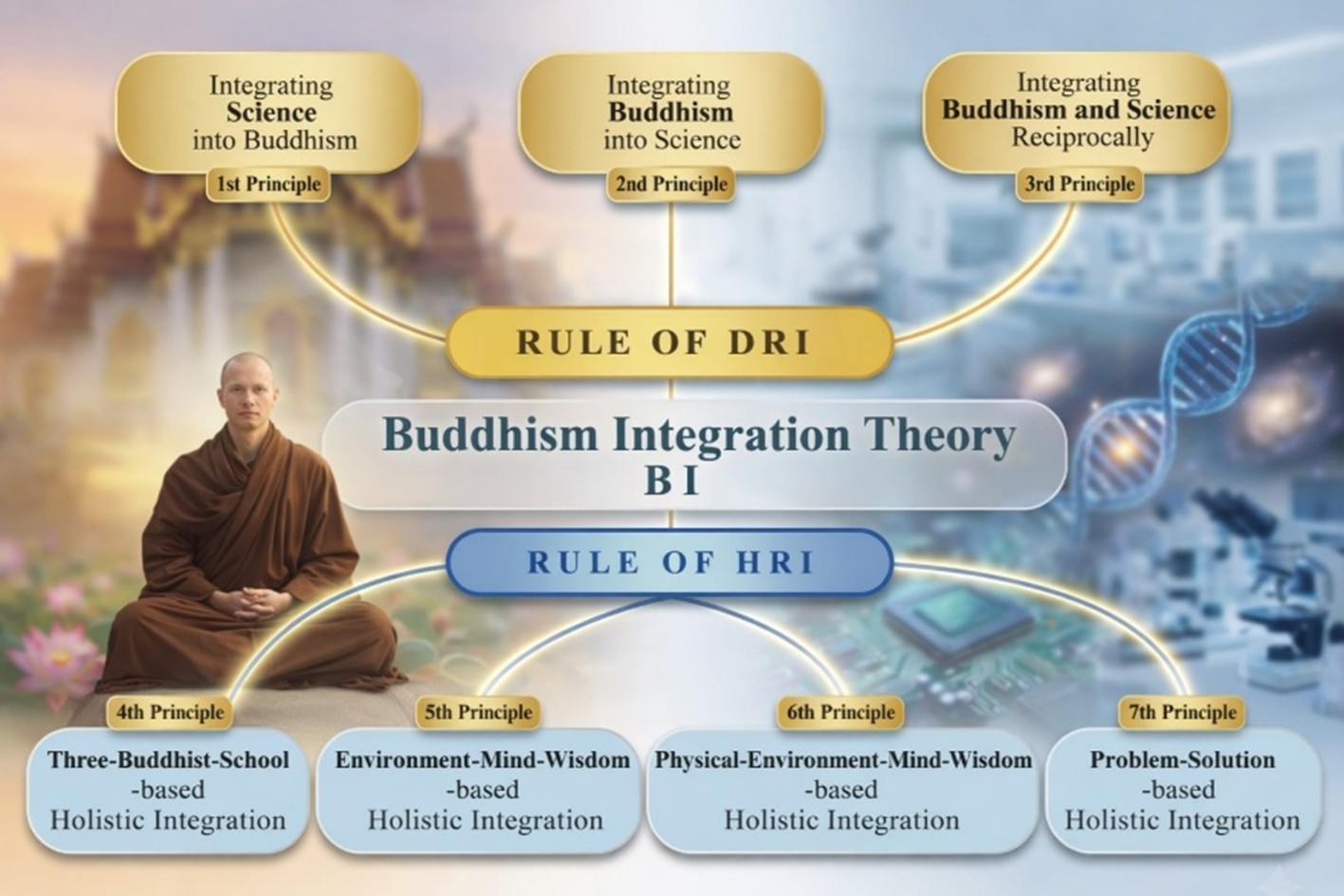
Main Results: The findings suggested that the wisdom-virtue framework from the three Buddhist schools reflected a holistic learning approach aligned well with the SDGs. The Theory of Buddhism Integration (BI) sustainably developed the wisdom and virtue of humankind in the 21st Century. The Rule of Dual-Relational Integration (DRI) governed three principles, namely: First principle-integrating science into Buddhism, second principle-integrating Buddhism into science, and third principle-integrating Buddhism and science reciprocally. The Rule of Holistic-Relational Integration (HRI) governed four principles, namely: Fourth principle-three-Buddhist-school-based holistic integration, fifth principle-environment-mind-wisdom-based holistic integration, sixth principle-physical-environment-mind-wisdom-based holistic integration, and seventh principle-problem-solution-based holistic integration. The seven principles explained different phenomena of dual and multidimensional integration for Buddhism-multidisciplinary-based integrators around the globe. The goal of the BI Theory was the sustainable development of wisdom and virtue through an integral perspective.
Involvement to Buddhadhamma: This breakthrough involves a scholarly engagement with the principles of wisdom and virtue through the reciprocal integration between Buddhadhamma and scientific inquiry. It harmonizes self-development, holistic insight, and environmental mindfulness, serving as a theoretical framework for sustainable human development aligned with the Buddha's epistemological and ethical vision of reality.
Conclusions: In the dynamic landscape of the twenty-first century, the cultivation of wisdom and morality within the three Buddhist sects reveals both shared and distinct characteristics unique to each tradition. These developments align harmoniously with the principles of the UN SDGs. The multidimensional integration of Buddhism, science, and other disciplines in this era is examined through the Seven Principles of DRI and the HRI rules within the framework of the BI Theory. By harmonizing theoretical contributions and practical implications for sustainable development, the theoretical novelty of the BI Theory advances beyond existing integrative or Wilberian models by minimizing conceptual overlap and clarifying theoretical boundaries.
References
Aguinis, H. (2024). Research Methodology: Best Practices for Rigorous, Credible, and Impactful Research. California, United States of America: SAGE Publications.
Bodhi, B (tr.). (2000). The Connected Discourses of the Buddha. A new Translation of the Saṃyutta Nikāya (Vols. 1-2). Oxford, United Kingdom: Pali Text Society.
Bodhi, B (tr.). (2012). The Numerical Discourses of the Buddha: A Translation of the Aṅguttara Nikāya. Massachusetts, United States of America: Wisdom Publications.
Bodhi, B. (2023). A theory of Buddhism integration for sustainable development of wisdom and virtue in the 21st century. (Mahatthanadull, S., Interviewer)
Brahmali, B. (2023). A theory of Buddhism integration for sustainable development of wisdom and virtue in the 21st century. (Mahatthanadull, S., Interviewer)
Carpenter, J. E. (Ed.). (1976). The Dīgha Nikāya. (Vol. 3; In Pali). London, United Kingdom: Routledge & Kegan Paul.
Cerin, P. (2006). Bringing economic opportunity into line with environmental influence: A discussion on the Coase theorem and the Porter and van der Linde hypothesis. Ecological Economics, 56(2), 209-225. https://doi.org/10.1016/j.ecolecon.2005.01.016.
Cherdsak. M. (2023). A theory of Buddhism integration for sustainable development of wisdom and virtue in the 21st century. (Mahatthanadull, S., Interviewer)
Collins, G. R. (2000). An integration view. In Johnson, E. L. & Jones, S. L. (Eds.), Psychology & Christianity: Four views. (pp. 102-129). Illinois, United States of America: InterVarsity Press.
Davids, R. (ed.). (1978). The Vibhaṅga: Being the Second book of The Abhidhamma Piṭaka. (In Pali). London, United Kingdom: Pali Text Society.
Denver, D. (2022). The Dharma in DNA: Insights at the Intersection of Biology and Buddhism. New York, United States of America: Oxford University Press.
Feer, M. L. (Ed.). (1975). Saṃyutta-Nikāya. Part III. Khandha-Vagga. (In Pali). London, United Kingdom: Pali Text Society.
Feer, M. L. (1976). Saṃyutta-Nikāya. Part V. Mahā-Vagga. (In Pali). London, United Kingdom: Pali Text Society.
Feer, M. L. (1990). Saṃyutta-Nikāya. Part IV. Saḷāyatana-Vagga. (In Pali). Oxford, United Kingdom: Pali Text Society.
Green, J. B. (2005). Body and Soul, Mind and Brain: Critical Issues. In Green, J. B., & Palmer, S. L. (Eds.), In Search of the Soul: Four Views of The Mind-Body Problem (pp. 7-32). Illinois, United States of America: InterVarsity Press.
Hardy, E. (Ed.). (1976). The Aṅguttara- Nikāya. Part III. Pañcaka-nipāta, and Chakka-nipāta. (In Pali). London, United Kingdom: Pali Text Society.
Hare, E. M. (Ed.). (1973). The book of the gradual sayings (Anguttara Nikāya). (Vol. 3: The books of the fives and sixes) (In Pali). London, United Kingdom: Pali Text Society.
Hazari, A. (2023). Research Methodology for Allied Health Professionals: A comprehensive guide to Thesis & Dissertation. Gateway East, Singapore: Springer. https://doi.org/10.1007/978-981-99-8925-6.
Jones, S. L. (2010). An integration view. In Johnson, E. L. (Ed.), Psychology & Christianity: Five views (pp. 101-128). Illinois, United States of America: InterVarsity Press.
Karba, R., Kocijan, J., Bajd, T., Karer, M. Ž. & Karer, G. (2023). Terminological Dictionary of Automatic Control, Systems and Robotics. Cham, Switzerland: Springer. https://doi.org/10.1007/978-3-031-35755-8.
Long, H. T. N, Phramaha Somphong Guṇākaro & Mahatthanadull, S. (2022). The Buddhist Emotional Intelligence Management: An Integration of Daniel Goleman's Theory and Theravāda Perspective. Journal of International Buddhist Studies, 13(2), 1-23.
Mastny, L. & Trumbull, K. (2022). Renewable energy data in perspective: Drawn from the Renewables 2022 Global Status Report. Paris, France: REN21 Secretariat.
Mertens, D. M. (2024). Research and Evaluation in Education and Psychology: Integrating Diversity With Quantitative, Qualitative, and Mixed Methods (6th ed.). California, United States of America: Sage.
Morgan, D. L. (2019). Focus groups. In Jupp, V. (Ed.), The SAGE Dictionary of Social Research Methods (pp. 121-122). London, United Kingdom: SAGE Publications Ltd.
Morris, R. (ed.). (1961). The Aṅguttara-Nikāya: Part I, Ekanipāta, Dukanipāta, and Tikanipāta (2nd ed., In Pali). London, United Kingdom: Pali Text Society.
Nakamori, Y. (2020). Fusing Systems Thinking with Knowledge Management. Journal of Systems Science and Systems Engineering, 29, 291-305. https://doi.org/10.1007/s11518-019-5450-8.
Ñānamoli, B. & Bodhi, B. (Trs.). (2001). The Middle Length Discourses of the Buddha. Oxford, United Kingdom: Pali Text Society.
Nicholson, H. (2023). Buddhism, Cognitive Science, and the Doctrine of Selflessness: A Revolution in Our Self-Conception. Abingdon, United Kingdom: Routledge.
Pakkan, S., Sudhakar, C., Tripathi, S. & Rao, M. (2023). A correlation study of sustainable development goal (SDG) interactions. Quality and Quantity, 57, 1937-1956. https://doi.org/10.1007/s11135-022-01443-4.
Panvong, W., Wongsuwan, N. & Bubpaphan, S. (2022). Learning Management Social Studies By Using Problem Base Learning (PBL) For 3rd Secondary Students. Journal of Management and Local Innovation, 4(4), 95-106.
Paṭhamakyaw Ashin Thiṭṭila (Seṭṭhila) Aggamahāpaṇḍita (Tr.). (1995). The book of analysis (Vibhanga). Oxford, United Kingdom: Pali Text Society.
Reynhout, K. A. (2007). The Hermeneutics of Transdisciplinarity: A Gadamerian Model of Transversal Reasoning. Transdisciplinarity in Science and Religion, 2, 77-101.
Rosen, A. M. (2019). Effective Research Methods for Any Project. Chantilly, France: The Great Courses.
Sandage, S. J. & Brown, J. K. (2018). Relational Integration of Psychology and Christian Theology: Theory, Research, and Practice. New York, United States of America: Routledge.
Savery, J. R. (2006). Overview of Problem-based Learning: Definitions and Distinctions. Interdisciplinary Journal of Problem-Based Learning, 1(1), 9-20. https://doi.org/10.7771/1541-5015.1002.
Sorenson, R. L. (1996). The Tenth Leper. Journal of Psychology and Theology, 24(3), 197-211. https://doi.org/10.1177/009164719602400302.
Soucy, A. (2020). Women and Vietnamese Buddhist practice in the shadow of secularism. In Harding, John S., Hori, Victor Sōgen. & Alexander Soucy (Eds.), Buddhism in the Global Eye: Beyond East and West (pp. 56-68). London, United Kingdom: Bloomsbury Publishing Plc.
Strickland, M. (2019). Relativistic quantum field theory: Vol. 2. Path integral formalism. California, United States of America: Morgan & Claypool Publishers.
Sutcha, S. & Tungkasamit, A. (2024). The study of logical thinking ability using Ariyasacca-based learning with card games in the subject S16101 Social Studies of Grade 6 students at Chumchonyodkaengsongkro School, Kalasin Province. Journal for Developing the Social and Community, 11(1), 447-460.
Thanaboripat, D. (2020). Transgenic Animals and Buddhist Law of Action (Kamma). The Journal of International Buddhist Studies College, 6(2), 21-31.
Trenckner, V. (Ed.). (1979). The Majjhima-Nikāya (Vol. 1, In Pali). London, United Kingdom: Pali Text Society.
Ven. Geshe Sonam Wangden. (2023). A theory of Buddhism integration for sustainable development of wisdom and virtue in the 21st century. (Mahatthanadull, S., Interviewer)
Ven. Nguyen Anh Tuan, Phramaha Hansa Dhammahaso & Mahatthanadull, S. (2021). A Buddhist approach of socially engaged Buddhism for a skillful communication. Journal of International Buddhist Studies, 12(2), 64-75.
Völker, F. (2022). Methodology and Mysticism: For an Integral Study of Religion. Religions, 13(2), 161. https://doi.org/10.3390/rel13020161.
Walleser, M. & Kopp, H. (Eds.). (1967). Manorathapūranī Buddhaghosa's commentary on the Aṅguttara-Nikāya. (Vol. 2: Eka-Duka-Tika-Nipāta-Vaṇṇanā, In Pali) (2nd ed.). London, United Kingdom: Pali Text Society.
Walshe, M (tr.). (1987). Thus have I heard: The long discourses of the Buddha (Dīgha Nikāya). London, United Kingdom: Wisdom Publications.
Wilber, K. (1998). The marriage of sense and soul: Integrating science and religion. New York, United States of America: Random House.
Wilber, K. (2006). Integral Spirituality: A Startling New Role for Religion in the Modern and Postmodern World. London, United Kingdom: Integral Books.
Wolters, A. (2007). No longer queen: The theological disciplines and their sisters. In Jeffrey, D. L. & Evans, C. S. (Eds.), The Bible and the University (pp. 59-79). Michigan, United States of America: Zondervan.
Wong, B. T. T. (2022). Physics of Buddhism. The physics and mathematics foundation of Buddhism. Pokfulam, Hong Kong: CERN.
Zainuri, A., Sukarno, S. & Huda, M. (2022). Understanding Scientific Literacy and Pedagogy Competence: A Critical Insight into Religious Integration Thinking Skills. Journal of Educational and Social Research, 12(1), 273-281. https://doi.org/10.36941/jesr-2022-0022.
Zhang, Z. (2022). Research on the Strategy of Integration of Information Technology and Inorganic Chemistry in Senior High School. BCP Social Sciences & Humanities, 20, 450-454. https://doi.org/10.54691/bcpssh.v20i.2358.
Downloads
Published
How to Cite
Issue
Section
License
Copyright (c) 2026 Journal of Buddhist Anthropology

This work is licensed under a Creative Commons Attribution-NonCommercial-NoDerivatives 4.0 International License.