A DIGITAL PLATFORM FOR BUDDHIST INNOVATIONS OF THE SAPPĀYAS 7 FOR TOURISM AND SUSTAINABLE POVERTY ALLEVIATION IN KOH LAD E-THEAN
Keywords:
Digital Platform (Design), Buddhist Sappāyas 7 Innovation (Framework), Koh Lad E-Thean, Poverty Alleviation (Sustainable)Abstract
Background and Objectives: Amidst rural economic stagnation and urban migration, local communities increasingly face labor shortages and fragile social structures. To alleviate sustainable poverty, digital platform activities have applied the Buddhist Sappayas 7 Innovations in Koh Lad E-Thean tourist attractions. This study explores the application of contemporary Buddhism to revitalize these communities, integrating traditional Buddhist knowledge with modern practices to foster wisdom, morality, and sustainable economic growth. This study aimed to investigate community and tourism-related data, develop a digital platform based on the Buddhist Sappāyas 7 Innovations, utilize, and evaluate the developed platform, and disseminate the innovation to promote sustainable poverty alleviation in Koh Lad E-Thean.
Methodology: Utilizing Participatory Action Research (PAR), this study engaged community leaders, villagers, universities, and religious organizations. A mixed-methods approach was employed, including platform development, community workshops, and a pre-post activity intervention with 30 key participants to measure economic and behavioral shifts.
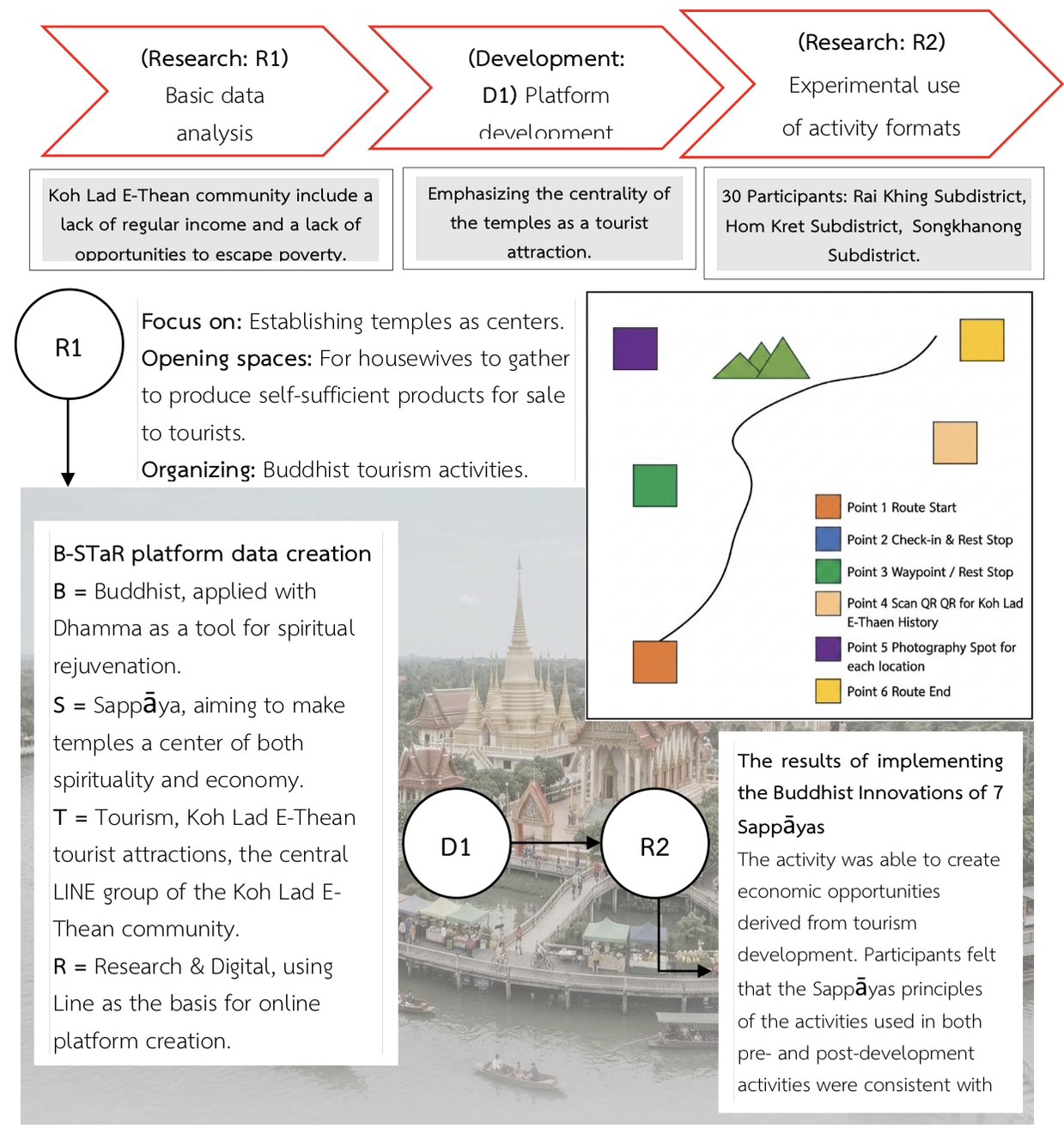
Main Results: Digital innovation platform was a technological infrastructure that integrated tools, data, and systems (Such as IoT, AI, and Cloud) to help organizations develop new products, services, or work processes (Digital Transformation), increasing efficiency, reducing costs, and creating a competitive advantage through a collaborative ecosystem, and organizations that can properly utilize the potential of the platform while enabling to access and leverage data to possibly create the greatest business advantage. The findings are organized into four progressive phases: The BSTR Model: Initial data revealed that traditional agriculture generated insufficient income, leaving temples uniquely positioned to act as spiritual and economic anchors. The Buddhist Spiritual Tourism and Resilience (BSTR) Model was created to establish a "Buddhist Digital Community" that harmonizes learning, spirituality, and local economies to achieve long-term poverty alleviation. The Avas Sappāyas Platform: A digital ecosystem was developed, integrating the remaining Sappāyas components: Gōcara (Eco-tourism Connectivity), Phassa (Cultural-intellectual Tourism Collaborations), Pukkhala (Fostering Mindful, Hospitable Community Members), Bhōchana (Reviving Mindful Local Culinary Heritage), Utu (Zero-pollution Eco-tourism), and Iriyāpatha (Converting Daily Physical Movement into Spiritual and Economic Value). Intervention Outcomes: Evaluation of 20 community activities among the 30 participants demonstrated statistically significant pre-to-post improvements. These activities directly generated new tourism-driven economic opportunities aligned with poverty reduction metrics. Dissemination & Training: The framework was scaled through YouTube training and hands-on workshops. Community leaders and villagers successfully designed localized tourist routes, demonstrated mindful food preparation, and implemented the "Move Freely, Travel Fun, and Cultivate Sustainable Lifestyles" campaign to ensure physical safety and tourist engagement.
Involvement to Buddhadhamma: This manuscript applies Buddhist principles, specifically the Sappāyas 7, to the development of wisdom and morality in contemporary tourism. By translating the Sappāyas 7 into digital and experiential formats, the project enables tourists and practitioners to engage with and understand Buddhist wisdom and morality from a practical, modern perspective.
Conclusions: This study offers significant academic and practical contributions by pioneering the concept of "Smart Buddhist Cultural Tourism." Methodologically, it demonstrates how PAR can bridge traditional spiritual practices with technological innovations. In practice, the Avas Sappāyas platform serves as a replicable template to standardize local temples and communities into "Smart Buddhist Tourist Sites," effectively integrating environmental, social, and economic facets to achieve sustainable, long-term poverty alleviation.
References
Arpornpisal, C., Vuthimedhi, Y. & Sangsuwan, T. (2019). A study of Components of Factors Influencing to Effective Managementof Community Enterprises in the Central Region of Thailand. Journal of Social Academic, 12(1), 195-203.
Chanyam, T., Mola, A. & Wongwatthanaphong, K. (2023). Sustainable Community Enterprise Development Policy to Strengthen the Local Economy. Interdisciplinary Academic and Research Journal, 3(4), 575-586. https://doi.org/10.14456/iarj.2023.208.
Chatchakul, N. (2011). Tourism Industry (3rd ed.). Bangkok, Thailand: Chulalongkorn University Press.
Deeprasert, J. & Yimprasert, U. (2023). Developing Thailand's Koh Lad E-Tan as a sustainable community tourism destination. Kasetsart Journal of Social Sciences, 44(4), 1219-1228.
Khansud, P. & Wongthanavasu, S. (2020). A Model of Poverty Alleviation in the Northeast of Thailand by the Royal Initiative Discovery Foundation. Local Administration Journal, 13(2), 137-152.
Mahatthanadull, S., Phramaha Nantakorn Piyabhani, Ven. Neminda, Ven. Anh Tuan, N., Ven. Tshering, U., Thanaboripat, D. & Mahatthanadull, S. (2026). Integration of Theravāda Buddhist wisdom and virtue for sustainable development in the 21st century. Kasetsart Journal of Social Sciences, 46(4), 460408.
Phra Natthapon Khemmakuno. (2023). An Application of the Seven Principles of Sappāya in the Development of Wat Bang Wong in Thung Yai District, Nakhon Si Thammarat Province. Journal of Buddhist Anthropology, 8(2), 150-162.
Phra Phromkunabhorn (P.A. Payutto). (2014). Buddhist Dictionary: A Compilation of Dhamma (27th ed.). Bangkok, Thailand: Mahachulalongkornrajavidyalaya University.
Phrasamran Thitawinyo (Chuechan), Matham S. & Phrasamuh Thongchai Sundarācāro. (2024). MANAGEMENT OF CULTURAL TOURISM RESOURCES ACCORDING TO THE SAPPAYA PRINCIPLE OF TEMPLES IN PAK CHONG DISTRICT NAKHONRATCHASIMA PROVINCE. Journal of Mani Chettha Ram Wat Chommani, 7(2), 350-365.
Phrompanyo, M. (2013). MANAGEMENT GUIDLINE FOR RELIGIOUS TOURISM TOWARD THEASEAN COMMUNITY: UBONRATCHATHANI PROVINCE. Journal of Thai Hospitality and Tourism, 8(2), 36-47.
Somnuxpong, S. & Chiarasumran, N. (2024). A Study of the Environmental, Economic, and Social/Cultural Impacts of Historical and Cultural Tourism in the Old Town District of Chiang Mai: Evaluating the Sustainable Development Possibilities for a Destination under Consideration as a World Heritage Site. J Sustain Res, 6(3), e240047. https://doi.org/10.20900/jsr20240047.
Thekingkiat, S. & Chomchaiya, C. (2023). Thai people's perception channels of the government's Soft Power display at APEC 2022. Thai Media Fund Journal, 2(1), 14-41.
Downloads
Published
How to Cite
Issue
Section
License
Copyright (c) 2026 Journal of Buddhist Anthropology

This work is licensed under a Creative Commons Attribution-NonCommercial-NoDerivatives 4.0 International License.