CONSUMER ATTITUDES TOWARD UNMANNED CONVENIENCE STORES IN THAILAND: APPLYING THE YONISOMANASIKARA APPROACH
Keywords:
Unmanned Convenience Stores, Consumer Attitudes, Technology Acceptance Model (TAM), Yonisomanasikara Approach, TrustAbstract
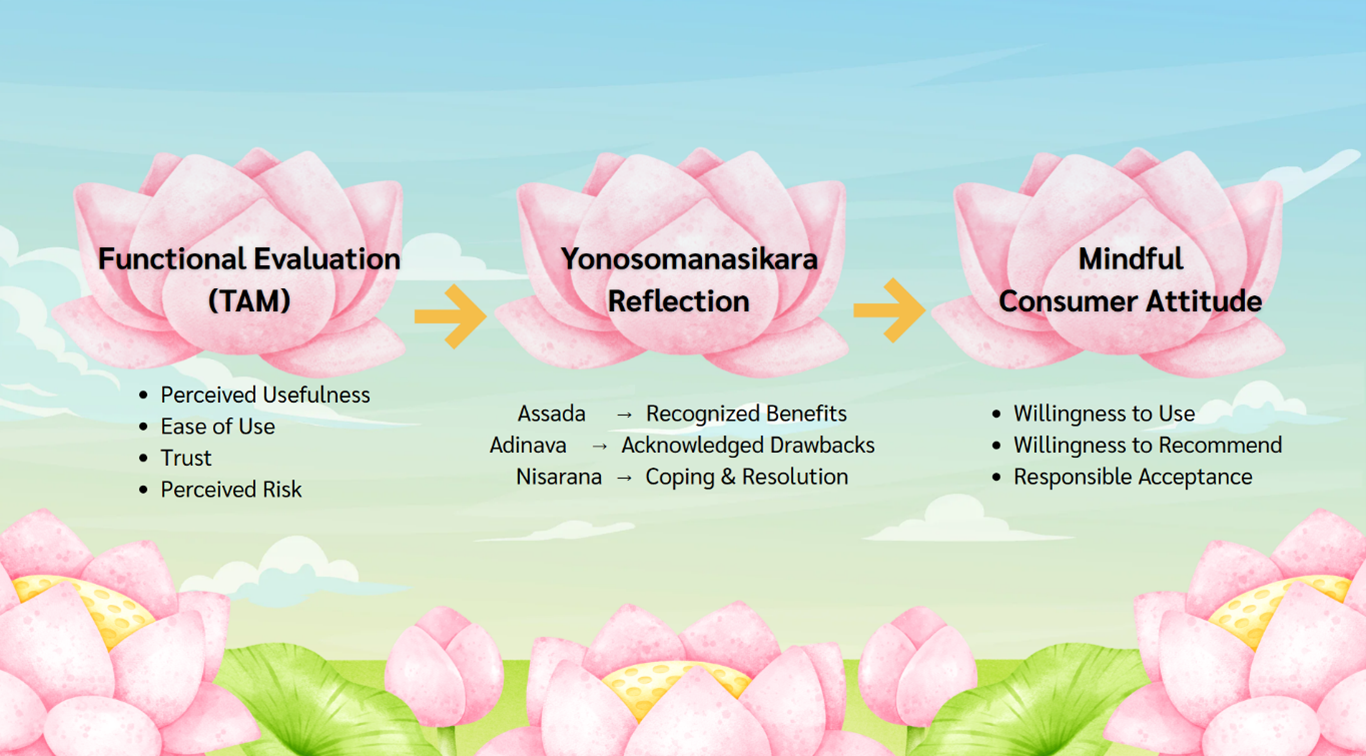
Background and Objectives: Unmanned convenience stores represent an emerging retail innovation that integrates artificial intelligence, the Internet of Things, and automated payment systems to deliver cashierless shopping experiences. Although these formats have expanded rapidly in technologically advanced economies, consumer acceptance remains uneven due to concerns related to trust, privacy, system reliability, and the absence of human interaction. Previous studies have predominantly examined these issues through functional and instrumental perspectives, often overlooking reflective, ethical, and culturally embedded dimensions of consumer decision-making. In particular, technology acceptance research grounded in the Technology Acceptance Model (TAM) has emphasized perceived usefulness and trust while paying comparatively limited attention to culturally informed reflective reasoning. In Thailand, unmanned convenience stores are still at an early stage of diffusion, and empirical research on consumer attitudes toward this retail format remains limited. Given Thailand's strong Buddhist cultural context, understanding technology acceptance through reflective and mindful evaluation is particularly relevant. Accordingly, this study pursued multiple interrelated objectives. First, it examined demographic and behavioral determinants of consumer attitudes toward unmanned convenience stores. Second, it analyzed perceived benefits (Assada) associated with unmanned retail systems. Third, it investigated perceived drawbacks (Adinava) and coping mechanisms (Nissarana) that influence consumer acceptance. Finally, it integrated the Yonisomanasikara reflective framework with established Technology Acceptance Model (TAM) constructs to assess its incremental explanatory power.
Methodology: A quantitative, cross-sectional survey was conducted with 396 consumers in Chonburi Province, Thailand, using a multi-stage sampling technique to capture urban, suburban, and tourism-related consumer segments. A structured questionnaire measured demographic characteristics, shopping behavior, TAM constructs (Perceived Usefulness, Ease of Use, Perceived Risk, Trust, and Attitude), and the three dimensions of Yonisomanasikara: Asada (Benefits), adinava (Drawbacks), and nissarana (Coping or Resolution). Hierarchical regression analysis was employed to compare a baseline TAM model with an extended integrative model incorporating reflective cognition.
Main Results: The results indicated generally positive consumer attitudes toward unmanned convenience stores. While perceived usefulness and trust significantly predicted attitudes in the baseline TAM model, hierarchical regression analysis revealed that the inclusion of Yonisomanasikara constructs significantly enhanced explanatory power. Most notably, nissarana emerged as the strongest predictor of consumer attitude, suggesting that acceptance was shaped not merely by recognizing benefits or minimizing risks, but by the ability to cognitively reconcile perceived drawbacks through reflective coping. Even when perceived risks and drawbacks were acknowledged, attitudes remained favorable when credible coping mechanisms were identified.
Involvement to Buddhadhamma: This study is positioned within Applied Buddhism. By empirically operationalizing Yonisomanasikara, a core Buddhist principle of wise reflection and analytical discernment, the research demonstrates how Buddhist cognitive training can inform contemporary technology acceptance behavior. The integration of Yonisomanasikara with the Technology Acceptance Model (TAM) positions Buddhist analytical reasoning as a reflective mechanism that shapes consumer evaluation beyond instrumental rationality. This applied approach illustrates the relevance of Buddhist principles in understanding modern digital retail systems and their implications for Buddhism and sustainable development.
Conclusions: The study concludes that reflective coping and resolution (Nissarana) constitute the most critical determinant of Thai consumers' attitudes toward unmanned convenience stores. Demographic characteristics exert comparatively limited influence, reinforcing the argument that acceptance is shaped more by reflective cognitive processing than by static personal attributes. Integrating Yonisomanasikara with TAM provides a culturally sensitive and ethically grounded framework that explains consumer acceptance as a process of mindful evaluation rather than uncritical adoption. The findings contribute to Buddhist-informed consumer research and offer guidance for designing unmanned retail systems that foster trust, transparency, and responsible engagement.
References
Ajzen, I. (2008). Consumer attitudes and behavior. In C. P. Haugtvedt, P. M. Herr, & F. R. Kardes (Eds.), Handbook of consumer psychology (pp. 525-548). United States, United States of America: Lawrence Erlbaum Associates.
Bombaerts, G., Anderson, J., Dennis, M., Gerola, A., Frank, L., Hannes, T., Hopster, J., Marin, L. & Spahn, A. (2023). Attention as practice. Global Philosophy, 33, 25. https://doi.org/10.1007/s10516-023-09680-4.
Chen, H., Yu, S., Huang, F., Zhu, B., Gao, L. & Qian, C. (2020). Spatio-temporal analysis of retail customer behavior based on clustering and sequential pattern mining. 2020 3rd International Conference on Artificial Intelligence and Big Data (ICAIBD) (pp. 284-288). Chengdu, China: IEEE. https://doi.org/10.1109/ICAIBD49809.2020.9137465.
Dastorani, M. & Khoshneshin, Z. (2017). An analytic review on the factors that affect Technology Acceptance Model (TAM) in Iranian universities. Interdisciplinary Journal of Virtual Learning in Medical Sciences, 8(2), e56028. https://doi.org/10.5812/ijvlms.56028.
Davis, F. D. (1989). Perceived Usefulness, Perceived Ease of Use, and User Acceptance of Information Technology. MIS Quarterly, 13(3), 319-340. https://doi.org/10.2307/249008.
de Luca, P. & Pegan, G. (2011). Prodotti verdi: Uno studio sperimentale sugli atteggiamenti e sulle scelte del consumatore. Micro & Macro Marketing, Rivista quadrimestrale, 2, 301-322. https://doi.org/10.1431/35142.
Denuwara, N., Maijala, J. & Hakovirta, M. (2021). The impact of unmanned stores' business models on sustainability. SN Business & Economics, 1, 143. https://doi.org/10.1007/s43546-021-00136-8.
Diana, M. G., Mascia, M. L., Tomczyk, Ł. & Penna, M. P. (2025). The Digital Divide and the Elderly: How Urban and Rural Realities Shape Well-Being and Social Inclusion in the Sardinian Context. Sustainability, 17(4), 1718. https://doi.org/10.3390/su17041718.
Dunggio, N. A. & Rasyid, R. (2024). The effect of financial risk, product risk, and security risk on online purchase intention with trust as a mediating variable for Make Over cosmetic products purchased online on Lazada. International Journal of Economics and Management Research, 3(2), 395-408. https://doi.org/10.55606/ijemr.v3i2.563.
Ee, T. R., Abdullah, N. H. & Japper, A. (2024). The future study of unmanned convenience store in Malaysia. Journal of Governance and Integrity, 7(1), 700-711. https://doi.org/10.15282/jgi.7.1.2024.10345.
García-Nieto, M., Ramón-Jerónimo, J. M. & Flórez-López, R. (2025). Effectiveness of Customer Relationship Management in Shopping Malls: Mall–Retailer Collaboration Empirics. Administrative Sciences, 15(1), 31. https://doi.org/10.3390/admsci15010031.
Grossman, P. (2015). Mindfulness: Awareness informed by an embodied ethic. Mindfulness, 6, 17-22. https://doi.org/10.1007/s12671-014-0372-5.
Hong, I.-y., Kim, W. & Lim, B. H. (2011). The impact of perceived risks upon consumer trust and purchase intentions. Asia Pacific Journal of Information Systems, 21(4), 1-25.
Hsu, H. T. & Lin, C. C. (2022). Extending the technology acceptance model of college learners' mobile‐assisted language learning by incorporating psychological constructs. British Journal of Educational Technology, 53(2), 286-306. https://doi.org/10.1111/bjet.13165.
Juan, P.-J. (2025). Exploring Key Determinants in the Adoption of Unmanned Retail Stores. Journal of Computers, 36(2), 31-41. https://doi.org/10.63367/199115992025043602003.
Malatji, W. R., Eck, R. V. & Zuva, T. (2020). Understanding the usage, modifications, limitations and criticisms of technology acceptance model (TAM). Advances in Science, Technology and Engineering Systems Journal, 5(6), 113-117. https://doi.org/10.25046/aj050612.
Nam, Y., Lee, S. & Lee, H. (2025). Consumer preferences for unmanned stores: A choice experiment study. Journal of Retailing and Consumer Services, 82, 104061. https://doi.org/10.1016/j.jretconser.2024.104061.
Pantano, E., Viassone, M., Boardman, R. & Dennis, C. (2022). Inclusive or exclusive? Investigating how retail technology can reduce old consumers' barriers to shopping. Journal of Retailing and Consumer Services, 68, 103074. https://doi.org/10.1016/j.jretconser.2022.103074.
Park, H. J. & Zhang, Y. (2022). Technology readiness and technology paradox of unmanned convenience store users. Journal of Retailing and Consumer Services, 65, 102523. https://doi.org/10.1016/j.jretconser.2021.102523.
Park, Y. J. & Yoon, S. J. (2022). Empirical finding on the determinants of collective consumption: Focused on consumption values, trust, and perceived risk. Journal of Open Innovation: Technology, Market, and Complexity, 8(4), 179. https://doi.org/10.3390/joitmc8040179.
Saleh, Z. I., Saleh, O. Z. & Saleh, O. Z. (2020). Technology acceptance model based on needs, social influence and recognized benefits. Proceedings of the 2020 International Conference on Innovation and Intelligence for Informatics, Computing and Technologies (3ICT) (pp. 1-6). Sakheer, Bahrain: IEEE. https://doi.org/10.1109/3ICT51146.2020.9311961.
Sari, R. D., Santoso, A., Kristiyana, N., Rokhmawati, D., Hidayat, A. S. & Santhi, M. W. (2023). A study on factors limiting online shopping behaviour of Indonesian consumers. YMER, 22(3), 1040-1066.
Satier, S. P., Intarakamhang, U., Tansuwannond, C. & Chatrakamollathas, S. (2017). Causal Model of Intelligent Consumption Behavior and Effects of Yoniso Manasikara Training Program. International Journal of Behavioral Science, 12(1), 29-42.
Seo, K. H. & Lee, J. H. (2021). The emergence of service robots at restaurants: Integrating trust, perceived risk, and satisfaction. Sustainability, 13(8), 4431. https://doi.org/10.3390/su13084431.
Shonin, E., Van Gordon, W., Singh, N. & Griffiths, M. (2015). Mindfulness of emptiness and the emptiness of mindfulness. In Shonin, E., Van Gordon, W. & Singh, N. (Eds.) Buddhist foundations of mindfulness. (pp. 159–178). Cham, Germany: Springer. https://doi.org/10.1007/978-3-319-18591-0_9.
Szabó-Szentgróti, E., Konczos-Szombathelyi, M., Rámháp, S. & Kézai, P. K. (2023a). How Consumers Accept Unmanned Smart Stores? – Introducing a Proposed Technology Acceptance Model. Chemical Engineering Transactions, 107, 373-378. https://doi.org/10.3303/CET23107063.
Szabó-Szentgróti, E., Rámháp, S. & Kézai, P. K. (2023b). Systematic review of cashierless stores (just walk out stores) revolutionizing the retail. Management & Marketing, 18(s1), 427-448. https://doi.org/10.2478/mmcks-2023-0023.
Wang, I. -C., Liao, C. -W., Lin, K. -P., Wang, C. H. & Tsai, C. -L. (2021). Evaluate the Consumer Acceptance of AIoT-Based Unmanned Convenience Stores Based on Perceived Risks and Technological Acceptance Models. Mathematical Problems in Engineering, 2021(1), 4416270. https://doi.org/10.1155/2021/4416270.
Wang, K., Pang, X., Zeng, Z., Xiong, H., Du, J., Li, G. & Baidoo, I. K. (2023). Research on irradiated food status and consumer acceptance: A Chinese perspective. Food Science & Nutrition, 11(9), 4964-4974. https://doi.org/10.1002/fsn3.3511.
Wang, X., Lin, W., Jiang, Y., Wu, Y., Liu, Y. & Zhou, W. (2022). Active learning and instructor accessibility in online talent training: A field experiment in China during COVID-19. Development and Learning in Organizations: An International Journal, 36(1), 14-16. https://doi.org/10.1108/DLO-02-2021-0023.
Yakhlef, A. (2015). Customer experience within retail environments: An embodied, spatial approach. Marketing Theory, 15(4), 545-564. https://doi.org/10.1177/1470593115569016.
Zirena-Bejarano, P. P. & Zirena, E. M. C. (2024). From consumer's attitude towards online purchase decision: Influence of friends and reference groups. Contemporary Management Research, 20(1), 1-24. https://doi.org/10.7903/cmr.23109.
Downloads
Published
How to Cite
Issue
Section
License
Copyright (c) 2026 Journal of Buddhist Anthropology

This work is licensed under a Creative Commons Attribution-NonCommercial-NoDerivatives 4.0 International License.