"BECAUSE I BELIEVE, I WORSHIP": A VISUAL AUTOETHNOGRAPHY OF FAITH, IDENTITY, AND THE BUDDHA STATUES IN THAILAND
Keywords:
Buddha Statue, Religious Identity, Visual Autoethnography, ThailandAbstract
Background and Objectives: The intersection between collections and popular culture has become an important topic of sociological debate, particularly within the context of contemporary Thai society. The Buddha statue represents a prominent cultural collection among devotees and practitioners of Buddhist worship. Simultaneously, it is closely connected to Buddhist institutions that exist amid the ongoing commodification of culture. Therefore, this study aimed to investigate the culture of Buddha statue worship and its relationship with social identity and everyday belief systems by employing visual autoethnography as a methodological approach.
Methodology: This study employed a qualitative research design using visual autoethnography, which integrates subjective experiences and memories through the lens of material culture. In this study,
I used photographs alongside personal field notes to construct a mixed analytical process that combined both inductive and deductive reasoning. Visual autoethnography challenges the conventions of traditional research by emphasizing active participation and reflexive engagement.
This situates personal experience as the central medium through which broader social phenomena can be interpreted and understood. Despite its potential, this approach remains relatively underutilized in the study of Buddha statue worship in contemporary Thai society.
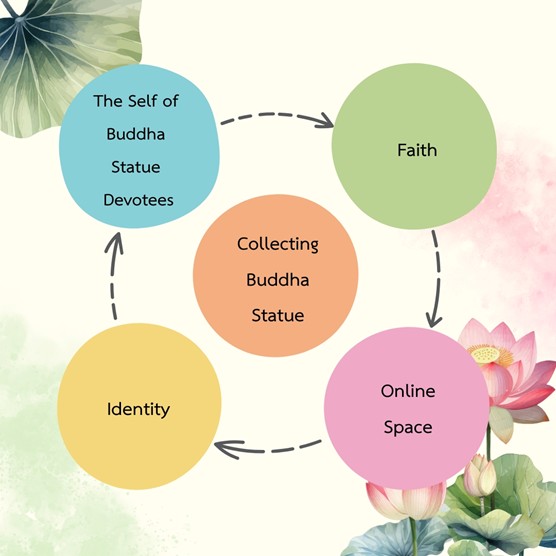
Main Results: The findings of this study revealed the intricate relationships between faith, online space, and the identities of Buddha statue devotees. These relationships demonstrated that the veneration and collection of Buddha statues constituted a distinct form of collection culture that reflected personal tastes and aesthetic preferences. Concomitantly, the practice of collecting Buddha statues was deeply embedded within the collective consciousness, a shared sense of faith and belonging tied to place. For example, devotion to Luangpho Phuttha Sothon embodied the collective identity of people from their hometown in the Chachoengsao Province, where spiritual reverence was closely intertwined with local rootedness. Such collective consciousness inevitably shaped how individuals positioned themselves within Buddhist veneration networks.
Involvement to Buddhadhamma: This article is situated within Applied Buddhism, focusing on understanding how the Buddha statue serves as a symbolic medium that facilitates (Buddhānussati) the recollection of the Buddha. Each element of the image embodies the moral and spiritual foundations of Buddhist teaching, which are the observance of sīla (Virtue), the cultivation of samādhi (Concentration), and the realization of paññā (Wisdom). Moreover, a certain series of Buddha images is produced through collective acts of merit-making, in which communities of devotees participate in casting the images with altruistic intentions, such as aiding people experiencing poverty or donating proceeds from the veneration process to public welfare. These practices exemplify the principle of Saṅgahavatthu 4 (The Four Bases of Social Harmony), reflecting the ways in which communities of faith collectively embody generosity, compassion, and moral solidarity through religious and material action.
Conclusions: This study contributes to sociological perspectives on the veneration of Buddha statues by highlighting the intricate relationships among faith, online space, identity, and the self of Buddha image devotees. The findings illustrate that Buddhist statue worship is not merely a religious act but also a social action shaped by interaction, belief, and aesthetic expression. The results have potential policy implications for supporting the development of cultural and creative industries rooted in the traditions of Buddhist institutions. In contemporary Thailand, there have been increasing government efforts to harness economic value from cultural heritage. Insights from this study can inform such initiatives by emphasizing how faith-based practices and religious material culture can serve as pathways for sustainable cultural innovation based on Buddhist values.
References
Baffelli, E., Caple, J., McLaughlin, L. & Schröer, F. (2021). The Aesthetics and Emotions of Religious Belonging: Examples from the Buddhist World. Numen: International Review for the History of Religions, 68(5-6), 421-435. https://doi.org/10.1163/15685276-12341634.
Bailey, G. & Mabbett, I. (2003). THE SOCIOLOGY OF EARLY BUDDHISM. Cambridge, United Kingdom: Cambridge University Press.
Banks, M. & Zeitlyn, D. (2001). Visual Methods in Social Research. London, United Kingdom: SAGE Publications.
Bateson, G. & Mead, M. (1942). BALINESE CHARACTER A PHOTOGRAPHIC ANALYSIS. New York, United States of America: New York Academy of Sciences.
Bourdieu, P. (1989). The Forms of Capital. In Richardson, J. (ed.), Handbook of Theory and Research for the Sociology of Education (pp. 241-258). Westport, Connecticut, United States of America: Greenwood.
De la Fuente, E. (2000). Sociology and Aesthetics. European Journal of Social Theory, 3(2), 235-247. https://doi.org/10.1177/136843100003002007 (Original work published 2000) .
Durkheim, E. (1995). The Elementary Forms of Religious Life. A New Translated by Karen E. Fields. New York, United States of America: The Free Press.
Hamratanaphon, C. (2024). Fortune for Sale: Amulet Agency and Post-Pandemic Precarity in Hanoi, Vietnam. [Doctoral dissertation, University of California Reverside]. ProQuest. https://escholarship.org/uc/item/7299n4xt.
Iamkhorpung, P. & Kosuta. M. (2022). The relationship between Buddhist and animist amulets in contemporary Thailand: PHRA KHRUEANG and KHRUEANG RANG. Kasetsart Journal of Social Sciences, 43(1), 53-59.
Kitiarsa, P. (2012). Mediums, monks, and amulets: Thai popular Buddhism today. Chiang Mai, Thailand: Silkworm Books.
McBain, P. (2024). The Amulet Culture of Thailand. Journal of the Siam Society, 112(2), 7-15.
Naepimai, N. & Chaisingkananont, S. (2023). Globalizing Thai amulets: the Chinese-Singaporean role in commoditizing objects of faith. Inter-Asia Cultural Studies, 24(5), 898-912. https://doi.org/10.1080/14649373.2023.2242154.
Pawakapan, N. (2021). Collecting Culture: Proposals, Debates and Development. Journal of Social Sciences, Chiang Mai University, 33(1), 147-191.
Payne, E. (2022). Moving the Material Me: A Visual Autoethnography. The Journal for Undergraduate Ethnography, 12(2), 36-54. https://doi.org/10.15273/jue.v12i2.11409.
Rosaldo, R. (2014). The Day of Shelly's Death: The Poetry and Ethnography of Grief. Durham & London, United Kingdom: Duke University Press.
Schipper, J. (2012). Toward a Buddhist Sociology: Theories, Methods, and Possibilities. The American Sociologist, 43, 203-222. https://doi.org/10.1007/s12108-012-9155-4.
Soontravanich, C. (2013). The Regionalization of Local Buddhist Saints: Amulets, Crime and Violence in Post-World War II Thai Society. Sojourn: Journal of Social Issues in Southeast Asia, 28(2), 179-215.
Srichampa, S. (2014). Thai Amulets: Symbol of the Practice of Multi-faiths and Cultures. In Liamputtong, P. (ed.), Contemporary Socio-Cultural and Political Perspectives in Thailand. Dordrecht. Nederland: Springer. https://doi.org/10.1007/978-94-007-7244-1_3.
Srinivas, T. (2012). Articles of Faith: Material Piety, Devotional Aesthetics and the Construction of a Moral Economy in the Transnational Sathya Sai Movement. Visual Anthropology, 25(4): 270-302. https://doi.org/10.1080/08949468.2012.687959.
Tambiah, S. J. (1982). Famous Buddha Images and the Legitimation of Kings: The Case of the Sinhala Buddha (Phra Sihing) in Thailand. RES: Anthropology and Aesthetics, 1982(4), 5-19.
Tarocco, F. (2011). On the market: consumption and material culture in modern Chinese Buddhism. Religion, 41(4), 627-644. https://doi.org/10.1080/0048721X.2011.624698.
Wall, S. (2008). Easier Said than Done: Writing an Autoethnography. International Journal of Qualitative Methods, 7(1), 38-53. https://doi.org/10.1177/160940690800700103.
Weber, M. (1965). The Sociology of Religion [Religions-soziologie]. London, United Kingdom: Methuen & Co. Ltd.
Williams-Oerberg, E. (2021). Buddhist Ritual as "Connectionwork": Aesthetics and Technologies of Mediating Religious Belonging. Numen: International Review for the History of Religions, 68(5-6), 488-512. https://doi.org/10.1163/15685276-12341637.
Downloads
Published
How to Cite
Issue
Section
License
Copyright (c) 2025 Journal of Buddhist Anthropology

This work is licensed under a Creative Commons Attribution-NonCommercial-NoDerivatives 4.0 International License.