BUDDHIST MONKS IN WATER GOVERNANCE: AN ANALYTICAL STUDY OF COMMUNITY RESILIENCE AND SOCIO-RELIGIOUS MEDIATION IN NORTHEASTERN THAILAND
Keywords:
Water Resource Management, Sustainability, Socio-religious Mediation, Community Resilience, Northeastern ThailandAbstract
Background and Objectives: In the context of Northeastern Thailand, water insecurity remains a persistent challenge shaped by environmental variability, limited infrastructure, and unequal resource distribution, which directly affects agricultural livelihoods and community well-being. Although national water policies have attempted to address these issues, many rural communities continue to face constraints in accessing sustainable and locally appropriate water management solutions. This situation highlights the importance of alternative, community-based approaches that are adaptive, participatory, and culturally grounded. Within this context, Buddhist monks have increasingly emerged as influential local actors who bridge the gap between state mechanisms and community needs. Their roles extend beyond spiritual leadership to include coordination, knowledge dissemination, and mobilization of collective action, thereby contributing to locally embedded forms of environmental governance and long-term community resilience. Therefore, the objectives of this study were to examine the role of Buddhist monks as socio-religious mediators in local governance and to explore how Buddhist teachings inform sustainable water management practices and community resilience.
Methodology: This study employed a qualitative multiple case study design, drawing on document analysis, non-participant observation, and semi-structured interviews with four monks who were recognized for their sustained engagement in water development initiatives. The analysis applied analytic induction and thematic content analysis to interpret how Buddhist doctrinal principles were operationalized in water governance practices and how these practices contributed to community resilience.
Main Results: The findings demonstrate that Buddhist monks function as key agents of socially engaged Buddhism by initiating and managing water resource systems that directly improve community well-being. In this context, Buddhist principles are not only interpreted as moral teachings but are operationalized as practical frameworks guiding collective action, infrastructure development, and equitable resource distribution. This reflects an expanded understanding of Buddhism for social benefits, where religious practice intersects with sustainable development, environmental stewardship, and local governance, thereby contributing to community resilience in conditions of ecological uncertainty.
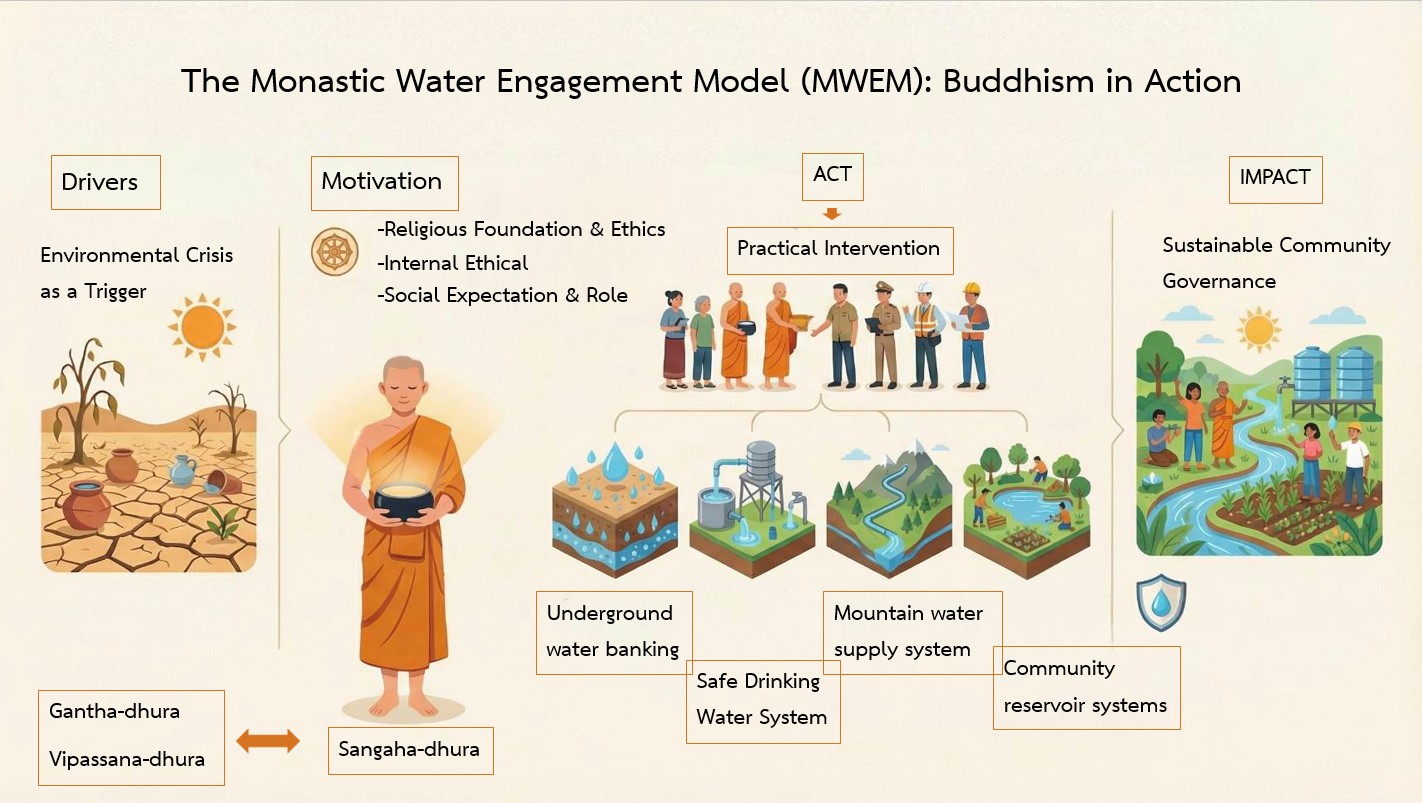
Involvement to Buddhadhamma: This study applied Buddhism, particularly its focus on social benefits. It demonstrates the interconnectedness between Buddhist teachings and monastic engagement through the two dimensions of monks' roles in community development. First, in terms of practice, the traditional Vinaya-based duties of Gantha-dhura (Scriptural Study) and Vipassana-dhura (Meditation Practice) have been extended toward socially oriented responsibilities expressed through Sangaha-dhura, the duty of social benevolence. Second, core Buddhist doctrines have been applied as conceptual foundations guiding monks' community involvement, including generosity, the Four Brahma Vihāra Dharmas, communal harmony, the ethics of reciprocal obligations (The Six Directions), and self-reliance. More specifically, these activities can be understood through canonical principles such as the Saṅgahavatthu 4, dāna, piyavācā, atthacariyā, and samānattatā, which explain practices such as establishing drinking-water systems and underground water banks and coordinating community participation. In addition, the Sāraṇīyadhamma 6 and the ethical framework of the Sigālovāda Sutta (Dīgha Nikāya 31) emphasize communal harmony and reciprocal responsibilities, while the Cakkavatti-Sīhanāda Sutta (Dīgha Nikāya 26) highlights the moral duty of leadership in ensuring fair distribution of resources. Consequently, monastic engagement in water-resource development in Northeastern Thailand reflects an expansion of the temple's traditional domain into broader societal spheres, demonstrating how canonical teachings are applied to contemporary ecological and developmental challenges.
Conclusions: This study makes a distinctive contribution by integrating Buddhist doctrinal analysis with community development and water resource management, demonstrating how religious ethics function as an operational framework for environmental governance. It advances interdisciplinary scholarship by linking Engaged Buddhism, rural development, and sustainability studies within the context of community resilience.
References
Congkrarian, E. (2019). Role of Thai Sangha in the Development of Social Enterprises: A Case Study of Phra Dhammongkolyarn (Luangphor Viriyang Sirintharo). [Doctoral dissertation, Rangsit University]. Graduate School, Rangsit University. https://rsuir-library.rsu.ac.th/bitstream/123456789/438/1/Ekaphot%20Congkrarian.pdf.
Lapthananon, P., Panyachit, S., Wanitchanon, P. & Saengpanya, P. (2020). Lessons learned from the Phetngam public welfare project 2017-2018. Nonthaburi, Thailand: Nitidhama Press.
Phra Paisal Visalo. (2003). The Future of Thai Buddhism: Trends and Strategies for Overcoming the Crisis. Bangkok, Thailand: Sodsri-Saridwong Foundation and The Buddhist Network for Buddhism and Thai Society.
Phrakru Kosol Sikkhakit. (2023). The role of Buddhist monks. (Kanjanapimai K., Interviewer)
Phrakru Silathammasophon. (2023). The role of Buddhist monks. (Kanjanapimai K., Interviewer)
Public Welfare Department of The Sangha Supreme Council. (2021). Buddhist monks and public welfare. Bangkok, Thailand: Romtham Graphic.
Sanyawiwat, S. (2004). Theories and strategies of social development. Bangkok, Thailand: Chulalongkorn University Press.
Somdet Phra Buddhaghosacarya (P. A. Payutto). (2018). Sustainable Development (21st ed.). Bangkok, Thailand: Thammasat University and Toyota Thailand Foundation.
Sudphungyang, P., Naintu, Y., Sonwa, S. & Seebutdee, S. (2023). Role of Monk in Local Development in Education and Culture: A Case Study of Phrakru Soonthorn Panyawimon. Journal of Academic Surindra Rajabhat, 1(1), 31-44.
Sumpong, S., Kaensombat, J. & Boonanak, A. (2022). Water with Drought in the Northeast. Journal of Humanities (Graduate Studies Edition), 10(2), 67-80.
Topanyawut, N. (2010). Experience in psychological healing: a case study of Phrapaponpatchara Jiradhammo, Watkhampramong, Sakolnakhorn Province. [Master's thesis, Chulalongkorn University]. Chulalongkorn University Theses and Dissertations (Chula ETD). https://www.thailis.or.th/tdc/browse.php?option=show&browse_type=title&titleid=334873&query=%B3%D1%B0%B9%D1%C2%20%E2%B5%BB%D1%AD%AD%D2%C7%D8%B8&s_m.
Wannasarnmatha, L. (1996). Roles of kinship in the care sickness. Khon Kaen, Thailand: Khon Kaen University.
Downloads
Published
How to Cite
Issue
Section
License
Copyright (c) 2026 Journal of Buddhist Anthropology

This work is licensed under a Creative Commons Attribution-NonCommercial-NoDerivatives 4.0 International License.