MATERNALIZING THE BUDDHA: PATRONAGE, NARRATIVE, AND GENDERED SACRED PERSONHOOD IN SOUTHERN THAILAND'S LAK PHRA PROCESSION
Keywords:
Lak Phra Procession, Maternalization, Buddha Images, Gender Performativity, Thai BuddhismAbstract
Background and Objectives: The Lak Phra procession of southern Thailand provides a distinctive lens for examining the relationship between Buddhist cosmology, material culture, and communal ritual. Although canonical doctrine presents the historical Buddha as mahāpurisa (Great Man) and venerates him as mahākaruṇiko nātho (Great Compassionate Protector), in several southern Thai communities, standing Buddha images are experienced as maternal presences. This study aims to examine how maternal sacred personhood emerges in Buddha images within the Lak Phra tradition. It also aims to develop an analytical model to identify the interaction of three dimensions: Female patronage, local narrative memory, and communal ritual repetition, through which these images come to be addressed and experienced as mothers. The study also seeks to explain why such maternalization occurs in some communities but not others within southern Thailand.
Methodology: This research was based on multi-sited ethnographic fieldwork conducted between 2022 and 2025 in Nakhon Si Thammarat, Songkhla, and Phatthalung. The study followed the movements of Buddha images in annual Lak Phra processions, observing how devotees spoke about them, how the images were dressed and carried, and how stories were shared within communities. These qualitative data, together with temple archives, original ornaments, and oral histories, were analyzed through established analytical dimensions and a theoretical framework integrating Butler's concept of gender performativity, Turner's notion of liminality and communitas, and Tambiah's analysis of ritual charisma and sensory participation.
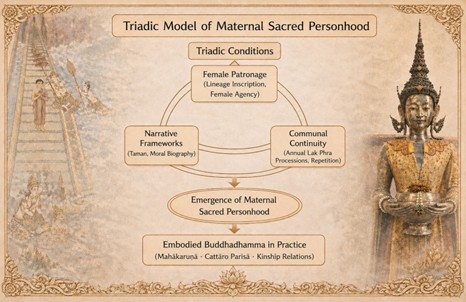
Main Results: The findings showed that the maternalization of Buddha images, where they are ritually addressed as Mae (Mother), emerges only when three conditions converge: Female patronage or lineage dedication, narrative frameworks, and communal continuity through annual Lak Phra processions. Through repeated acts of naming, dressing, ornamentation, carrying, and relational address, ritual practice stabilizes maternal sacred personhood across generations. Where this triad is present, maternal identity becomes enduring; Where it is absent, images remain ungendered despite similar ritual contexts. In this process, compassion is enacted through touch, sound, labor, and care within shared ritual life. Maternalized images also function as vehicles of female religious agency, enabling laywomen within the Fourfold Assembly (Cattāro Parisā) to shape sacred meaning and transmit lineage memory. Ultimately, the Lak Phra tradition shows that the Buddha's compassion is lived through relationships, leaving a lasting sense of shared movement with a presence both sacred and intimately human.
Involvement to Buddhadhamma: This study is situated within Applied Buddhism, focusing on how Buddhism contributes to the development of wisdom and morality through religious ritual and communal life. It shows that the Buddha's canonical compassion (Mahākaruṇā), as articulated in Buddhadhamma, is actively interpreted and enacted in local practice. In the Lak Phra tradition, this enactment aligns with the Fourfold Assembly (Cattāro Parisā), where lay participation sustains Buddhist life. Through the maternalization of Buddha images, compassion becomes a relational and accessible form grounded in kinship idioms, reflected in the Pāli dictum "Mātā Mittaṁ Sake Ghare" (A Mother is a Friend in the Home). The study thus demonstrates how core Buddhist principles are applied in everyday communal practice through ritual, memory, and social relations.
Conclusions: Maternal Buddha images in the Lak Phra tradition are more than symbolic artifacts; They are socially constituted sacred presences whose maternal personhood emerges through the interplay of ritual practice, narrative memory, and gendered community agency. Their study shows that Buddhadhamma is preserved as doctrine and embodied in lived ritual life, where it actively shapes kinship, gender relations, and communal identity in southern Thai Buddhism.
References
Beal, S. (1884). Si-Yu-Ki: Buddhist Records of the Western World (Vol. 2). London, United Kingdom: Trübner & Co.
Bhirasri, S. (2015). An Appreciation of Sukhothai Art. Bangkok, Thailand: Fine Arts Department of Thailand.
Buddharakkhita, A. (1985). The Dhammapada: The Buddha's Path of Wisdom. Kandy, Sri Lanka: Buddhist Publication Society.
Bunyarit, S. (1989). The Boat Song at Pho Cape, Songkhla. Songkhla, Thailand: Songkhla Teacher's College.
Butler, J. (1993). Bodies That Matter: On the Discursive Limits of "Sex". New York, United States of America: Routledge.
Butler, J. (1999). Gender Trouble: Feminism and the Subversion of Identity. New York, United States of America: Routledge.
Diskul, S. (1970). Art in Thailand: A Brief History. Bangkok, Thailand: Silpakorn University.
Fleming, B. & Mann, R. (Eds.). (2014). Material Culture and Asian Religions. In B. Fleming & R. Mann (Eds.), Material culture and Asian religions: Text, image, object (pp. 135-148). New York, United States of America: Routledge. https://doi.org/10.4324/9780203753033.
Ngernthaworn, S. C., Singhapun, M., Supsin, W. & Bunsin, O. (2025). Local Artisans of Nakhon: Phra Lak and the Artisan Lineage in Nakhon Si Thammarat, Thailand. Journal of Buddhist Anthropology, 10(3), 455-473.
Ohnuma, R. (2012). Ties That Bind: Maternal Imagery and Discourse in Indian Buddhism. Oxford, United Kingdom: Oxford University Press. https://doi.org/10.1093/acprof:oso/9780199915651.001.0001.
Seeger, M. (2013). Reversal of Female Power, Transcendentality, and Gender in Thai Buddhism: The Thai Buddhist Female Saint Khun Mae Bunruean Tongbuntoem (1895-1964). Modern Asian Studies, 47(5), 1488-1519. https://doi.org/10.1017/S0026749X11000898.
Sumchinda, P. (2007). Crowned Buddha Images in the Grand Palace: The Knowledge That Must Be Changed and the Conflicts That Must Be Analyzed. In History to be Inscribed: Collected Academic Articles on Art History on the Occasion of the Retirement of Assoc. Prof. Dr. Piriya Krairiksh (pp. 37-155). Bangkok, Thailand: Amarin Printing and Publishing.
Swearer, D. K. (2004). Becoming the Buddha: The Ritual of Image Consecration in Thailand. Princeton, New Jersey, United States of America: Princeton University Press.
Takakusu, J. (1896). A Record of The Buddhist Religion as Practised in India and the Malay Archipelago (A.D. 671-695). Oxford, United Kingdom: Clarendon Press.
Tambiah, S. J. (1984). The Buddhist saints of the forest and the cult of amulets: a study in charisma, hagiography, sectarianism, and millennial Buddhism. New York, United States of America: Cambridge University Press.
Turner, V. (1991). The Ritual Process: Structure and Anti-Structure. New York, United States of America: Cornell University Press.
Ubonphan, U. (1998). City of the Buddha: History of Important Buddha Images. Journal Sarn Nakhon Si Thammarat, 28(10), 13-21.
Downloads
Published
How to Cite
Issue
Section
License
Copyright (c) 2026 Journal of Buddhist Anthropology

This work is licensed under a Creative Commons Attribution-NonCommercial-NoDerivatives 4.0 International License.