THE INFLUENCE OF BUDDHIST LEADERSHIP DIMENSIONS ON EMPLOYEE WELL-BEING: THE MEDIATING ROLE OF WORKPLACE MINDFULNESS
Keywords:
Buddhist Leadership, Workplace Mindfulness, Employee Well-Being, Four Brahmavihāras, Four IddhipādaAbstract
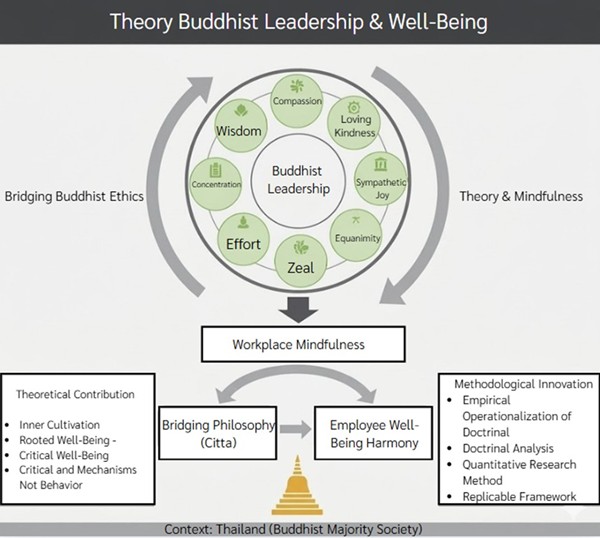
Background and Objectives: In organizational environments characterized by rapid change, intensifying competition, and psychological demands, employee well-being has become a critical determinant of sustainable organizational performance. Conventional leadership approaches often emphasize efficiency and control while neglecting employees' emotional, ethical, and cognitive development. In response to these limitations, Buddhist leadership offers a holistic paradigm grounded in mindfulness, compassion, moral integrity, and wisdom. Rooted in the Four Brahmavihāras; Loving-kindness (Mettā), compassion (Karuṇā), sympathetic joy (Muditā), and equanimity (Upekkhā) and the Four Iddhipāda; Zeal (Chanda), effort (Viriya), concentration (Citta), and wisdom or investigation (Vīmaṃsā). Buddhist leadership conceptualizes leadership as a process of cultivation and ethical responsibility. However, existing studies have largely treated Buddhist or mindful leadership as a unidimensional construct, limiting theoretical precision and empirical depth. Therefore, this study aimed to examine the influence of eight doctrinally grounded Buddhist leadership dimensions on employee well-being within Thai organizational contexts, with workplace mindfulness functioning as a mediating mechanism.
Methodology: A quantitative cross-sectional survey design was employed to examine the relationships among Buddhist leadership dimensions, workplace mindfulness, and employee well-being. Data were collected through structured questionnaires distributed both online and in paper format to 400 employees across educational institutions, public organizations, healthcare facilities, and private enterprises in Thailand. Participants were selected using purposive and stratified sampling techniques to ensure representation across organizational levels. The data were analyzed using descriptive statistics, Pearson correlation, and multiple regression analysis to assess direct and mediating relationships among the variables.
Main Results: The findings indicate that Buddhist leadership functions as a multidimensional construct with differentiated effects on workplace outcomes. Wisdom (Vīmaṃsā), Equanimity (Upekkhā), Effort (Viriya), and Concentration (Citta) significantly enhanced workplace mindfulness, suggesting that leaders who demonstrate cognitive discernment, emotional balance, perseverance, and focused attention foster a mindful organizational climate. In terms of direct effects on employee well-being, Loving-kindness (Mettā), Compassion (Karuṇā), and Equanimity (Upekkhā) emerged as significant predictors, highlighting the importance of moral-emotional leadership behaviors in promoting psychological satisfaction and emotional stability. Furthermore, workplace mindfulness was identified as a strong predictor of employee well-being and was found to partially mediate the effects of Wisdom and Equanimity, underscoring its pivotal role as a psychological mechanism linking leadership practices to employee outcomes.
Involvement to Buddhadhamma: This study operationalizes the Four Brahmavihāras and the Four Iddhipāda into empirically measurable leadership dimensions and aligns them with the Threefold Training (Tisikkhā) framework of morality (Sīla), concentration (Samādhi), and wisdom (Paññā). In accordance with the journal's classification, this research is situated within Applied Buddhism, as it applies fundamental Buddhist doctrinal principles to contemporary organizational leadership and employee well-being. By integrating Buddhist ethical teachings with modern organizational behavior and mindfulness theory, the study demonstrates how Buddhadhamma can be systematically translated into practical leadership practices in modern management contexts. The findings reaffirm that leadership grounded in compassion, equanimity, mindful awareness, and wisdom reflects core Buddhist teachings aimed at reducing suffering (Dukkha) and promoting collective well-being (Sukha) within organizational life.
Conclusions: The findings provide empirical support for Buddhist leadership as a multidimensional model associated with employee well-being. The final regression model explained 68% of the variance in employee well-being (R² = .68), with Workplace Mindfulness demonstrating a substantial effect (β = .41, p < .001). Wisdom (β = .22, p < .001) and Equanimity (β = .19, p < .01) showed meaningful associations with workplace mindfulness, which partially mediated several leaderships-well-being relationships. These results highlight the practical relevance of integrating wisdom, equanimity, and compassion into leadership development and human resource practices. Overall, the study suggests that Buddhist leadership dimensions are statistically and practically associated with improved psychological outcomes and sustainable organizational functioning in Thai work contexts.
References
Bakker, A. B. & Demerouti, E. (2007). The Job Demands‐Resources model: state of the art. Journal of Managerial Psychology, 22(3), 309-328. https://doi.org/10.1108/02683940710733115.
Brislin, R. W. (1980). Translation and content analysis of oral and written materials. In Triandis, H. C. and Berry, J. W. (Eds.), Handbook of cross-cultural psychology: Methodology (pp. 389-444). Boston, United States of America: Allyn and Bacon.
Cawthorn, A. (2025). Mindful Leadership and Employee Well-Being: The Next Competitive Advantage. Marion, United States of America: IWU Indiana Wesleyan University Press.
Choi, E., Gruman, J. A. & Leonard, C. M. (2022). A balanced view of mindfulness at work. Organizational Psychology Review, 12(1), 35-72. https://doi.org/10.1177/20413866211036930.
Demerouti, E., Bakker, A. B., Nachreiner, F. & Schaufeli, W. B. (2001). The job demands-resources model of burnout. Journal of Applied Psychology, 86(3), 499-512. https://doi.org/10.1037/0021-9010.86.3.499.
Hair, J. F., Black, W. C., Babin, B. J. & Anderson, R. E. (2019). Multivariate Data Analysis (8th ed.). Andover, United Kingdom: Cengage Learning, EMEA.
Kumprang, K. & Suriyankietkaew, S. (2024). Mechanisms of Organizational Mindfulness on Employee Well-Being and Engagement: A Multi-Level Analysis. Administrative Sciences, 14(6), 121. https://doi.org/10.3390/admsci14060121.
Kuo, T.-S., Raj, A. & Sharma, K. (2025). Assessing the Effectiveness of Mindfulness at Workplace on Work-Life Balance and Job Performance. Journal of Information Systems Engineering & Management, 10(22s), 326-337. https://doi.org/10.52783/jisem.v10i22s.3524.
Lozano, L. M., García-Cueto, E. & Muñiz, J. (2008). Effect of the Number of Response Categories on the Reliability and Validity of Rating Scales. Methodology: European Journal of Research Methods for the Behavioral and Social Sciences, 4(2), 73-79. https://doi.org/10.1027/1614-2241.4.2.73.
Mohammed, A-H. A., Harfi, B. & Chen, L. (2023). The Role of Leadership Mindfulness on Employee Well-Being through mediating Role of Ethical Leadership. Dinkum Journal of Economics and Managerial Innovations, 2(2), 71-81.
Pinck, A. S. & Sonnentag, S. (2018). Leader Mindfulness and Employee Well-Being: The Mediating Role of Transformational Leadership. Mindfulness, 9, 884-896. https://doi.org/10.1007/s12671-017-0828-5.
Reb, J., Narayanan, J. & Chaturvedi, S. (2014). Leading Mindfully: Two Studies on the Influence of Supervisor Trait Mindfulness on Employee Well-Being and Performance. Mindfulness, 5, 36-45. https://doi.org/10.1007/s12671-012-0144-z.
Sentin, I., Camgoz, S. M., Karapinar, P. B., Aydin, E. M. & Ekmekci, O. T. (2025). Does mindfulness matter on employee outcomes? Exploring its effects via perceived stress. BMC Psychology, 13, 295. https://doi.org/10.1186/s40359-025-02626-y.
Zheng, X., Zhu, W., Zhao, H. & Zhang, C. (2015). Employee well-being in organizations: Theoretical model, scale development, and cross-cultural validation. Journal of Organizational Behavior, 36(5), 621-644. https://doi.org/10.1002/job.1990.
Downloads
Published
How to Cite
Issue
Section
License
Copyright (c) 2026 Journal of Buddhist Anthropology

This work is licensed under a Creative Commons Attribution-NonCommercial-NoDerivatives 4.0 International License.