EXPLORING HOW BUDDHIST NETWORKS ENCOURAGE MENTAL HEALTH CARE: PATHWAYS TO BUILDING HEALTHY COMMUNITIES IN URBAN THAILAND
Keywords:
Social Capital, Buddhist Institutions, Mental Health, Urban Areas, ThailandAbstract
Background and Objective: The challenges of mental health problems in Thailand require collaboration from various social institutions. However, studies examining the role of Buddhist institutions in addressing mental health problems through participatory approaches remain limited. Moreover, previous studies linking social networks with mental health issues have suggested potential pathways for ensuring comprehensive healthcare at multiple levels. This article aimed to examine the relationship between social networks and mental health care, focusing on the role of Buddhist institutions as initiators of community-based support networks.
Methodology: Drawing on action research, this study examined the relationship between social networks and mental health care across four provinces: Bangkok, Chiang Mai, Khon Kaen, and Phuket. Data were collected through focus groups, workshops, and lessons-learned reviews that reflected the stages of action research. Content analysis was subsequently employed to analyze the data and synthesize the findings. Action research was adopted because it facilitates purposeful social change and aligns with the objectives of this study.
Main Results: Action research conducted across the four sites led to the development of supportive social networks for mental and cognitive well-being grounded in Buddhist principles, with each initiative shaped by its local context. In Bangkok, a model was developed that integrated Buddhist teachings with artistic processes and counseling activities led by monks and youth volunteers from Satri Si Suriyothai School. The initiative enhanced youth attitudes toward Buddhism, strengthened civic-mindedness, and resulted in the establishment of a collaborative network recognized by city policymakers. In Chiang Mai, social innovation emerged through the "Jarigano" coffee brand, a collaborative initiative between Dhamma-jārika monks and local youth. The project generated employment and income for community members while contributing to psychological stability. Profits were reinvested to support Buddhist outreach and community-based activities. In Khon Kaen, a Buddhist university collaborated with public health agencies and Village Health Volunteers (VHVs) to support older adults. The initiative reduced stress and anxiety among elderly participants, strengthened social cohesion, and contributed to the establishment of a community health learning center. In Phuket, cross-sector collaboration among the sangha, public health authorities, and the police created a protective mental health framework for youth. Young participants developed greater awareness of drug-related and legal risks while also practicing mindfulness to enhance self-regulation and emotional resilience.
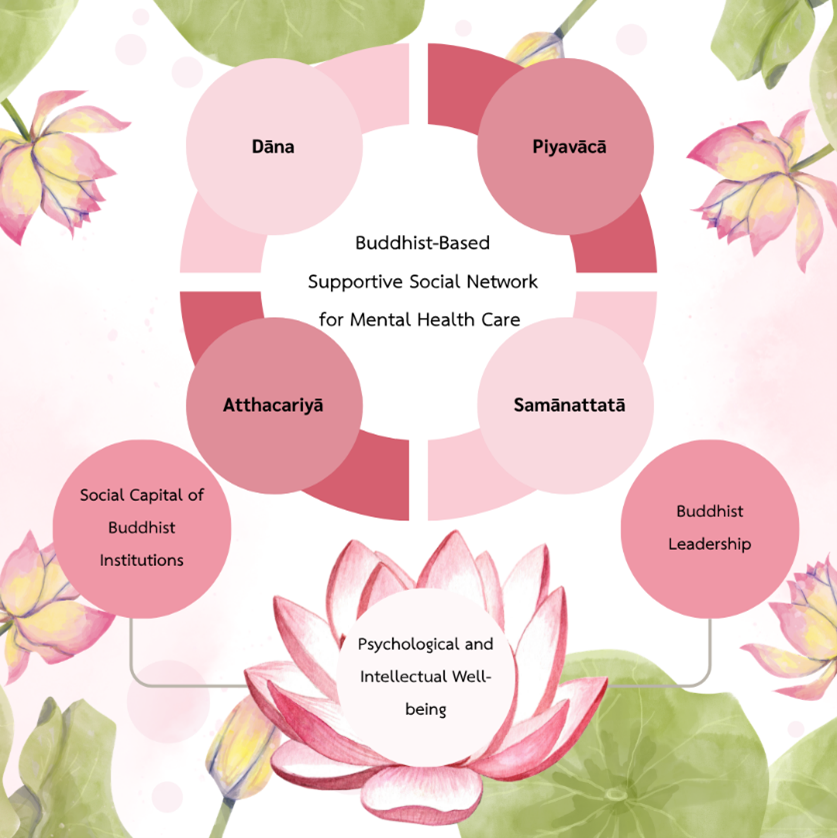
Involvement to Buddhadhamma: This article is situated within the field of Applied Buddhism, examining how Buddhist principles are translated into social action through the framework of the Four Sangahavatthu. It also highlights the role of Buddhism in fostering the development of wisdom and morality, which underpin the ethical orientation of these practices. Dāna is reflected in the creation of networks that enable community participation and the sharing of emotional support. Piyavācā is expressed through persuasive and unifying communication that encourages community engagement. Atthacariyā is embodied in concrete activities carried out for the collective good, helping alleviate psychological distress and strengthen communal well-being. Finally, Samānattatā is demonstrated through sustained collaboration among multiple sectors in supporting the mental health of community members.
Conclusions: The study demonstrates that religious leadership and the monastic community play a significant role in strengthening social capital and fostering meaningful collaboration among diverse network partners. The application of Buddhist principles through practical activities not only supports emotional and cognitive healing but also contributes to structural transformations, including influencing public policy and developing socially oriented business models. These findings suggest that religious networks can serve as effective and sustainable actors in addressing community mental health challenges.
References
Baker, C. & Phongpaichit, P. (2021). Thailand and the COVID-19 Pandemic in 2020. In Singh, D. & Cook, M. (eds.), Southeast Asian Affairs 2021 (pp. 356-378). Buona Vista district, Singapore: ISEAS–Yusof Ishak Institute.
Blaxter, M. (2003). Biology, social class and inequalities in health: their synthesis in 'health capital'. In G. Bendelow, L. Birke, & S. Williams (Eds.), Debating Biology, Sociological Reflections on Health, Medicine and Society, (pp. 69-83). London, United Kingdom: Routledge.
Borchert, T. (2024). The Power and Authority of Monks in the Contemporary Thai Sangha. Contemporary Buddhism, 24(1-2), 3-31. https://doi.org/10.1080/14639947.2024.2344727.
Bourdieu, P. (1986). The Forms of Capital. In Richardson, J. G. (ed.), Handbook of Theory and Research for the Sociology of Education, (pp. 241-258). Connecticut, United States of America: Greenwood Press.
Cheng, F. K. & Tse, S. (2015). Applying the Buddhist Four Immeasurables to Mental Health Care: A Critical Review. Journal of Religion & Spirituality in Social Work: Social Thought, 34(1), 24-50. https://doi.org/10.1080/15426432.2014.921128.
Cockerham, W. C. (2024). Sociology of Mental Disorder (12th edition). London, United Kingdom: Routledge. https://doi.org/10.4324/9781003407652.
Daniel, F.-J. (2010). Action Research and Performativity: How Sociology Shaped a Farmers' Movement in The Netherlands. Sociologia Ruralis, 51(1), 17-34. https://doi.org/10.1111/j.1467-9523.2010.00525.x.
Eliksson, M. (2011). Social capital and health – implications for health promotion. Global Health Action, 4(1), 5611. https://doi.org/10.3402/gha.v4i0.5611.
Ferlander, S. (2007). The Importance of Different Forms of Social Capital for Health. Acta Sociologica, 50(2), 115-128. https://doi.org/10.1177/0001699307077654.
Iamtrakul, P. & Chayphong, S. (2023). Factors affecting the development of a healthy city in Suburban areas, Thailand. Journal of Urban Management, 12(3), 208-220. https://doi.org/10.1016/j.jum.2023.04.002.
Jearajit, C., Promjittiphong, C. & Soonsinpai, T. (2022). Toward the Well-being Society: The Development of HealthNetwork, Buddhist Organizations, Nakhon Nayok and Sa Kaeo Provinces. Journal of Liberal Arts, Ubon Ratchathani University, 18(2), 132-156.
King, S. B. (2009). Socially Engaged Buddhism. Hawaii, United States of America: University of Hawai'i Press.
Lin, N. (2001). Social Capital: A Theory of Social Structure and Action. Cambridge, United Kingdom: Cambridge University Press. https://doi.org/10.1017/CBO9780511815447.
L-Y. Lim, L., Kjellstrom, T., Sleigh, A., Khamman, S., Seubsman, S. A., Dixon, J. & Banwell, C. (2009). Associations between urbanisation and components of the health-risk transition in Thailand. A descriptive study of 87,000 Thai adults. Global Health Action, 2(1). https://doi.org/10.3402/gha.v2i0.1914.
National Statistical Office. (2021). 2020 Mental Health Survey. Bangkok, Thailand: National Statistical Office.
Panyachit, S. (2025). Barefoot Health: The Healthy Lifestyle Path of Monks in Thailand. Journal of Population and Social Studies, 34, 236-252.
Pholphirul, P. & Srijamdee, K. (2025). Buddhist Practices and Mental Health Outcomes in Thailand. Journal of Religion and Health, 2025. https://doi.org/10.1007/s10943-025-02354-y.
Pongsawat, P. (2024). Bangkok in the Time of Covid-19: The Consideration of the Covid-19's Impacts from the Production of Space Perspective. Journal of Social Sciences Naresuan University, 20(1), 1-31. https://doi.org/10.69650/jssnu.2024.264572.
Pornsiripongse, S., Sasiwongsaroj, K. & Ketjamnong, P. (2014). Buddhist Temple: A Religious Capital Approach for Preparing Thailand Toward the Aging Society. In Liamputtong, P. (eds.), Contemporary Socio-Cultural and Political Perspectives in Thailand, (pp. 65-82). Dordrecht, Netherlands: Springer. https://doi.org/10.1007/978-94-007-7244-1_4.
Putnam, R. D. (2000). Bowling Alone: The Collapse and Revival of American Community. New York, United States of America: Simon and Schuster.
Rajaram, S. S. (2007). An Action-Research Project: Community Lead Poisoning Prevention. Teaching Sociology, 35(2), 138-150.
Ruengorn, C., Awiphan, R., Wongpakaran, N., Wongpakaran, T. & Nochaiwong, S. (2021). Association of job loss, income loss, and financial burden with adverse mental health outcomes during coronavirus disease 2019 pandemic in Thailand: A nationwide cross-sectional study. Depression and Anxiety, 38(6), 648-660. https://doi.org/10.1002/da.23155.
Sasiwongsaroj, K., Wada, T., Okumiya, K., Imai, H., Ishimoto, Y., Sakamoto, R., Fujisawa, M., Kimura, Y., Chen, W.-l., Fukutomi, E. & Matsubayashi, K. (2014). Buddhist social networks and health in old age: A study in central Thailand. Geriatrics & Gerontology International, 15(11), 1210-1218. https://doi.org/10.1111/ggi.12421.
Shonin, E., Van Gordon, W. & Griffiths, M. D. (2016). Mindfulness and Buddhist-Derived Treatment Techniques in Mental Health and Addiction Settings. In Shonin, E., Gordon, W., Griffiths, M. (eds.), Mindfulness and Buddhist-Derived Approaches in Mental Health and Addiction, (pp. 1-16). Cham, Switzerland: Springer. https://doi.org/10.1007/978-3-319-22255-4_1.
Snel, E., Engbersen, G., de Boom, J. & van Bochove, M. (2022). Social Capital as Protection Against the Mental Health Impact of the COVID-19 Pandemic. Frontiers in Sociology, 7, 728541. https://doi.org/10.3389/fsoc.2022.728541.
Son, J. & Sung, P. (2024). The relationship among generalized trust, social networks, and social resources across 30 countries. International Sociology, 39(4), 375-398. https://doi.org/10.1177/02685809241251770.
Suavansri, P., Pichayayothin, N., Espinosa, P. R., Areekit, P., Nilchantuk, C., Jones, T. S., French, J. J., Mam, E., Moore, J. B. & Heaney, C. A. (2022). Well-being in Thailand: A Culturally Driven Grounded Inquiry Exploration of a Complex Construct. Applied Research Quality Life, 17, 3327-3347. https://doi.org/10.1007/s11482-022-10067-7.
Tangopasvilaisakul, P. (2022). The Predicaments of (Some) Middle Class: A Preliminary Study of Way of Living and Voices Lost during the COVID-19 Pandemic. Parichart Journal, 35(2), 50-68. https://doi.org/10.55164/pactj.v35i2.249891.
Thianthai, C. & Tamdee, P. (2024). Understanding Digital Well-being and Insights From Technological Impacts on University Students' Everyday Lives in Bangkok. Journal of Health Research, 38(2), 137-145. https://doi.org/10.56808/2586-940X.1069.
Wiist, W. H., Sullivan, B. M., St. George, D. M. & Wayment, H. A. (2012). Buddhists' Religious and Health Practices. Journal of Religion and Health, 51, 132-147. https://doi.org/10.1007/s10943-010-9348-5.
Wun'Gaeo, C. & Wun'Gaeo, S. (2021). Thailand and Covid-19: Institutions and social dynamics from below. In Piererse, J. N., Lim, H. & Khondlker, H. (eds.), Covid-19 and Governance Crisis Reveals, (pp. 88-97). London, United Kindom: Routledge. https://doi.org/10.4324/9781003154037.
Zhang, D., Kong, C., Zhang, M. & Kang, J. (2022). Religious Belief-Related Factors Enhance the Impact of Soundscapes in Han Chinese Buddhist Temples on Mental Health. Frontiers in Psychology, 12, 774689. https://doi.org/10.3389/fpsyg.2021.774689.
Downloads
Published
How to Cite
Issue
Section
License
Copyright (c) 2026 Journal of Buddhist Anthropology

This work is licensed under a Creative Commons Attribution-NonCommercial-NoDerivatives 4.0 International License.