JAYAMAṄGALA GĀTHĀ AND PSYCHOLOGICAL COPING IN APPLIED BUDDHISM
Keywords:
Narrative Coping, Buddhadhamma Application, Jayamaṅgala Gāthā, Thematic Analysis, Psychological CopingAbstract
Background and Objectives: Contemporary life is characterized by rapid social change, economic uncertainty, and persistent psychological stress, making coping an essential life skill for sustaining psychological well-being. Modern psychological research emphasizes emotion regulation, resilience, cognitive appraisal, and meaning making as key mechanisms for managing adversity. Religious and cultural traditions also provide moral and contemplative resources that cultivate inner stability and ethical clarity. Within the Theravāda Buddhist tradition, the Jayamaṅgala Gāthā, commonly known in Thai as the Phahung Chant, is widely recited as a sacred chant recounting the Buddha's victories over various adversaries. The term Jayamaṅgala Gāthā means "Verses of Auspicious Victory." Although often interpreted as a ritual text for blessings and protection, its narrative structure presents a sequence of encounters in which challenges are resolved through virtues such as wisdom, patience, loving-kindness, and moral clarity. This documentary research aimed to analyze the narrative structure of the Jayamaṅgala Gāthā in terms of life challenges and their modes of resolution grounded in Buddhadhamma, and to construct a Buddhist coping framework for developing life coping skills in relation to contemporary psychological well-being.
Methodology: The study employed documentary research with qualitative thematic content analysis. The primary data consisted of the canonical text of Jayamaṅgala Gāthā preserved in Theravāda chanting traditions and supported by relevant academic literature. Each narrative episode within the chant served as the unit of analysis. The analytical process involved close textual reading, coding of symbolic life challenges and corresponding modes of resolution, and iterative grouping of codes into broader coping themes. Thematic synthesis was used to interpret how Buddhist virtues embedded in the narrative episodes function as coping processes. Analytical transparency was maintained through explicit connections between textual evidence, coding categories, and thematic interpretation.
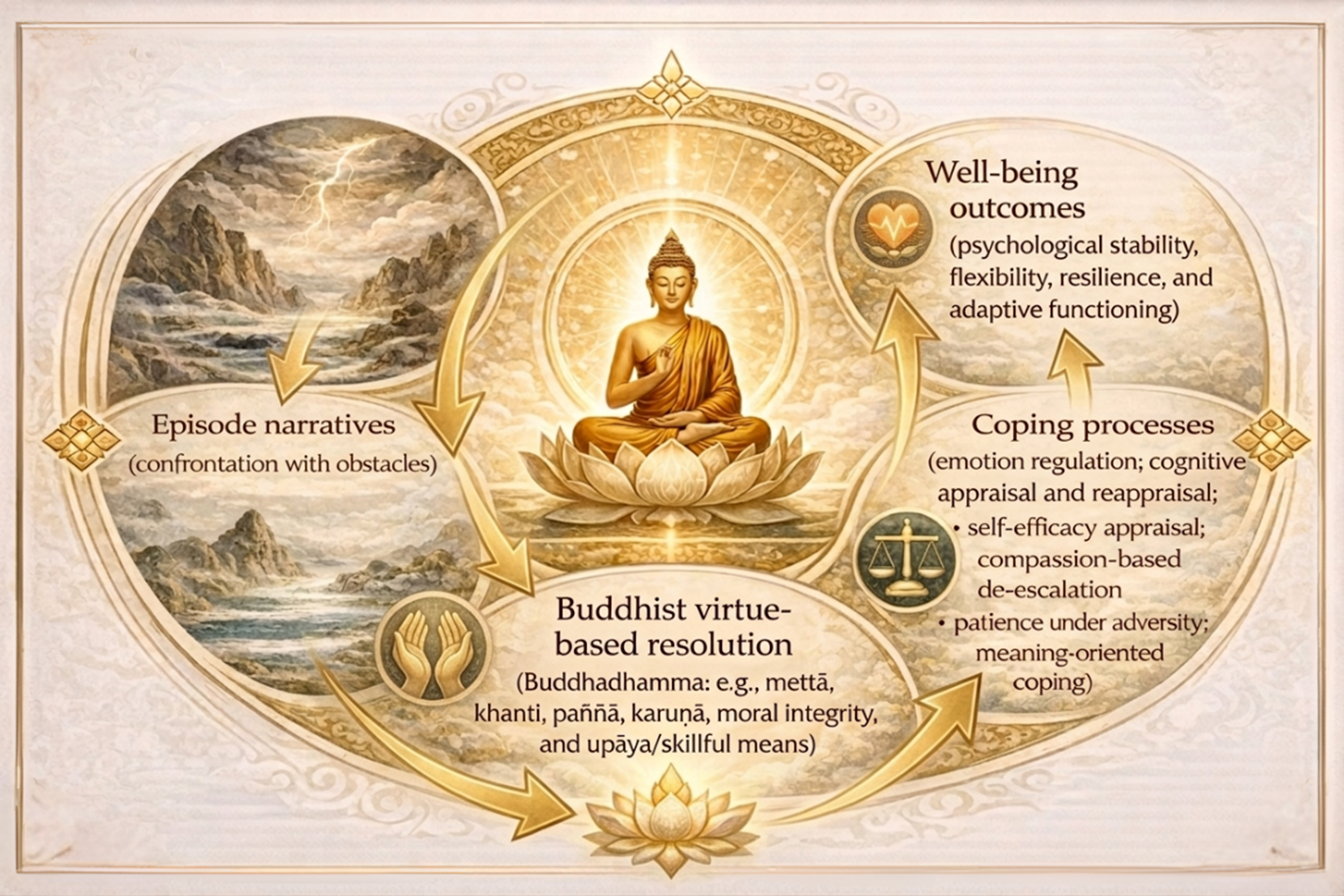
Main Results: The findings indicate that the chant functions as a structured set of coping exemplars rather than merely a ritual recitation. Across the narrative episodes, diverse forms of adversity were identified, including fear, aggression, anger, rigid beliefs, false accusation, attachment to power, and distorted understanding. These adversities are consistently resolved through inner cultivation. Five integrative coping processes emerged: Emotional regulation, patience and endurance, compassion-based conflict de-escalation, wisdom-based clarification, and context-sensitive skillful means. These processes reflect core Buddhadhamma principles such as paññā, mettā, khanti, and samādhi, demonstrating their roles as moral-psychological mechanisms that support both wisdom development and ethical cultivation.
Involvement to Buddhadhamma: From the perspective of Applied Buddhism, the chant can be interpreted as a culturally embedded narrative model that illustrates how Buddhist ethical principles guide responses to adversity. The narrative episodes portray "Victory" as internal transformation through wisdom, compassion, patience, and ethical discipline. This interpretation highlights the role of Buddhism in the development of wisdom and morality through narrative-based learning processes.
Conclusions: The Jayamaṅgala Gāthā can be understood as a narrative-based coping framework rooted in Buddhadhamma. Conceptually, the study demonstrates how Buddhist ethical principles can be translated into a structured coping model relevant to contemporary psychological contexts. Practically, the findings suggest that the chant may function as a reflective resource for developing coping skills in educational, contemplative, and well-being settings. The study contributes to Applied Buddhism by presenting a model that integrates wisdom development and moral cultivation within a contemporary well-being framework.
References
Folkman, S. & Lazarus, R. S. (1990). Coping and emotion. In N. L. Stein, B. Leventhal & T. Trabasso (Eds.), Psychological and biological approaches to emotion (pp.313-332). New Jersey, United States of America: Lawrence Erlbaum Associates, Inc.
Gautam, S., Jain, A., Chaudhary, J., Gautam, M., Gaur, M. & Grover, S. (2024). Concept of mental health and mental well-being, it's determinants and coping strategies. Indian journal of psychiatry, 66(Suppl 2), S231-S244.
Jiraphattrakul, T. (2023). A Study of Meditation Guidelines to Reduce Stress in Daily Life of Weekend Meditation Practitioners at Wat Klang Bang Phra, Nakhon Pathom Province. Journal of Institute of Trainer Monk Development, 6(3), 58-68.
Kladsumnaing, P. & Rattanangam, S. (2023). Chanting Resulting in the Quality of Life Development of Buddhists in Samut Sakhon Province. The Journal of Institute of Trainer Monk Development, 6(3), 24-34.
Lee, L. A. (2021). The Impact of Chanting on Wellness, Well-Being, and Stress: A Qualitative Study [Doctoral dissertation, Alliant International University]. Alliant International University ProQuest Dissertations & Theses.
Lewis Hall, M. E. & Hill, P. (2019). Meaning-making, suffering, and religion: a worldview conception. Mental Health, Religion & Culture, 22(5), 467-479.
Lumpakorn, N. & Pengkaesorn, A. (2024). Semiotics: Decoding Bahum Prayer from Mural Painting in Buddhaisawan Chapel. Journal of Buddhist Studies, 15(1), 261-275.
Makrudin, S. (2023). Influence of Buddha-Jaya-Mangala Gatha on Thai Society. Mahamakut Graduate School Journal, 21(2), 169-182.
Malisorn, N., Laochalad, S., Amornpan, K. & Wongfaluean, S. (2023). The belief behavior of praying across the years in Thai society. Journal of Dhammasuksa Research, 6(2), 267-281.
Mekkhachorn, N. (2024). Prayer: Its Psychological Value is Greater than You Think. Journal of The Guidance Psychology Association of Thailand: GPAT Journal (Online), 1(1), 11-20.
Nilsson, A., Surakarn, A. & Peungposop, N. (2025). INTEGRATING MINDFULNESS AND YOGA: A BUDDHIST-INSPIRED PROGRAM TO ENHANCE COGNITIVE FLEXIBILITY AND EMOTION REGULATION IN OLDER THAI ADULTS. Journal of Buddhist Anthropology, 10(2), 226-238.
Paley, B. & Hajal, N. J. (2022). Conceptualizing Emotion Regulation and Coregulation as Family-Level Phenomena. Clinical Child and Family Psychology Review, 25(1), 19-43.
Perry, G., Polito, V., Sankaran, N. & Thompson, W. F. (2022). How Chanting Relates to Cognitive Function, Altered States and Quality of Life. Brain Sciences, 12(11), 1456.
Phengprapha, P. & Khunarak, K. (2021). NARRATIVE OF BUDDHA'S CONFRONTATION WITH MARA IN CONTEMPORARY MEDIA: TRANSMISSION OF TEACHING TRADITIONAL LITERATURE. Journal of MCU Ubon Review, 6(1), 756-768.
Phrakru Kositwattananukul Anuwutthano (Panpradit), Phrakru Chittasunthon Thachapaalo (Chukeang), Panasre, S. & PhraAtthaphon Kittipalo. (2025). AN ANALYSIS OF THE ETHICAL VALUES IN THE BUDDHIST CHANT PUTTACCHAYAMONGKOLKATHA FOR . Journal of Social Science Development, 8(8), 129-137.
Phrakru Opasdhammapitak (Siam Tejadhammo). (2016). The Development of the Chanting Model in the Current Thai Society. Journal of MCU Buddhapanya Review, 1(1), 23-36.
Phrakru Paladsuwattanapanditkul (Phon Sommana). (2024). Improving the Quality of Life through Chanting Buddhist Scriptures. Journal of Applied Psychology and Buddhism for Society, 10(2), 355-372.
Phramaha Somchai Khantisarano, Srirat, N. & Sisabai, S. (2025). DEVELOPING A MODEL FOR MANAGING THE WELL-BEING OF MONKS AND NOVICES IN CHOM THONG DISTRICT BANGKOK WITH THE PARTICIPATION OF NETWORK PARTNERS. Journal of MCU Social Science Review, 14(1), 238-249.
Poluektova, O., Kappas, A. & Smith, C. A. (2023). Using Bandura's Self-Efficacy Theory to Explain Individual Differences in the Appraisal of Problem-Focused Coping Potential. Emotion Review, 15(4), 302-312.
Silvers, J. A. (2022). Adolescence as a pivotal period for emotion regulation development. Current Opinion in Psychology, 44, 258-263.
Stolz, K. & Herzig, M. (2024). Living conditions, life world and life coping skills (MOOC course reader). Winterthur, Switzerland: ZHAW Zurich University of Applied Sciences. https://doi.org/10.21256/zhaw-2480.
Sun, F. K., Chiu, N. M., Yao, Y., Wu, M. K., Hung, C. F., Chen, C. C., Lee Y. H. & Chiang, C. Y. (2022). The effects of logotherapy on meaning in life, depression, hopelessness, and suicidal ideation, in patients with depression: An intervention study. Perspectives in Psychiatric Care, 58(4), 1891-1899.
Szabó, K. & Baji, I. (2025). The current status and applications of logotherapy and existential analysis: A narrative review. Developments in Health Sciences, 8(2), 82-100.
Wortmann, J. H. & Park, C. L. (2009). Religion/Spirituality and Change in Meaning after Bereavement: Qualitative Evidence for the Meaning Making Model. Journal of Loss and Trauma, 14(1), 17-34.
Xu, J. (2021). The lived experience of Buddhist-oriented religious coping in late life: Buddhism as a cognitive schema. Journal of Health Psychology, 26(10), 1549-1560.
Yusoontorn, W. (2025). THE BUDDHIST PATH TO OVERCOMING OBSTACLES: A CASE STUDY OF THE BUDDHAJAYAMAṄGALA GĀTHĀ(THE PHAHUNG CHANT). Journal of Buddhist Educational Innovation, 1(3), 65-74.
Downloads
Published
How to Cite
Issue
Section
License
Copyright (c) 2026 Journal of Buddhist Anthropology

This work is licensed under a Creative Commons Attribution-NonCommercial-NoDerivatives 4.0 International License.