DIGITAL PEDAGOGY AS HUMAN CULTIVATION: A BUDDHIST ANTHROPOLOGICAL ANALYSIS OF ONLINE ENGLISH INSTRUCTION
Keywords:
Tri-sikkhā, Buddhist Anthropology, Online English InstructionAbstract
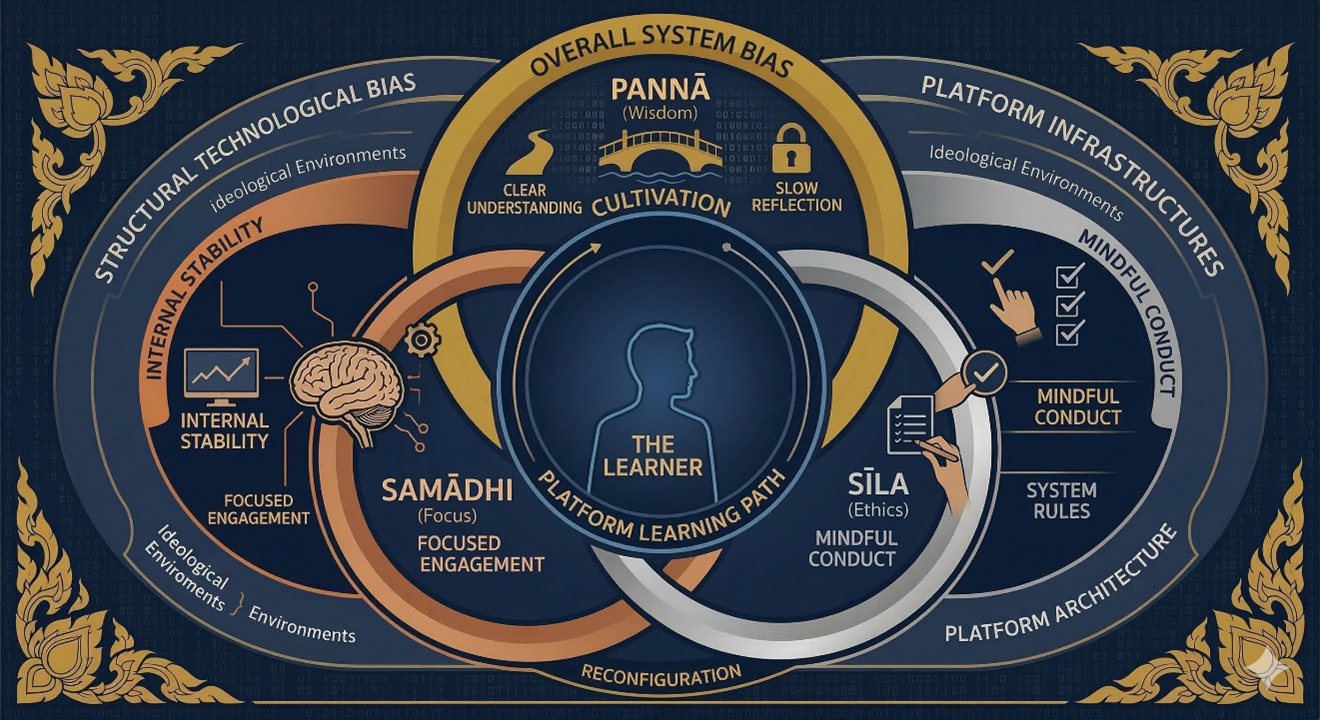
Background and Objectives: As online English instruction becomes pervasive in contemporary Thailand, existing scholarship primarily focuses on instructional efficiency, leaving the anthropological impact on learner formation underexplored. This study addresses this gap by advancing Buddhist anthropology to examine secular digital education as a contemporary terrain of ethical-epistemic formation. The primary objective is to investigate how digital pedagogy operates as a formative environment where discipline, attention, and discernment are structured and normalized. By reinterpreting the Tri-sikkhā (Sīla, Samādhi, and Paññā) as an analytical grammar rather than a doctrinal schema, this research specifically aims to analyze how technologically mediated learning enacts, approximates, or distorts these three dimensions of cultivation. Through this framework, the study demonstrates how Buddhist categories illuminate the subtle processes through which digital environments produce subjects and shape cognitive dispositions within modern educational life.
Methodology: This study employed a qualitative interpretive design, treating online instructional materials not as neutral tools but as cultural artifacts that reflect broader technological and educational regimes. Data Collection and Analysis Using purposive sampling, ten publicly accessible Thai online English instruction video clips were selected to represent contemporary asynchronous pedagogy. Data corpus includes instructional sequencing, visual organization, narrative framing, and pedagogical pacing. The analysis was systematically aligned with the Tri-sikkhā framework, comprising Sīla (Discipline), Samādhi (Attention), and Paññā (Discernment), utilizing it as an analytical grammar to trace ethical-epistemic formation. The interpretive process was conducted through five explicit stages. First, a detailed transcription of both verbal and non-verbal pedagogical cues was performed. Second, data classification was conducted, where findings were categorized through the heuristic lenses of the three Tri-sikkhā dimensions. Third, thematic reduction was employed to distill complex interactions into core pedagogical themes. Fourth, the synthesis stage utilized these themes to map patterns across cases and identify how digital environments structured learner dispositions. Last, the analysis underwent validation by cross-referencing findings with canonical Buddhist scholarship to ensure interpretive integrity. By documenting these structured procedures, the study explicitly demonstrates how digital pedagogy enacts, approximates, or distorts traditional architectures of human cultivation.
Main Results: Applying the Tri-sikkhā framework revealed an uneven enactment of Buddhist principles in digital English instruction. Sīla exposed how platforms enforced procedural discipline through routinized sequencing, yet rarely cultivated internalized ethical awareness. Samādhi revealed a reliance on engineered attentional strategies, such as short segments and visual stimulation, that produced momentary focus but limited sustained contemplation. Finally, Paññāwas profoundly constrained; Pedagogy privileged mechanized translation and surface comprehension over deep reflexive inquiry. Ultimately, these categories demonstrated how digital environments intensified behavioral order while structurally marginalizing wisdom-centered human cultivation.
Involvement to Buddhadhamma: Classified within Applied Buddhism, this study contributes to the intersection of Buddhism, globalization (Information Technology), and the development of wisdom and morality. By repositioning the Tri-sikkhā as a critical analytical resource for secular practices, the research revealed that online instruction operated as ethical-epistemic training where discipline and attention were amplified, and discernment was limited. This situates digital education within the anthropology of formation, extending applied Buddhist anthropology to analyze how platform infrastructures reshape contemporary modes of conduct and knowing beyond religious domains.
Conclusions: The study concludes that online English instruction functions as a formative environment rather than a mere pedagogical tool. Findings confirmed that digital pedagogy enforced proceduralized discipline and engineered attention while profoundly constraining wisdom. This research offers a conceptual contribution to Buddhist anthropology by extending its analytical scope into secular spaces and to digital education by demonstrating that platforms actively recalibrate how learners perceive experience, intensifying behavioral control while narrowing the conditions for insight.
References
Abeysekara, A. (2002). Colors of the Robe: Religion, Identity, and Difference. Columbia, United States of America: University of South Carolina Press.
Asad, T. (1993). Genealogies of Religion: Discipline and Reasons of Power in Christianity and Islam. Baltimore, United States of America: Johns Hopkins University Press.
Bayne, S. (2015). What is the matter with 'technology-enhanced learning'? Learning, Media and Technology, 40(1), 5-20. https://doi.org/10.1080/17439884.2014.915851.
Bayne, S., Evans, P., Ewins, R., Knox, J., Lamb, J., Macleod, H., O'Shea, C., Ross, J., Sheail, P. & Sinclair, C. (2020). The Manifesto for Teaching Online. Cambridge, MA, United States of America: MIT Press.
Bell, C. (2007). Teaching Ritual. Oxford, United Kingdom: Oxford University Press.
de Vries, F. M. (2024). Thinking Through Texts: The Pedagogy and Practice of Sui-Tang Buddhist Scholasticism. [Doctor in Philosophy in Buddhist Studies in the Graduate Division, University of California, Berkele]. University of California, Berkeley. https://www.proquest.com/openview/5496bb4e399e8ddce5219cf78c3d18aa/1?pq-origsite=gscholar&cbl=18750&diss=y.
Dreyfus, H. L. (2001). On the Internet. London, United Kingdom: Routledge. https://doi.org/10.4324/9780203187876.
Fenwick, T. & Edwards, R. (2010). Actor-Network Theory in Education. London, United Kingdom: Routledge. https://doi.org/10.4324/9780203849088.
Gethin, R. (1998). The Foundations of Buddhism. Oxford, United Kingdom: Oxford University Press.
Han, B. C. (2018). The Expulsion of the Other: Society, Perception and Communication Today. Cambridge, United Kingdom: Polity Press.
Hershock, P. D. (2006). Buddhism in the Public Sphere Reorienting Global Interdependence. London, United Kingdom: Routledge.
Houtman, G. (1999). Mental Culture in Burmese crisis politics: Aung San Suu Kyi and the National League for Democracy. Tokyo, Japan: Tokyo University of Foreign Studies.
Kabat-Zinn, J. (2013). Full catastrophe living: Using the wisdom of your body and mind to face stress, pain, and illness (Rev. ed.). New York, United States of America: Bantam.
Keown, D. (2005). Buddhist Ethics: A Very Short Introduction. Oxford, United Kingdom: Oxford University Press.
Kitiarsa, P. (2012). Mediums, Monks, and Amulets: Thai Popular Buddhism Today. Chiang Mai, Thailand: Silkworm Books.
Knox, J. (2019). What Does the 'Postdigital' Mean for Education? Three Critical Perspectives on the Digital, with Implications for Educational Research and Practice. Postdigital Science and Education, 1(2), 357-370. https://doi.org/10.1007/s42438-019-00045-y.
Lopez, D. S. (2012). The Scientific Buddha: His Short and Happy Life. New Haven, United States of America: Yale University Press.
McMahan, D. L. (2009). The Making of Buddhist Modernism. Oxford, United Kingdom: Oxford University Press. https://doi.org/10.1093/acprof:oso/9780195183276.001.0001.
Rosa, H. (2013). Social Acceleration: A New Theory of Modernity. New York, United States of America: Columbia University Press. https://doi.org/10.7312/rosa14834.
Selwyn, N. (2016). Education and Technology: Key Issues and Debates (2nd ed.). London, United Kingdom: Bloomsbury Academic.
Taylor, C. (2007). A Secular Age. Cambridge, United States of America: Belknap Press of Harvard University Press.
Teräs, M., Suoranta, J., Teräs, H. & Curcher, M. (2020). Post-Covid-19 Education and Education Technology 'Solutionism': a Seller's Market. Postdigital Science and Education, 2(3), 863-878. https://doi.org/10.1007/s42438-020-00164-x.
Thich Nhat Hanh. (1999). The Heart of the Buddha's Teaching Transforming Suffering into Peace, Joy, and Liberation. New York, United States of America: Harmony Books.
UNESCO. (2015). Rethinking Education: Towards a Global Common Good? Paris, France: UNESCO Publishing.
Zhao, Y., Emler, T. E., Snethen, A. & Yin, D. (2019). An Education Crisis Is a Terrible Thing to Waste: How Radical Changes Can Spark Student Excitement and Success. New York, United States of America: Teachers College Press.
Downloads
Published
How to Cite
Issue
Section
License
Copyright (c) 2026 Journal of Buddhist Anthropology

This work is licensed under a Creative Commons Attribution-NonCommercial-NoDerivatives 4.0 International License.