RETHINKING LIVING BUDDHIST HERITAGE: MONASTIC NETWORKS AND TRANSREGIONAL AUTHORITY IN SRI LANKA AND SOUTH ASIA
Keywords:
Living Buddhist Heritage, Monastic Networks, Theravāda Continuity, Cultural Diplomacy, South Asian BuddhismAbstract
Background: This study examines how core Buddhist teachings are constituted and perpetuated through lived religious practices and institutional forms. Buddhadhamma refers to the teachings generated during the enlightenment of the Buddha, which have been transmitted over the past 2, 560 years through doctrinal teaching, moral practice, and the Buddhist monastic institutions. However, it has been preserved within the Pāli canon and understood for centuries of Buddhist learning. Their persistence depends not only on textual but also on the social and institutional processes of reproduction. Since the Mauryan period (321-185 BCE), Buddhism has shaped both the material and immaterial landscapes of South Asia. While scholarship has frequently approached Buddhist heritage through architecture, archaeological documentation, or textual transmission, this study argues that Buddhist heritage in Sri Lanka is better understood as a dynamic socio-religious process that is sustained through interconnected monastic networks. From its early expansion, Buddhism moved across political and cultural boundaries through the circulation of monks, relics, texts, and ritual practices, embedding doctrinal authority within institutional and ritual forms. Sri Lanka, one of the most enduring centers of Theravāda continuity, provides a compelling case. Sacred sites such as Anuradhapura, Polonnaruwa, and the Temple of the Tooth Relic in Kandy function not merely as historical monuments but as active religious environments sustained through monastic lineages, ritual traditions, and devotional communities.
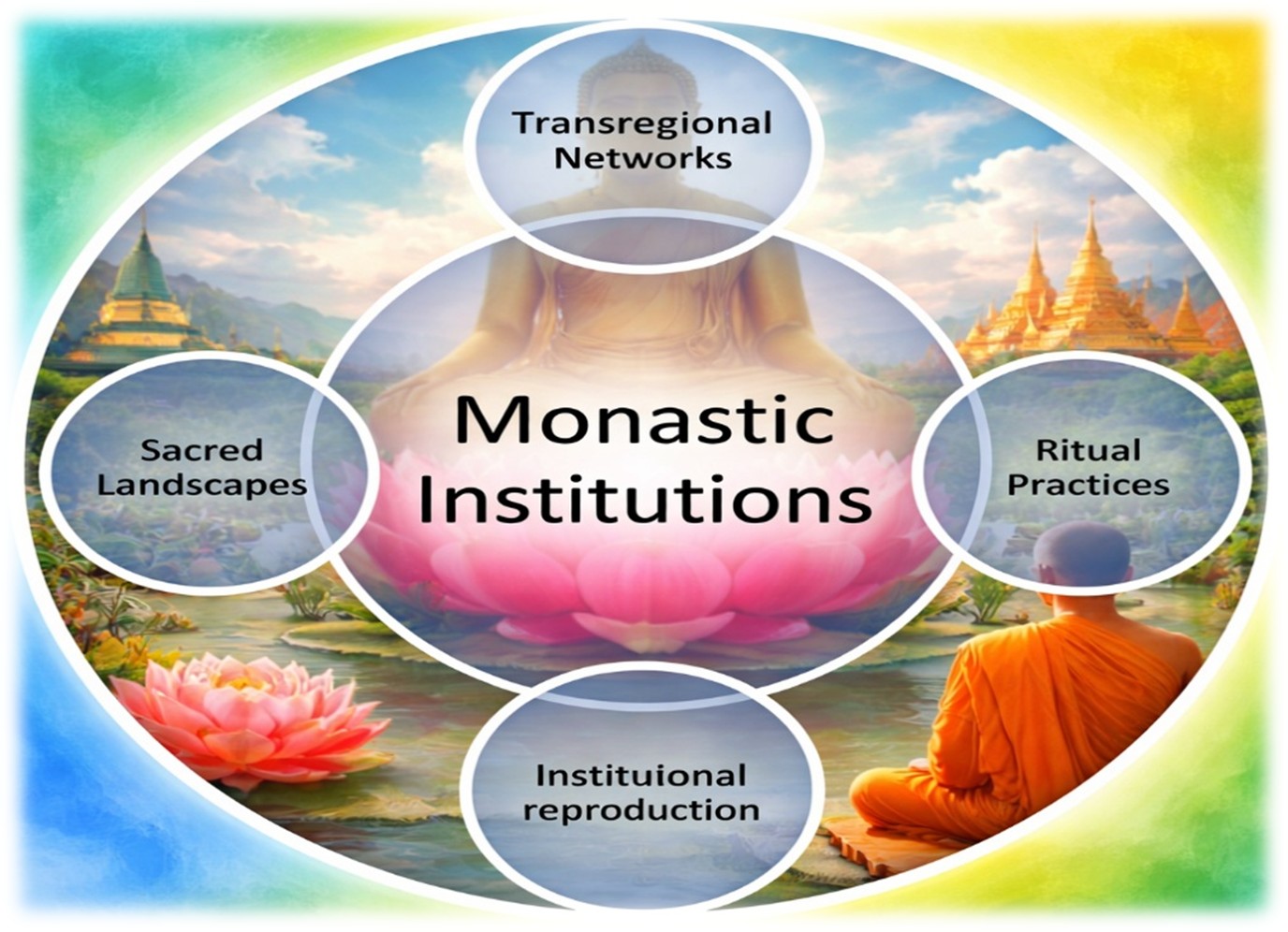
Involvement to Buddhadhamma: Living heritage traditions associated with these sacred landscapes embody core principles of Buddhadhamma. Monastic discipline enacts sīla (Ethical Conduct) as a foundational structure for both monastic and lay communities, while the preservation of the monastic regulations reflects the persistence of the tradition of the Vinaya in the Theravāda practice. Pilgrimage promotes acts of piety and charity that bring about puñña (Merit), which underlies mutualism between the monastic Saṅgha and lay followers. In this exchange, the Buddhist ethical values are replicated in everyday social life. Ritual cycles materialize teachings on anicca (Impermanence) through repetition, renewal, and commemorative performance. At the same time, Paññā (Wisdom) and compassion are cultivated not solely through scriptural study but through embodied participation in ritual practices, religious education, and communal activities which are organized by monastic institutions. Monastic networks thus operate as the structural nexus through which ethical practice, sacred sites, doctrinal continuity, and social organization are continuously reproduced. In this way, Buddhadhamma is sustained not merely as textual doctrine but as lived, relational practice embedded within heritage sites and institutional structures. This framework highlights how religious institutions transform doctrinal teachings into lived practices that sustain the Theravāda tradition.
Conclusions: By situating sacred centers within networks of monastic lineage, governance, and transregional affiliation, the article challenges static models of heritage that isolate monuments from lived religious practice. Instead, it advances a processual understanding of Theravāda continuity in which authority and identity are actively negotiated through ethical discipline, ritual performance, institutional organization, and devotional participation. From this perspective, Sri Lanka emerges as a pivotal doctrinal and institutional node within both South Asian and global Buddhist networks. The endurance of Buddhadhamma in this context does not rely only on the preservation of texts or monuments but on the ongoing interaction between monastic communities, sacred landscapes, and lay practitioners. Living Buddhist heritage, therefore, represents an active religious framework in which the teachings of the Buddha are sustained through embodied practice, interdependence, and institutional resilience rather than preservation alone.
References
Aris, M. (1979). Bhutan: The Early History of a Himalayan Kingdom. Warminster, England: Aris & Phillips.
Bandaranayake, S. (2023). Sinhalese Monastic Architecture: The Vihāras of Anurādhapura. Leiden, Netherlands: E. J. Brill. https://doi.org/10.1163/9789004646452.
Behrendt, K. A. (2007). The Art of Gandhara in The Metropolitan Museum of Art. New York, United States of America: The Metropolitan Museum of Art.
Chakrabarti, D. K. (1992). Ancient Bangladesh: a study of archaeological sources. Delhi, India: Oxford University Press.
Flood, F.B. (2009). Objects of Translation: Material Culture and Medieval "Hindu-Muslim" Encounter. Princeton, United States of America: Princeton University Press.
Forbes, A. D. W. (1987). The Pre-Islamic Archaeology of the Maldive Islands. Bulletin de lUra, K. (2015). The Experience of Gross National Happiness as Development Framework. ADB South Asia Working Paper Series, No.42. Manila,
Philippines: Asian Development Bank.École française d'Extrême-Orient, 76, 281-288. DOI: https://doi.org/10.3406/befeo.1987.1726.
Geiger, W. (1912). The Mahāvaṃsa or The Great Chronicle of Ceylon. London, United Kingdom: Oxford University Press.
Gombrich, R. & Obeyesekere, G. (1989). Buddhism Transformed: Religious Change in Sri Lanka. Princeton, United States of America: Princeton University Press.
Gombrich, R. F. (2006). Theravāda Buddhism: A Social History from Ancient Benares to Modern Colombo. London, United Kingdom: Routledge.
Goonatilake, S. (1998). Toward a Global Science: Mining Civilizational Knowledge. Bloomington, United States of America: Indiana University Press.
Harrison, R. (2013). Heritage Critical Approaches. London, United Kingdom: Routledge.
Holt, J. C. (1991). Buddha in the Crown: Avalokiteśvara in the Buddhist Traditions of Sri Lanka. New York, United States of America: Oxford University Press.
Huntington, S. L. (1985). The art of ancient India: Buddhist, Hindu, Jain. New York, United States of America: Weatherhill.
Jha, M. I. (2004). SAARC: The Road Ahead: A Case for Constructive Diplomacy. New Delhi, India: National Book Organization.
Levy, R. I. (1991). Mesocosm: Hinduism and the Organization of a Traditional Newar City in Nepal. Berkeley, United States of America: University of California Press.
Malalasekera, G. P. (1928). The Pāli Literature of Ceylon. Colombo, Sri Lanka: M. D. Gunasena.
Malalgoda, K. (1976). Buddhism in Sinhalese Society: 1750-1900. Berkeley, United States of America: University of California Press.
Nye, J. S., Jr. (2004). Soft Power: The Means to Success in World Politics. New York, United States of America: Public Affairs.
Rhie, M. M. & Thurman, R. A. F. (2000). Wisdom and Compassion: The Sacred Art of Tibet Expanded edition. New York, United States of America: Harry N. Abrams/Thames & Hudson.
Rosenfield, J. M. (1967). The Dynastic Arts of the Kushans. Berkeley, United States of America: University of California Press.
Sen, T. (2003). Buddhism, Diplomacy, and Trade: The Realignment of Sino-Indian Relations, 600-1400. Honolulu, United States of America: Association for Asian Studies and University of Hawai'i Press.
Slusser, M. S. (1982). Nepal Mandala A Cultural Study of The Kathmandu Valley. Princeton, United States of America: Princeton University Press.
Smith, L. (2006). Uses of Heritage. New York, United States of America: Routledge.
South Asian Association for Regional Cooperation (SAARC). (1985). Charter of the South Asian Association for Regional Cooperation. Dhaka, Bangladesh: SAARC Secretariat.
Spencer, J. (2007). Anthropology, Politics, and the State: Democracy and Violence in South Asia. Cambridge, United Kingdom: Cambridge University Press.
Tambiah, S. J. (1992). Buddhism Betrayed? Religion, Politics, and Violence in Sri Lanka. Chicago, United States of America: University of Chicago Press.
Thapar, R. (2012). Ashoka and the Decline of the Mauryas. London, United Kingdom: Oxford University Press.
UNESCO. (2019). Operational Guidelines for the Implementation of the World Heritage Convention. Paris, France: UNESCO.
United Nations General Assembly. (1999). Resolution 54/115: International Recognition of the Day of Vesak. New York, United States of America: United Nations.
Ura, K. (2015). The Experience of Gross National Happiness as Development Framework. ADB South Asia Working Paper Series, No.42. Manila, Philippines: Asian Development Bank.
Downloads
Published
How to Cite
Issue
Section
License
Copyright (c) 2026 Journal of Buddhist Anthropology

This work is licensed under a Creative Commons Attribution-NonCommercial-NoDerivatives 4.0 International License.