THE APPLICATION OF THE FOUR PRINCIPLES OF IDDHIPADA IN THE SCHOLARLY COMMUNICATION OF SCOPUS-INDEXED AUTHORS: A CASE STUDY OF SRINAKHARINWIROT UNIVERSITY, THAILAND
Keywords:
Scholarly Communication, Srinakharinwirot University, Iddhipada, Internal DriversAbstract
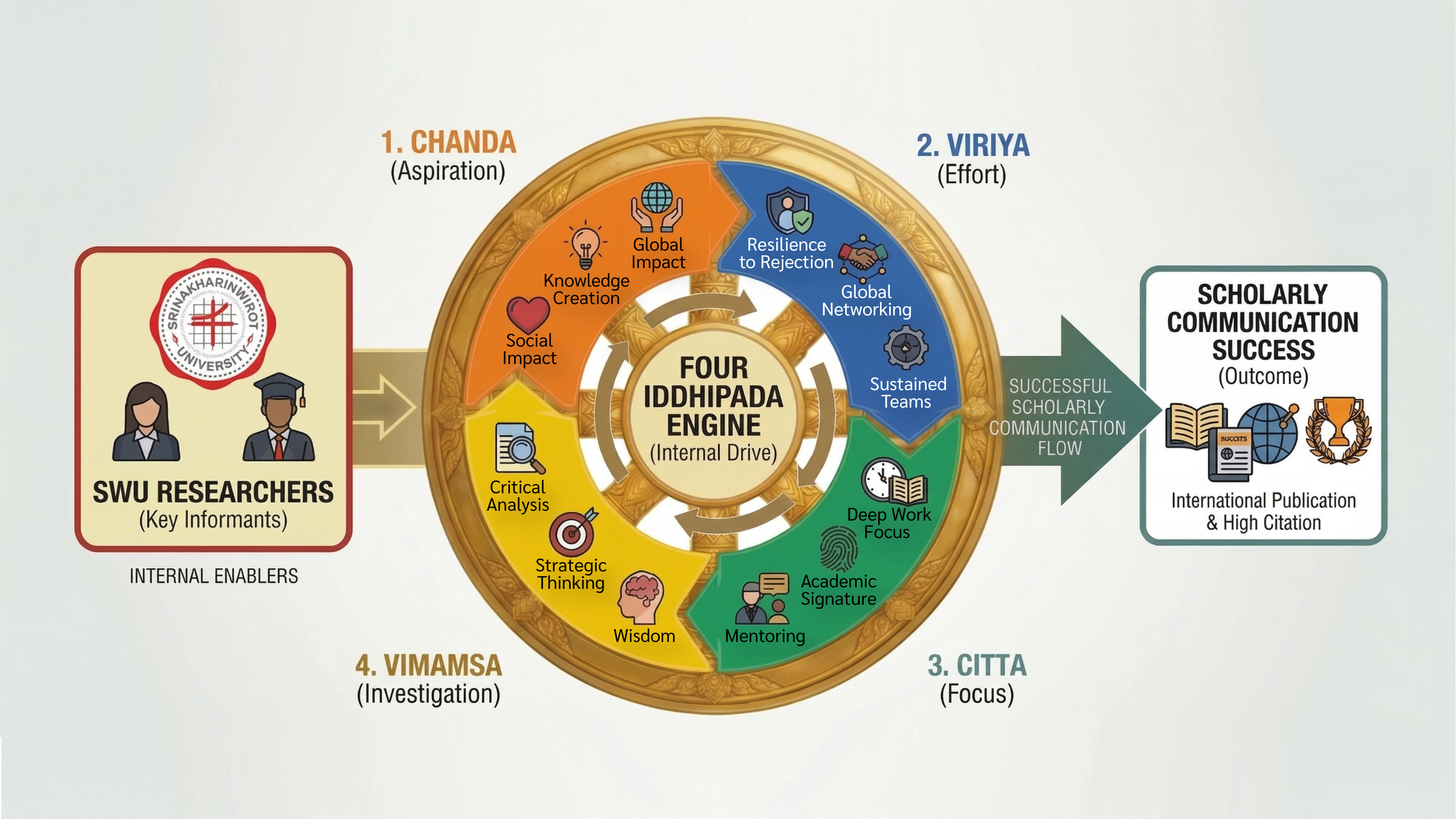
Background and Objective: Scholarly communication is the creation, peer review, sharing and preservation of a wide variety of academic outputs. It functions as a recognized metric of academic performance, which includes emerging formats such as preprints and online scholarly exchanges. Bibliometrics is used to evaluate scholarly communication, with publication and citation counts as the primary metrics. However, quantitative metrics ignore internal and cultural factors that drive academic success. To address this gap and extend existing scholarly communication research, this study explores how Buddhist principles contextualize the research practices of Thai scholars. The findings indicate that the four principles of Iddhipada are essential teachings in Buddhism that address internal qualities. They are: 1) Chanda (Aspiration), representing satisfaction and passion in work; 2) Viriya (Effort), supporting perseverance when facing obstacles; 3) Citta (Focus), involving concentration and mindfulness, and 4) Vimamsa (Investigation), using wisdom for reflection and improvement. The four principles of Iddhipada are crucial internal drivers for scholars to produce high-quality academic work in order to promote their success in academia. Therefore, this study aimed to explore how the four principles of Iddhipada (Four Paths to Success) Buddhist principles are applied within the scholarly communication process of authors affiliated with Srinakharinwirot University, whose works are indexed in the Scopus database.
Methodology: This qualitative study employed purposive sampling to include 18 key informants, namely, authors at Srinakharinwirot University with high citation rates indexed in Scopus. The data were collected from semi-structured in-depth interviews from October 2024 to August 2025, with a valid instrument designed to explore the application of the four principles of Iddhipada while they work. Furthermore, expert validation was undertaken for the interviews, and a pilot phase was implemented to establish reliability. The data analysis adopted content analysis, triangulation, and inductive analysis. This integrated approach ensured the reliability of the results and facilitated the synthesis of various information sources into a unified framework.
Main Results: The initial bibliometric analysis revealed that 5,504 Scopus-indexed publications were produced across 26 academic units from 1981 to 2025. Building on this context, the qualitative findings demonstrated that international publication success is not merely a result of academic skills but is systematically driven by integrating the four principles of Iddhipada. The informants utilized Chanda to transform personal intent into public-oriented research commitments. Furthermore, Viriya and Citta functioned synergistically to overcome unwholesome states (Akusala-dhamma), such as mental stagnation, fostering grit and a growth mindset amidst complex academic duties. Lastly, Vimamsa was applied as a strategic and analytical tool for critical decision-making throughout the publication cycle.
Involvement to Buddhadhamma: In accordance with the scope of Applied Buddhism, this study conceptualizes the four principles of Iddhipada as a practical framework for scholarly communication. Integrating these traditional teachings with contemporary research practices provides a philosophical foundation for knowledge creation. Specifically, internal cultivation through mindfulness and wise reflection enhances the academic management process. Ultimately, this applied approach strengthens researchers' ethical commitments and sustains their engagement with international publication standards.
Conclusions: Based on these findings, the four principles of Iddhipada could be framed for academic excellence. Academic institutions should focus on context-specific support that models these enablers. In this way, universities would implement policies that help researchers apply Vimamsa (Investigation) to address peer-review feedback and cultivate Viriya (Effort) to build emotional resilience, thereby enhancing research productivity and scholarly quality.
References
Abdel Khalek, A. M. (2015). Happiness, health, and religiosity among Lebanese young adults. Cogent Psychology, 2(1), 1035927. https://doi.org/10.1080/23311908.2015.1035927.
Argyle, M. & Hills, P. (2000). Religious Experiences and Their Relations With Happiness and Personality. The International Journal for the Psychology of Religion, 10(3), 157-172. https://doi.org/10.1207/S15327582IJPR1003_02.
Association of College & Research Libraries. (2013). Intersections of Scholarly Communication and Information Literacy: Creating Strategic Collaborations for a Changing Academic Environment. Chicago, Illinois: Association of College and Research Libraries.
Can Oz, Y., Duran, S. & Dogan, K. (2022). The Meaning and Role of Spirituality for Older Adults: A Qualitative Study. Journal of Religion and Health, 61(2), 1490-1504. https://doi.org/10.1007/s10943-021-01258-x.
Chaiphugdee, D. (2021). Innovative curriculum development for vocational skill enhancement and learning solution for underprivileged youths using community learning resources. International Journal of Science and Innovative Technology (IJSIT), 4(2), 42-51.
Childs, E. (2010). Religious Attendance and Happiness: Examining Gaps in the Current Literature A Research Note. Journal for the Scientific Study of Religion, 49(3), 550-560. https://doi.org/10.1111/j.1468-5906.2010.01528.x.
Chuang, R. & Chen, G. M. (2003). Buddhist perspectives and human communication. Intercultural Communication Studies, 12(4), 65-80.
Cranney, S. (2013). Do People Who Believe in God Report More Meaning in Their Lives? The Existential Effects of Belief. Journal for the Scientific Study of Religion, 52(3), 638-646. https://doi.org/10.1111/jssr.12046.
Das, A. K. (2015). Scholarly Communication. Paris, France: United Nations Educational, Scientific and Cultural Organization.
Esat, G., Day, S. & Smith, B. H. (2021). Religiosity and happiness of Turkish speaking Muslims: does country happiness make a difference? Mental Health, Religion & Culture, 24(7), 713-727. https://doi.org/10.1080/13674676.2021.1926444.
Estrada, C. A. M., Lomboy, M. F. T. C., Gregorio, E. R., Amalia, E., Leynes, C. R., Quizon, R. R. & Kobayashi, J. (2019). Religious education can contribute to adolescent mental health in school settings. International Journal of Mental Health Systems, 13(1), 28. https://doi.org/10.1186/s13033-019-0286-7.
Fincham, F. D. (2022). Towards a psychology of divine forgiveness. Psychology of Religion and Spirituality, 14(4), 451-461. https://doi.org/10.1037/rel0000323.
Francis, L. J. (1998). Happiness is a thing called stable extraversion: a further examination of the relationship between the Oxford Happiness Inventory and Eysencks dimensional model of personality and gender. Personality and Individual Differences, 26(1), 5-11. https://doi.org/10.1016/S0191-8869(98)00185-8.
French, S. & Joseph, S. (1999). Religiosity and its association with happiness, purpose in life, and self-actualisation. Mental Health, Religion & Culture, 2(2), 117-120. https://doi.org/10.1080/13674679908406340.
Grim, J. (2011). The roles of religions in activating an ecological consciousness. International Social Science Journal, 62(205-206), 255-269. https://doi.org/10.1111/issj.12008.
Hackney, C. H. & Sanders, G. S. (2003). Religiosity and Mental Health: A Meta–Analysis of Recent Studies. Journal for the Scientific Study of Religion, 42(1), 43-55. https:doi.org/10.1111/1468-5906.t01-1-00160.
Hanjai, P., Thongiang, B. & Phrakruvinaithorn Wutthichai Chayawuddho. (2024). The Role of Educational Institute Administrators on Iddhipada 4 Principles that Affect the Happiness of Teachers' Work Performance Under the Secondary Education Service Area Nakhon Si Thammarat Office. Journal of Mani Chettha Ram Wat Chommani, 7(4), 758-776. https://doi.org/10.3389/frma.2019.00004.
Ignat, T., Ayris, P., Gini, B., Stepankova, O., Özdemir, D., Bal, D. & Deyanova, Y. . (2021). Perspectives on Open Science and The Future of Scholarly Communication: Internet Trackers and Algorithmic Persuasion. Frontiers in Research Metrics and Analytics, 6, 748095. https://doi.org/10.3389/frma.2021.748095.
Key Informant 1. (2025). Principles for Successful Scopus Publishing. (Chongchorhor, C. & Interviewer)
Key Informant 14. (2025). Principles for Successful Scopus Publishing. (Chongchorhor, C. & Interviewer)
Key Informant 15. (2025). Principles for Successful Scopus Publishing. (Chongchorhor, C. & Interviewer)
Key Informant 17. (2025). Principles for Successful Scopus Publishing. (Chongchorhor, C. & Interviewer)
Key Informant 2. (2025). Principles for Successful Scopus Publishing. (Chongchorhor, C. & Interviewer)
Key Informant 3. (2025). Principles for Successful Scopus Publishing. (Chongchorhor, C. & Interviewer)
Key Informant 5. (2025). Principles for Successful Scopus Publishing. (Chongchorhor, C. & Interviewer)
Key Informant 8. (2025). Principles for Successful Scopus Publishing. (Chongchorhor, C. & Interviewer)
Key Informant 9. (2025). Principles for Successful Scopus Publishing. (Chongchorhor, C. & Interviewer)
Khaitan, T. & Norton, J. C. (2019). The right to freedom of religion and the right against religious discrimination: Theoretical distinctions. InternationalJournal of Constitutional Law, 17(4), 1125-1145. https://doi.org/10.1093/icon/moz087.
Lewis, C. A., Maltby, J. & Burkinshaw, S. (2000). Religion and Happiness: Still no association. Journal of Beliefs & Values, 21(2), 233-236. https://doi.org/10.1080/713675504.
Nell, W., & Rothmann, S. (2018). Hope, religiosity, and subjective well-being. Journal of Psychology in Africa, 28(4), 253-260. https://doi.org/10.1080/14330237.2018.1505239.
O’Sullivan, L. & Lindsay, N. (2023). The relationship between spiritual intelligence, resilience, and well-being in an Aotearoa New Zealand sample. Journal of Spirituality in Mental Health, 25(4), 277-297. https://doi.org/10.1080/19349637.2022.2086840.
Onthaisong, S. (2020). Children and Youths Promotion for Buddhist Activity Participation of Monks at Muang District, Chaiyapum Province. Journal of Administration and Social Science Review, 3(1), 41-48.
Patel, V. M., Ashrafian, H., Almoudaris, A., Makanjuola, J., Bucciarelli-Ducci, C., Darzi, A. & Athanasiou, T. (2013). Measuring academic performance for healthcare researchers with the H index: which search tool should be used? Medical principles and practice: international journal of the Kuwait University, Health Science Centre, 22(2), 178-183. https://doi.org/10.1159/000341756.
Phabua, T., Phrakhru Opatnontakitti (Sakda Obhaso) & Chaisuk, P. (2024). Development of a Motivation Model in Performing Work According to Iddhipada Principles of Secondary School Teachers Under the Office of Phra Nakhon Si Ayutthaya Secondary Educational Service Area. Journal of Educational Review Faculty of Education in MCU, 11(2), 643-656.
Phra Brahmagunabhorn (P.A. Payutto). (2002). Dictionary of Buddhism: Numerical Vocabulary Words. Bangkok, Thailand: Mahachulalongkornrajavidyalaya University.
Phra Srirajamongkolpandit, Boonkham, W., PiaEia, K., Pagkaew, V. & Patawong, N. (2022). Problem Study Buddhist Youth of Thailand. Journal of Philosophical Vision, 2(2), 97-110.
Phra Teerawat Jaranathammo (Khanungsub). (2017). The Application of Iddhipada 4 for the Management of Sub-District Administrative Organization Wat Bot District, Phitsanulok Province. Mekong-Salween Civilization Studies Journal, 8(2), 109-130.
Phra Thiti Kittipanyo (Jamnong Suk). (2019). A study of the four path accomplishments (Iddhipada) as the Stimulation for Being Wholesome. Journal of MBU Humanities, 11(2), 77-88.
Phuprasom, N. (2022). Student Health Situation in Thailand 2021. Bangkok, Thailand: Department of Health, Bureau of Health Promotion of Thailand.
Põder, E. (2022). What Is Wrong with the Current Evaluative Bibliometrics? Frontiers in Research Metrics and Analytics, 6, 824518. https://doi.org/10.3389/frma.2021.824518.
Pongphumma, L. (2017). Knowledge Boromarajonani Chon Buri.Chonburi, Thailand: Boromarajonani College of Nursing.
Pretolesi, D., Stanzani, I., Ravera, S., Vian, A. & Barla, A. (2025). Artificial intelligence and network science as tools to illustrate academic research evolution in interdisciplinary fields: The case of Italian design.PLoS ONE,20(1), e0315216. https://doi.org/10.1371/journal.pone.0315216.
Pritchard, A. (1969). Statistical bibliography or bibliometrics. Journal of Documentation, 25(4), 348-349.
Robinson, K. M. (2010). Policy issues in mental health among the elderly. Nursing Clinics of North America, 45(4), 627-634. https://doi.org/10.1016/j.cnur.2010.06.005.
Singh, K., Junnarkar, M., Singh, D., Suchday, S., Mitra, S. & Dayal, P. (2020). Associations Between Religious/Spiritual Practices and Well-Being in Indian Elderly Rural Women. Journal of Religion and Health, 59(6), 2753-2774. https://doi.org/10.1007/s10943-019-00877-9.
Somkhane, P. (2023). Integration of Buddhist Iddhipāda Principles in Online Learning Management: A Mixed-Methods Research and Development Study of Social Studies Teachers in Northeast Thailand. Insights into Modern Education (i-ME), 1(3), 50-73.
Tantalanukul, S., Netchang, S., Mapiw, P., Kaewkhong, N., Phomma, A. & Juntasan, I. (2025). Integrating Buddhist wisdom with holistic health promotion: A case study of monks in the digital age in Muang Uttaradit district. Journal of Buddhist Anthropology, 10(1), 69-79.
Wang, K., Zhou, K. Z. & Bai, X. (2023). Buddhist influence and the executive-employee pay gap: An institutional contingency framework. Journal of Business Research, 166, 114091. https://doi.org/10.1016/j.jbusres.2023.114091.
Winzer, L., Samutachak, B. & Gray, R. S. (2018). Religiosity, spirituality, and happiness in Thailand from the perspective of Buddhism. Journal of Population and Social Studies, 26(1), 1-16.
Wolfram, D. (2019). Understanding and navigating the scholarly communication landscape in the twenty-first century. Frontiers in Research Metrics and Analytics, 4.
Yulek, D., Sawetworravhot, T. & Aunjanam, S. (2022). The use of the four Iddhipada principles of academic administration of educational administrators according to the opinions of administrators and teachers under the Office of Education Phuket Municipality. Journal of Mani Chettha Ram Wat Chommani, 5(3), 54-70.
Zotti, R., Speziale, N. & Barra, C. (2016). On the causal effect of religiosity on life satisfaction using a propensity score matching technique. International Journal of Social Economics, 43(10), 1031-1048. https://doi.org/10.1108/IJSE-12-2014-0262.
Downloads
Published
How to Cite
Issue
Section
License
Copyright (c) 2026 Journal of Buddhist Anthropology

This work is licensed under a Creative Commons Attribution-NonCommercial-NoDerivatives 4.0 International License.