INSTITUTIONAL MINDFULNESS BELL PRACTICE FOR MANAGERIAL AWARENESS: EVIDENCE FROM STABN RADEN WIJAYA
Keywords:
Mindfulness Bell, Managerial Awareness, Work Climate, Buddhist EducationAbstract
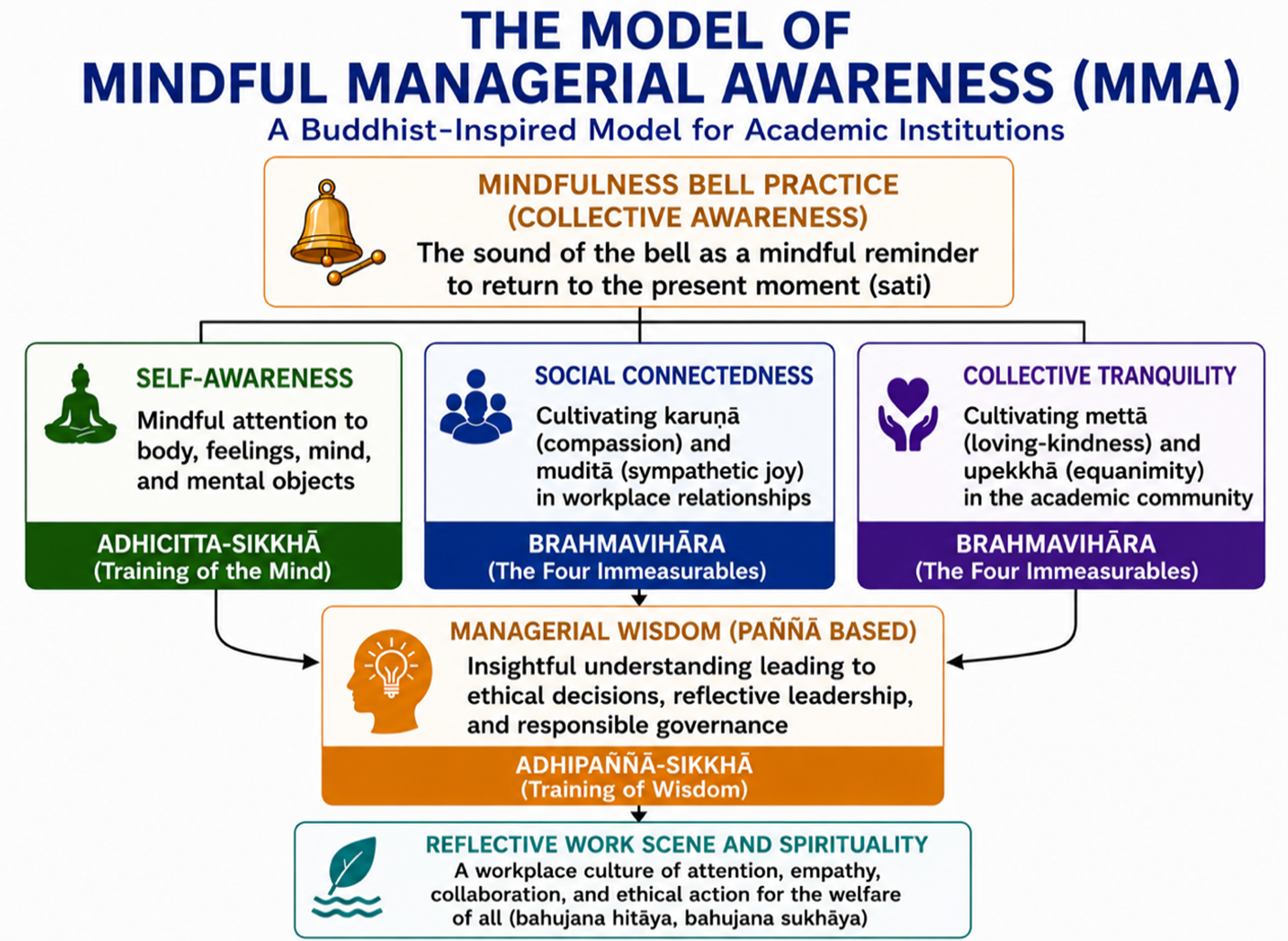
Background and Objectives: This study was conducted to clarify how mindfulness practices can serve as structured managerial tools in higher education institutions. At STABN Raden Wijaya, the mindfulness bell has been implemented three times daily for more than one year as a routine practice to pause activities, regulate attention, and foster collective awareness among academic staff. Despite its consistent application, the specific role and impact of this practice in shaping managerial awareness and the institutional work climate have not been systematically examined. This study aimed: To analyse the systematic implementation and level of institutional engagement in the mindfulness bell practice within the pluralistic environment of STABN Raden Wijaya; To evaluate the impact of regular mindfulness practice on the development of individual managerial awareness, focusing particularly on emotional regulation and reflective behaviour; To investigate how collective mindfulness influences the institutional work climate by promoting social connectedness and harmony across various religious backgrounds; and To develop an integrative conceptual model called Mindful Managerial Awareness (MMA) that connects Buddhist awareness principles with contemporary organisational governance.
Methodology: This study used a mixed-methods sequential explanatory design, in which quantitative data were collected first and followed by qualitative data to explain and enrich the statistical findings. Quantitative data were collected via a closed-ended questionnaire distributed via Google Forms to 44 respondents from a total population of 89 employees. Qualitative data were obtained from open-ended questionnaire responses, participatory observation of daily mindfulness bell sessions, and institutional documentation. Quantitative data were analysed using descriptive statistics, and qualitative data were analysed using thematic analysis. Data integration was conducted through triangulation to ensure interpretive depth and validity.
Main Results: The results indicated a high level of institutional acceptance and engagement with the mindfulness bell practice. All respondents reported awareness of and participation in the programme, with 84.1% engaging consistently in all daily sessions. A majority of respondents (63.6%) perceived the practice as having a strongly positive effect on concentration and work atmosphere, while others reported moderate benefits. Thematic analysis revealed six core themes: Self-awareness, social interconnectedness across religious boundaries, collective calmness, empathetic work relations, reflective managerial awareness, and spiritual-institutional balance. A significant proportion of non-Buddhist respondents described the practice as universal rather than sectarian, highlighting its role in fostering inclusivity and mutual respect.
Involvement to Buddhadhamma: From a Buddhadhamma perspective, the mindfulness bell reflects the practice of sati (Mindfulness) as a foundation of awareness while cultivating mettā (Loving-kindness) and karuṇā (Compassion) in workplace relationships. These values support calm and ethical leadership grounded in paññā (Wisdom), demonstrating how Buddhist teachings may be applied within contemporary organisational life. This study is therefore classified under Applied Buddhism, particularly in the domain of Buddhist management and educational practice.
Conclusions: This study indicates that the mindfulness bell practice plays an important role in strengthening collective awareness in the institutional environment. Employees demonstrated improved emotional regulation and stronger social interaction, while the practice also supported the development of reflective leadership behaviour. These findings suggest that mindfulness functions not only as an individual psychological intervention but also as an organisational culture mechanism. In this context, the mindfulness bell serves as a practical tool for fostering attention, empathy, and collaborative decision-making in a multireligious academic setting.
References
Anālayo, B. (2019). A Task for Mindfulness: Facing Climate Change. Mindfulness, 10, 1926-1935. https://doi.org/10.1007/s12671-019-01187-7.
Bayot, M., Vermeulen, N., Kever, A. & Mikolajczak, M. (2020). Mindfulness and Empathy: Differential Effects of Explicit and Implicit Buddhist Teachings. Mindfulness, 11, 5-17. https://doi.org/10.1007/s12671-018-0966-4.
Braun, V. & Clarke, V. (2006). Using thematic analysis in psychology. Qualitative Research in Psychology, 3(2), 77-101. https://doi.org/10.1191/1478088706qp063oa.
Burmansah, B., Rugaiyah, R., Mukhtar, M., Nabilah, S., Ripki, A. J. H. & Fatayan, A. (2020). Mindful Leadership: The Ability of the Leader to Develop Compassion and Attention without Judgment - A Case Study of the Leader of Buddhist Higher Education Institute. European Journal of Educational Research, 9(1), 51-65. https://doi.org/10.12973/eu-jer.9.1.51.
Degbey, W. Y. (2025). 99: Mindful Leadership. In Elgar Encyclopedia of Leadership (pp. 238-241). Cheltenham, United Kingdom: Edward Elgar Publishing. https://doi.org/10.4337/9781035307074.000104.
Dhiman, S. K. (2020). Anatomy of mindfulness at work. In Dhiman, S.K. (Eds.), The Routledge Companion to Mindfulness at Work (1st Ed.). (pp. 3-23). London, United Kingdom: Routledge. https://doi.org/10.4324/9780429244667-1.
Eberth, J. & Sedlmeier, P. (2012). The Effects of Mindfulness Meditation: A Meta-Analysis. Mindfulness, 3, 174-189. https://doi.org/10.1007/s12671-012-0101-x.
Fiocco, A. J., Mallya, S., Farzaneh, M. & Koszycki, D. (2019). Exploring the Benefits of Mindfulness Training in Healthy Community-Dwelling Older Adults: A Randomised Controlled Study Using a Mixed Methods Approach. Mindfulness, 10, 737-748. https://doi.org/10.1007/s12671-018-1041-x.
Giraldi, T. (2019). What Is Mindfulness? In Giraldi, T. (Eds.), Psychotherapy, Mindfulness and Buddhist Meditation (1st Ed.). (pp. 13-35). London, United Kingdom: Palgrave Macmillan, Cham. https://doi.org/10.1007/978-3-030-29003-0_2.
Girivirya, S., Choompolpaisal, P., Makcharoen, P. & Esteve, J. (2023). The Dilemma: Easy implementation of the Buddhist Sunday School Curriculum during the COVID-19 Pandemic in the era of digital technology advancement. AIP Conference Proceedings, 17 August 2023, 2805(1), 030002. https://doi.org/10.1063/5.0148972.
Guillaumie, L., Boiral, O. & Champagne, J. (2017). A mixed-methods systematic review of the effects of mindfulness on nurses. Journal of Advanced Nursing, 73(5), 1017-1034. https://doi.org/10.1111/jan.13176.
Huynh, T., Hatton-Bowers, H. & Smith, H. M. (2019). A Critical Methodological Review of Mixed Methods Designs Used in Mindfulness Research. Mindfulness, 10, 786-798. https://doi.org/10.1007/s12671-018-1038-5.
Islam, G. I. & Holm, M. (2019). Mindfulness in Practice: Alternative Mindsets in the French Financial Sector. Academy of Management Proceedings, 2019(1), 16529. https://doi.org/10.5465/AMBPP.2019.16529abstract.
Jowsey, T., Deng, C. & Weller, J. (2021). General-purpose thematic analysis: a useful qualitative method for anaesthesia research. BJA Education, 21(12), 472-478. https://doi.org/10.1016/j.bjae.2021.07.006.
Lam, A. H. Y., Ho, L. M. K., Lam, S. K. K., Chan, C. K. Y., Chan, M. M. K., Pun, M. W. M. & Wang, K. M. P. (2024). Effectiveness and experiences of integrating Mindfulness into Peer-assisted Learning (PAL) in clinical education for nursing students: A mixed-method study. Nurse Education Today, 132, 106039. https://doi.org/10.1016/j.nedt.2023.106039.
Li, P. & Ramirez, D. R. (2017). Zen and psychotherapy. In Masuda, A. & O'Donohue, W. (Eds.), Handbook of Zen, Mindfulness, and Behavioural Health (pp. 169-194). Cham, Switzerland: Springer. https://doi.org/10.1007/978-3-319-54595-0.
Lim, J. J., Roberts, C., Graham, O., Coady, S., Topliss, J. & Staton, C. (2025). Understanding medical students' intercalation decisions to preserve the clinical academic pipeline: a mixed-method survey. BMC Medical Education, 25, 1316. https://doi.org/10.1186/s12909-025-07609-6.
Mammen, B. N., Lam, L. & Hills, D. (2025). Evaluating the impact of an educational intervention with cognitive rehearsal training on preparing pre-registration nursing students to respond to workplace incivility. Nurse Education Today, 150, 106685. https://doi.org/10.1016/j.nedt.2025.106685.
Marques, J. (2021). At the intersection of workplace spirituality and Buddhist psychology: a critical summary of literature. Journal of Global Responsibility, 12(2), 137-157. https://doi.org/10.1108/JGR-10-2019-0101.
Moskovich, L. & Rozani, V. (2025). Health profession students' perceptions of ChatGPT in healthcare and education: insights from a mixed-methods study. BMC Medical Education, 25, 98. https://doi.org/10.1186/s12909-025-06702-0.
Neves-Pereira, M. S., Carvalho, M. A. B. de & Aspesi, C. de C. (2018). Mindfulness and Buddhism: Contributions of Buddhist philosophical and religious teachings to the fields of psychology and education: Contributions of Buddhist philosophical and religious teachings to the fields of psychology and education. Gifted Education International, 34(2), 144-154. https://doi.org/10.1177/0261429417716347.
Reynolds, R., Edge, D., Neill, S., Hayward, M., Alexandropoulou, M. & Carey, M. (2024). Impact of the Nursing and Midwifery Council (2018), Future Nurse: Standards of proficiency for registered nurses on children's nursing curriculum – A cross-sectional study. Nurse Education Today, 140, 106284. https://doi.org/10.1016/j.nedt.2024.106284.
Roussel, L. (2019). Leadership's Impact on Quality, Outcomes, and Costs. Critical Care Nursing Clinics of North America, 31(2), 153-163. https://doi.org/10.1016/j.cnc.2019.02.003.
Rutigliano, N. K. H., Samson, R. M., & Frye, A. S. (2017). Mindfulness: Spiriting Effective Strategic Leadership and Management. In Wang, V. C. X. (Eds.), Encyclopaedia of Strategic Leadership and Management. (pp. 460-469). Hershey, United States of America: IGI Global. https://doi.org/10.4018/978-1-5225-1049-9.ch033.
Sisk, D. A. (2018). An Exploration of Mindfulness Practices and Leadership. Creative Education, 9(9), 1302-1311. https://doi.org/10.4236/ce.2018.99097.
Verweij, H., van Ravesteijn, H., van Hooff, M. L. M., Lagro-Janssen, A. L. M. & Speckens, A. E. M. (2018). Does Mindfulness Training Enhance the Professional Development of Residents? A Qualitative Study. Academic Medicine, 93(9), 1335-1340. https://doi.org/10.1097/ACM.0000000000002260.
Vu, M. C. & Tran, T. (2021). Trust Issues and Engaged Buddhism: The Triggers for Skilful Managerial Approaches. Journal of Business Ethics, 169, 77-102. https://doi.org/10.1007/s10551-019-04273-x.
Whitesman, S. & Mash, R. (2024). Assessing the Effect of a 2-Year Mindfulness-Based Training Programme on Personal and Professional Functioning: A Mixed-Methods Study. Mindfulness, 15, 230-241. https://doi.org/10.1007/s12671-023-02279-1.
Wibowo, A. & Paramita, W. (2022). Resilience and Turnover Intention: The Role of Mindful Leadership, Empathetic Leadership, and Self-Regulation. Journal of Leadership & Organisational Studies, 29(3), 325-341. https://doi.org/10.1177/15480518211068735.
Downloads
Published
How to Cite
Issue
Section
License
Copyright (c) 2026 Journal of Buddhist Anthropology

This work is licensed under a Creative Commons Attribution-NonCommercial-NoDerivatives 4.0 International License.