BUDDHIST PHILOSOPHY AND SUSTAINABLE DEVELOPMENT: INTEGRATING SOCIETY, ECONOMY, AND ENVIRONMENT
Keywords:
Sustainable Development, Wisdom Spiral, Buddhist Philosophy, Inner Transformation, Engaged BuddhismAbstract
Background and Objective: Prosperity achieved by human civilization loses its real meaning if the socio-economic well-being of mankind and its stewardship of natural systems are ignored. Any damage to these systems makes them unsustainable and ultimately threatens human civilization. The discussion of this study focuses on two contrasting philosophical approaches to sustainable development: An ongoing growth-oriented model that relies on profit, technology, and policy solutions, and an ethically grounded, justice-oriented view historically rooted in South Asian communities. The core debate centers on whether profit should define social and ecological outcomes, or whether social values should set the limits of profit. Whether sustainability is best understood as an individual market choice or as a collective responsibility, and the environmental crisis faced by humanity reflects a deficit of technology, or a crisis of ethical values that requires a fundamental shift. The main objective of the study was to critically examine the perspectives of sustainability with reference to Buddhist and spiritual practices in South Asia as a collective resource that informed holistic and value-driven responses to pressing global challenges, supported by empirical examples of development practices.
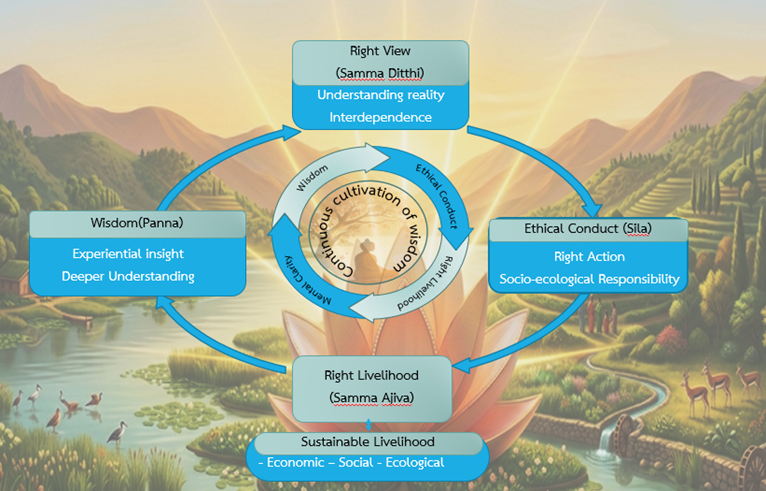
Methodology: A qualitative design with documentary research has been followed. With a systematic review of the literature, including classical Buddhist texts, the canon in Pali, and experiences from engaged Buddhism, the primary sources for the analysis were taken from these sources. Ideas from Key informants comprising 10 specialists regarding Buddhist Philosophy and their application have been conducted and taken as a guide for the analysis. Evidence from community-based practices has been incorporated to explain the understanding of Buddhism not only as a philosophy, but as an ethical and lively resource for supporting sustainable development. Applying a thematic approach to content analysis and comparative textual interpretation, the study proposes the concept of the Wisdom spiral, integrating the inner transformation with outer sustainability.
Main Results: Unlike the contemporary worldview, the indigenous and Buddhist worldviews and practices recognize the interdependence of all life and teach that true prosperity does not come from unlimited growth but from ethical living. The system guided by Buddhist philosophy offers an alternative in which harmony between human society, the ecosystem, and all beings can be achieved with deep respect. Proving philosophical guidelines of interdependence, the Middle Way, and shared responsibility, Buddhist philosophy suggests a moral and practical framework for environmental, social, and economic balance with human-nature relations. The evidence from indigenous values and traditions in South Asian communities also reflects the lived experience of alternatives.
Involvement to Buddhadhamma: Drawing from the Buddhist philosophy and practices of Engaged Buddhism, this paper examines how Buddhist ideas have been reshaped in modern times as both spiritual imperatives and practical tools for shaping and implementing policy. A dialectical approach has been followed to find differences between the original Buddhist teaching and initiatives taken by engaged Buddhism for sustainable development. This allows for a nuanced understanding of how spiritual philosophy can help to shape the ethical boundaries of recent orientation. An interpretative textual analysis rooted in a historical cultural context has been explored to examine how classical Buddhist traditions are interpreted in practices.
Conclusions: Drawing on the concept of the wisdom spiral, integrated with the sustainability bottom line, the study concludes that sustainability requires more than technological advancement, and development becomes meaningful only when it respects economic viability, considers social equity, and respects ecological limits. The findings emphasize that human activity should be guided by moderation, compassion, and interdependence. Sustainability is more than a technological advancement. It is not value-neutral but requires fundamental ethical transformation that Buddhist and spiritual practices can offer holistically.
References
Ariyaratne, A. T. (1999). Collected Works of A. T. Ariyaratne: Sarvodaya Peace Meditation Programme. Moratuwa, Sri Lanka: Sarvodaya Vishva Lekha Press.
Becker, C. U. (2023). Ethical underpinnings for the economy of the Anthropocene: Sustainability ethics as key to a sustainable economy. Ecological Economics , 211, 107868. https://doi.org/10.1016/j.ecolecon.2023.107868.
Beery, T., Olafsson, A. S., Gentin, S., Maurer, M., Stålhammar, S., Albert, C., Bieling, C., Buijs, A., Fagerholm, N., Garcia-Martin, M., Plieninger, T. & Raymond, C. M. (2023). Disconnection from nature: Expanding our understanding of human–nature relations. People and Nature, 5(2), 470-488. https://doi.org/10.1002/pan3.10451.
Bhusal, S. (2025). Balancing Self-Satisfaction and Moderation: The Ideal Economic Philosophy in the Nepalese Context. Asian Journal of Interdisciplinary Research, 68-78. https://doi.org/10.54392/ajir2515.
Blanc, J. & Meißner, A. (2025). Towards a Holistic Approach to Sustainable Development: Inner Development as a Missing Link for Sustainability Transformation. Religions, 16(1), 76. https://doi.org/10.3390/rel16010076.
Bodhi, B. (2012). The Numerical Discourses of the Buddha: A Translation of the Anguttara Nikaya. Massachusetts, United States of America: Wisdom Publications.
Bond, G. D. (2004). Buddhism at Work:Community Development, Social Empowerment and the Sarvodaya Movement. Kumarian Press, United States of America: The University of California.
Brundtland, H. G. (1987). Our Common Future: Report of the World Commission on Environment and Development. Oxford, England: Oxford University Press.
Bunte, M. (2023). Uncivil Society and Democracy's Fate in Southeast Asia: Democratic Breakdown in Thailand, Increasing Illiberalism and Ethnic Cleansing in Myanmar. Journal of Current Southeast Asian Affairs, 42(3), 372-394. https://doi.org/10.1177/18681034231208467.
Daly, H. E. (1996). Beyond Growth: The Economics of Sustainable Development. Massachusetts, United States of America: Beacon Press.
Darlington, S. M. (2012). The Ordination of a Tree: The Thai Buddhist Environmental Movement. New York, United States of America: SUNY Press. https://doi.org/10.1353/book21405.
Dhiman, S. & Marques, J. (Eds.). (2016). Spirituality and Sustainability: New Horizons and Exemplary Approaches (1st ed.). Cham, Switzerland: Springer International Publishing. https://doi.org/10.1007/978-3-319-34235-1.
Dodge, R., Daly, A., Huyton, J. & Sanders, L. D. (2012). The challenge of defining wellbeing. International Journal of Wellbeing, 2, 222-235. https://doi.org/10.5502/ijw.v2i3.4.
Kaza, S. (2009). 'The Greening of Buddhism: Promise and Perils'. In M. E. Tucker & D. R. Williams, Buddhism and Ecology: The Interconnection of Dharma and Deeds. Cambridge, Massachusetts: Harvard University Press. https://doi.org/10.1093/oxfordhb/9780195178722.003.0008.
Kehler, S. & Birchall, S. J. (2021). Social vulnerability and climate change adaptation: The critical importance of moving beyond technocratic policy approaches. Environmental Science & Policy, 124, 471-477. https://doi.org/10.1016/j.envsci.2021.07.025.
Kittiprapas, S. (2019). BUDDHIST APPROACH AND HAPPINESS FOR SUSTAINABLE DEVELOPMENT. The Journal of International Buddhist Studies College, 1(1), 90-123.
Kraft, K. (1992). Inner Peace, World Peace: Essays on Buddhism and Nonviolence. New York, United States of America: State University of New York Press.
Kuhn, T. S. (2012). The Structure of Scientific Revolutions 50th Anniversary Edition. Chicago, United States of America: University of Chicago Press. https://doi.org/10.7208/chicago/9780226458144.001.0001.
Loy, D. R. (2010). The World Is Made of Stories. Massachusetts, United States of America: Wisdom Publications.
Macy, J. & Johnstone, C. (2012). ACTIVE HOPE: How to Face the Mess We're in without Going Crazy. California, United States of America: New World Library.
Massey, M. (2007). Sustainable development 20 years after Brundtland: time for more patience and pragmatism. London, United Kingdom: Chatham House.
Phrakhrusamu Woravit Phasuko (Dutsadeephuttipun) & Kaewwilai, M. K. (2025). From Buddhadhamma to Ecological Harmony: Buddhist Ethics as a Pathway to Sustainable Wellbeing. The Journal of International Buddhist Studies College (JIBSC), 11(2), 240-262.
Queen, C. S. & King, S. B. (1996). Engaged Buddhism: Buddhist Liberation Movements in Asia. New York, United States of America: SUNY Press.
Regmi, U. (2024). Buddhist Cultural Heritage of Lo Manthang and Satellite Settlements, Mustang, Nepal. Literary Studies, 37(1), 162-179. https://doi.org/10.3126/litstud.v37i1.63040.
Rockström, J., Steffen, W., Noone, K., Persson, Å., Chapin, F. S., III., Lambin, E. F., Lenton, T. M., Scheffer, M., Folke, C., Schellnhuber, H. J., Nykvist, B., de Wit, C. A., Hughes, T., van der Leeuw, S., Rodhe, H., Sörlin, S., Snyder, P. K., Costanza, R., Svedin, U., Falkenmark, M., Karlberg, L., Corell, R. W., Fabry, V. J., Hansen, J., Walker, B., Liverman, D., Richardson, K., Crutzen, P. J. & Foley, J. A. (2009). A safe operating space for humanity. Nature, 461(7263), 472-475. https://doi.org/10.1038/461472a.
Sachs, J. D. (2015). The Age of Sustainable Development. New York, United States of America: Columbia University Press.
Schumacher, E. F. (1973). SMALL IS BEAUTIFUL: Economics as if People Mattered. London, England: Blond & Briggs.
Shastree, U. (1996). Religious converts in India : socio-political study of neo-Buddhists. New Delhi, India: Mittal Publication.
Sivaraksa, S. (2011). The Wisdom of Sustainability: Buddhist Economics for the 21st Century. London, England: Souvenir Press.
Sivaraksa, S., Kotler, A. & Bennett, N. (2009). The wisdom of sustainability: Buddhist economics for the 21st century. Hawaii, United States of America: Koa Books.
Summers, J. & Smith, L. (2014). The Role of Social and Intergenerational Equity in Making Changes in Human Well-Being Sustainable. AMBIO, 43(6), 718-728. https://doi.org/10.1007/s13280-013-0483-6.
UN. (1996). Report of the World Summit for Social Development. New York, United States of America: United Nations.
UNDP, N. (2007). Thailand Human Development Report 2007: Sufficiency Economy and Human Development. Bangkok, Thailand: UNDP.
UNESCO. (2004). Shaping the Future, We Want: UN Decade of Education for Sustainable Development (2005-2014). Final Report. Paris, France: UNESCO.
United Nations. (2023). Transforming our world: the 2030 Agenda for Sustainable Development. New York, United States of America: The General Assembly.
Ura, K., Alkire, S., Zangmo, T. & Wangdi, K. (2012). An Extensive Analysis of GNH Index. Thimphu, Bhutan: Centre for Bhutan Studies.
Venerable Dhammapitaka (P. A. Payutto). (1994). Buddhist economics: a middle way for the market place. Bangkok, Thailand: Buddhadhamma Foundation.
Walker, S., Smith, E. A, Bennett, N., Bannister, E., Narayana, A., Nuckols, T., Pineda Velez, K., Wrigley, J. & Bailey, K. M. (2024). Defining and conceptualizing equity and justice in climate adaptation. Global Environmental Change, 87, 102885. https://doi.org/10.1016/j.gloenvcha.2024.102885.
Zsolnai, L. (Ed.). (2011). Ethical Principles and Economic Transformation-A Buddhist Approach. Berlin, Germany: Springer. https://doi.org/10.1007/978-90-481-9310-3.
Downloads
Published
How to Cite
Issue
Section
License
Copyright (c) 2026 Journal of Buddhist Anthropology

This work is licensed under a Creative Commons Attribution-NonCommercial-NoDerivatives 4.0 International License.