SHIFTING ETHICS AND PSYCHOLOGY: HOW BUDDHIST PRACTICE, EXEMPLARS, AND ROUTINE CAN CHANGE INDIVIDUALS AT GOMDE
Keywords:
Tibetan Vajrayana, Psychological Transformation, EthicsAbstract
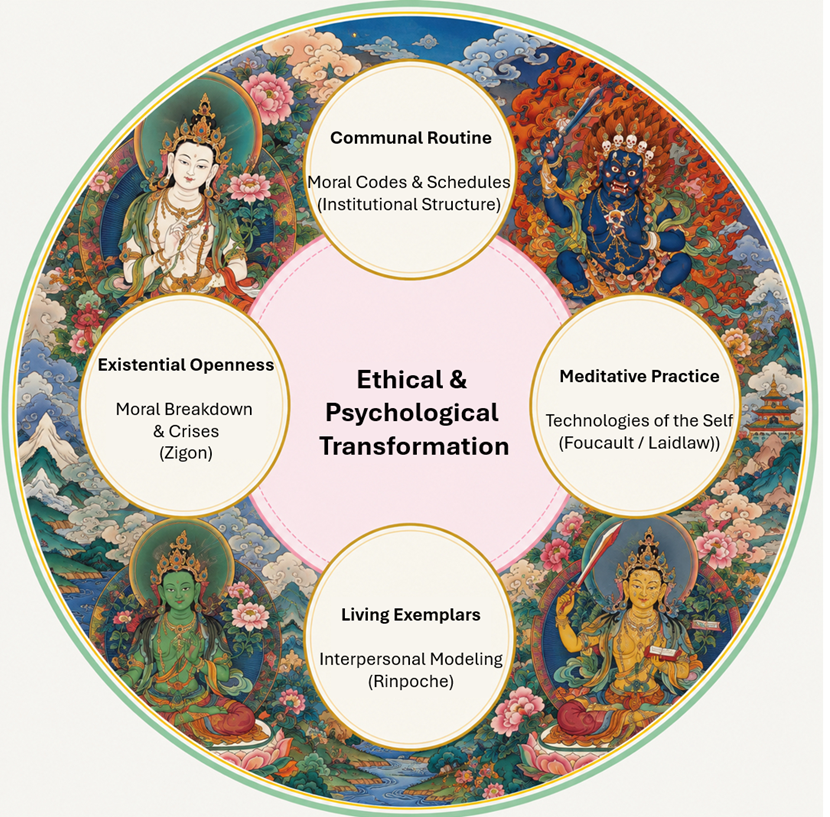
Background: Ethical life can be modified depending on the cultural context one is situated within: "Our" good is not the only good, nor, potentially, the good we should aspire to at all. The variety that exists in the domain of ethical life leads to questions about the sanctity of a supposed predetermined morality, hence raising issues for those who adhere to certain ethical conduct because that conduct is believed to be ethical. In Rangjung Yeshe Gomde, a Tibetan Vajrayana Buddhist meditation centre located in the foothills of the Upper Austrian Alps, these questions and issues come to the fore. It is a centre that acts as a transition zone for potential self-reformation; One that supplies Western meditators interested in Tibetan Buddhist philosophy a place in which to reset from the dominant values in one's social milieu. Here, students learn that there are alternative ways to realize values that differ from the ones that have been inculcated within themselves. Gomde thus enables Western students to reframe and alter their ethical and psychological considerations; Many individuals I describe in this article turn to Buddhism when life becomes heavy and no longer makes sense, and they subsequently have profound shifts in how they think they ought to be living. The setting, teachings, practices, and exemplars encourage this reassessment. That Buddhist meditation, which allows students to reframe mental phenomena and thus induces a critical reflexivity about their responses to the vicissitudes of life, is clear in a setting like Gomde. Yet this "Universal" capacity for moral reasoning is contextually inflected. Nevertheless, self-formation at Gomde provides an environment for a fruitful analysis of the reflexive efforts people employ to lead an ethical life, even if located in "Pedagogically" oriented forms and embedded in the routines of daily life. Therefore, with ethnographic engagement, I show how Buddhadhamma, in this setting, accompanied by other factors, can lead to ethical and psychological transformation: I enable an anthropological account of how and why some Western interlocutors deviate from societal and psychological norms. To work through this argument, I detail: The role that meditation and Buddhadhamma have in reassessing values; The importance of an openness to new ideals; And how exemplars can simultaneously allow people to reimagine their ethical conduct whilst enabling a continuation of a culturally divergent set of ethical values in a novel environment.
Involvement to Buddhadhamma: This article analyses how contemporary Western subjects utilize Tibetan Buddhist practices, routines, and relationships to transform their psychological well-being, highlighting a link between Buddhism and the development of wisdom and morality.
Conclusions: The meditative practices, ethical teachings, and exemplars at Gomde allow interested students a chance to diverge from pre-existing values and norms, causing substantial changes in some. Although these techniques are profound, the ability they have to alter people's values depends on other social factors. Hence, underpinning the ethical transformations at Gomde are pertinent social dynamics ranging from the political landscape one inhabits to health factors. The original data of this research is a significant subject matter to engage with because it allows a close connection with a form of social life historically underdeveloped in the anthropological canon. Understanding how people believe they ought to live, the mechanisms that enable these evaluations to change, and what happens when they do change are all topics that have thus been assessed. I therefore provide important material for helping gain insight into the various dimensions of ethics across society. When this can be better understood, how people work and operate in different settings can be better understood: A study of ethics is a study of social life, and vice versa.
References
Asad, T. (1993). Genealogies of Religion: Discipline and Reasons of Power in Christianity and Islam. Baltimore, United States of America: Johns Hopkins University Press.
Baumann, M. (1994). The transplantation of Buddhism to Germany: Processive modes and strategies of adaptation. Method & Theory in the Study of Religion, 6(1), 35-61.
Cook, J. & Diemberger, H. (2021). Buddhism. In Stein, F. (Ed.), The open encyclopaedia of anthropology. Cambridge, United Kingdom: The Cambridge Encyclopedia of Anthropology. http://doi.org/10.29164/21buddhism.
Cook, J. (2010). Meditation in Modern Buddhism: Renunciation and Change in Thai Monastic Life. Cambridge, United Kingdom: Cambridge University Press.
Cook, J. (2015). Detachment and engagement in mindfulness-based cognitive therapy. In Yarrow, T. Candea, M., Trundle, C. & Cook, J. (Eds.), Detachment: essays on the limits of relational thinking (pp. 219-235). Manchester, United Kingdom: Manchester University Press.
Cook, J. (2023). Self-cultivation. In Laidlaw, J. (Ed.), The Cambridge Handbook for the Anthropology of Ethics (pp. 411-432). Cambridge, United Kingdom: Cambridge University Press.
Das, V. (2007). Life and Words: Violence and the Descent into the Ordinary. California, United States of America: University of California Press. https://doi.org/10.1525/9780520939530.
Evans, N. H. A. (2023). Exemplars. In J. Laidlaw (Ed.), The Cambridge Handbook for the Anthropology of Ethics (pp. 433-459). Cambridge, United Kingdom: Cambridge University Press. https://doi.org/10.1017/9781108591249.017.
Faubion, J. D. (2001). Toward an Anthropology of Ethics: Foucault and the Pedagogies of Autopoiesis. Representations, 74(1), 83-104. https://doi.org/10.1525/rep.2001.74.1.83.
Faubion, J. D. (2011). An Anthropology of Ethics. Cambridge, United Kingdom: Cambridge University Press.
Ferrara, A. (2008). The Force of the Example: Explorations in the Paradigm of Judgment. Columbia, United States of America: Columbia University Press.
Foucault, M. (1978). The History of Sexuality: Volume 1: An Introductio. New York, United States of America: Random House, Inc.
Foucault, M. (1988). Technologies of the Self. In P. Rabinow (Ed.), Ethics Subjectivity and Truth: Essential Works of Foucault 1954-1984 (pp. 223-252). London, United Kingdom: Routledge.
Foucault, M. (1997). Ethics Subjectivity and Truth: The Essential Works of Foucault 1954-1984. Rabinow, P. (Ed.) (Vol1). New York, United States of America: The New Press.
Heywood, P. (2023). The Two Faces of Michel Foucault. In J. Laidlaw (Ed.), The Cambridge Handbook for the Anthropology of Ethics (pp. 130-154). Cambridge, United Kingdom: Cambridge University Press. https://doi.org/10.1017/9781108591249.005.
Hirschkind, C. (2006). The Ethical Soundscape: Cassette Sermons and Islamic Counterpublics. Columbia, United States of America: Columbia University Press.
Humphrey, C. (1997). Exemplars and rules: Aspects of the discourse of moralities in Mongolia. In Howell, S. (Ed.), The Ethnography of Moralities (pp. 25-47). London, United Kingdom: Routledge.
Laidlaw, J. & Mair, J. (2019). IMPERFECT ACCOMPLISHMENT: The Fo Guang Shan Short-Term Monastic Retreat and Ethical Pedagogy in Humanistic Buddhism. Cultural Anthropology, 34(3), 328-358. https://doi.org/10.14506/ca34.3.02.
Laidlaw, J. (2014). The Subject of Virtue: An Anthropology of Ethics and Freedom. Cambridge, United Kingdom: Cambridge University Press.
Laidlaw, J. (2023). Introduction Life. In Laidlaw, J. (Ed.), The Cambridge Handbook for the Anthropology of Ethics (pp. 729-896). Cambridge, United Kingdom: Cambridge University Press.
Lambek, M. (2000). The Anthropology of Religion and the Quarrel between Poetry and Philosophyhy. Current Anthropology, 41(3), 309-320.
Lambek, M. (2010). Ordinary Ethics: Anthropology, Language and Action. New York, United States of America: Fordham University Press.
Mahmood, S. (2011). Politics of Piety: The Islamic Revival and the Feminist Subject. Philadelphia, United States of America: Princeton University Press.
Robbins, J. (2004). Becoming Sinners: Christianity and Moral Torment in a Papua New Guinea Society. California, United States of America: University of California Press.
Robbins, J. (2007). Between Reproduction and Freedom: Morality, Value, and Radical Cultural Change. Ethnos, 72(3), 293-314.
Robbins, J. (2018). Where in the World Are Values?: Exemplarity, Morality, and Social Process. In Laidlaw, J., Bodenhorn, B. & Holbraad M. (Eds.), Recovering the Human Subject: Freedom, Creativity and Decision (pp. 174-192). Cambridge, United Kingdom: Cambridge University Press.
Seigel, J. (2005). The Idea of the Self: Thought and Experience in Western Europe since the Seventeenth Century. Cambridge, United Kingdom: Cambridge University Press. https://doi.org/10.1017/CBO9780511818141.
Teasdale, J. D. (1999). Metacognition, mindfulness and the modification of mood disorders. Clinical Psychology and Psychotherapy, 6(2), 146-155. http://dx.doi.org/10.1002/(SICI)1099-0879(199905)6:2<146::AID-CPP195>3.0.CO;2-E.
Westerhoff, J. C. (2022). Nāgārjuna. California, United States of America: Stanford University Press.
Zigon, J. (2007). Moral breakdown and the ethical demand: A theoretical framework for an anthropology of moralities. Anthropological Theory, 7(2), 131-150. https://doi.org/10.1177/1463499607077295.
Zigon, J. (2008). Morality: An Anthropological Perspective (1st ed.). London, United Kingdom: Routledge. https://doi.org/10.4324/9781003086147.
Zigon, J. (2010). Moral and ethical assemblages. Anthropological Theory, 10(1-2), 3-15. https://doi.org/10.1177/1463499610370520.
Downloads
Published
How to Cite
Issue
Section
License
Copyright (c) 2026 Journal of Buddhist Anthropology

This work is licensed under a Creative Commons Attribution-NonCommercial-NoDerivatives 4.0 International License.