MINDFUL MOVEMENT AND PROPRIOCEPTIVE AWARENESS IN OLDER THAI ADULTS: A BUDDHIST-INFORMED STUDY OF EMBODIED CONFIDENCE
Keywords:
Proprioceptive Awareness, Embodied Confidence, Mindful MovementAbstract
Background and Objectives: Older adults often demonstrate slower movement patterns, hesitate to stand up, or experience difficulties with balance, which frequently indicate aging in daily life. The ability to perceive body position, movement, and muscular effort gradually deteriorates as a result of these experiences, which can affect mobility, self-confidence, and independence. Proprioception senses and controls body position and movement through receptors in muscles, joints, and skin. Although movement-based interventions provide physical benefits, little is known about how older adults' proprioceptive awareness changes as a lived, embodied process, particularly in relation to their overall physical and mental well-being. This study aimed to explore how older Thai adults experience changes in body awareness through mindful movement, to interpret these experiences through the Buddhadhamma lens, and to understand how awareness contributes to embodied confidence in daily life.
Methodology: A qualitative phenomenology study was employed to gain insight into the participants' lived bodily experiences. Eight older Thai adults, aged 61 to 67, were included in an eight-week training program focused on gentle, mindful movement and effort regulation. After completion of all the sessions, participants participated in in-depth, semi-structured interviews lasting 60 to 90 minutes. Thematic analysis was used for analyzing the data, focusing on three key areas: Awareness of posture, calm and controlled movement, and the ability to adjust effort gently and kindly.
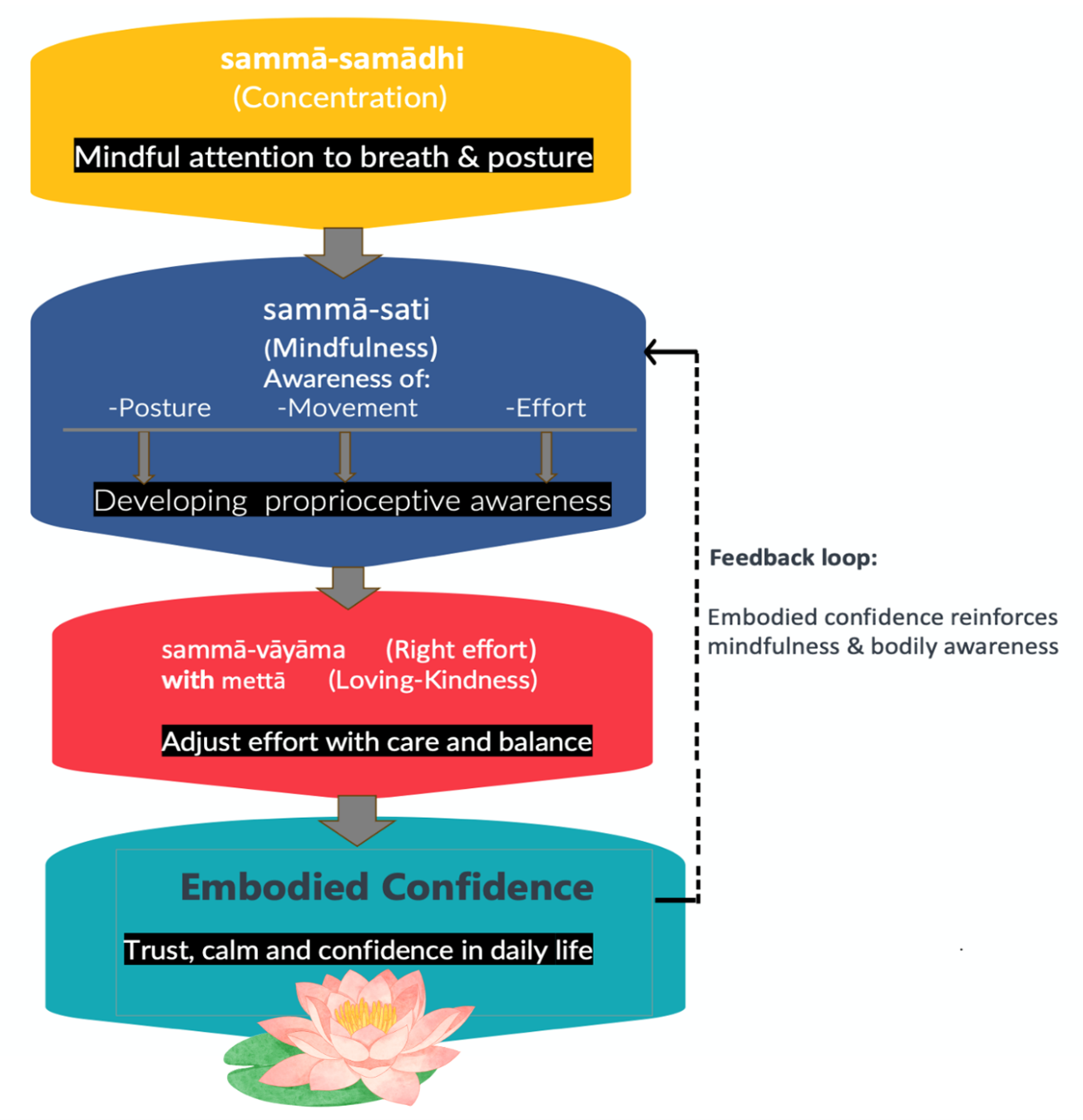
Main Results: Participants reported greater awareness of posture, resulting in enhanced alignment and balance; More consistent and stable movement accompanied by a sensation of calmness; And a better capacity to regulate muscular effort with precision. Consistent with the first objective, these changes reflected proprioceptive awareness as a progressive lived process, generally described as "Feeling the Body More Clearly," with greater sensitivity to subtle shifts in weight, tension, and balance. These changes implemented across into daily activities, where participants found it easier to move around, were less fearful of falling, and felt more confident in their own abilities when standing and walking. Addressing the second objective, these experiences reflected mindful awareness (Sammā-sati), balanced and non-forcing effort (Sammā-vāyāma), and stable, continuous concentration (Sammā-samādhi) from a Buddhadhamma perspective. Participants also expressed a relationship with their bodies through patience and loving-kindness (Mettā), corresponding to a transition from exertive control to gentle, mindful awareness. In line with the third objective, these bodily changes were experienced as increased ease, stability, and trust, contributing to the development of embodied confidence in daily life.
Involvement to Buddhadhamma: This study explored Buddhadhamma principles through applied practice in mindful movement, focusing on the development of mindfulness (Sammā-sati), concentration (Sammā-samādhi), right effort (Sammā-vāyāma), and loving-kindness (Mettā). These characteristics emerged from lived experience rather than doctrines, turning a bodily awareness into practical understanding and self-monitoring. The findings suggest how contemplative principles can be applied to movement-based practice, linking traditional Buddhist concepts with contemporary health promotion.
Conclusions: The findings suggest that mindful movement informed by Buddhadhamma may support proprioceptive awareness and embodied confidence in older adults. Participants' experiences indicate that incorporating mindful attention, balanced effort, and sustained concentration into movement practice might cultivate a more attentive, calm, and compassionate relationship with the body. These changes extended beyond physical improvement, contributing to greater ease, stability, and trust in everyday movement over time. Although based on a modest qualitative sample and not intended for extensive generalization, the findings spotlight the potential benefits of integrating contemplative principles with movement-based practices to promote active and mindful aging.
References
Bandura, A. (1977). Self-efficacy: Toward a unifying theory of behavioral change. Psychological Review, 84(2), 191-215. https://doi.org/10.1037/0033-295X.84.2.191.
Blom, E. H., Duncan, L. G., Ho, T. C., Connolly, C. G., LeWinn, K. Z., Chesney, M. A. & Yang, T. T. (2014). The development of an RDoC-based treatment program for adolescent depression: "Training for Awareness, Resilience, and Action" (TARA). Frontiers in Human Neuroscience, 8, 630. https://doi.org/10.3389/fnhum.2014.00630.
Braun, V. & Clarke, V. (2006). Using thematic analysis in psychology. Qualitative Research in Psychology, 3(2), 77-101. https://doi.org/10.1191/1478088706qp063oa.
Calsius, J., De Bie, J., Hertogen, R. & Meesen, R. (2016). Touching the Lived Body in Patients with Medically Unexplained Symptoms. How an Integration of Hands-on Bodywork and Body Awareness in Psychotherapy may Help People with Alexithymia. Frontiers in Psychology, 7, 253. https://doi.org/10.3389/fpsyg.2016.00253.
Efstathiou, M., Giannaki, C. D., Roupa, Z., Hadjisavvas, S. & Stefanakis, M. (2022). Evidence of distorted proprioception and postural control in studies of experimentally induced pain: a critical review of the literature. Scandinavian Journal of Pain, 22(3), 445-456. https://doi.org/10.1515/sjpain-2021-0205.
Gard, T., Brach, N., Hölzel, B. K., Noggle, J. J., Conboy, L. A. & Lazar, S. W. (2012). Effects of a yoga-based intervention for young adults on quality of life and perceived stress: The potential mediating roles of mindfulness and self-compassion. The Journal of Positive Psychology, 7(3), 165-175. https://doi.org/10.1080/17439760.2012.667144.
Goble, D. J., Coxon, J. P., Wenderoth, N., Van Impe, A. & Swinnen, S. P. (2009). Proprioceptive sensibility in the elderly: Degeneration, functional consequences and plastic-adaptive processes. Neuroscience & Biobehavioral Reviews, 33(3), 271-278. https://doi.org/10.1016/j.neubiorev.2008.08.012.
Gothe, N. P., Fanning, J., Awick, E., Chung, D., Wójcicki, T. R., Olson, E. A., Mullen, S. P., Voss, M., Erickson, K. I., Kramer, A. F. & McAuley, E. (2014). Executive Function Processes Predict Mobility Outcomes in Older Adults. Journal of the American Geriatrics Society, 62(2), 285-290. https://doi.org/10.1111/jgs.12654.
Hagen, I. & Bhavanani, A. B. (2025). How to Facilitate Self-Reflection, Personal Development, and Coping with Stress: Yoga and Yogic Breathing for Increasing Health, Healing and Wellbeing. New Delhi, India: IntechOpen. https://doi.org/10.5772/intechopen.1010406.
Makkabphalanon, K., Thangkratok, P., Bunnaphasitthasothin, C., Pramnoi, P. & Madsong, C. (2025). The Effectiveness of a Mindfulness-Based Art Therapy Program on Sleep Quality among Urban Older Adults in Thailand: A Quasi-Experimental Study. Patient preference and adherence, 19, 3183-3195. https://doi.org/10.2147/PPA.S551988 .
Noradechanunt, C., Worsley, A. & Groeller, H. (2017). Thai Yoga improves physical function and well-being in older adults: A randomised controlled trial. Journal of Science and Medicine in Sport, 20(5), 494-501. https://doi.org/10.1016/j.jsams.2016.10.007.
Proske, U. & Gandevia, S. C. (2012). The Proprioceptive Senses: Their Roles in Signaling Body Shape, Body Position and Movement, and Muscle Force. Physiological Reviews, 92(4), 1651-1697. https://doi.org/10.1152/physrev.00048.2011.
Riemann, B. L. & Lephart, S. M. (2002). The Sensorimotor System, Part II: The Role of Proprioception in Motor Control and Functional Joint Stability. Journal of Athletic Training, 37(1), 80-84.
Schmalzl, L., Powers, C. & Henje Blom, E. (2015). Neurophysiological and neurocognitive mechanisms underlying the effects of yoga-based practices: towards a comprehensive theoretical framework. Frontiers in Human Neuroscience, 9, 235. https://doi.org/10.3389/fnhum.2015.00235.
Tantrongphak, K., Anantapong, K. & Suriyaamarit, D. (2025). The Thai Version of the Updated Perceived Control Over Falling Scale: A Study of Cross-Cultural Adaptation, Reliability, and Validity in Older Adults. Journal of Health Science and Medical Research, 44(3), 1-12. https://doi.org/10.31584/jhsmr.20251268.
Varela, F. J., Thompson, E. & Rosch, E. (1991). The Embodied Mind: Cognitive Science and Human Experience. Massachusetts, United States of America: MIT Press.
Wallace, B. A. (2011). Minding Closely: The Four Applications of Mindfulness. Ithaca, United States of America: Snow Lion Publications.
Wang, J., Li, Y., Yang, G.-Y. & Jin, K. (2025). Age-Related Dysfunction in Balance: A Comprehensive Review of Causes, Consequences, and Interventions. Aging and Disease, 16(2), 714-737. https://doi.org/10.14336/AD.2024.0124-1.
World Health Organization. (2015). World report on ageing and health. Geneva, Switzerland: World Health Organization.
Youkhana, S., Dean, C. M., Wolff, M., Sherrington, C. & Tiedemann, A. (2016). Yoga-based exercise improves balance and mobility in people aged 60 and over: a systematic review and meta-analysis. Age and Ageing, 45(1), 21-29. https://doi.org/10.1093/ageing/afv175.
Downloads
Published
How to Cite
Issue
Section
License
Copyright (c) 2026 Journal of Buddhist Anthropology

This work is licensed under a Creative Commons Attribution-NonCommercial-NoDerivatives 4.0 International License.