TRANSFORMING MORAL TEACHING MONKS: THE NSW-360 COMPETENCY MODEL FOR THE MODERN ERA
Keywords:
Buddhist Moral Education, Moral Teaching Monks, NSW-360 Competency Model, Active Learning and Coaching, Digital Era EducationAbstract
Background and Objective: Thai society is currently facing a significant moral and ethical crisis among children and youth, driven by rapid technological changes and globalization. In response, the government has implemented the Moral Teaching Monks in Schools Project, involving over 18,000 monks nationwide. However, many Moral Teaching Monks still use one-way lectures that do not motivate learners. This is compounded by the generational gap that inhibits them from adapting Dhamma content to modern youth behaviors and responding properly to challenging questions. Moreover, limited knowledge of educational psychology, coaching, and technology integration restricts their ability to encourage critical thinking and active learning. The results show low student engagement and weak learner-centered practices in digital-age classrooms. Therefore, this study aims to develop the NSW-360 model to transform moral teaching monks into modern learning facilitators and coaching-oriented educators.
Methodology: This study employed a Research and Development (R&D) framework in two phases. Phase 1 involved empirical field implementation through competency development workshops with 131 Moral Teaching Monks. A total of 109 completed evaluation forms were returned (83.20% Response Rate) and analyzed using descriptive statistics and content analysis. The Talent-SCANN tool was utilized to assess individual potential and support active learning approaches. Phase 2 focused on model synthesis and validation through an expert seminar involving seven distinguished scholars who evaluated the intervention and validated the competency model. Qualitative data were analyzed using content analysis. Four instruments were used: 1) A five-point Likert satisfaction survey, 2) Digital reflection platforms (InnerCorner and Kahoot), 3) A POSDCoRB-based checklist, and 4) Semi-structured interviews for triangulation.
Main Results: The findings revealed that participants reported the highest level of satisfaction with the competency development model ( = 4.67, S.D. = 0.18), indicating a strong and consistent perception of effectiveness. Importantly, satisfaction was associated not only with the organization of the workshop but also with the acquisition of modern pedagogical competencies, including coaching skills, TalentSCANN-based Self-assessment, and the use of digital applications. These competencies strengthened monks' ability to serve as Kalyanamitta (Spiritual Friends) for the digital generation. Qualitative synthesis identified six key domains where Buddhist principles were practically embodied: 1) Deep listening, 2) Compassionate and constructive communication, 3) Active learning and coaching, 4) Integration of Buddhist foundations and national competencies, 5) Sustainability as a critical concern, and 6) The evolving role of Moral Teaching Monks.
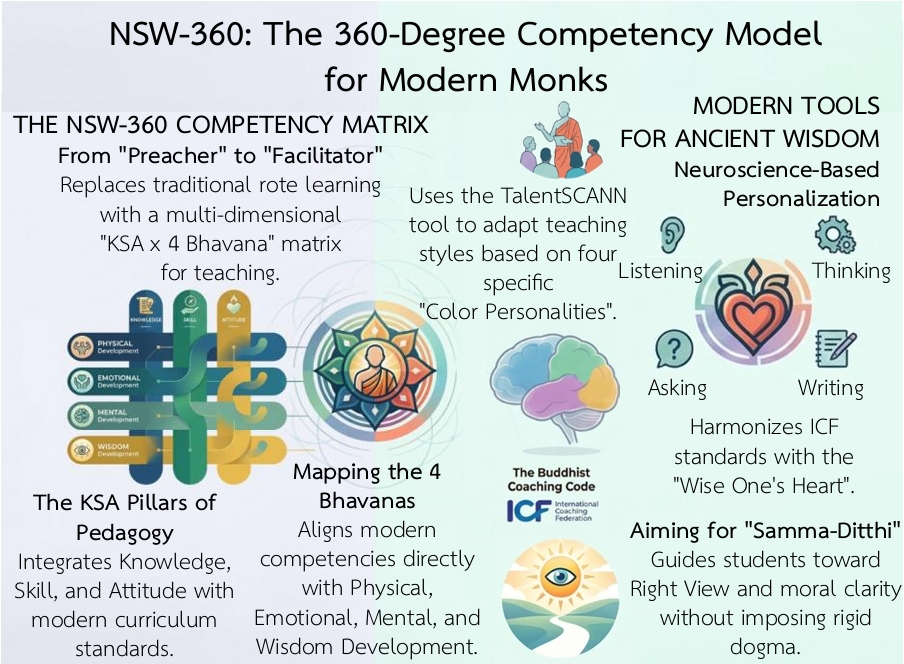
Involvement to Buddhadhamma: The core of the NSW-360 Model is grounded in Applied Buddhism, focusing on the development of wisdom and morality among monks and people in educational and social contexts. It represents a shift in ecclesiastical pedagogy by redefining monks from traditional preachers to Dhamma learning facilitators and coaches of holistic development through a KSA × 4 Bhavana framework, integrating Knowledge (Pariyatti), Skill (Patipatti), and Attitude (Pativedha) with the Four Bhavana: Physical, emotional, mental, and wisdom development. By integrating Buddhist principles, neuroscience-informed personality tools, and a Buddhist Coaching code grounded in Trisikkha (Threefold Training), the model aligns modern competency standards with classical Buddhist foundations while preserving the authenticity of the Dhamma.
Conclusions: The NSW-360 model effectively bridges Buddhist knowledge and modern teaching methods to enable the transformation of monks into more holistic teachers of the digital era. The model not only enhances the teaching skills but also enables monks to connect with learners through deep listening, compassionate communication, and make Dhamma more meaningful and relevant to daily life. Policy recommendations include establishing Nakhon Sawan Campus as a prototype hub and developing a professional certification system. Ultimately, moral education in the modern world includes not only content but also a human-centered pedagogy that can create trust, moral reflection, and long-lasting social impact.
References
Abildinova, G., Abdykerimova, E., Assainova, A., Mukhtarkyzy, K. & Abykenova, D. (2024). Preparing educators for the digital age: teacher perceptions of active teaching methods and digital integration. Frontiers in Education, 9, 1473766. https://doi.org/10.3389/feduc.2024.1473766.
Office of Moral Teaching Monks, Mahachulalongkornrajavidyalaya University. (2020). Master Plan of the Office of Moral Teaching Monks (fiscal years 2020-2026). Phra Nakhon Si Ayutthaya, Thailand: Mahachulalongkornrajavidyalaya University.
Office of the Education Council. (2017). National qualifications framework (Revised ed.). Bangkok, Thailand: Ministry of Education.
Phra Brahmagunabhorn (Payutto, P. A.). (2016). True Education Begins with Wise Consumption (R. Moore, Trans.). Nakhon Pathom, Thailand: Wat Nyanavesakavan.
Phra Santi Santinkaro (Chaisongkram), Chamnanphuttiphon, S. & Temrat, S. (2024). Roles of Monks in Teaching Modern Morality for Thai Society Development. Journal of Buddhistic Sociology, 9(1). 277-290.
Phra Supachai Sirimangalo (Chankrathok), Phrakhru Phipitjarutham & Sukhsaptaweephol, S. (2025). Guidelines for Developing the Roles of Monks as Morality Teachers in Schools. The Journal of Research and Academics, 8(5), 33-52. https://doi.org/10.14456/jra.2025.108.
Phramaha Kamphol Atthapalo (Chamnan), Saengnont, K. & Phrakrusangkarak Chakkit Bhuripanno. (2022). Guidelines for Development of Desirable Characteristics of Teacher-Monks in Thai Society. Journal of Educational Review Faculty of Education in MCU, 9(2), 1-10.
Phramaha Noppadol Seethong, Kotchasit, S. & Klangphahol, K. (2022). The Development of a Training Program Model Based on Transformative Learning Theory to Enhance Moral Project Advisory Competency of Moral Teaching Monks. Journal of Buddhist Anthropology, 7(5), 261-277.
Phramaha Narongraj Krongchuea, Vanichwatanavorachai, S., Sithsungnoen, C. & Tosila, C. (2022). The Development of Differentiated Coaching Model for Development Competencies by the Four Noble Truths Based Learning for Morality Teaching Monk. Academic MCU Buriram Journal, 7(1), 172-186.
Tao, T., Balakrishnan, V. & Binti Kamaruddin, A. Y. (2025). Research on Moral Reasoning Applicable to The Education of Pre-Service Teachers: A Systematic Literature Review. Cogent Education, 12(1). https://doi.org/10.1080/2331186X.2025.2554324.
Wang, Y., Nokkala, T. & Moate, J. (2024). Comparing Finnish and Chinese National Teacher Education Frameworks from the Teacher Competency Perspective. European Journal of Teacher Education, 1-20. https://doi.org/10.1080/02619768.2024.2361108.
Wei, R. C., Darling-Hammond, L., Andree, A., Richardson, N. & Orphanos, S. (2009). Professional learning in the learning profession: A status report on teacher development in the United States and abroad. Stanford, United States of America: National Staff Development Council & The School Redesign Network at Stanford University.
Downloads
Published
How to Cite
Issue
Section
License
Copyright (c) 2026 Journal of Buddhist Anthropology

This work is licensed under a Creative Commons Attribution-NonCommercial-NoDerivatives 4.0 International License.