THE RELATIONSHIP BETWEEN STATE LAW AND MONASTIC DISCIPLINE AMID SOCIAL CHANGE IN THAI SOCIETY
Keywords:
Public Governance, State-Religion Relations, Buddhist Monastic Discipline (Vinaya), Religious Regulation, ThailandAbstract
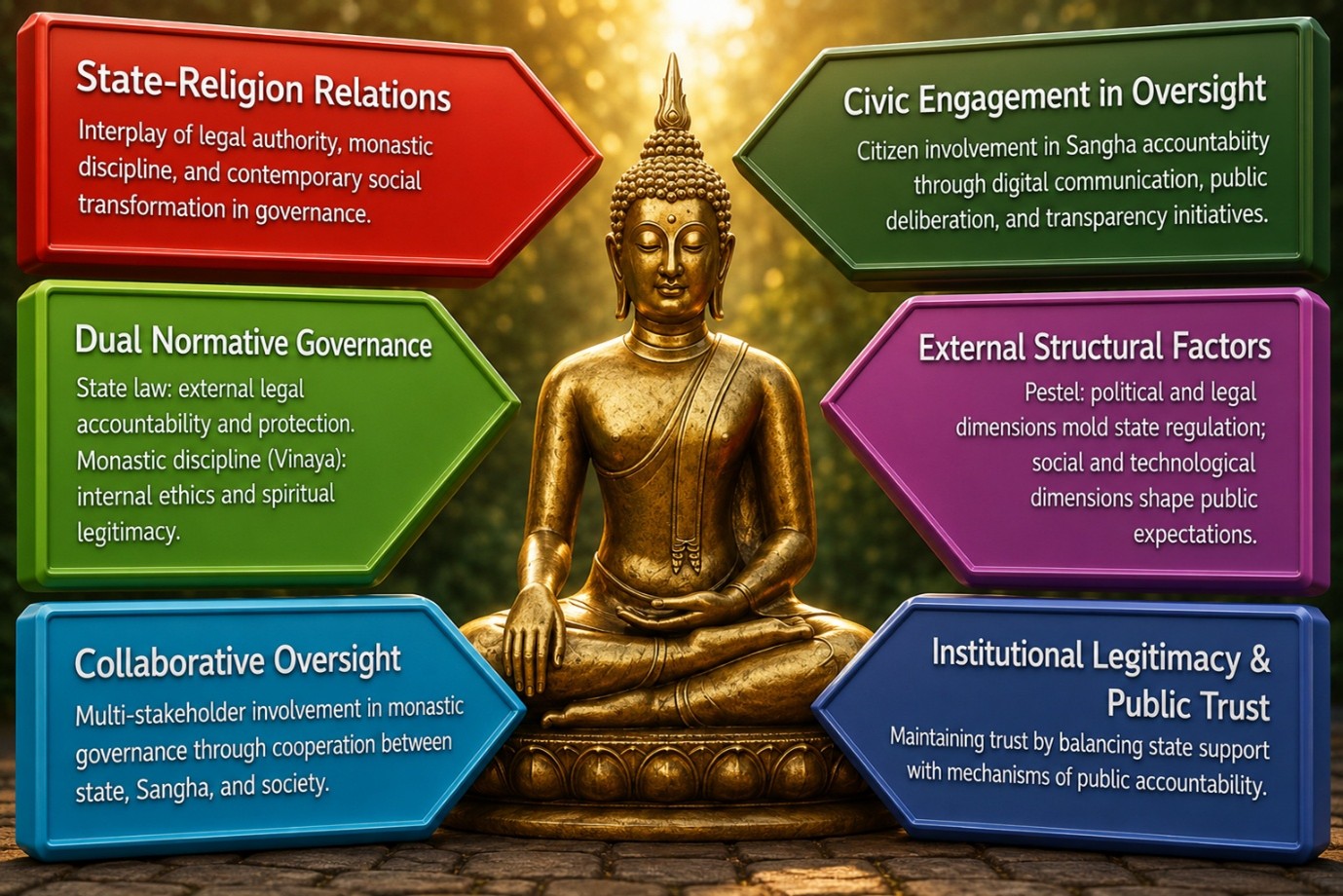
Background and Objectives: For centuries, the principles of morality, cultural customs, and social structures in Thai society have been built on the foundation of Buddhism. At the same time, the Thai state has used legal authority over the Sangha in order to maintain public order, institutional accountability, and public confidence in religious institutions. Thus, Buddhist monks are subject to two interrelated systems: Monastic discipline and state law. In contemporary Thailand, rapid social and technological changes, particularly in digital communication and heightened public awareness, have raised expectations for transparency and good governance in religious organizations. This study aimed to examine the role of state law in regulating the Sangha, to analyze the relationship between state law and monastic discipline in Sangha governance, and to investigate the impact of social change on legal enforcement and the maintenance of monastic discipline in Thai society.
Methodology: This research used qualitative research. The data were collected through semi-structured in-depth interviews with thirty key informants, including government officials, ecclesiastical administrators, legal scholars, scholars of Buddhist studies, and civil society representatives. The participants were carefully chosen on the grounds of their knowledge and direct experience of the administration and governance of religion. Also, Sangha laws, regulations, governance policies, and academic literature pertinent to religion and public administration were used as documentary analysis. All interview data were transcribed and analyzed using qualitative content analysis and thematic analysis. The findings were categorized into themes on governance mechanisms, institutional accountability, legal authority, and social transformation.
Main Results: The study results suggest that the state law is very important in the regulation of the Sangha, especially in the areas of organizational management, temple asset administration, and maintenance of public order. Legal frameworks provide transparency, accountability, and institutional legitimacy. Monastic discipline remains the key method by which monks control their behavior, emphasizing morality, good conduct, and the observance of religious purity. The study concluded that state law and monastic discipline generally complement rather than conflict with each other. Monastic discipline is concerned with internal ethical standards and spiritual integrity; State law is concerned with external accountability, social responsibility, and public interest. In cases where the behavior of monks affects society or is contrary to legal regulations, the power of the state is needed to maintain social order and carry out legal procedures.
Involvement to Buddhadhamma: The findings were in line with the Buddhist beliefs about morality, responsibility and harmony in society. Monastic discipline is ethical self-control, integrity, and spiritual responsibility; State law is justice, accountability, and collective welfare. Social and technological developments, in particular digital media, also contributed to public participation and scrutiny of temple administration, and increased transparency and responsiveness in state institutions and the Sangha.
Conclusions: Today's good governance of the Sangha in Thailand must balance state law, monastic discipline, and societal expectations. Transparency, public confidence, and the continued relevance and stability of Buddhism in Thailand require cooperation between the state, the Sangha, and the public. At the same time, linking legal systems to Buddhist ethics can increase institutional legitimacy and foster sustainable governance in the face of continuing social and technological changes.
References
Bowen, G. A. (2009). Document Analysis as a Qualitative Research Method. Qualitative Research Journal, 9(2), 27-40. https://doi.org/10.3316/QRJ0902027.
Campbell, H. A. (2013). Digital Religion: Understanding Religious Practice in New Media Worlds. London, United Kingdom: Routledge.
Creswell, J. W. & Poth, C. N. (2018). Qualitative Inquiry & Research Design Choosing Among Five Approaches (4th ed.). California, United States of America: SAGE Publications, Inc.
Doe, N. (2018). Comparative Religious Law: Judaism, Christianity, Islam. Cambridge, United Kingdom: Cambridge University Press.
Fox, J. (2013). An Introduction to Religion and Politics: Theory and Practice. London, United Kingdom: Routledge.
Neuman, W. L. (2014). Social Research Methods: Qualitative and Quantitative Approaches (7th ed.). London, United Kingdom: Pearson Education Limited.
Norris, P. & Inglehart, R. (2019). Cultural Backlash: Trump, Brexit, and Authoritarian Populism. Cambridge, United Kingdom: Cambridge University Press.
OECD. (2021). Government at a Glance 2021. Paris, France: OECD Publishing. https://doi.org/10.1787/1c258f55-en.
Sandberg, R. (2011). Law and Religion. Cambridge, United Kingdom: Cambridge University Press. https://doi.org/10.1017/CBO9780511976865.
Saunders, B., Sim, J., Kingstone, T., Baker, S., Waterfield, J., Bartlam, B., Burroughs, H. & Jinks, C. (2018). Saturation in qualitative research: exploring its conceptualization and operationalization. Quality & Quantity, 52(4), 1893-1907. https://doi.org/10.1007/s11135-017-0574-8.
Schonthal, B. (2017). Formations of Buddhist constitutionalism in South and Southeast Asia. International Journal of Constitutional Law, 15(3), 705-733. https://doi.org/10.1093/icon/mox049.
Stepan, A. C. (2000). Religion, Democracy, and the "Twin Tolerations". Journal of Democracy, 11(4), 37-57. https://doi.org/10.1353/jod.2000.0088.
Subrahmanyan, A. (2019). Worldly compromise in Thai Buddhist modernism. Journal of Southeast Asian Studies, 50(2), 179-201. https://doi.org/10.1017/S0022463419000250.
Tamir, C., Connaughton, A. & Salazar, M. A. (2020). The Global God Divide: People's thoughts on whether belief in God is necessary to be moral vary by economic development, education and age. Washington, D.C., United States of America: Pew Research Center.
Vasileiou, K., Barnett, J., Thorpe, S. & Young, T. (2018). Characterising and justifying sample size sufficiency in interview-based studies: systematic analysis of qualitative health research over a 15-year period. BMC Medical Research Methodology, 18, 148. https://doi.org/10.1186/s12874-018-0594-7.
Downloads
Published
How to Cite
Issue
Section
License
Copyright (c) 2026 Journal of Buddhist Anthropology

This work is licensed under a Creative Commons Attribution-NonCommercial-NoDerivatives 4.0 International License.