ENHANCING EMOTIONAL WELLNESS ACROSS GENERATIONS THROUGH TRI-SIKKHĀ
Keywords:
Emotional Wellness, Tri-sikkhā, Generational Diversity, Buddhist Psychology, Emotional ResilienceAbstract
Background and Objectives: In everyday life, individuals across all age groups face increasing emotional stress from academic pressure, work demands, and rapid social change. These challenges directly affect emotional stability and quality of life, making emotional well-being a critical concern across the lifespan. There is a growing need for culturally grounded approaches. The Buddhist Threefold Training (Tri-sikkhā), comprising Sīla (Ethics), Samādhi (Concentration), and Paññā (Wisdom), offers an integrated framework for regulating behavior, emotion, and cognition. However, its empirical application across different stages of life remains limited. This study aimed to explore the state of emotional well-being across different age groups, to examine the relationship between emotional well-being and the Threefold Training (Tri-sikkhā), and to identify the roles of Sīla, Samādhi, and Paññā in emotional development across the lifespan.
Methodology: This study employed an exploratory sequential mixed-methods design comprising two major phases. In Phase I (Qualitative), purposive in-depth interviews were conducted with 12 key informants selected from a pool of 40 specialists, including Buddhist scholars, contemplative practitioners, and psychology specialists with expertise in Tri-sikkhā, holistic wellness, and lifespan human development. In Phase II (Quantitative), the instrument was administered to a final sample of 400 participants (n = 400) drawn from a multigenerational population in Ko Chan District, Chon Buri Province (N = 26,967). Quantitative data were analyzed using descriptive statistics, Pearson correlation analysis, exploratory factor analysis, chi-square testing, and multiple regression analysis. Findings from both phases were integrated to formulate age-specific practical guidelines for sustainable emotional flourishing across the lifespan.
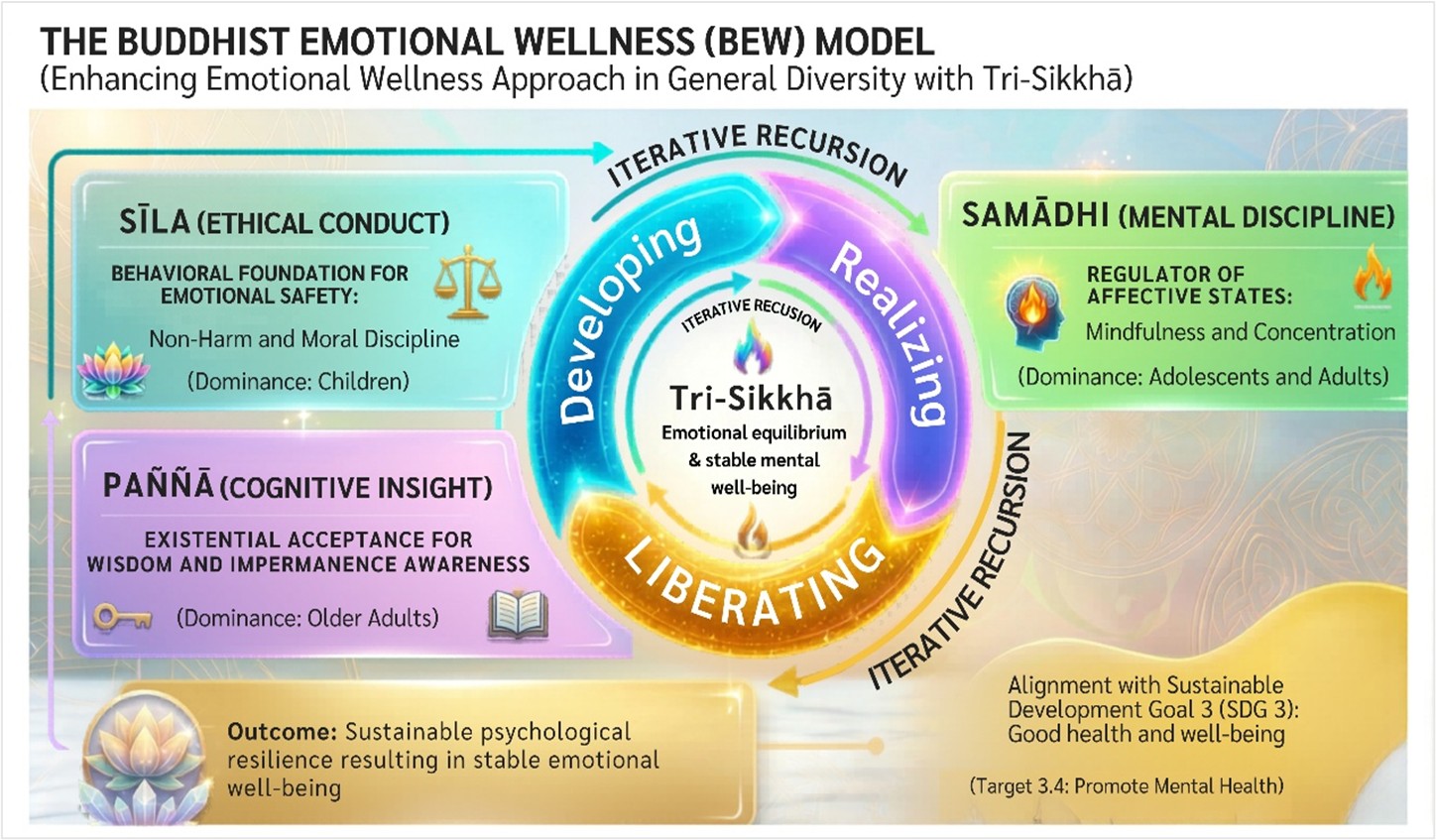
Main Results: The findings demonstrated significant positive correlations between all components of the Threefold Training and emotional well-being (p < .001). However, the most striking discovery was the dynamic synchronization between specific training components and developmental stages. For children, Sīla was the most significant predictor of stability (β = .55), as ethical training cultivates rule-based behavior, reduces harmful actions, and creates a stable social environment, which directly supports early emotional security and self-regulation. For adolescents and adults, Samādhi emerged as the critical variable (β = .61 and β = .58, respectively), as concentration training strengthens attentional control, reduces emotional reactivity, and enables individuals to manage stress through sustained awareness and mental focus. Conversely, for older adults, Paññā (Wisdom) became the dominant predictor (β = .68), as insight-based understanding allows individuals to reinterpret life experiences, let go of attachment, and reduce suffering through the realization of non-self (Anattā) and impermanence.
Involvement to Buddhadhamma: Tri-Sikkhā operationalizes Buddhadhamma into a psychological framework for emotional regulation. Sīla serves as a behavioral stabilizer by reducing moral conflict; Samādhi functions primarily as attentional self-regulation; and Paññā (Wisdom) functions as the highest form of cognitive restructuring, aiming to dismantle ego-centric biases (Anattā) that underlie mental suffering. This study is situated within Applied Buddhism and aligns with the development of wisdom and morality, as it applies Tri-Sikkhā to enhance ethical conduct, mental stability, and insight across different stages of life.
Conclusions: The study supports Tri-sikkhā as an empirically grounded Buddhopsychological framework for lifelong emotional flourishing. The findings show that emotional well-being can be effectively supported through different components of Tri-sikkhā across the lifespan, with Sīla strengthening stability in childhood, Samādhi supporting emotional regulation in adolescence and adulthood, and Paññā fostering insight and acceptance in later life. This research offers a roadmap for educators, mental health practitioners, and policymakers to foster social harmony and sustainable well-being across generational diversity.
References
Anālayo, B. (2020). Mindfulness in Early Buddhism: Characteristics and functions. Cambridge, United Kingdom: Windhorse Publications.
Bhikkhu P. A. Payutto (Somdet Phra Buddhaghosacariya). (2021). Buddhadhamma: The Laws of Nature and Their Benefits to Life (R. P. Moore, Trans.). Bangkok, Thailand: Buddhadhamma Foundation.
Carstensen, L. L., Isaacowitz, D. M. & Charles, S. T. (1999). Taking time seriously: A theory of socioemotional selectivity. American Psychologist, 54(3), 165-181. https://doi.org/10.1037/0003-066X.54.3.165.
Creswell, J. W. (2014). Research Design: Qualitative, Quantitative, and Mixed Methods Approaches (4th ed.). Thousand Oaks, United States of America: SAGE Publications.
Denzin, N. K. (2012). Triangulation 2.0. Journal of Mixed Methods Research, 6(2), 80-88. https://doi.org/10.1177/1558689812437186.
Ekman, P., Davidson, R. J., Ricard, M. & Wallace, B. A. (2005). Buddhist and Psychological Perspectives on Emotions and Well-Being. Current Directions in Psychological Science, 14(2), 59-63. https://doi.org/10.1111/j.0963-7214.2005.00335.x.
Elo, S. & Kyngäs, H. (2008). The qualitative content analysis process. Journal of advanced nursing, 62(1), 107-115. https://doi.org/10.1111/j.1365-2648.2007.04569.x.
Enders, C. K. (2010). Applied Missing Data Analysis. New York, United States of America: The Guilford Press.
Erikson, E. H. (1963). Childhood and society (2nd ed.). New York, United States of America: Norton.
Guillén, M. F. (2023). The Perennials: The Megatrends Creating a Postgenerational Society. New York, United States of America: St. Martin's Press.
Hair, J. F., Black, W. C., Babin, B. J. & Anderson, R. E. (2019). Multivariate Data Analysis (8th ed.). Andover, United Kingdom: Cengage Learning.
Heckhausen, J., Wrosch, C. & Schulz, R. (2010). A Motivational Theory of Life-Span Development. Psychological Review, 117(1), 32-60.
Hesse-Biber, S. N. (2015). Mixed Methods Research: The "Thing-ness" Problem. Qualitative Health Research, 25(6), 775-788. https://doi.org/10.1177/1049732315580558.
Kabat-Zinn, J. (2003). Mindfulness-based interventions in context: Past, present, and future. Clinical Psychology: Science and Practice, 10(2), 144-156. https://doi.org/10.1093/clipsy.bpg016.
Keng, S.-L., Smoski, M. J. & Robins, C. J. (2011). Effects of mindfulness on psychological health: A review of empirical studies. Clinical Psychology Review, 31(6), 1041-1056. https://doi.org/10.1016/j.cpr.2011.04.006.
Miles, M. B., Huberman, A. M. & Saldaña, J. (2014). Qualitative Data Analysis: A Methods Sourcebook (3rd ed.). Thousand Oaks, United States of America: SAGE Publications.
Office of the National Economic and Social Development Board. (2018). National strategy 2018-2037 (Summary). Bangkok, Thailand: Office of the National Economic and Social Development Board.
Rhys Davids, T. W. & Rhys Davids, C. A. F. (Trans.). (2010). Dialogues of the Buddha (Dīgha-Nikāya) (Part III). Bristol, United Kingdom: The Pali Text Society.
Ryff, C. D. (1989). Happiness is everything, or is it? Explorations on the meaning of psychological well-being. Journal of Personality and Social Psychology, 57(6), 1069-1081. https://doi.org/10.1037/0022-3514.57.6.1069.
Seligman, M. E. P. (2011). Flourish: A visionary new understanding of happiness and well-being. New York, United States of America: Free Press.
Downloads
Published
How to Cite
Issue
Section
License
Copyright (c) 2026 Journal of Buddhist Anthropology

This work is licensed under a Creative Commons Attribution-NonCommercial-NoDerivatives 4.0 International License.