HEART OF THE KUANKRENG SWAMP: A BUDDHIST-LED JOURNEY TOWARD SUSTAINABLE FOREST STEWARDSHIP
Keywords:
Buddhist-based Environmental Education, Kuankreng Peat Swamp Management, Spiritual Stewardship, Community-led ConservationAbstract
Background and Objectives: The Kuankreng Peat Swamp Forest (KPSF) in Southern Thailand is a vital social-ecological system providing critical ecosystem services. However, it faces severe threats from recurring wildfires and land degradation, often driven by a disconnect between human ethics and nature. This study aimed to examine the current environmental conditions, ecological benefits, and factors contributing to environmental degradation in KPSF; To assess existing environmental education learning frameworks and community awareness related to KPSF management; To develop the DHAMMA-EE Model by integrating Buddhist principles with environmental conservation practices; and To evaluate the quality and effectiveness of the model.
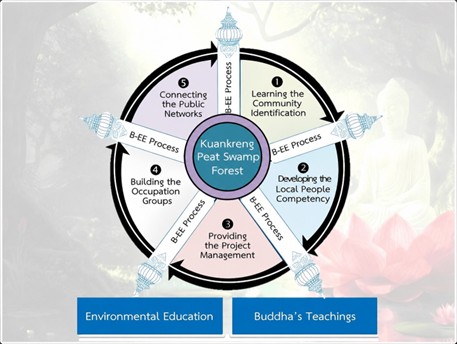
Methodology: This research employed a participatory mixed-methods design conducted across three provinces: Nakhon Si Thammarat, Phatthalung, and Songkhla. To address the first two objectives, a situational analysis was performed through a quantitative survey of 400 residents, using proportional stratified random sampling to identify degradation factors and current awareness levels. Qualitative data were gathered via in-depth interviews and focus group discussions with 53 purposively selected community leaders and ecological experts to evaluate existing educational frameworks. For the third objective, the DHAMMA-EE Model was synthesized by integrating the "B-EE Process" with core Buddhist tenets, specifically Paticcasamuppada (Dependent Origination), Tilakkhaṇa (Three Characteristics), and Tisikkhā (Threefold Learning). Finally, the fourth objective was fulfilled by implementing the model through community workshops and evaluating its effectiveness using the Kirkpatrick Evaluation Framework, which measured four levels: Reaction, Learning, Behavior, and Results (Public Benefit).
Main Results: The findings demonstrated that the DHAMMA-EE Model significantly facilitated "Environmental Actualization" among participants. By anchoring environmental education in the principles of Dependent Origination, Three Characteristics, and Threefold Learning, the model successfully shifted stakeholder mindsets from anthropocentric consumption to social-ecological interdependency. Quantitatively, the evaluation showed exceptionally high scores across all Kirkpatrick dimensions. Participants demonstrated a profound increase in cognitive understanding of peat swamp ecology ( = 8.04), while the behavioral assessment revealed a proactive commitment to wildfire prevention and sustainable harvesting. Most notably, the model empowered the community to initiate 20 local stewardship projects. The "Public Benefit" score (
= 8.02) confirmed that the integration of Buddhist ethics fostered a sense of "Local Dignity" and self-reliance, creating a resilient social-ecological harmony that transcends conventional top-down management approaches.
Involvement to Buddhadhamma: This research is categorized under Applied Buddhism, particularly Buddhism and sustainable development, as it demonstrates the application of Buddhist wisdom to address modern environmental crises. Specifically, the development of the DHAMMA-EE Model serves as a Buddhist innovation in the form of process and method development for ecological preservation. Furthermore, the study aligns with Buddhism and sustainable development by integrating the principles of Dependent Origination, Three Characteristics, and Threefold Learning to foster long-term environmental stewardship within the KPSF. By addressing spiritual causes through mindful discipline, this integration shifts behavior toward a compassionate, interdependent relationship with nature.
Conclusions: The DHAMMA-EE Model proves to be a robust and culturally resonant framework for environmental management in Buddhist-majority contexts. Unlike standard educational programs that focus solely on information transfer, this model facilitates an internal transformation, a "Heart-centered" journey, that leads to sustainable collective action. The research concludes that for the KPSF to survive and thrive, management strategies must move beyond biophysical conservation to include the spiritual and ethical dimensions of the human spirit. The DHAMMA-EE Model offers a scalable and adaptable pathway for other threatened ecosystems, demonstrating that when environmental stewardship is rooted in ancient wisdom, it provides a powerful catalyst for modern ecological restoration and social well-being.
References
Agus, C., Azmi, F. F., Widiyatno, Ilfana, Z. R., Wulandari, D., Rachmanadi, D., Harun, M. K. & Yuwati, T. W. (2019). The Impact of Forest Fire on the Biodiversity and the Soil Characteristics of Tropical Peatland. In W. L. Filho, J. Barbir & R. Preziosi (Eds.), Handbook of Climate Change and Biodiversity (pp. 287-303). Cham, Switzerland: Springer Nature. https://doi.org/10.1007/978-3-319-98681-4_18.
Al-Habshi, M. & Mahmud, M. (2026). Spiritual Ecology and Climate Justice: A Systematic Review of Faith-Based Environmental Movements in Southeast Asia. ROOTS: Journal of Religious Outreach, Otherness, Tolerant Education, and Spiritual Ecology, 1(1), 1-13.
Asante, D. B., Adom, D., Asante, A. & Gyamera, V. (2025). Combating the Global Environmental Crisis Using Indigenous Ecological Knowledge: The Case of Kwahu Traditional Area, Ghana. Frontiers in Human Dynamics, 7, 1457544. https://doi.org/10.3389/fhumd.2025.1457544.
Association of Southeast Asian Nations (ASEAN). (2023). ASEAN Peatland Management Strategy 2023-2030. Jakarta, Indonesia: ASEAN Secretariat.
Balode, L. & Blumberga, D. (2024). Comparison of the Economic and Environmental Sustainability for Different Peatland Strategies. Land, 13(4), 518. https://doi.org/10.3390/land13040518.
Baron-Aguilar, C., Boswell, R., Cisneros-Montemayor, A., Copenhaver, A. E., Costa, Y., Frid, A., Hiwasaki, L., Hudson, M., Jones, N. J. R., Kelly, B. P., Khan, M., Kosgei, J., Leonard, K., Metcalf, V. K., Moshani, A., Oduro, G. Y., Paul, K., Rakotondrazafy, V., Retter, G.-B., Scott, C. P., Uku, J. & Strand, M. (2025). Co-producing Ocean Plans with Indigenous and Traditional Knowledge Holders. npj Ocean Sustainability, 4, 58. https://doi.org/10.1038/s44183-025-00158-x.
Bonn, A., Allott, T., Evans, M., Joosten, H. & Stoneman, R. (2016). Peatland Restoration and Ecosystem Services: Science, Policy and Practice. Cambridge, United Kingdom: Cambridge University Press.
Cano, N. A., Gilmore, M. P., Benson, E., Valderrama, D., Dimitrie, D. & Griffiths, B. M. (2026). Indigenous Perspectives on the Co-management of a Regional Conservation Area in the Peruvian Amazon. Environmental Management, 76, 109. https://doi.org/10.1007/s00267-025-02310-2.
Darlington, S. M. (2012). The Ordination of a Tree: The Thai Buddhist Environmental Movement. New York, United States of America: State University of New York Press.
Food and Agriculture Organization of the United Nations. (2001). State of the World's Forests 2001. Rome, Italy: Food and Agriculture Organization of the United Nations.
Forest Land Management Bureau. (2014). Forest area in 2014 Analyzed from 124 Thaichote Satellite Imageries During 2012-2013. Bangkok, Thailand: Royal Forest Department.
Kamnan, C. (2017). Agree to use the Religious Teachings for Developing and Managing the Kuankreng Peat Swamp Forest. (Yamaphat, S., Interviewer)
Khampeera, A., Yongsatisak, T., Yongchalermchai, P. & Kerdkurang, K. (2021). Analysis of Fire Risk Areas During Drought in Kuan Kreng Peat Swamp, Nakhon Si Thammarat Province Using a GIS-AHP Method. Thai Journal of Science and Technology, 10(2), 234-250. https://doi.org/10.14456/tjst.2021.19.
Kirkpatrick, J. D. & Kirkpatrick, W. K. (2016). Kirkpatrick's Four Levels of Training Evaluation. Alexandria, United States of America: ATD Press.
Krunoi, B. (2017). Community Perspectives on the Development and Management of the Kuankreng Peat Swamp Forest. (Yamaphat, S., Interviewer)
Luang, D. (2017). Application of Buddha's Teachings in Managing the Kuankreng Peat Swamp Forest. (Yamaphat, S., Interviewer)
Macy, J. (1991). Mutual Causality in Buddhism and General Systems Theory: The Dharma of Natural Systems. New York, United States of America: State University of New York Press.
Mezirow, J. (2000). Learning as Transformation: Critical Perspectives on a Theory in Progress. San Francisco, United States of America: Jossey-Bass Inc Pub.
Nash, K. L., Atminarso, D., Blythe, J. L., Chadijah, A., Astuti, S. S., Utomo, A. D., Pratama, B. B., Sumarto, B. K. A., Muhamad, G., Surbani, I. L. & Wibowo, A. (2026). The Sleeping Giant of Kalimantan: A Review of Fish and Fisheries of the Peatlands. Reviews in Fisheries Science & Aquaculture, 34(2), 258-293. https://doi.org/10.1080/23308249.2025.2543806.
Nasution, M. S, Rusli, Z., Heriyanto, M., Zulkarnaini., Syahza A., Adianto., Mayarni. & Ismandianto. (2025). Green governance and institutional resilience: strengthening environmental policies for a low-carbon economy in mangrove ecosystems. Front. Polit. Sci, 7,1631249. https://doi.org/10.3389/fpos.2025.1631249.
New Forests. (2024). New Forests' Tropical Asia Forest Fund 2 to invest in Kuan Kreng Landscape Peatland Conservation and Restoration Project in Thailand. Sydney, Australia: New Forests.
Nuyim, T. (2003). Guideline on Peat Swamp Forest Rehabilitation and Planting in Thailand. Research Findings from the Pikulthong Royal Department Study Project. Narathiwat, Thailand: Global Environment Centre & Wetland International-Thailand Office.
Office of Natural Resources and Environmental Policy and Planning [ONEP]. (2008). National Report on the Implementation of the Convention on Wetlands: Thailand. Bangkok, Thailand: Ministry of Natural Resources and Environment.
Ostrom, E. (2015). Governing the Commons: The Evolution of Institutions for Collective Action. Cambridge, United Kingdom: Cambridge University Press.
Phengklai, C., Niyomdham, C., Premrasmi, A., Chirathanakorn, K. & Pooma, R. (2014). Peat Swamp Forest of Thailand. Thai Forest Bulletin (Botany), (18), 1-42.
Phoryai, A. (2017). Levels of Environmental Education Process Learning (EE- Process) About theKuankreng Peat Swamp Forest. (Yamaphat, S., Interviewer)
Phra Brahmagunabhorn (P. A. Payutto). (2016). Buddhist Economics. Bangkok, Thailand: Wat Nyanavesakavan.
Sivaraksa, S. (2009). The Wisdom of Sustainability: Buddhist Economics for the 21st Century. Kihei, United States of America: Koa Books.
Sponsel, L. E. (2012). Spiritual Ecology: A Quiet Revolution. California, United States of America: Praeger.
United Nations Development Programme. (2021). Kuan Kreng Peat Swamp Forest: A Natural Wonder for Community Livelihoods: Maximizing Carbon Sink Capacity and Conserving Biodiversity through Sustainable Conservation, Restoration and Management of Peat-swamp Ecosystems Project. Bangkok, Thailand: UNDP (Thailand).
United Nations Educational, Scientific and Cultural Organization. (2016). Education for People and Planet: Creating Sustainable Futures for all. Paris, France: UNESCO Publishing.
United Nations Educational, Scientific and Cultural Organization. (2020). Education for Sustainable Development: A Roadmap. Paris, France: UNESCO Publishing. https://doi.org/10.54675/YFRE1448.
Williams, M. (2006). Deforesting the Earth from Prehistory to Global Crisis, An Abridgment. Chicago, United States of America: The University of Chicago Press.
World Commission on Forests and Sustainable Development (WCFSD). (1999). Our Forests, Our Future: Summary Report. Manitoba, Canada: WCFSD.
Yunus, M., Pagdee, A. & Baral, H. (2025). Local Livelihoods and Determinants of Peatland Protection in Indonesia. Trees, Forests and People, 19, 100800. https://doi.org/10.1016/j.tfp.2025.100800.
Downloads
Published
How to Cite
Issue
Section
License
Copyright (c) 2026 Journal of Buddhist Anthropology

This work is licensed under a Creative Commons Attribution-NonCommercial-NoDerivatives 4.0 International License.