ENHANCING BUDDHIST EDUCATION THROUGH THE SAN-DONTA TRADITION OF THAI-KHMER COMMUNITIES IN THAILAND
Keywords:
Buddhist Education, Thai-Khmer Community, San-Donta Tradition, Moral EducationAbstract
Background and Objectives: Amid rapid social change and cultural transformation in contemporary Thai society, increasing concerns have emerged regarding the weakening transmission of moral values and cultural identity among younger generations. Although Buddhist education remains part of the national curriculum, limited research has examined how local cultural heritage can function as an applied framework for enhancing the learning of Buddhist principles in schools. The San-Donta Tradition represents a significant cultural institution that integrates animistic ancestral belief with Theravāda Buddhist ethical teachings. This study aims to examine the cultural heritage of the San-Donta Tradition among the Thai-Khmer community in Thailand and analyze its embedded Buddhist principles to explore pathways for their integration into school-based moral and ethical education.
Methodology: This study adopted a qualitative documentary research design grounded in rigorous cultural and textual analysis, deliberately delimited to secondary data synthesis. Using a keyword-based purposive strategy focusing on "San-Donta Tradition" "Thai-Khmer Community," "Buddhist Principles" "Moral Education" and "School Instruction" a credible analytical corpus was gathered from academic literature and ethnographic records. Following Klaus Krippendorff's framework, data analysis was executed through a systematic three-stage qualitative content and thematic analysis procedure such as open coding, categorization, and thematic synthesis. This analytical process identified and categorized embedded Buddhist principles into individual-level virtues and social-level ethical reinforcement, ultimately transforming descriptive cultural knowledge into a validated pedagogical framework for formal school-based Buddhist education.
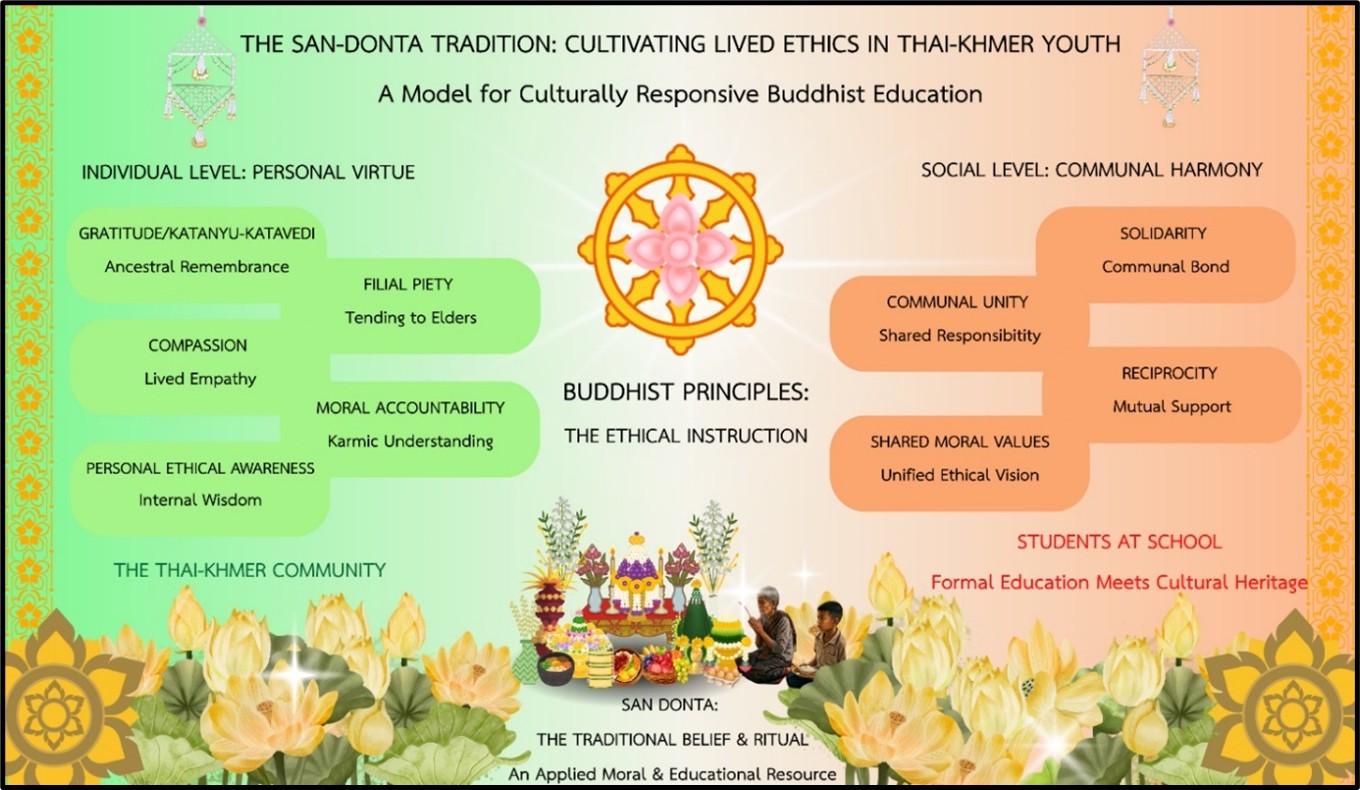
Main Results: The findings revealed that the San-Donta Tradition functioned as an active, culturally embedded moral system operating symbiotically across two operational levels. At the individual level, the ritual naturally cultivated personal virtues of gratitude (Katanyu-katavedi), filial piety, compassion, and karmic moral accountability through practical ancestral remembrance and merit-making (Puñña). These ritualistic elements served as experiential learning mechanisms that effectively transformed abstract Theravāda Buddhist ethical doctrines into lived personal experiences. At the social level, collective participation across kinship networks reinforced communal harmony and social sympathy (Saṅgaha-vatthu), visibly manifesting as enhanced solidarity, mutual reciprocity, and intergenerational respect. By successfully synthesizing animistic ancestral reverence with Buddhist moral philosophy, the tradition established a holistic ethical framework that bridged spiritual continuity with reciprocal social responsibility. Ultimately, the results demonstrated that the San-Donta Tradition operated not merely as a passive ceremonial heritage, but as a functional informal moral curriculum capable of structurally enhancing Buddhist principle instruction within formal educational settings.
Involvement to Buddhadhamma: This study demonstrates that the San-Donta Tradition reflects a form of applied Buddhism grounded in cultural practice and aligns with Applied Buddhism in the development of wisdom and morality. Core Buddhist values such as gratitude, compassion (Karuṇā), loving-kindness (Mettā), and ethical conduct (Sīla) are embedded within ritual actions and social norms. The practice of merit transfer reinforces understanding of karma and moral causation, while communal harmony reflects principles aligned with the Noble Eightfold Path, particularly right conduct and right intention. By integrating these culturally embodied teachings into educational contexts, schools can connect doctrinal Buddhist content with students lived cultural experiences. Such integration promotes moral reflection, ethical reasoning, and social responsibility grounded in local identity and spiritual heritage.
Conclusions: The study underscores the significant role of the San-Donta Tradition as a sustainable cultural framework for enhancing the learning of Buddhist principles in Thai-Khmer communities. Functioning as both an individual system of moral cultivation and a communal ethical structure, the tradition supports character development, intergenerational continuity, and social harmony. Integrating cultural heritage into school instruction offers a culturally responsive approach to Buddhist education that strengthens ethical awareness, communal solidarity, and long-term moral development.
References
Bailey, C. A. (2018). A Guide to Qualitative Field Research (3rd ed.). Thousand Oaks, United States of America: SAGE Publications, Inc. https://doi.org/10.4135/9781071909614.
Bowen, G. A. (2009). Document Analysis as a Qualitative Research Method. Qualitative Research Journal, 9(2), 27-40. https://doi.org/10.3316/QRJ0902027.
Chaiyachartkittyos, C., Pikulsri, C. & Srimueng, J. (2025). Transformations in the Ritual Music of the Khmer Ethnic Group in the Southern Area of Northeast Thailand. Pakistan Journal of Life and Social Sciences, 23(1), 2557-2569. https://doi.org/10.57239/PJLSS-2025-23.1.00200.
Chunhabunyatip, P., Sasaki, N., Grünbühel, C., Kuwornu, J. K. M. & Tsusaka, T. W. (2018). Influence of Indigenous Spiritual Beliefs on Natural Resource Management and Ecological Conservation in Thailand. Sustainability, 10(8), 2842. https://doi.org/10.3390/su10082842.
Creswell, J. W. & Poth, C. N. (2018). Qualitative Inquiry & Research Design Choosing Among Five Approaches (4th ed.). California, United States of America: SAGE Publications, Inc.
Creswell, J. W. (1998). Qualitative Inquiry and research design: Choosing among five traditions. London, United Kingdom: Sage.
Krippendorff, K. (2019). Content Analysis: An Introduction to Its Methodology. Thousand Oaks, United States of America: SAGE Publications, Inc. https://doi.org/10.4135/9781071878781.
Lertpiboon, P. (2025). The Offering Rituals in Thailand's Agricultural Festival: The Dual Construction of Nature Worship and Cultural Identity. Art and Society, 4(1), 15-17. https://doi.org/10.56397/AS.2025.01.03.
Mahamakut Buddhist University. (1984). The Dhammapada commentary (Vol. 6) (10th ed.). Bangkok, Thailand: Mahamakut Buddhist University Press.
Meethaisong, T. (2021). An Adaptation of Culture and Beliefs in Isan Society. Sripatum Review of Humanities and Social Sciences, 21(2), 56-70.
Muenjanchoei, R. (1999). The influence of beliefs, traditions and rituals of the Thai song on the development on quality of life : a case study of Laemkacaw 2 village Lamlukbua subdistrict Dontum District Nakhonpathom Province. [Unpublishedmaster's thesis dissertation]. Nakhon Pathom, Thailand: Mahidol University Library.
Ngo, T. P. L. & Nguyen, N. T. (2021). CONTINUITY AND TRANSFORMATION OF RURAL COMMUNAL TEMPLES IN VIETNAM: A CASE STUDY OF TÂN CHÁNH VILLAGE, LONG AN PROVINCE. International Journal of Asia Pacific Studies, 17(2), 249-282. https://doi.org/10.21315/ijaps2021.17.2.10.
Office of Cultural Affairs, Buriram province. (2010). Final report on the cultural ecosystem development project of the Mekong-Chi-Mun River basins: A case study of Nong Taeng Subdistrict, Krasang District, Buriram Province. Buriram, Thailand: Office of Cultural Affairs, Buriram province.
Office of the Council of State. (1999). Royal Gazette: Decree Edition, Vol. 116, Section 74 Kor (August 19, 1999). Bangkok, Thailand: Office of the Council of State.
Phra Nat Caruvanno (Yiram), Laphontan, S. & Phrakruvinaithorn Thammrat Khemadharo. (2021). An Analytical Study of Beliefs and Rituals in the San Don Ta Merit of People in Surin Province. Academic MCU Buriram Journal, 6(2), 301-315.
Phra Somphong Janseeda. (2021). A study of beliefs about ghosts (pretas) appearing in the San Don Ta tradition of Buriram Province. Journal of Buddhist Studies Vanam Dongrak, 2(1), 117-126.
Phumiphol Bhikkhu Foundation. (1988). Pali-Thai-English dictionary (Phumiphol Bhikkhu edition). Bangkok, Thailand: Phumiphol Bhikkhu Foundation.
Pruksa, S., Sripoona, S., Lowirakorn, S., Chaitokkia, S. & Hutchinson, C. (2022). Supporting Sustainable Development by Identifying Ways to Enhance and Conserve Local Food Wisdom, Loei Province, Thailand. Sustainability, 14(12), 6978. https://doi.org/10.3390/su14126978.
Rattanapanawong, S. (2006). The study of Surin Khmer terms in Saen Don Ta tradition. [Master's thesis, Silpakorn University]. Silpakorn University. https://sure.su.ac.th/xmlui/handle/123456789/2832.
Schrock, J. L., Crowe, I., Fromme, M., Gosier, D. E., McKenzie, V. S., Myers, R. W. & Stegeman, P. L. (1970). Minority Groups in Thailand (Ethnographic Study Series). Washington, D.C., United States of America: Cultural Information Analysis Center.
Siripaphapagon, Y. (2018). Donta: A Cultural Preservation of the Khmer People in Surin Province. Hatyai Academic Journal, 16(2), 237-249.
Siriphaprapagon, Y., Kanthiang, K., Klangrit, S., Kaewhom, C. & Visutdho, N. (2023). Cultural tourism promotion and development in Surin Province. AIP Conference Proceedings, (2685), 040017. https://doi.org/10.1063/5.0118140.
Sornyai, P. (2019). THE STUDY ANALYZE THE MUSICAL CEREMONY SHANKAR (KHMER WEDDING CEREMONY) AS A SHARED HERITAGE BETWEEN THAILAND AND CAMBODIA. UDON THANI RAJABHAT UNIVERSITY JOURNAL OF HUMANITIES AND SOCIAL SCIENCE, 8(2), 61-75.
Sripattanet, T. (2019). Using historical methods in education San Don Ta tradition in Khukhan district, using the project as a learning base(PBL), Integration TPACK, CBL and CLIL. Journal of Faculty of Education, Sisaket Rajabhat University, 3(2), 35-47.
UNESCO. (2003). 2003 Convention for the Safeguarding of the Intangible Cultural Heritage. Paris, France: UNESCO.
UNESCO. (2018). Basic texts of the 2003 Convention for the Safeguarding of the Intangible Cultural Heritage, 2018 edition. Paris, France: UNESCO.
United Nations Department of Economic and Social Affairs. (2025). Goal 16: Promote just, peaceful and inclusive societies. New York, United States of America: United Nations.
Visalo, P. (2025). Buddhist Spirituality and Social Action: The Collected Writing of Phra Paisal Visalo (J. S. Watts, Ed.). Bangkok, Thailand: International Network of Engaged Buddhists (INEB).
Worachat, P. (1987). Power structure of Thai communities speaking Khmer in Northeastern Thailand: A case study of Phromthep Subdistrict, Tha Tum District, Surin Province. [Unpublishedmaster's thesis dissertation]. Maha Sarakham, Thailand: Mahasarakham University Library.
Wulf, C. (2025). Handbook on Intangible Cultural Practices as Global Strategies for the Future: Twenty Years of the UNESCO Convention on Safeguarding Intangible Cultural Heritage. Cham, Switzerland: Heritage Studies. https://doi.org/10.1007/978-3-031-72123-6.
Zabulis, X., Partarakis, N., Zidianakis, E. & Kaplanidi, D. (2025). A Critical Review of the Function of Intangible Cultural Heritage as a Driver for Social Resilience and Cohesion. Encyclopedia, 5(4), 189. https://doi.org/10.3390/encyclopedia5040189.
Downloads
Published
How to Cite
Issue
Section
License
Copyright (c) 2026 Journal of Buddhist Anthropology

This work is licensed under a Creative Commons Attribution-NonCommercial-NoDerivatives 4.0 International License.