A BUDDHIST-APPROACH TRAINING PROGRAM FOR EMPLOYEE WELL-BEING IN TECHNOLOGY-OVERUSED WORKPLACE
Keywords:
Employee Well-being, Buddhist Teachings, Meditation, Technology Overuse, WorkplaceAbstract
Background and Objectives: Nowadays, technology-overused workplaces place employees under constant pressure through continuous notifications, digital tasks, and expectations of constant availability. Although many organizations have tried to improve external working conditions, sustainable relief may also require inward forms of mental cultivation. While mindfulness has become increasingly popular in workplace wellness programs, many existing approaches focus mainly on stress reduction techniques without addressing the deeper mental habits and emotional attachments that cause suffering in employees' daily lives. Therefore, the research objectives were to examine the impacts of technology overuse on employee well-being in the workplace, to explore the role of Buddhadhamma and meditation practices in promoting employee well-being, and to develop a training program integrating Buddhadhamma and meditation practices for technology-overused work environments.
Methodology: This qualitative study used data triangulation to gather insights from 33 key informants, involving 22 employees facing technology-induced strain, 9 Buddhist scholars or meditation masters, and 2 organizational experts. Data were collected across three stages of a training program (Pre-training, During-training, and Post-training) through online open-ended questionnaires, in-depth interviews, and focus discussions, followed by thematic analysis. A pilot training program was then delivered to 3 selected case studies through eight individual online sessions conducted over one month via Zoom. Each participant followed the same core structure and themes while receiving individualized guidance and reflection throughout the process. The sessions combined discussions of Buddhadhamma, meditation practices, and practical reflection on every workday experience.
Main Results: Findings indicated that the excessive reliance on digital technologies significantly deteriorated employee well-being. Buddhadhamma provided a profound understanding of these experiences not only as workplace problems but also as reflections of craving, attachment, restlessness, and habitual mental reactivity. Besides, meditation practices helped practitioners become more aware of their thoughts, emotions, and deep-seated behaviors in daily situations involving technology use. After completing the pilot training program, participants reported positive changes in their awareness, emotional regulation, and mental and physical well-being. They also described the program as a meaningful way to reconnect with balance and purpose in life and expressed a strong desire to continue practicing.
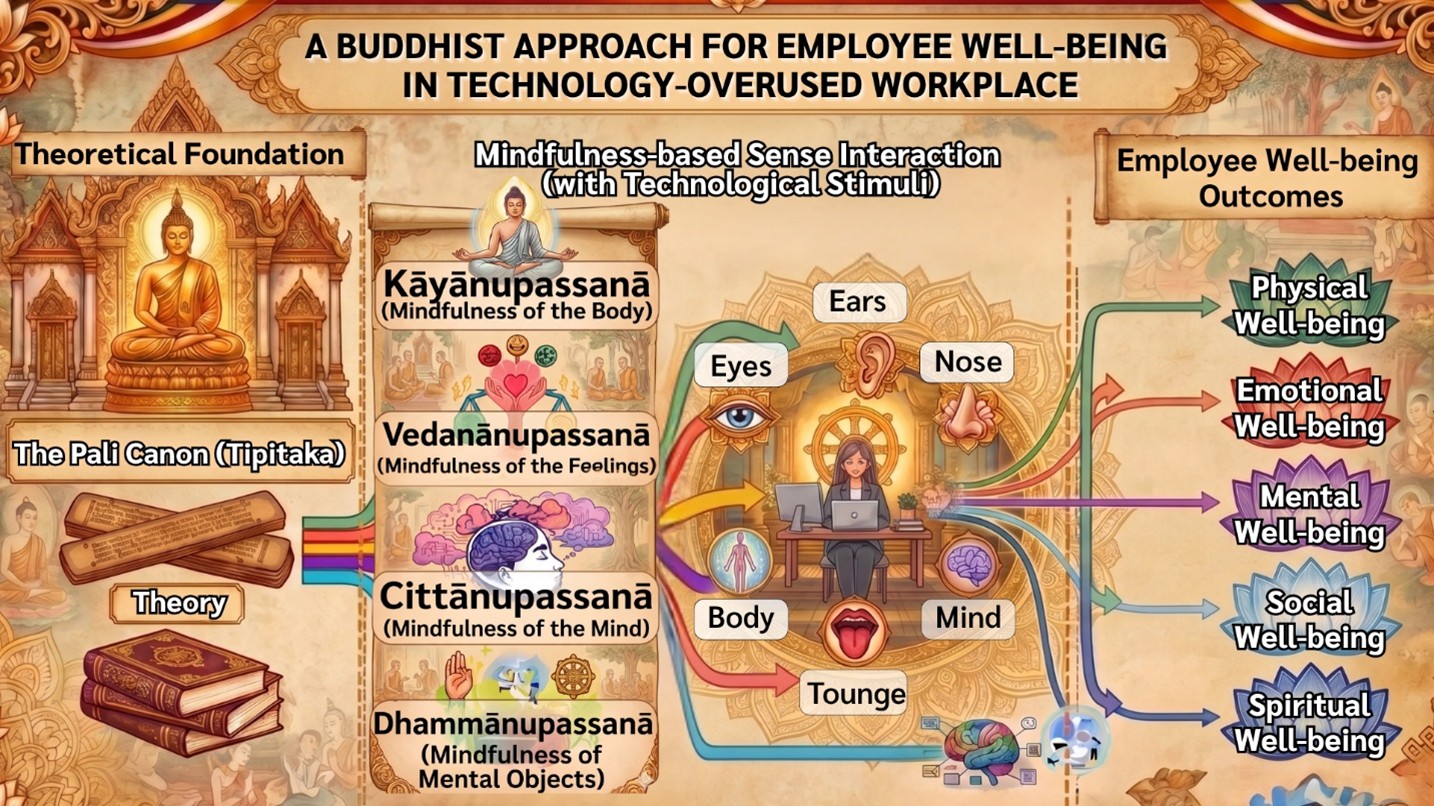
Involvement to Buddhadhamma: The research applied Buddhist principles to the modern context of information technology in a globalized world. The core Buddhadhamma involved the Four Noble Truths, the Twelve Links of Dependent Origination, the Three Marks of Existence, the Four Divine Abidings, the Four Foundations of Mindfulness, and the Mindfulness of Breathing, both as theoretical foundations and practical methods. These teachings were deliberately organized into different well-being dimensions and paired with meditation techniques to support a deeper understanding of the causes of distress and the mind's habitual tendency to react, accumulate, and intensify experiences. This integrated approach was designed not only to help participants alleviate workplace stress and dissatisfaction but also to cultivate a broader and clearer perspective on the relationship between work, life, and spiritual fulfillment.
Conclusions: The pilot program represented a practical application of Buddhadhamma-informed mindfulness in the modern workplace. It introduced Buddhadhamma to modern organizational contexts as a right way of living rather than a religious form and positioned meditation grounded in such wisdom as a foundation for longer-term mental and behavioral change. This approach facilitated the cultivation of spiritual well-being while also contributing to other dimensions of employee well-being. Although the findings were exploratory, they suggested that the program may be relevant not only in technology-intensive settings but also in other high-pressure work environments.
References
Alruwayyeh, H. Y. A. A. (2018). The Effects of Technology in the Modern Office Work Environment. The International Journal of Engineering and Science (IJES), 7(3), 1-7.
Alzain, H., Alghazal, R., Qurain, A. A. & Karkadan, M. (2023). Fostering and Sustaining Employees' Happiness in the Oil, Gas, and Energy Industry: The Role of Organizational Chief Happiness Officer in Implementing Happiness Initiatives and Programs. Paper presented at the International Petroleum Technology Conference, Bangkok, Thailand, March 2023. 1-10. https://doi.org/10.2523/IPTC-22718-MS.
Bhatt, N. & Kothari, T. P. (2022). Determinants of Technostress: A Systematic Literature Review. European Journal of Business Science and Technology, 8(2), 159-171. https://doi.org/10.11118/ejobsat.2022.007.
Bhikkhu P. A. Payutto (Somdet Phra Buddhaghosacariya). (2021). Buddhadhamma: The Laws of Nature and Their Benefits to Life. Bangkok, Thailand: Buddhadhamma Foundation.
Bhikkhu, T. (2016). Sutta Nipata: The Discourse Group. California, United States of America: Metta Forest Monastery.
Bodhi, B. (2005). In the Buddha's Words: An Anthology of Discourses from the Pali Canon. Boston, United States of America: Wisdom Publications.
Bodhi, B. (2012). The Numerical Discourses of the Buddha: A Translation of the Aṅguttara Nikāya. Boston, United States of America: Wisdom Publications.
Burgess, J. & Connell, J. (2020). New technology and work: Exploring the challenges. The Economic and Labour Relations Review, 31(3), 310-323. https://doi.org/10.1177/1035304620944296.
Chan, P. T. (2025). A Buddhist-approached Training Program to Cultivate Employee Well-being in a Technology-overused Workplace. (Pham, C. C., Interviewer)
Coventry, P. (2015). Buddhism at Work: An Analysis of the Impact of Buddhist Concepts and Practices on Western Organisations. [Master's thesis, International Buddhist College]. Academia. https://shorturl.asia/xzWdn.
Dim, W. & Sheahan, J. (2022). "Safeness by Design - The Future of Work: Designing for Safety, Wellbeing and the Workplaces of Tomorrow". Melbourne, Australia: RMIT University. https://doi.org/10.25439/rmt.27401610.
Dingermans, J. (2020). Towards the digital future of HR: exploring the relationship between techno overload and work-life balance with leadership as a moderator. [Master's Thesis, Tilburg University]. Arno Academic Publication Online. https://arno.uvt.nl/show.cgi?fid=153461.
Gunaratana, B. H. (2011). Mindfulness In Plain English. Boston, United States of America: Wisdom Publications.
Gyatso, T. (2000). The Meaning of Life: Buddhist Perspectives on Cause and Effect. Boston, United States of America: Wisdom Publications.
Jha, A., Pathan, M., Sindhi, T. & Panjiyar, D. (2023). "Techvolution: Unraveling the Impact of Technology on Human Lifestyle and Strategies for Adaptation". International Journal of Creative Research Thoughts (IJCRT), 11(11), 963-979.
Jiwattanasuk, N., Premsakul, K., Tanpoonkiat, W. & Deegalle, M. (2024). Cultivating Mindfulness Activities to Develop Peaceful Well-being. Journal of International Buddhist Studies, 15(1), 69-87.
Johnson, A., Dey, S., Nguyen, H., Growth, M., Joyce, S., Tan, L., Glozier, N. & Harvey, S. B. (2020). A Review and Agenda for Examining How Technology-driven Changes at Work Will Impact Workplace Mental Health and Employee Well-being. Australian Journal of Management, 45(3), 402-424. https://doi.org/10.1177/0312896220922292.
Joshi, D. R., Neupane, U., Singh, J. K., Khanal, B. & Belbase, S. (2021). Effects of Using Digital Devices on Food Consumption among University Students in Nepal. International Research Journal of MMC, 2(4), 36-54. https://doi.org/10.3126/irjmmc.v2i4.41552.
Khetjoi, S., Thasa, W., Raisa-nguan, S. & Uthaphan, P. (2021). The Scientific Buddhism to Improve Human's Well-being. Turkish Journal of Computer and Mathematics Education, 12(8), 2962-2965.
Lee, Y. (2019). Workplace Health and Its Impact on Human Capital: Seven Key Performance Indicators of Workplace Health. In O. K. (Ed.), Indoor Environment and Health. (pp. 1-29). London, United Kingdom: IntechOpen. https://doi.org/10.5772/intechopen.85936.
Mahatthanadull, S. & Mahatthanadull, S. (2019). Holistic Well-beings Promotion for Balanced Way of Life According to Buddhist Psychology. Journal of MCU Nakhondhat, 6(3), 1161-1172.
Mahatthanadull, S. (2020). Life Coaching: A View from Buddhist Psychotherapy and Counseling. Journal of International Buddhist Studies, 11(1), 1-24.
Mahatthanadull, S., Piyabhani, P. N., Kraichakr, O. & Mahatthanadull, S. (2020). A Conceptual Model of Bi-Dimensional Development for Happiness Access by Biofeedback Process. Phra Nakhon Si Ayutthaya, Thailand:
Mahachulalongkornrajavidyalaya University Press. https://doi.org/10.13140/RG.2.2.23347.99360/1.
Maslow, A. H. (1943). A Theory of Human Motivation. Psychological Review, 50(4), 370-396. https://doi.org/10.1037/h0054346.
Mental Health Europe. (2022). Report on Digitalisation in Mental Health: Mental health in the digital age: Applying a human rights based, psychosocial approach as compass. Brussels, Belgium: Mental Health Europe.
Metteyya, B. (2018). Mental Wellbeing with Special Reference to Sabbasavasutta. [Doctoral Dissertation, Mahachulalongkornrajavidyalaya University]. Buddhaghosa.mcu.ac.th. https://shorturl.asia/iRY5w.
Mitropoulou, E. M., Karagianni, M. & Thomadakis, C. (2022). Social Media Addiction, Self-Compassion, and Psychological Well-Being: A Structural Equation Model. Alpha Psychiatry, 23(6), 298-304. https://doi.org/10.5152/alphapsychiatry.2022.22957.
Morgan, J. W. & Gore, J. S. (2019). The Influence of Technological Reliability and Supervisory Supportiveness on Work Stress. Kentucky Journal of Undergraduate Scholarship, 3(1), 47-58.
Ñāṇamoli, B. & Bodhi, B. (1995). The Middle Length Discourses of the Buddha: A New Translation of the Majjhima Nikaya. Kandy, Sri Lanka: Buddhist Publication Society.
Nhat Hanh, T. & Cheung, L. (2010). Savor: Mindful Eating, Mindful Life. San Francisco, United States of America: HarperOne.
Pannasara. (2024). The Buddhist Ways of Healthy Living for People in the Information Technological Era. [Unpublished doctoral dissertation]. Phra Nakhon Si Ayutthaya, Thailand: Mahachulalongkornrajavidyalaya University.
Phra Dhammanan Parisuddhajayo. (2025). A Buddhist-approached Training Program to Cultivate Employee Well-being in a Technology-overused Workplace. (Pham, C. C., Interviewer)
Phra Sukeesom Siratechaputtiyo. (2025). A Buddhist-approached Training Program to Cultivate Employee Well-being in a Technology-overused Workplace. (Pham, C. C., Interviewer)
Raković, L., Sakal, M. & Matković, P. (2022). Digital Workplace – Advantages and Challenges. Anali Ekonomskog Fakulteta U Subotici, 58(47), 65-78. https://doi.org/10.5937/AnEkSub2247065R.
Rasool, T., Warraich, N. F. & Sajid, M. (2022). Examining the Impact of Technology Overload at the Workplace: A Systematic Review. Sage Open, 12(3). https://doi.org/10.1177/21582440221114320.
Sharpe, A. & Fard, S. M. (2022). The Current State of Research on The Two-way Linkages between Productivity and Well-being. Geneva, Switzerland: International Labour Organization.
Shresth, A. K., Luitel, B. C., Nandram, S. S. & Petchsawang, P. (2023). Conceptualization of Workplace Spirituality in an Eastern Context. Journal of Business and Management Research, 5(1-2), 35-39. https://doi.org/10.3126/jbmr.v5i1-2.58570.
Thakur, P. & Kumari, S. (2024). Technostress: A Critical Assessment of Its Negative Aspects and Strategies for Coping. ITM Web of Conferences, 65, 1-6. https://doi.org/10.1051/itmconf/20246505004.
The Mindfulness Initiative Private Sector Working Group. (2016). Building the Case for Mindfulness in the Workplace. Oxford, United Kingdom: Mindfulness Initiative.
Thinley, D. (2025). A Buddhist-approached Training Program to Cultivate Employee Well-being in a Technology-overused Workplace. (Pham, C. C., Interviewer)
Ulluwishewa, R., Uthumange, A., Weerakoon, R. & Perera, D. (2020). Some Reflections on Achieving Happiness at the Workplace Through Practical Buddhism. In Dhiman, S. (Ed.), The Palgrave Handbook of Workplace Well-Being. (pp. 1-23). Cham, Switzerland: Palgrave Macmillan. https://doi.org/10.1007/978-3-030-02470-3_21-1.
World Health Organization. (2021). Health Promotion Glossary of Terms 2021. Geneva, Switzerland: World Health Organization.
Yeung, O. & Johnston, K. (2016). The Future of Wellness at Work. Florida, United States of America: Global Wellness Institute.
Downloads
Published
How to Cite
Issue
Section
License
Copyright (c) 2026 Journal of Buddhist Anthropology

This work is licensed under a Creative Commons Attribution-NonCommercial-NoDerivatives 4.0 International License.