RURAL BUDDHIST AGENCY IN CONTEMPORARY INDONESIA: TRIBUANA MANGGALA BHAKTI AS A NEW PRACTICE
Keywords:
Tribuana Manggala Bhakti, Javanese Buddhists, Religious Hybridity, Rite Invention, Contemporary IndonesiaAbstract
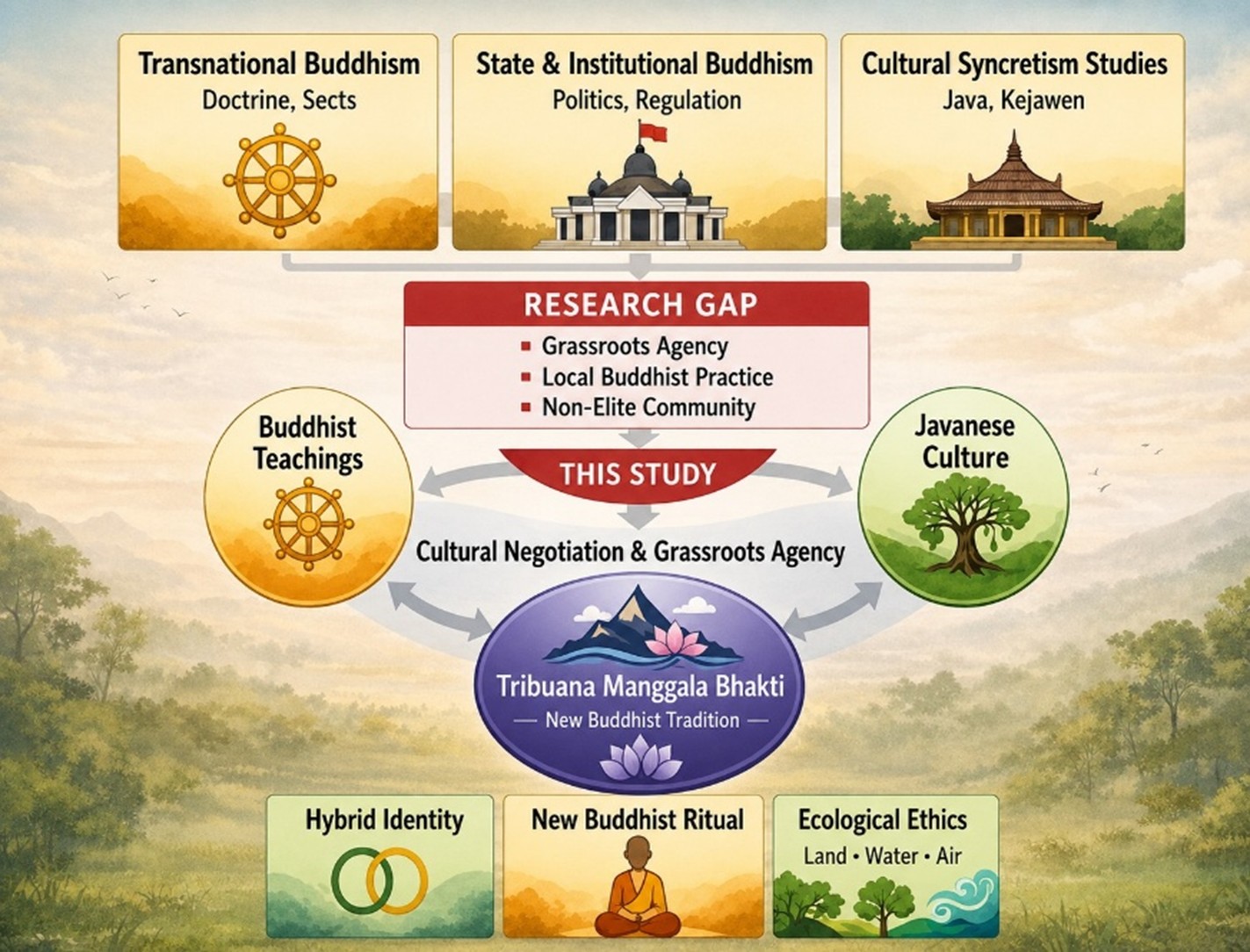
Background and Objectives: Buddhism, though practiced by a minority in Indonesia, a country with the world's largest Muslim population, represents a religion of rich multidimensional traditions, with Mahayana, Theravada, and Vajrayana coexisting across the archipelago. Within this landscape, Javanese Buddhists occupy a particularly complex position. They live within a state framework on religion largely shaped by a monotheistic paradigm that conceives religion as a singular, exclusive, and clearly bounded belief system. Yet their lived religiosity embodies a hybrid religious life shaped by the historical layers of Hinduism, ancient Buddhism, Islam, and Kejawen, which continue to inform how the Javanese Buddhist community perceives, practices, and expresses its religiosity. This tension between a singular conception of religion and a hybrid experience has prompted Javanese Buddhists to construct practices grounded in their own cultural identity, particularly within Theravada communities, which, though inspired by mainland Southeast Asian Theravada traditions, increasingly incorporate indigenous Javanese elements. One significant outcome is Tribuana Manggala Bhakti, a Javanese Buddhist religious-cultural rite developed in Jatimulyo, Kulon Progo, Yogyakarta. This research aims to examine the principles and patterns through which this community negotiates Buddhism and Javanese cultural identity through the invention of the Tribuana Manggala Bhakti, and to reveal what this negotiation discloses about the working of religious localization within a state framework oriented toward homogenous religion.
Methodology: This research applied an ethnohistorical approach, combining ethnographic fieldwork with historical analysis. Fieldwork was conducted with the Javanese Buddhist community in Jatimulyo, Kulon Progo, Yogyakarta, Indonesia, which was purposively selected as the primary site where Tribuana Manggala Bhakti is actively practiced. Field data were complemented by historical records and relevant scholarly literature on Buddhism in Indonesia and Southeast Asia.
Main Results: The findings revealed that the Javanese Buddhist community demonstrated significant agency in negotiating its religious identity. Rather than passively reproducing transnational Buddhist traditions, the community actively engages in a creative process of cultural negotiation by selectively integrating Javanese values, symbols, and ceremonial forms into Buddhist practice. Tribuana Manggala Bhakti emerged as the product of this negotiation, a ritual framework that was simultaneously Buddhist in doctrinal orientation and Javanese in cultural expression. For practitioners, the rite was not merely ceremonial but functioned as a way of embodying Buddhist values within a familiar cultural world, where reverence toward all sentient beings, gratitude toward ancestors, and harmony with nature became lived practices rather than abstract teachings.
Involvement to Buddhadhamma: From the perspective of applied Buddhism, this construction reflects a meaningful engagement with core Buddhist teachings, expressed through locally meaningful cultural forms. Tribuana Manggala Bhakti is essentially a form of puja, a widely shared devotional practice that serves as a vehicle for expressing core teachings. The community preserves the structure and intent of puja by integrating Javanese expression into its execution, cultivating wisdom and moral sensibility through the doctrinal principle of reverence and loving-kindness toward all sentient beings across the three realms (Tribuana): Air, land, and water, from which the ritual derives its name. This illustrates how Buddhadhamma can serve as a flexible yet principled foundation that accommodates cultural diversity without compromising its essential doctrines.
Conclusions: The Javanese Buddhist community in Jatimulyo, through its construction of Tribuana Manggala Bhakti, occupies a dynamic position at the intersection of transnational Buddhist tradition and local cultural identity. This case exemplifies a broader pattern of religious localization in which a Buddhist community asserts cultural agency while maintaining doctrinal integrity. Tribuana Manggala Bhakti stands as a quiet testimony that religious life, when allowed to breathe within its layered historical roots, can remain faithful to doctrine while resisting the demand to become a homogenous, sealed-off form.
References
Abdullah, I. (2006). Konstruksi dan Reproduksi Kebudayaan. Yogyakarta, Indonesia: Pustaka Pelajar.
Bhabha, H. K. (2004). The location of culture. New York, United States of America: Routledge.
Brown, I. (1987). Contemporary Indonesian Buddhism and Monotheism. Journal of Southeast Asian Studies, 18(1), 108-117. https://doi.org/10.1017/S0022463400001284.
Brown, I. (2004). The Revival of Buddhism in Modern Indonesia. In Ramstedt, M. (Ed.), Hinduism in modern Indonesia: A minority religion between local, national, and global interests. (pp. 45-55). London, United Kingdom: Routledge Curzon.
Buaban, J. (2025). A Critical Lens on Peace: Examining Conflict and Resistance in Indonesian Buddhist Studies. Journal of Buddhist Studies Chulalongkorn University, 32(1), 1-31.
Campbell, B. G. (2017). The Power of Place. In Bauman, W. A., Bohannon, R. & O'Brien, K. J. (Eds.), Grounding Religion: A Field Guide to the Study of Religion and Ecology (2nd ed.). (pp. 94-114). London, United Kingdom: Routledge.
Carmack, R. M. (1972). Ethnohistory: A Review of its Development, Definitions, Methods, and Aims. Annual Review of Anthropology, 1, 227-246. https://doi.org/10.1146/annurev.an.01.100172.001303.
Chia, J. M.-T. (2018). Neither Mahāyāna nor Theravāda: Ashin Jinarakkhita and the Indonesian Buddhayāna Movement. History of Religions, 58(1), 24-63. https://doi.org/10.1086/697932.
Dressler, M. & Mandair, A. P. S. (2011). Secularism and Religion-Making. New York, United States of America: Oxford University Press.
Geertz, C. (1957). Ritual and Social Change: A Javanese Example. American Anthropologist, 59(1), 32-54. https://doi.org/10.1525/aa.1957.59.1.02a00040.
Geertz, C. (1960). The religion of Java. Chicago, United States of America: University of Chicago press.
Hobsbawm, E. & Ranger, T. (Eds.). (1992). The Invention of Tradition (Canto ed.). Cambridge, United Kingdom: Cambridge University Press.
Holt, J. C. (2009). Spirits of the Place: Buddhism and Lao Religious Culture. Honolulu, United States of America: University of Hawai'i Press.
Hughes-Freeland, F. (1991). A Throne for the People: Observations on the Jumenengen of Sultan Hamengku Buwono X. Indonesia, 51, 129-152. https://doi.org/10.2307/3351068.
Maarif, S. (2019). Indigenous Religion Paradigm: Re-interpreting Religious Practices of Indigenous People. Institute of Philosophy, University of Tsukuba. https://doi.org/10.15068/00155157.
McCombes, S. & George, T. (2025). What Is a Research Methodology? | Steps & Tips. Amsterdam, Netherlands: Scribbr.
McDaniel, J. T. (2010). Buddhism in Modern Southeast Asia. Religion Compass, 4(11), 657-668. https://doi.org/10.1111/j.1749-8171.2010.00247.x.
Musman, A. (2015). Lurik-Pesona, Ragam & filosofi. Yogyakarta, Indonesia: Penerbit Andi.
Nugroho, S. S. (2019). Wedaring Laku Memayu Hayuning Bawana: Dimensi Filsafat, Mistik, Religius dan Sains dalam Masyarakat Jawa. Ponorogo, Indonesia: Uwais Inspirasi Indonesia.
Picard, M. & Madinier, R. (Eds.). (2011). The Politics of Religion in Indonesia: Syncretism, orthodoxy, and religious contention in Java and Bali. London, United Kingdom: Routledge.
Pusat Data dan Analisa Tempo. (2019a). Festival Keraton: Bersatunya Dinasti Mataram (18). Jakarta, Indonesia: TEMPO Publishing.
Pusat Data dan Analisa Tempo. (2019b). Perkembangan Budha Awal Tahun 1970an Sebagai Tonggak Perubahan Budha Indonesia. Jakarta, Indonesia: TEMPO Publishing.
Ramstedt, M. (Ed.). (2004). Hinduism in Modern Indonesia: A Minority Religion Between Local, National, and Global Interests. London, United Kingdom: RoutledgeCurzon.
Ricklefs, M. C. (2013). Mengislamkan Jawa: Sejarah Islamisasi di Jawa dan Penentangnya dari 1930 sampai Sekarang. Jakarta, Indonesia: PT Serambi Ilmu Semesta.
Rizzo, R. (2024). Buddhism in Indonesia: A Study of Multiple Revivals (1st ed.). Routledge. https://doi.org/10.4324/9781003389514.
Saputra, A. A. & Heppyana, N. P. A. (2023). Aktualisasi Sad Kertih sebagai Dasar Tatanan Kehidupan. PRAMANA Jurnal Hasil Penelitian, 3(2), 123. https://doi.org/10.55115/jp.v3i2.3774.
Sb. (2023). The History of Buddhism in Jatimulyo. (Jayanti, C. D., Interviewer)
Sh. (2024). The Invention of Buddhism Rites in Jatimulyo. (Jayanti, C. D., Interviewer)
Sm. (2024). The History of Buddhism in Jatimulyo. (Jayanti, C. D., Interviewer)
Smith, R. (2020). Mysticism and Syncretism on the Island of Java. Brattleboro, United States of America: Independent Study Project (ISP) Collection.
Sr. (2024). The History of Buddhism in Jatimulyo. (Jayanti, C. D., Interviewer)
Sulani, P. (2025). Ketika Kejawen Bertemu Buddha: Transformasi Sosial Wong Banyumasan dalam Dinamika Orde Baru. Yogyakarta, Indonesia: Deepublish.
Sutrisno, E. L. (2018). Negotiating the Confucian Religion in Indonesia: Invention, Resilience and Revival (1900-2010). [Doctoral Dissertation, University of Washington]. University Libraries, University of Washington. Anthropology. http://hdl.handle.net/1773/42177.
SW. (2024). The History of Buddhism in Jatimulyo. (Jayanti, C. D., Interviewer)
Totok. (2022). Cahaya Dharma di Bukit Menoreh: Sejarah Perkembangan Agama Buddha di Kabupaten Kulon Progo. Yogyakarta, Indonesia: Peace Within.
Woodward, M. (2011). Java, Indonesia and Islam. New York, United States of America: Springer.
Woodward, M. R. (1988). The "Slametan": Textual Knowledge and Ritual Performance in Central Javanese Islam. History of Religions, 28(1), 54-89. https://doi.org/10.1086/463136.
Yulianti. (2024). The Making of Buddhism in Modern Indonesia: South and Southeast Asian Networks, 1900-1959. Leiden, Netherlands: Leiden University Press.
Downloads
Published
How to Cite
Issue
Section
License
Copyright (c) 2026 Journal of Buddhist Anthropology

This work is licensed under a Creative Commons Attribution-NonCommercial-NoDerivatives 4.0 International License.