THE INTEGRATION OF ARIYASACCA PRINCIPLES-BASED LEARNING MANAGEMENT FOR STUDENTS OF INTERNATIONAL BUDDHIST STUDIES COLLEGE
Keywords:
Ariyasacca Principles, Buddhist Higher Education, Learning Management, Applied Buddhism, Buddhism and the Development of Wisdom and MoralityAbstract
Background and Objectives: At the International Buddhist Studies College (IBSC), students reported that they faced concrete daily challenges related to academic requirements and language barriers, as well as limited integration between contemplative practice and learning processes. Although the principles of Ariyasacca have long been regarded as an effective approach to problem-solving, their application in learning management in international Buddhist higher education has received limited attention. Therefore, this study aimed to investigate the learning management challenges faced by students at IBSC, to examine how Ariyasacca principles illuminate their causes and provide a framework for their transformation within an educational context, and to develop an Ariyasacca Principles-Based Learning Management Model (APBLM) that integrates doctrinal wisdom with evidence-based institutional practice.
Methodology: A multiphase mixed-methods design was used. Specifically, Phase 1 integrated data from surveys of 48 students and in-depth interviews with 30 students and 11 lecturers to identify learning management challenges and needs; Phase 2 combined documentary analysis with in-depth interviews to examine how the principles of Ariyasacca manifested in educational environment and guided pedagogical improvements; And Phase 3 synthesized the findings of the first two phases to develop and validate the APBLM through four forms of validation: Empirical, pedagogical, theoretical, and comparative.
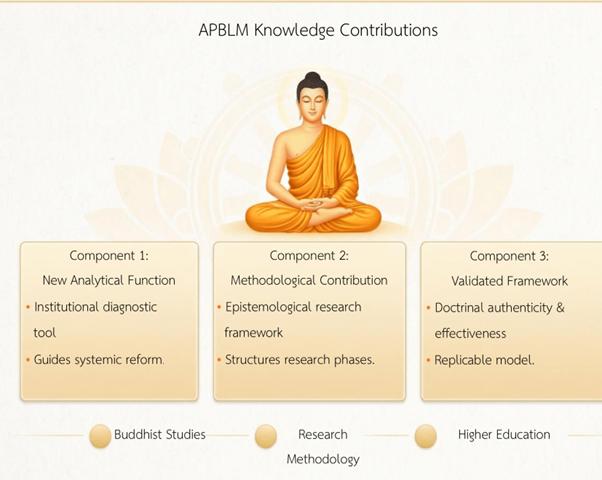
Main Results: This study revealed that five challenge clusters at IBSC, manifesting with moderate intensity (Overall Dukkha Weighted Mean = 3.09), collectively formed a self-reinforcing feedback system. The causes of these challenges emerged from the interaction of external conditions and internal dispositions (Samudaya = 2.82). In particular, students maintained high aspirations (Nirodha = 3.97) and strong receptivity to Buddhist-based solutions (Magga = 4.02), even though they encountered moderate challenges. Documentary and interview analyses further established that the principles of Ariyasacca could be mapped onto an educational context. Based on these findings, the Ariyasacca Principles-Based Learning Management Model (APBLM), a cyclical learning management framework validated through four forms of validation, was proposed to address curriculum design, contemplative pedagogy, language support, experiential learning, community building, and institutional reform.
Involvement to Buddhadhamma: This study falls within the field of Applied Buddhism, which relates particularly to Buddhist innovations in method development and to Buddhism and the development of wisdom and morality by applying the principles of Ariyasacca to develop a systematic learning management model for international Buddhist higher education. The principles of Ariyasacca, while being ancient teachings, retain relevance in terms of identifying suffering and proposing paths for its resolution when applied in the context of institutions. By applying doctrinal wisdom to educational practice without diminishing the core values of the principles, this study positions the APBLM as an embodiment of Buddhist skillful means (Upāya-kosalla) in education, thereby showing how classical Buddhist teachings can contribute to institutional transformation and also support the development of wisdom and morality in contemporary multicultural academic settings.
Conclusions: This study provided the APBLM, a cyclical framework that can guide institutional reform over time while preserving its internal consistency with Buddhist principles. The APBLM also showed that instead of being opposites, academic rigor and spiritual depth could support each other when institutions in Buddhist higher education apply their foundational wisdom to address the challenges that students encounter in the environment of multicultural learning.
References
Audmuangpiea, S. Ruangsan, N. & Saengsai, P. (2024). The Development of a Learning Management Model Based on the Four Noble Truths to Promote Creative Problem-solving Skills among Undergraduate Students at Mahamakut Buddhist University, Isan Campus. Journal of Buddhist Education and Research, 10(3), 41-52.
B01. (2025). Interview on Learning Management Challenges and the Integration of Ariyasacca Principles in Buddhist Higher Education at IBSC. (Tran, H. H., Interviewer)
Bodhi, B. (Trans). (2000). The Connected Discourses of the Buddha: A New Translation of the Saṃyutta Nikāya (Vol. 2). Boston, United States of America: Wisdom Publications.
Jiwattanasuk, M. N. (2025). Interview on Learning Management Challenges and the Integration of Ariyasacca Principles in Buddhist Higher Education at IBSC. (Aggadhammo, R., Interviewer)
Jongchaloemchai, P., Yamrung, R. & Cheausuwantavee, C. (2021). Development of Learning Management Model for Enhancing Preservice Teachers' Creative Problem-Solving Skill. Journal of Research and Curriculum Development, 11(1), 132-142.
M01. (2025). Interview on Learning Management Challenges in Buddhist Higher Education at IBSC. (Tran, H. H., Interviewer)
M06. (2025). Interview on Learning Management Challenges and the Integration of Ariyasacca Principles in Buddhist Higher Education at IBSC. (Tran, H. H., Interviewer)
M07. (2025). Interview on Learning Management Challenges and the Integration of Ariyasacca Principles in Buddhist Higher Education at IBSC. (Tran, H. H., Interviewer)
M12. (2025). Interview on Learning Management Challenges and the Integration of Ariyasacca Principles in Buddhist Higher Education at IBSC. (Tran, H. H., Interviewer)
Mahatthanadull, S. (2020). Concepts and Principles of Buddhism. [Doctoral dissertation, Mahachulalongkornrajavidyalaya University]. ResearchGate. https://www.researchgate.net/publication/34062885_Teaching_Document_CONCEPTS_AND_PRINCIPLES_OF_BUDDHISM.
Nārada, M. (Ed. & Trans). (2007). A Comprehensive Manual of Abhidhamma: The Abhidhammattha Saṅgaha of Āchariya Anuruddha (3rd ed). Kandy, Sri Lanka: Buddhist Publication Society.
Ounraun, W. & Onthanee, A. (2023). An Instructional Model Development Based on Social Constructivism and Authentic Learning Approaches to Enhance Differentiated Instruction Ability for Student Teachers. Journal of Education and Innovation, 25(1), 222-237.
P04. (2025). Interview on Learning Management Challenges and the Integration of Ariyasacca Principles in Buddhist Higher Education at IBSC. (Tran, H. H., Interviewer)
P10. (2025). Interview on Learning Management Challenges in Buddhist Higher Education at IBSC. (Tran, H. H., Interviewer)
P11. (2025). Interview on Learning Management Challenges and the Integration of Ariyasacca Principles in Buddhist Higher Education at IBSC. (Tran, H. H., Interviewer)
Phra Paladraphin Buddhisaro. (2025). Interview on Learning Management Challenges and the Integration of Ariyasacca Principles in Buddhist Higher Education at IBSC. (Aggadhammo, R., Interviewer)
Phra Suthep Suddhiyano. (2025). Interview on Learning Management Challenges in Buddhist Higher Education at IBSC. (Aggadhammo, R., Interviewer)
Phrakhupalad Sak Mahāvīro (Kosolsuphawat), Phrakhrusangharak Chakkit Bhuripanyo, Chaisuk, P. & Sritragarn, T. (2021). Model of Teaching and Learning Management according to the Four Noble Truths for Primary School Students . Psychology and Education Journal, 58(1), 3766-3771. https://doi.org/10.17762/pae.v58i1.1386.
Phramaha Anon Anando. (2025). Interview on Learning Management Challenges and the Integration of Ariyasacca Principles in Buddhist Higher Education at IBSC. (Aggadhammo, R., Interviewer)
Phramaha Duriya Kittisaro (Sungyoka). (2026). A Model of Personnel Management in the Digital Era Based on the Four Noble Truths for Administrators of Mahachulalongkornrajavidyalaya University. Journal of Social Sciences Innovations, 3(1), 38-53. https://doi.org/10.14456/jssi.2026.4.
Phramaha Sompong Khunakaro. (2025). Interview on Learning Management Challenges and the Integration of Ariyasacca Principles in Buddhist Higher Education at IBSC. (Aggadhammo, R., Interviewer)
Phramaha Songwit Variddhiṭhāyī. (2025). Interview on Learning Management Challenges and the Integration of Ariyasacca Principles in Buddhist Higher Education at IBSC. (Aggadhammo, R., Interviewer)
Phramaha Weerasak Abhinandavedi. (2025). Interview on Learning Management Challenges in Buddhist Higher Education at IBSC. (Aggadhammo, R., Interviewer)
Phraprayad Abhinanto (Muan Si Phrom), Srinok, S. & Wongsuwan, N. (2022). The Development of Learning Activity Package Using the Four Noble Truths Method for Promoting the Cause Factor Inquiry Thinking Ability of the 3rd Secondary Students. Journal of Legal Entity Management and Local Innovation, 8(8), 37-50.
Sangthong, S. (2020). The Development of Mecca Model to Enhance Critical Reading Abilities for Upper Secondary School Students. Journal of Graduate Studies and Social Sciences, Uttaradit Rajabhat University, 10(2), 105-117.
Sayadaw, M. T. L. (2004). Manual of The Four Noble Truths. In Soe, D. S. W. (Eds.), The Manuals of Buddhism: The Expositions of the Buddha-Dhamma. (pp. 249-284). Yangon, Myanmar: Mother Ayeyarwaddy Publishing House.
Sidee, N. (2025). Interview on Learning Management Challenges in Buddhist Higher Education at IBSC. (Aggadhammo, R., Interviewer)
Sīlānandabhivamsa, S. U. (2014). Four Noble Truths. In Myint, U. H. (Eds.), Well-Informed Buddhist (Kalyāṇa). (pp. 81-102). San Jose, United States of Americ: Tathāgata Meditation Center.
Walshe, M. (Trans). (1995). The Long Discourses of the Buddha: A Translation of the Dīgha Nikāya. Boston, United States of America: Wisdom Publications.
Watana, S. (2025). Interview on Learning Management Challenges in Buddhist Higher Education at IBSC. (Aggadhammo, R., Interviewer)
Downloads
Published
How to Cite
Issue
Section
License
Copyright (c) 2026 Journal of Buddhist Anthropology

This work is licensed under a Creative Commons Attribution-NonCommercial-NoDerivatives 4.0 International License.