BUDDHIST-ORIENTED MANAGEMENT THROUGH THE COMMUNITY OF BAN SANAM ACCORDING TO THE PRINCIPLE OF SANGAHAVATTHU
Keywords:
Buddhist-oriented Management, Sangahavatthu, Community Development, Community Identity, Media CommunicationAbstract
Background and Objectives: Buddhism serves as a fundamental foundation of life and culture in Thai society. The Four Sangahavatthu (Bases of Social Solidarity) principles are Dana (Giving), Piyavaca (Kindly Speech), Atthacariya (Useful Conduct), and Samanattata (Even and Equal Treatment), providing essential guidelines for fostering unity and harmonious coexistence. The Ban SaNam community in Uthai Thani Province maintains a close relationship with Buddhism and local culture. Therefore, examining Buddhist-oriented management through the community's way of life, based on the Sangahavatthu, is significant for understanding community identity and media communication patterns, as well as ultimately leading to the development of a community management model tailored to the local context. This study aims to: Examine the Buddhist-oriented management approach through the way of life of the Ban SaNam community based on the Sangahavatthu principles, to analyze the identity that connects Buddhism with local culture, to investigate media communication patterns utilized in Buddhist-oriented management within the Ban SaNam community, and to develop a Buddhist-oriented management model for the Ban SaNam community based on the Sangahavatthu principles.
Methodology: This study employed a mixed-methods research design. Qualitative data were collected through in-depth interviews with 12 key informants, selected via purposive sampling, including experts in Buddhist-oriented management, the Ban SaNam community identity, and media communication. Quantitative data were gathered using questionnaires from a sample group of 400 participants, comprising community leaders, abbots, assistant abbots, and temple committee members in Uthai Thani Province.
Main Results: The research findings indicated that the Sangahavatthu principles were effectively applied in the management of the Ban SaNam community. These principles support unity, cooperation, and mutual assistance among community members. The community's identity was closely connected to Buddhism and local culture, as reflected in its traditions, beliefs, and social activities, with the temple serving as a central institution, and media communication patterns were found to play a vital role in coordinating community cooperation and activities. The overall level of agreement regarding media use was high ( = 4.71, S.D. = 0.41), indicating that both traditional and modern communication channels contribute to effective information dissemination and participation.
Involvement to Buddhadhamma: This study is related to Applied Buddhism, focusing on Buddhism and sustainable development: Buddhist-oriented Management in the Ban SaNam. The community reflects the practical application of Sangahavatthu principles in everyday life. The Four Sangahavatthu (Bases of Social Solidarity) principles are: Dana (Giving) refers to giving, self-sacrifice, and sharing resources for the benefit of others without selfishness. Piyavaca (Kindly Speech) refers to speaking with polite, gentle, and sincere words and refraining from using harsh or abusive language. Atthacariya (Useful Conduct) refers to performing beneficial actions or rendering assistance for the benefit of others, and Samanattata (Even and Equal Treatment) refers to being consistent and impartial, sharing both suffering and happiness with others, and not taking advantage of others.
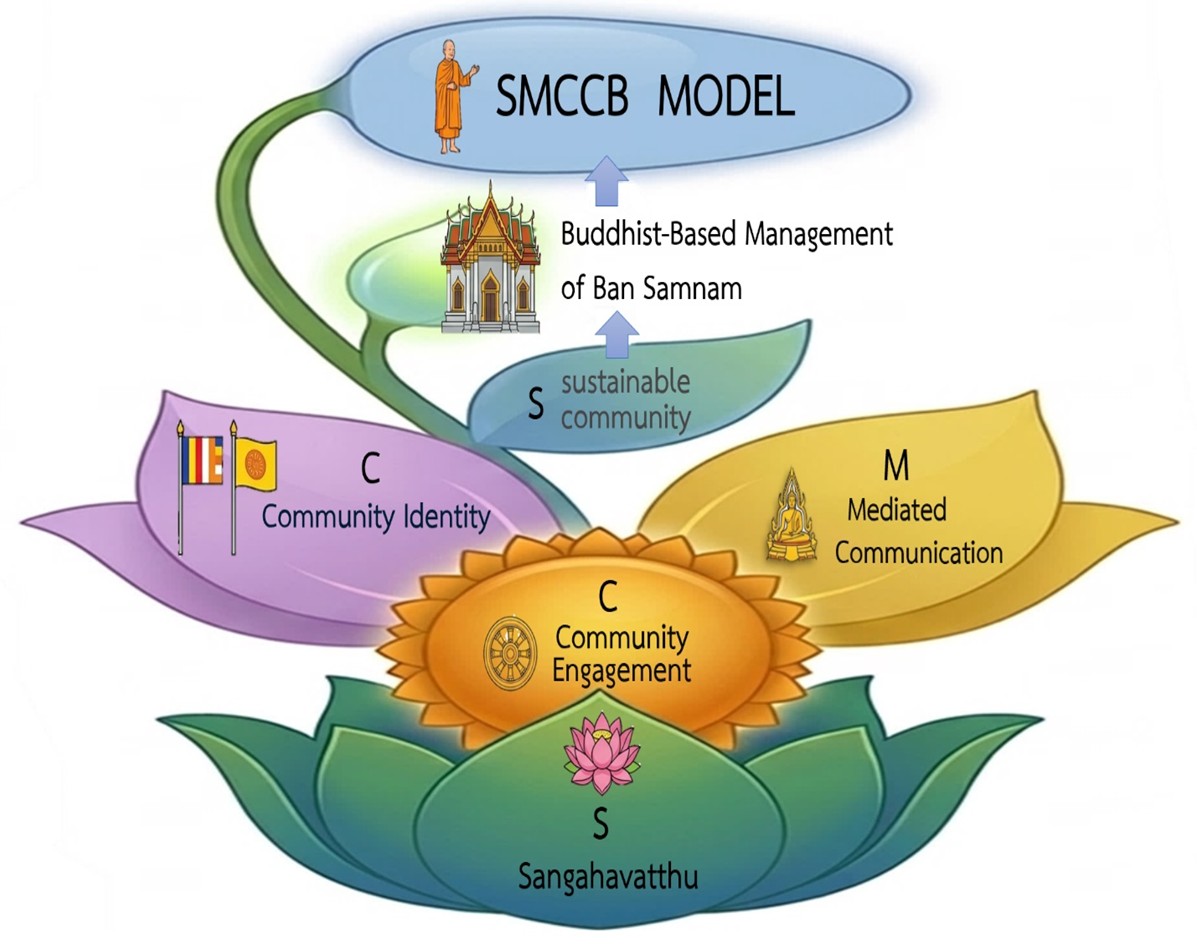
Conclusions: The Ban SaNam community exhibits a way of life and identity deeply rooted in Buddhism and local culture. The proposed "Buddhist-oriented Management Model" integrates Sangahavatthu principles within the community management process. This integration enhances public participation, strengthens social relationships, and promotes community resilience and sustainability. The temple serves as a central hub for religious and social activities, reinforcing collaboration among community members. Ultimately, this model provides a practical framework for sustainable community development based on Buddhist principles.
References
Bunmee, K. (2024). The Application of Buddhist Dhamma for Democratic Development in Thai Society. Journal of Buddhist Sociology, 9(4), 76-85.
Geertz, C. (1973). The Interpretation of Cultures: Selected Essays. New York, United States of America: Basic Books.
Gethin, R. (1998). The Foundations of Buddhism. Oxford, United Kingdom: Oxford University.
Harvey, P. (2013). An Introduction to Buddhism Teachings, History and Practices. New York, United States of America: Cambridge University Press.
Keown, D. (2013). Buddhism: A Very Short Introduction. Oxford, United Kingdom: Oxford University Press.
Khachonphop, W. & Phuenchomphoo, P. (2019). Leadership to the Four Principles of Sangahavatthu in Khon Kaen Subdistrict Administrative Organization, Mueang District, Roi Et Province. Academic Journal of Mahamakut Buddhist University Roi Et Campus, 8(2), 1-9.
McQuail, D. (2010). McQuail's mass communication theory (6th ed.). London, United Kingdom: SAGE Publications.
Metaapinunt, W., Thitapanyo, P. M. & Bamrungphak, S. (2018). Creating Happiness with the Sangaha-Vatthu 4 of theCommunities in Nong Song Hong District KhonKaen Province. Dhammathas Academic Journal, 18(3), 271-282.
Office of the National Economic and Social Development Council. (2023). The Thirteenth National Economic and Social Development Plan (2023-2027) . Bangkok, Thailand: Office of the Prime Minister.
Phanthanaphruet, N. & Phra Yordkom Chainirattisai. (2025). The Application of the Four Bases of Social Solidarity (Sangahavatthu) in Promoting Political Participation. Buddho Journal, 4(2), 35-47.
Phoorisri, T., Mararat, A. & Phramaha Penkiat Kittivisuddho (Sitthisit). (2021). The Study of Public Welfare of Developer Monks on Lifestyle Behaviors Toward Threefold Training and Sangghavatthu 4 And Well-Being of Community. Journal of MCU Nakhonhat, 8(7), 310-325.
Phra Anan Asapho Suriya, Phramaha Anan Anuttaro, Pongpha, P. & Khammuangsaen, B. (2025). Cultivating Peace and Unity: The Four Sangahavatthu in Practice. Journal of Dhamma for Life, 31(4), 666-676.
Phra Brahmagunabhorn (P. A. Payutto). (1992). Buddhist Economics: A Middle Way for the Market Place. Bangkok, Thailand: Buddhadhamma Foundation.
Phra Nadet Paguno (Somboonprom), Phrakru Phisalsarbunthit & Phrakrujiradhammathat. (2021). Propose Guidelines for Community Development According to the Four Sangkhahawatthu Principles of OTOP Community People, Banbokwan, Khamp Bok Wan Sub-District, Nong Khai District, Nong Khai Province. Journal of Modern Learning Development, 7(1), 44-55.
Phuenchomphoo, P., Phraklairung Panyawachiro & Phadungkit, N. (2021). The Guidelines in Applying of the Principles of Sangahavatthu to Develop the Community Leaders of the Central Northeast to Strengthening Community Well-being. Academic Journal of Mahamakut Buddhist University Roi Et Campus, 10(1), 190-203.
Rahula, W. (1959). What the Buddha Taught. New York, United States of America: Grove Press.
Sonsuep, T., Phra Medhivajarapundit. & Phrakrupalad Adisak Vajirapañño.(2024). The Development of Community Leaders to Promote a Peaceful Community Based on 'Bowon' Power According to the Buddhist Peaceful Means: A Case Study of Non Sila 2 Community, Ban Non Sila, Non Sila Subdistrict, Non Sila District, Khon Kaen Province. Journal of Buddhist Innovation Review, 5(3), 20-35.
Sutthiphun, A., Thedkamchorn, K. & Arunyawat, Y. (2021). Buddhist Community Building Process. Journal of Graduate MCU , 8(3), 392-404.
United Nations. (2015). Transforming our world: the 2030 Agenda for Sustainable Development. New York, United States of America: United Nations.
Downloads
Published
How to Cite
Issue
Section
License
Copyright (c) 2026 Journal of Buddhist Anthropology

This work is licensed under a Creative Commons Attribution-NonCommercial-NoDerivatives 4.0 International License.