BUDDHADHAMMA AND SME RESILIENCE: POST-FLOOD RECOVERY IN HAT YAI DISTRICT, THAILAND
Keywords:
Post-flood Recovery, SMEs, Hat Yai, ResilienceAbstract
Background and Objectives: Natural disasters increasingly disrupt economic systems, particularly affecting SMEs, which are highly vulnerable due to limited resources and adaptive capacity. In Thailand, SMEs play a major role in employment and GDP, yet the 2025 flood in Hat Yai caused severe financial losses, business interruptions, and psychological distress among entrepreneurs. These challenges highlighted the need for recovery approaches that address not only economic reconstruction but also cultural and psychological resilience. In the Thai context, Buddhadhamma, including the Four Noble Truths, the Noble Eightfold Path, and Sangahavatthu IV (The Four Bases of Social Solidarity), provides practical guidance for coping with crises and strengthening community support. However, limited research has integrated Buddhist teachings into SME resilience frameworks. Therefore, this study aims to examine the multidimensional impacts of the 2025 flood on SMEs, analyze the application of Buddhist principles in post-disaster recovery, and develop a Buddhist Resilience Model for SMEs to explain sustainable recovery processes.
Methodology: This study employed a qualitative phenomenological approach within an interpretivist paradigm. Twenty-five SME entrepreneurs affected by the 2025 flood in Hat Yai District were purposively selected. Data were collected through in-depth interviews, focus group discussions, and participant observation over a three-month period. Thematic analysis was used, and trustworthiness was ensured through triangulation, member checking, and peer debriefing.
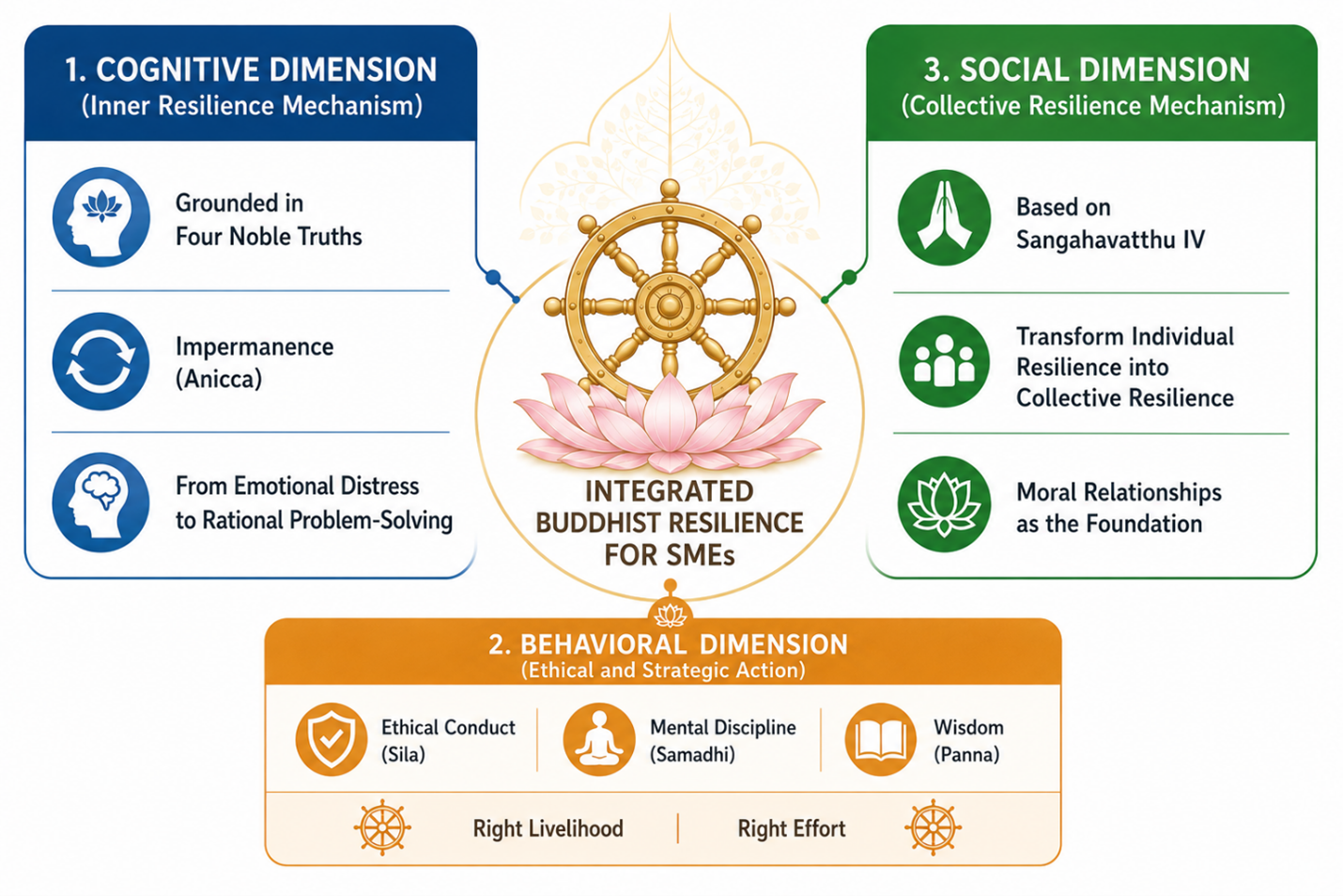
Main Results: The findings revealed that the flood generated multidimensional impacts, including financial losses, operational disruption, supply chain breakdowns, and psychological stress. Participants described Buddhadhamma as an important resource for recovery. The Four Noble Truths supported acceptance and understanding of adversity, the Noble Eightfold Path guided ethical and strategic decision-making, and Sangahavatthu IV strengthened cooperation and mutual assistance within communities. Based on these findings, the study developed the "Integrated Buddhist Resilience Model for SMEs," consisting of three interconnected dimensions: Cognitive Dimension (Inner Resilience), Behavioral Dimension (Ethical and Strategic Action), and Social Dimension (Collective Resilience). These dimensions interacted dynamically to enhance personal adaptability, ethical conduct, and community cohesion, ultimately contributing to long-term sustainable recovery. The findings suggested that SME resilience was a holistic process shaped by Buddhist principles and supported by both internal and external adaptive mechanisms.
Involvement to Buddhadhamma: This study falls under Applied Buddhism, specifically the area of Buddhism and Sustainable Development. It applies core Buddhist principles, including the Four Noble Truths, the Noble Eightfold Path, and Sangahavatthu IV, as practical frameworks for SME recovery. These teachings support cognitive adaptation, ethical decision-making, and social cooperation among entrepreneurs facing post-disaster challenges. Buddhadhamma serves as both a psychological coping mechanism and a moral foundation for business practices, fostering compassion, mutual support, and community resilience. The findings demonstrate that Buddhist principles can be effectively integrated into economic recovery strategies, contributing to sustainable development, social cohesion, and long-term community resilience in disaster management contexts.
Conclusions: SME recovery following the 2025 flood cannot be explained solely by economic factors but also involves psychological and socio-cultural dimensions. Buddhadhamma played a significant role in helping entrepreneurs adapt to adversity, make ethical decisions, and strengthen community cooperation. Recovery was not merely a return to normal conditions but a process of transformation through which entrepreneurs rebuilt livelihoods, maintained hope, and developed resilience for future challenges. The findings demonstrate that Buddhist principles can provide meaning, collective strength, and practical guidance for sustainable recovery in disaster contexts.
References
Adger, W. N. (2000). Social and Ecological Resilience: Are They Related? Progress in Human Geography, 24(3), 347-364. https://doi.org/10.1191/030913200701540465.
Aldrich, D. P. (2012). Building Resilience: Social Capital in Post-Disaster Recovery. Chicago, United States of America: University of Chicago Press.
Bonanno, G. A. (2004). Loss, Trauma, and Human Resilience: Have We Underestimated the Human Capacity to Thrive After Extremely Aversive Events? American Psychologist, 59(1), 20-28. https://doi.org/10.1037/0003-066X.59.1.20.
Borchert, T. A. (2017). Educating Monks: Minority Buddhism on China's Southwest Border. Honolulu, United States of America: University of Hawai'i Press.
Braun, V. & Clarke, V. (2006). Using thematic analysis in psychology. Qualitative Research in Psychology, 3(2), 77-101. https://doi.org/10.1191/1478088706qp063oa.
Creswell, J. W. & Poth, C. N. ((2017). Qualitative Inquiry and Research Design: Choosing among Five Approaches (4th ed.). London, United Kingdom: SAGE Publications.
Doern, R. (2016). Entrepreneurship and crisis management: The experiences of small businesses during the London 2011 riots. International Small Business Journal: Researching Entrepreneurship, 34(3), 276-302. https://doi.org/10.1177/0266242614553863.
Emirbayer, M. (1997). Manifesto for a Relational Sociology. American Journal of Sociology, 103(2), 281-317. https://doi.org/10.1086/231209.
Folke, C., Carpenter, S. R., Walker, B., Scheffer, M., Chapin, T. & Rockström, J. (2010). Resilience Thinking: Integrating Resilience, Adaptability and Transformability. Ecology and Society, 15(4), 20. https://doi.org/10.5751/ES-03610-150420.
Gigerenzer, G. & Gaissmaier, W. (2011). Heuristic Decision Making. Annual Review of Psychology, 62, 451-482. https://doi.org/10.1146/annurev-psych-120709-145346.
Guest, G., Bunce, A. & Johnson, L. (2006). How Many Interviews Are Enough?: An Experiment with Data Saturation and Variability. Field Methods, 18(1), 59-82. http://dx.doi.org/10.1177/1525822X05279903.
Harvey, P. (2013). An Introduction to Buddhism: Teachings, History and Practices (2nd ed.). Cambridge, United Kingdom: Cambridge University Press.
Holling, C. S. (1973). Resilience and Stability of Ecological Systems. Annual Review of Ecology, Evolution, and Systematics, 4, 1-23. https://doi.org/10.1146/annurev.es.04.110173.000245.
Intraprasert, D. Y., Mohan, K. P. & Sombatwattana, P. (2023). Sufficiency Living Wage in Thailand: Exploring Buddhist Influences on Sustainable Livelihoods and Happiness. In S. C. Carr, Tackling Precarious Work: Toward Sustainable Livelihoods. (pp. 200-220). New York, United States of America: Routledge. https://doi.org/10.4324/9781003440444.
Kahneman, D. (2011). Thinking, Fast and Slow. New York, United States of America: Farrar, Straus and Giroux.
Keyes, C. F. (1983). Economic Action and Buddhist Morality in a Thai Village. Journal of Asian Studies, 42(4), 851-868. https://doi.org/10.2307/2054768.
McMahan, D. L. (2008). The Making of Buddhist Modernism. New York, United States of America: Oxford University Press.
Mungkalarungsi, S. & Katsanook, S. (2025). Assess the knowledge and awareness of disaster risks among 15 - 60 years old in Chiang Mai. Journal of Academic for Public and Private Management, 7(1), 354-367. https://doi.org/10.14456/jappm.2025.24.
North, D. C. (1990). Institutions, Institutional Change and Economic Performance. Cambridge, United Kingdom: Cambridge University Press.
Park, C. L. (2010). Making sense of the meaning literature: An integrative review of meaning making and its effects on adjustment to stressful life events. Psychological Bulletin, 136(2), 257-301. https://doi.org/10.1037/a0018301.
Participant 14. (2026). Application of Buddhadhamma in SMEs Recovery. (Noknoi, C., Interviewer)
Participant 21. (2026). Application of Buddhadhamma in SMEs Recovery. (Noknoi, C., Interviewer)
Participant 5. (2026). Multidimensional Impacts of the Flood on SMEs. (Noknoi, C., Interviewer)
Participant 7. (2026). Application of Buddhadhamma in SMEs Recovery. (Noknoi, C., Interviewer)
Schober, J. (2011). Modern Buddhist Conjunctures in Myanmar: Cultural Narratives, Colonial Legacies, and Civil Society. Honolulu, United States of America: University of Hawai'i Press.
Schumacher, E. F. (1973). Small is Beautiful: Economics as If People Mattered. London, United Kingdom: Blond & Briggs.
Scott, W. R. (2014). Institutions and Organizations: Ideas, Interests, and Identities (4th ed.). Thousand Oaks, United States of America: SAGE Publications.
The Office of Small and Medium Enterprises Promotion. (2021). Annual Report 2021. Bangkok, Thailand: Vision Prepress.
Tierney, K. (2019). Disasters: A Sociological Approach. Cambridge, United Kingdom: Polity.
United Nations Office for Disaster Risk Reduction. (2025). Global Assessment Report on Disaster Risk Reduction: Resilience Pays: Financing and Investing for our Future. Geneva, Switzerland: UN Office for Disaster Risk Reduction.
Walker, B., Holling, C. S., Carpenter, S. R. & Kinzig, A. (2004). Resilience, Adaptability and Transformability in Social–ecological Systems. Ecology and Society, 9(2), 5. https://doi.org/10.5751/ES-00650-090205.
Wisner, B., Blaikie, P., Cannon, T. & Davis, I. (2004). At Risk: Natural hazards, people's vulnerability and disasters (2nd ed.). London, United Kingdom: Routledge.
Downloads
Published
How to Cite
Issue
Section
License
Copyright (c) 2026 Journal of Buddhist Anthropology

This work is licensed under a Creative Commons Attribution-NonCommercial-NoDerivatives 4.0 International License.