DISCOURSE AND MEANING CONSTRUCTION OF AMULET NARRATIVES IN ONLINE AMULET MAGAZINES
Keywords:
Narrative Discourse, Buddhist Amulets, Meaning Construction, Online Amulet Magazines, Social RealityAbstract
Background and Objectives: In contemporary society, younger generations tend to have fewer direct experiences with religion due to social changes and the diminishing role of religious institutions in everyday life. Nevertheless, perceptions of religion continue to be mediated through mass media, which play a significant role in producing and disseminating social meanings. In this context, online amulet magazines have emerged as important discursive spaces for presenting narratives about Buddhist amulets that integrate beliefs, faith, historical value, and economic value. This study aimed to: 1) Examine the characteristics of amulet narrative discourses presented in online amulet magazines, and 2) Analyze the processes through which meanings are constructed through such narratives.
Methodology: This qualitative study employed documentary research to investigate amulet narratives published in online amulet magazines between 2020 and 2025. A total of 110 issues were purposively selected for analysis. Research instruments included data-recording forms and textual analysis forms. The study adopted Discourse Analysis in conjunction with Narrative Theory as analytical frameworks to examine language use, narrative structures, and socio-cultural contexts. The findings were presented through an analytical description.
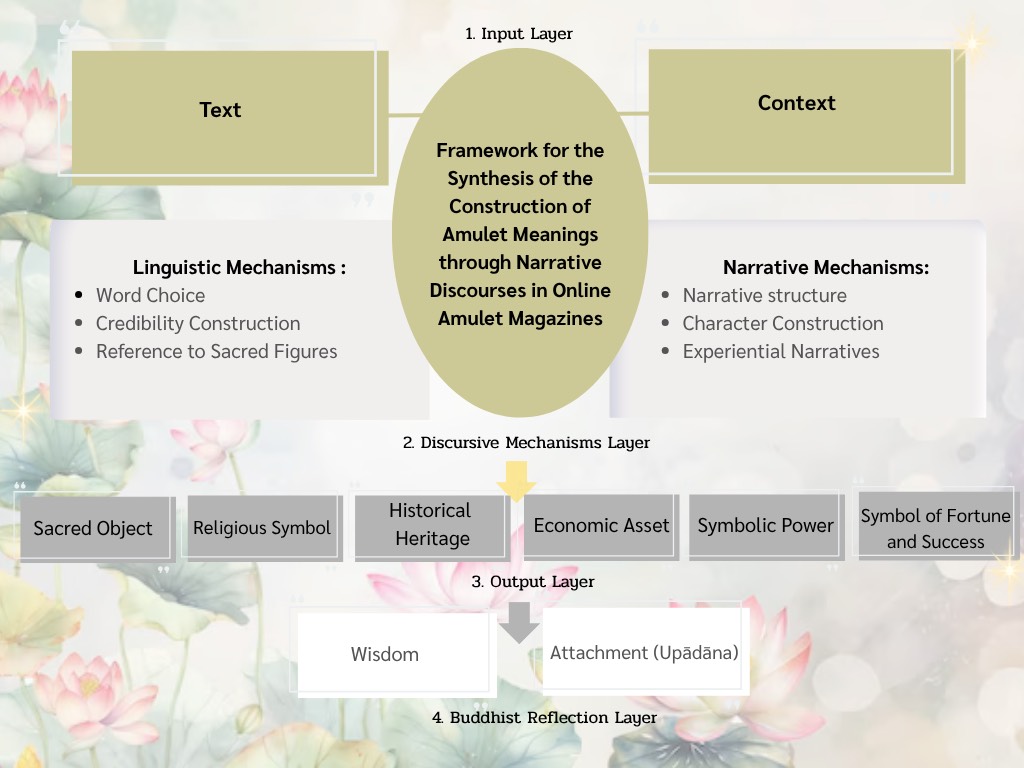
Main Results: The findings revealed that amulet narrative discourses could be classified into nine categories: 1) Sacredness discourse, 2) Discourse of referencing influential figures, 3) Historical value discourse, 4) Economic and investment value discourse, 5) Credibility-building discourse, 6) Experiential and belief discourse, 7) Rarity and collectability discourse, 8)Religious legend and belief discourse, and 9) State-institution-related discourse. These discourses collectively shaped audiences' perceptions and interpretations of amulets, constructing meanings in six dimensions: 1) Sacred objects, 2) Religious and cultural symbols, 3) Historical and cultural heritage, 4) Collectible objects and economic assets, 5) Products of symbolic power associated with individuals and institutions, and 6) Symbols of fortune and success. The findings demonstrate the role of language and narrative in producing, reinforcing, and reproducing social reality regarding Buddhist amulets within Thai society.
Involvement to Buddhadhamma: The findings can be interpreted through the framework of the Kalama Sutta, which emphasizes critical reflection and rational inquiry before accepting beliefs. Discourses that emphasize sacredness and miracles may encourage uncritical acceptance of certain beliefs. At the same time, the valuation of amulets in terms of ownership and economic worth reflects the Buddhist concept of upādāna (Attachment or Clinging), which is closely related to the cultivation of wisdom through the principles of morality (Sīla), concentration (Samādhi), and wisdom (Paññā)
Conclusions: This study demonstrates that online amulet magazines function as significant discursive spaces in constructing meanings of Buddhist amulets through language and storytelling. These discursive practices influence audiences' perceptions, beliefs, and value judgments regarding amulets across religious, cultural, and economic dimensions. The findings contribute to a deeper understanding of the relationship among media, discourse, and the construction of social reality in contemporary Thai society.
References
Amulet Online Magazine. (2020a). Amulet Online, Year 18, Issue No. 241. Bangkok, Thailand: Amulet Online Publishing.
Amulet Online Magazine. (2020b). Amulet Online, Year 18, Issue No. 244. Bangkok, Thailand: Amulet Online Publishing.
Amulet Online Magazine. (2021a). Amulet Online, Year 19, Issue No. 254. Bangkok, Thailand: Amulet Online Publishing.
Amulet Online Magazine. (2021b). Amulet Online, Year 19, Issue No. 256. Bangkok, Thailand: Amulet Online Publishing.
Amulet Online Magazine. (2021c). Amulet Online, Year 19, Issue No. 258. Bangkok, Thailand: Amulet Online Publishing.
Amulet Online Magazine. (2021d). Amulet Online, Year 19, Issue No. 263. Bangkok, Thailand: Amulet Online Publishing.
Amulet Online Magazine. (2021e). Amulet Online, Year 19, Issue No. 268. Bangkok, Thailand: Amulet Online Publishing.
Amulet Online Magazine. (2021f). Amulet Online, Year 19, Issue No. 270. Bangkok, Thailand: Amulet Online Publishing.
Appadurai, A. (1986). The social life of things: Commodities in cultural perspective. Cambridge, United Kingdom: Cambridge University Press. http://dx.doi.org/10.1017/cbo9780511819582.
Chantanee, A. (2016). Economy of amulets in Thailand. Journal of Global of Perspectives in Humanities and Social Sciences, 10(1), 94-105.
Fairclough, N. (2010). Critical Discourse Analysis: The Critical Study of Language (2nd ed.). New York, United States of America: Routledge.
Foucault, M. (1972). The Archaeology of Knowledge and The Discourse on Language. New York, United States of America: Pantheon Books.
Foucault, M. (1980). Power/Knowledge: Selected Interviews and Other Writings, 1972-1977. New York, United States of America: Pantheon.
Jenkins, H. (2006). Convergence Culture: Where Old and New Media Collide. New York, United States of America: New York University Press.
Jirabovornwisut, S. (2023). Approaches and Narrative Techniques of TV Drama for Promoting Thai Cuisine Culture: A Case Study of 'Pad Thai, The Secret Recipe'. Journal of Siam Communication Arts Review, 22(2), 33-55.
Kaewthep, K. (2006). The Science of Media and Cultural Studies (2nd ed.). Bangkok, Thailand: Edison Press Products.
Sawangboonsatic, C. (2020). "Kon Len Prah" Thai Buddhist Amulet Magazine: Multimodal Discourse. Journal of Liberal Arts, Rangsit University, 16(1), 29-50.
Van Hulst, M., Metze, T., Dewulf, A., de Vries, J., van Bommel, S. & van Ostaijen, M. (2025). Discourse, framing and narrative: three ways of doing critical, interpretive policy analysis. Critical Policy Studies, 19(1), 74-96. https://doi.org/10.1080/19460171.2024.2326936.
Downloads
Published
How to Cite
Issue
Section
License
Copyright (c) 2026 Journal of Buddhist Anthropology

This work is licensed under a Creative Commons Attribution-NonCommercial-NoDerivatives 4.0 International License.