DEVELOPMENT OF AN AI-BASED DHAMMA TIKTOK PLATFORM INSPIRED BY BUDDHIST TEACHINGS TO PROMOTE PSYCHOLOGICAL RESILIENCE AMONG THE WORKFORCE
Keywords:
AI-based Dhamma TikTok, Buddhist Teachings, Psychological Resilience, WorkforceAbstract
Background and Objectives: Thailand's rapid transition from an agricultural-based economy to industrial and service-based sectors has intensified workplace stress, burnout, and emotional exhaustion among the workforce. These mental health challenges were further exacerbated by the COVID-19 pandemic, which increased job insecurity and psychological distress. Although employee assistance programs are widely available, many interventions remain grounded primarily in Western psychological frameworks and often lack cultural relevance within Thai society. At the same time, short-form digital platforms such as TikTok have become influential communication channels but frequently contain misinformation and limited evidence-based mental health content. Consequently, a significant empirical gap persists regarding interventions that integrate Artificial Intelligence (AI) with indigenous cultural wisdom to support psychological resilience. This study, therefore, aimed to: Examine current mental health challenges and resilience needs among the workforce; Develop an AI-based dhamma TikTok platform inspired by Buddhist teachings to enhance psychological resilience; And evaluate the effectiveness of the AI-based dhamma TikTok platform among working adults.
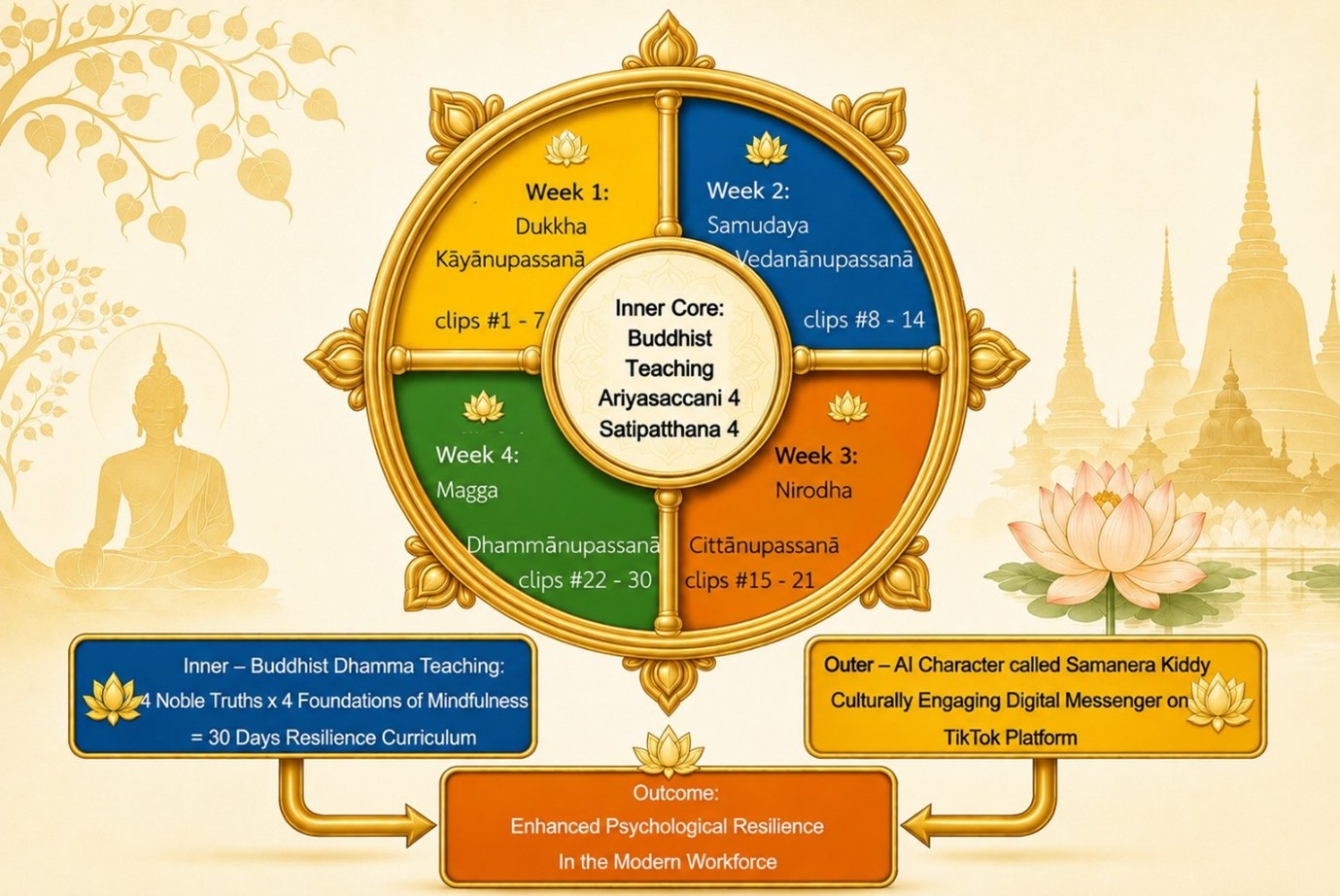
Methodology: This study employed a three-phase mixed-methods Research and Development (R&D) design. Phase 1 used semi-structured interviews with 35 workforce informants to explore current mental health challenges and resilience needs, using thematic analysis. Phase 2 involved the development and validation of 30 AI-generated Dhamma video clips integrating the Four Noble Truths (Ariyāsacca 4) and the Four Foundations of Mindfulness (Satipaṭṭhāna 4). Content development was conducted through in-depth interviews with experts (n = 17) and validated through focus group discussions (n = 9) before implementation as a 30-day intervention. Phase 3 employed a mixed-methods evaluation, including a pre-post assessment with the Connor-Davidson Resilience Scale (CD-RISC-10) and post-intervention qualitative interviews.
Main Results: Phase 1 identified three major mental health challenges among the workforce: Work-related stress, emotional and cognitive dysregulation, and interpersonal strain. Three resilience needs were also identified, including emotional support, emotional regulation skills, and accessible mental health tools. Phase 2 resulted in the development of an AI-based Dhamma TikTok platform featuring an animated novice monk delivering 30 short-form video clips grounded in a Buddhist psychological resilience framework. In Phase 3, quantitative findings demonstrated a statistically significant improvement in resilience scores, increasing from a moderate level ( = 23.29, S.D. = 5.91) before the intervention to a high level after the intervention (
= 33.26, S.D. = 5.55), as confirmed by paired sample t-test analysis (t = 7.9060, p < 0.01). Qualitative findings further indicated reduced occupational stress, improved emotional regulation, and more compassionate interpersonal relationships in the workplace.
Involvement to Buddhadhamma: The finding demonstrated that the Four Noble Truths and the Four Foundations of Mindfulness, when adapted into digital micro-practices, could support psychological resilience through inner regulation, empathic connection, purposeful mindset, and transformative growth. The resulting Samanera Kiddy Dhamma Wheel Model (SKDWM) integrated Buddhist contemplative principles with AI-supported digital communication for workforce mental health promotion. The study therefore contributes to both Traditional Buddhism, through the application of the Four Noble Truths and the Four Foundations of Mindfulness derived from Buddhadhamma and the Pali Canon, and Applied Buddhism in the areas of Buddhist Innovation.
Conclusion: This AI-based Dhamma TikTok platform showed potential for enhancing psychological resilience among the Thai workforce by integrating Buddhist contemplative practice with modern digital technology. The intervention contributed to reduced occupational stress, improved emotional regulation, and healthier interpersonal interaction. The findings suggest that culturally grounded digital mental health tools offer a practical approach for workplace wellness promotion, helping working adults cultivate mindfulness, emotional balance, and inner resilience amid the pressures of everyday working life. Future studies should include larger samples, longer intervention periods, and broader population groups to further evaluate the effectiveness and applicability of the model.
References
Adha, A. Z., Kurnia, G. M., Qomaruddin, M. B. & Widati, S. (2025). Potential and Challenges of TikTok as a Media for Mental Health Education for Young Generation: Literature Review. Media Gizi Kesmas, 14(1), 176-193. https://doi.org/10.20473/mgk.v14i1.2025.176-193.
Anwar, F. & Iqbal Z. (2023). Devils of the Digital Era: Tetheredness to Technology and Mental Health in The Context of The Workplace. International Journal of Membrane Science and Technology, 10(5), 780-787.
Bodhi, B. (2000). The Connected Discourses of the Buddha. A New Translation of the Saṃyutta Nikāya. Massachusetts, United States of America: Wisdom Publications.
Braun, V. & Clarke, V. (2021). Thematic Analysis a Practical Guide. New York, United States of America: SAGE.
Chung, D., Meng, Y. & Wang, J. (2025). The Role of Short-Form Video Apps in Mitigating Occupational Burnout and Enhancing Life Satisfaction Among Healthcare Workers: A Serial Multiple Mediation Model. Healthcare, 13(4), 355. https://doi.org/10.3390/healthcare13040355.
Connor, K. M. & Davidson, R. T. (2003). Development of a new resilience scale: The Connor-Davidson Resilience Scale (CD-RISC). Depress. Anxiety, 18, 76-82. https://doi.org/10.1002/da.10113.
Creswell, J. W. & Plano Clark, V. L. (2018). Designing and Conducting Mixed Methods Research (3rd ed.). California, United States of America: SAGE.
Creswell, J. W. (2003). Research Design: Qualitative, Quantitative, And Mixed Methods Approaches Second Edition. California, United States of America: SAGE Publications.
Davids, R. (Ed.). (1978). The Vibhaṅga: Being the Second Book of The Abhidhamma Piṭaka. London, United Kingdom: Pali Text Society.
Feer, M. L. (Ed.). (1975). Saṃyutta-Nikāya. Part III. Khandha-Vagga. London, United Kingdom: Pali Text Society.
Feer, M. L. (1976). Saṃyutta-Nikāya. Part V. Mahā-Vagga. London, United Kingdom: Pali Text Society.
Felszeghy, S., Kurki, P., Liukkonen, M., Suominen, A.-L. & Huhtela, O. (2024). The combination of listening to background music and deep breathing as a stress reduction strategy during dental preclinical study. Journal of Dental Education, 88, 342-347. https://doi.org/10.1002/jdd.13424.
Gross, J. J. (2015). Emotion Regulation: Current Status and Future Prospects. Psychological Inquiry, 26(1), 1-26. https://doi.org/10.1080/1047840x.2014.940781.
ingh, K., Kaur Sohi, K., Kaur, H. & Singh, P. (2023). Buddhism and Its Contribution to Positive Psychology. Religious and Spiritual Practices in India, 113-139. https://doi.org/10.1007/978-981-99-2397-7_6.
Klangrit, S., Lu, T.-C., Shen, Z., Tubmarerng, C., Sutthikanpakorn, S., Phueakbuakhao, W., Kaewkanha, C., Siripaprapagon, Y. & Kumar, V. (2025). The Role of Buddhist Practices in Promoting Happiness among Young Workers Population in. Journal of Buddhist Anthropology, 10(1), 16-32.
Lee, S., Yoon, S. I., Song, G. J., Park, H. Y., Chung, S. Y. & Kim, J. W. (2025). Effectiveness of Mobile Mindfulness Training on Stress, Burnout, and Work Engagement of Office Workers: Protocol for A Randomized Controlled Trial. Frontiers in Public Health, 12, 1440824. https://doi.org/10.3389/fpubh.2024.1440824.
Liu, C., Tu, Y., Lin, L.-J., Chen, H., Liu, T.-H., Lin, H.-L. & Chiou, W.-K. (2025). The Effects of Short Video App–guided Loving-kindness Meditation on Interpersonal Mindfulness, Empathy, Collaboration, Affect, and Workplace Well-being among Working Professionals. Frontiers in Public Health, 13, 1716315. https://doi.org/10.3389/fpubh.2025.1716315.
Marsh, E., Perez Vallejos, E. & Spence, A. (2024). Overloaded by Information or Worried About Missing Out on It: A Quantitative Study of Stress, Burnout, and Mental Health Implications in the Digital Workplace. Sage Journals, 1-17. https://doi.org/10.1177/21582440241268830.
Michaelsen, M. M., Graser, J., Onescheit, M., Tuma, M. P., Werdecker, L., Pieper, D. & Esch, T. (2023). Mindfulness-Based and Mindfulness-Informed Interventions at the Workplace: A Systematic Review and Meta-Regression Analysis of RCTs. Mindfulness, 14, 1271-1304. https://doi.org/10.1007/s12671-023-02130-7.
Mohamad, N. I., Othman, A. S., Hasan, H., Asha'ari, M. J. & Mahadi, M. H. (2025). Workplace Stress: How Demands, Interpersonal Conflict, and Role Ambiguity Affect Human Well-Being. Journal of Information Systems Engineering and Management, 10(40s), 402-418. https://doi.org/10.52783/jisem.v10i40s.7308.
Ñāṇamoli, B. & Bodhi, B. (1995). The Middle Length Discourses of the Buddha. Massachusetts, United States of America: Wisdom Publications.
National Statistical Office Ministry of Digital Economy and Society. (2023). Statistics Yearbook Thailand. Bangkok, Thailand: National Statistical Office.
Neff, K. D. (2003). Self-Compassion: An Alternative Conceptualization of a Healthy Attitude Toward Oneself. Self and Identity, 2(2), 85-101. https://doi.org/10.1080/15298860309032.
Nie, J., Shao, H., Fan, Y., Shao, Q., You, H., Preindl M. & Jiang, X. (2024). LLM-based Conversational AI Therapist for Daily Functioning Screening and Psychotherapeutic Intervention via Everyday Smart Devices. New York, United States of America: ACM. https://doi.org/10.48550/arXiv.2403.10779.
Patton, M. Q. (2015). Qualitative Research & Evaluation Methods Integrating Theory and Practice (4th ed.). California, United States of America: SAGE.
Phong, C. T. (2025). Awakening from within: an exploration of self-healing through Buddhist approach. Journal of Spirituality in Mental Health, 27(3), 329-357. https://doi.org/10.1080/19349637.2024.2361666.
Phophichit, N. (2025). Effects Of Four Foundations of Mindfulness-Based Intervention (Ffmbi) On Mindfulness Levels of International Practitioners and Mental Well-Being of Hungarian Practitioners. LIFE: International Journal of Health and Life-Sciences, 59-60. https://doi.org/10.20319/icrlsh.2025.5960.
Rhys Davids, T. W. & Carpenter, J. E. (Eds.). (1966). The Dīgha Nikāya (Vol. 2). London, United Kingdom: Pali Text Society.
Ruengorn, C., Awiphan, R., Wongpakaran, N., Wongpakaran, T. & Nochaiwong, S. (2021). Association of job loss, income loss, and financial burden with adverse mental health outcomes during coronavirus disease 2019 pandemic in Thailand: A nationwide cross-sectional study. Depression and Anxiety, 38, 648-660. https://doi.org/10.1002/da.23155.
Rzyczniok, P., Kopczyński, M., Rasińska, A., Matusik, J., Jachimczak, J. & Bala, P. (2025). Artificial Intelligence in Mental Health Care: Opportunities, Challenges, and Ethical Dilemmas. International Journal of Innovative Technologies in Social Science, 2(3), 47. https://doi.org/10.31435/ijitss.3(47).2025.3529.
Tedeschi, R. G. & Calhoun, L. G. (2004). TARGET ARTICLE: "Posttraumatic Growth: Conceptual Foundations and Empirical Evidence". Psychological Inquiry, 15(1), 1-18. https://doi.org/10.1207/s15327965pli1501_01.
Trenckner, V. (Ed.). (1979). The Majjhima-Nikāya (Vol. 1). (In Pali). London, United Kingdom: Pali Text Society.
Tung, C-P. & Rong, J-R. (2022). Exploring the Mediating Effect of Emotional Intelligence on Perceived Stress and Interpersonal Relationships Among Nursing. International Journal of Studies in Nursing, 7(2), 1-10. https://doi.org/10.20849/ijsn.v7i2.1079.
Van der Schyff, E. L., Ridout, B., Amon, K. L., Forsyth, R. & Campbell, A. J. (2023). Providing Self-Led Mental Health Support Through an Artificial Intelligence–Powered Chat Bot (Leora) to Meet the Demand of Mental Health Care. Journal of Medical Internet Research, 25, e46448. https://doi.org/10.2196/46448.
World Health Organization. (2021). Comprehensive Mental Health Action Plan 2023-2030. Geneva, Switzerland: World Health Organization.
Wu, Q., Cao, H. & Du, H. (2023). Work Stress, Work-Related Rumination, and Depressive Symptoms in University Teachers: Buffering Effect of Self-Compassion. Psychology Research and Behavior Management, 16, 1557-1569. https://doi.org/10.2147/PRBM.S403744.
Yuvasri. & PM, M. (2025). Effectiveness of Mindfulness-Based Intervention on Cognitive Flexibility, Digital Burnout and Emotional Regulation among College Students. Advanced International Journal for Research (AIJFR), 6(6), 1-9.
Downloads
Published
How to Cite
Issue
Section
License
Copyright (c) 2026 Journal of Buddhist Anthropology

This work is licensed under a Creative Commons Attribution-NonCommercial-NoDerivatives 4.0 International License.