
ลักษณะทางจุลภาคของพืชสมุนไพรพิกุลและเดือยไก่ จากกายวิภาคศาสตร์ของเปลือกไม้ เนื้อไม้ และดอก
Article Sidebar
Main Article Content
บทคัดย่อ
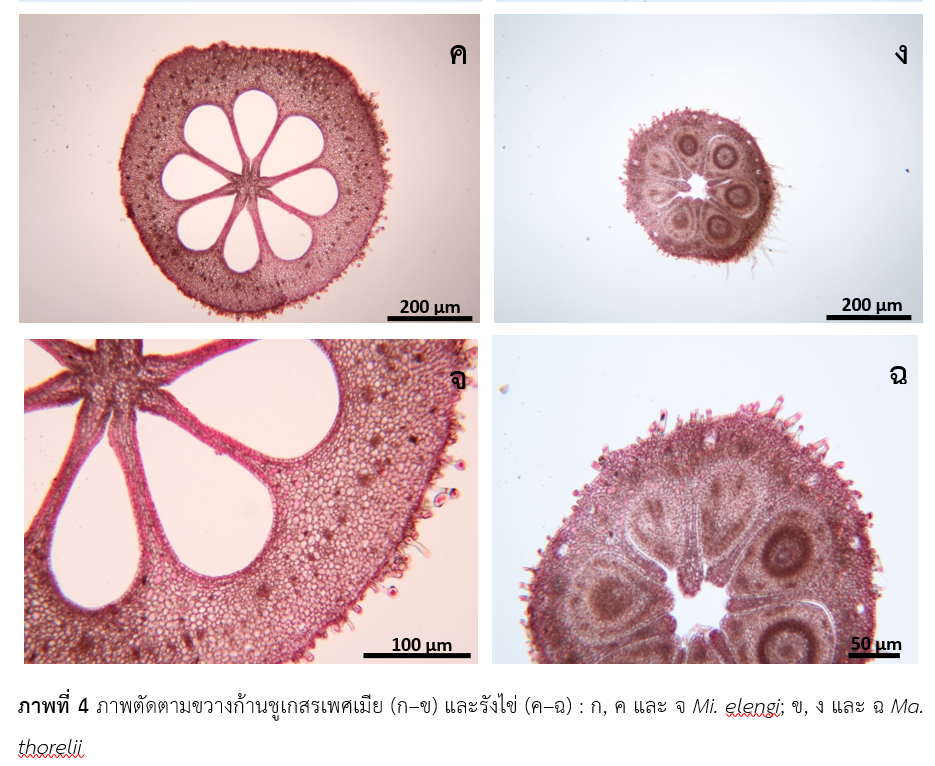
ศึกษาลักษณะทางจุลภาคของพืชสมุนไพรพิกุล (Mimusops elengi L.) และเดือยไก่ (Madhuca thorelii (Dubard) H.J.Lam) จากกายวิภาคศาสตร์เปลือกไม้ เนื้อไม้ และดอก เพื่อใช้ประกอบการจัดทำข้อมูลทางจุลภาคในการกำหนดมาตรฐานยาสมุนไพรไทย ดำเนินการวิจัยตั้งแต่เดือนสิงหาคม พ.ศ. 2561 ถึง เดือนกันยายน พ.ศ. 2562 โดยสำรวจและเก็บตัวอย่างพืชในจังหวัดอุบลราชธานีและจังหวัดศรีสะเกษ จากนั้นนำเปลือกไม้ เนื้อไม้ และดอกมาตัดตามขวาง ย้อมด้วยซาฟรานินโอความเข้มข้น 1% ในน้ำ และศึกษาภายใต้กล้องจุลทรรศน์แบบใช้แสง พบว่าลักษณะสำคัญของเปลือกไม้ เนื้อไม้ และดอกของพืชทั้งสองชนิด ดังนี้ (1) รูปร่างเซลล์คอร์กในชั้นเพริเดิร์มเป็นสี่เหลี่ยมผืนผ้า (2) มีเซลล์น้ำยางในเปลือกไม้ (3) การกระจายตัวของเซลล์เวสเซลในเนื้อไม้เป็นแบบกระจาย (4) กลีบเลี้ยงมีไทรโคม (5) กลีบดอกมีเซลล์หลั่ง (6) ก้านชูเกสรเพศผู้มีมัดท่อลำเลียง 1 มัด (7) อับเรณูมี 4 พู (8) เรณูเป็นแบบรูซ้อนทับร่อง มี 3–4 ช่องเปิด ซึ่งลักษณะเหล่านี้สามารถนำมาใช้เป็นข้อมูลประกอบเพิ่มเติมสำหรับการจัดทำข้อกำหนดมาตรฐานยาสมุนไพรไทยได้
Article Details
วารสารวิทยาศาสตร์และวิทยาศาสตร์ศึกษา (JSSE) เป็นผู้ถือลิสิทธิ์บทความทุกบทความที่เผยแพร่ใน JSSE นี้ ทั้งนี้ ผู้เขียนจะต้องส่งแบบโอนลิขสิทธิ์บทความฉบับที่มีรายมือชื่อของผู้เขียนหลักหรือผู้ที่ได้รับมอบอำนาจแทนผู้เขียนทุกนให้กับ JSSE ก่อนที่บทความจะมีการเผยแพร่ผ่านเว็บไซต์ของวารสาร
แบบโอนลิขสิทธิ์บทความ (Copyright Transfer Form)
ทางวารสาร JSSE ได้กำหนดให้มีการกรอกแบบโอนลิขสิทธิ์บทความให้ครบถ้วนและส่งมายังกองบรรณาธิการในข้อมูลเสริม (supplementary data) พร้อมกับนิพนธ์ต้นฉบับ (manuscript) ที่ส่งมาขอรับการตีพิมพ์ ทั้งนี้ ผู้เขียนหลัก (corresponding authors) หรือผู้รับมอบอำนาจ (ในฐานะตัวแทนของผู้เขียนทุกคน) สามารถดำเนินการโอนลิขสิทธิ์บทความแทนผู้เขียนทั้งหมดได้ ซึ่งสามารถอัพโหลดไฟล์บทความต้นฉบับ (Manuscript) และไฟล์แบบโอนลิขสิทธิ์บทความ (Copyright Transfer Form) ในเมนู “Upload Submission” ดังนี้
1. อัพโหลดไฟล์บทความต้นฉบับ (Manuscript) ในเมนูย่อย Article Component > Article Text
2. อัพโหลดไฟล์แบบโอนลิขสิทธิ์บทความ (Copyright Transfer Form) ในเมนูย่อย Article Component > Other
ดาวน์โหลด ไฟล์แบบโอนลิขสิทธิ์บทความ (Copyright Transfer Form)
เอกสารอ้างอิง
Bell, C. R. (n.d.). Plant Variation and Classification. Macmillan, London.
Bureau of Drug and Narcotic, Department of Medical Sciences. (2017). Handbook of Data Preparation of Thai Herbs in Thai Herbal Pharmacopoeia (in Thai). Nonthaburi: 1241 Miraculous.
Chantaranothai, P. (2014). Sapotaceae. In T. Santisuk and H. Balslev (Eds.), Flora of Thailand, Vol. 11(4), pp. 610–655. Bangkok: Prachachon Co. Ltd.
Chuakul, W., Prathanturarug, S. and Jenjittikul, T. (2000). Encyclopedia of Thai Herbs, no. 4, Isan medicinal plants (in Thai). Bangkok: Amarin Printing and Publishing.
Department of Medical Sciences. (2018). Thai Herbal Pharmacopoeia 2018. Bangkok: Keawjawjom & Suan Sunandha Rajabhat University.
Forest and Plant Conservation Research Office Director. (2013). Pikun, Mimusops elengi Linn (in Thai). In M. Ruadrew and N. Cheerawatnapan (Eds.), Medicinal Plants in Botanical Gardens and Arboretums. Bangkok: SP Plate.
Forest and Plant Conservation Research Office Director. (2015). Medicinal Plants in Botanical Gardens and Arboretums, No. 2 (in Thai). Bangkok: SP Plate.
Gami, B. Pathak, S. and Parabia, M. (2012). Ethnobotanical, phytochemical and pharmacological review of Mimusops elengi Linn. The Asian Pacific Journal of Tropical Biomedicine, 2(9), 743–748.
Harley, M. M. (1991). The pollen morphology of the Sapotaceae. Kew Bulletin, 46(3), 379–491.
Kadam, P. V., Deoda, R. S., Shivatare, R. S., Yadav, K. N. and Patil, M. J. (2012). Pharmacognostic, phytochemical and physiochemical studies of Mimusops elengi Linn. stem bark (Sapotaceae). Der Pharmacia Lettre, 4(2), 607–613.
Kadam, P. V., Yadav, K. N., Deoda, R. S., Shivatare, R. S. and Patil, M. J. (2012). Mimusops elengi: A review on ethnobotany, phytochemical and pharmacological profile. Journal of Pharmacognosy and Phytochemistry, 1(3), 64–74.
Kaspo, P. (2014). Study on linear equation for Non-destructive leaf area estimation of 10 fragrant plants. Departmant of Horticulture, Faculty of Agriculture at Kamphaeng Saen Kasetsart University, Kamphaeng Saen Campus, Nakhon Pathom.
Khare, P., Kishore, K. and Sharma, D. K. (2018). Medicinal uses, phytochemistry and pharmacological profile of Madhuca longifolia. Asian Journal of Pharmacy and Pharmacology, 4(5), 448–459.
Kukachka, B. F. (1981). Wood anatomy of the neotropical Sapotaceae: XX Minilkara. Research Paper FPL, 371, 1–14.
Metcalfe, C. R. and Chalk, L. (1979). Anatomy of the Dicotyledons vol. 1, 2nd ed. London: Oxford at the Carendon Press.
Moteriya, P., Padalia, H., Rathod, T., Desai, D. and Chanda, S. (2018). Phamarcognostic standardization of Madhuca indica leaf and stem, an important medicinal plant. International Journal of Phamaceutical Sciences and Research, 6(2), 705–711.
National Drug System Development Committee. (2012). National List of Essential Medicines (in Thai). Royal Thai Government Gazette, 23 January 2013.
Office of the Permanent Secretary for Ministry of Natural Resources and Environment. (2007). Encyclopedia of Bioresources in Chik Du, Hua Taphan District, Amnat Charoen (in Thai). Bangkok: Ministry of Natural Resources and Environment.
Shailajan, S. and Gurjar, D. (2015). Evaluation of Mimusops elengi L. flowers using pharmacognostic approach. Pharmacognosy Communications, 5(1), 83–92.
Zollner, T. and Schwarz, M. (2013). Herbal reference standards: applications definitions and regulatory requirements. Revista Brasileira de Farmacognosia Brazilian Journal of Pharmacognosy, 23(1), 1–21.
